

Tag Archives: 2026 Guide


ERP for Small Business: The 2026 Strategic Guide to Choosing Scalable Solutions

ERP for Small Business: The 2026 Strategic Guide to Choosing Scalable Solutions

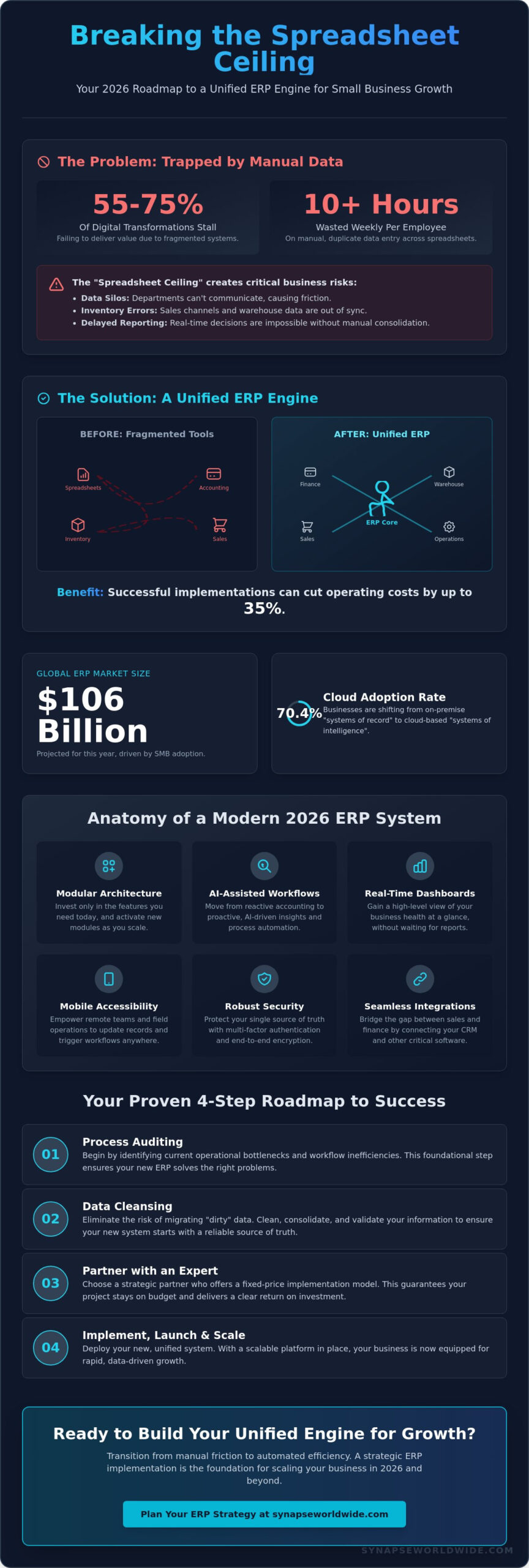
Why do 55% to 75% of digital transformations stall before they deliver value, while others manage to cut operating costs by 35% almost overnight? The difference lies in moving beyond basic software to a strategic erp for small business that acts as a unified engine for growth. If you’re currently managing inventory and cash flow through a fragmented web of spreadsheets, you already know the friction of manual data entry. It’s a bottleneck that limits your vision and stalls your momentum.

It’s natural to feel concerned about high implementation costs or the risk of project failure. You want a single source of truth that simplifies your operations rather than adding more complexity. This guide promises to show you how to transition to a scalable platform that automates your workflows and provides real-time visibility into every corner of your company. We’ll explore the latest 2026 releases from industry leaders like Microsoft and NetSuite, examine how AI-assisted workflows are redefining efficiency, and provide a clear roadmap for choosing a solution that scales alongside your ambitions.

Key Takeaways

  • Break through the “Spreadsheet Ceiling” by shifting from manual data entry to a unified architecture that supports rapid, data-driven decision making.
  • Learn how a modular erp for small business provides a customizable dashboard for real-time analytics without the burden of paying for unnecessary features.
  • Compare the scalability of major ERP players against custom integrated solutions that leverage middleware to bridge the gap between sales and finance.
  • Follow a proven 2026 roadmap that prioritizes process auditing and data cleansing to eliminate the risk of migrating “dirty” data into your new system.
  • See why a fixed-price implementation model from a strategic partner ensures your digital transformation stays on budget and delivers a clear return on investment.

The Spreadsheet Ceiling: Why Your Business Needs an ERP in 2026

Growth follows a predictable path until it hits a hard limit. We call this the “Spreadsheet Ceiling.” It’s the moment when your manual data management stops being a cost-saving measure and starts stunting your revenue. For a modern organization, Enterprise resource planning (ERP) represents a transition from fragmented tools to a unified data architecture. It’s not just a software upgrade; it’s a foundational change in how your business breathes. By consolidating every department into a single digital nervous system, you move away from the chaos of disconnected files.

In 2026, an erp for small business is no longer a luxury reserved for the enterprise tier. The global market for these systems is projected to reach $106 billion this year, driven by a fundamental shift in how data is used. While traditional accounting software tells you what happened last month, a modern ERP uses AI-driven insights to tell you what’s likely to happen next week. This shift from reactive accounting to proactive resource planning is what allows small teams to punch above their weight class and compete with much larger entities.

Signs You Have Outgrown Your Accounting Software

If your team spends more time reconciling data than analyzing it, you’ve hit the ceiling. You’ll notice frequent errors in inventory levels because your sales channels aren’t talking to your warehouse. Real-time financial reporting becomes impossible without hours of manual consolidation in Excel. Industry data suggests that team members in growing companies often waste over 10 hours every week on duplicate data entry. These aren’t just inconveniences. They’re direct drains on your profitability and primary indicators that your current infrastructure is failing to support your scale.

The Core Business Value of Centralised Data

Centralization is the antidote to departmental silos. When sales, warehouse, and finance operate from a single source of truth, the friction that slows down your operations disappears. This connectivity directly improves the customer experience through faster order processing and pinpoint-accurate shipping updates. Most importantly, a centralized system creates the essential foundation for business process automation. By removing the human element from repetitive tasks, you reduce error rates and free your staff for high-value strategic work that actually moves the needle.

The 2026 landscape demands a “system of intelligence” rather than just a “system of record.” With 70.4% of businesses now adopting cloud-based ERP solutions, the standard for operational speed has increased. If you’re still relying on manual updates, you aren’t just moving slower; you’re operating with a significant informational disadvantage. Transitioning to an integrated ecosystem ensures that every decision you make is backed by real-time data rather than historical guesswork.

Essential Features of a Modern SMB ERP System

The architecture of a modern erp for small business has evolved from a rigid, all-or-nothing software package into a flexible, modular ecosystem. This shift is critical for growing companies because it allows you to invest only in the specific functionalities you need today, while retaining the ability to activate new modules as your operations expand. According to a leading industry perspective on ERP, the primary value of these systems lies in their ability to scale without requiring a total infrastructure overhaul. You might start with core finance and inventory, then layer on advanced logistics or human resources as your headcount increases.

Visibility is the cornerstone of effective leadership. Modern systems prioritize real-time analytics and customizable dashboards that provide a high-level view of your business health at a glance. You shouldn’t have to wait for end-of-month reports to understand your cash flow or inventory turnover. This data must be accessible anywhere; mobile accessibility is now a standard requirement for remote teams and field operations. Whether your staff is in a warehouse or on a client site, they need the ability to update records and trigger workflows instantly. Protecting this data is equally vital. Robust security protocols, including multi-factor authentication and end-to-end encryption, are non-negotiable in an environment where digital threats are increasingly sophisticated.

CRM and Sales Management Integration

Revenue growth depends on how well you manage your pipeline. Implementing website CRM integration is often the first strategic step toward full ERP success. By connecting your sales efforts directly to your back-office systems, you can track the entire customer journey from the initial lead generation to the final invoice. This connectivity allows for automated follow-ups and personalized marketing, ensuring that no revenue opportunities are missed due to human oversight. If you are looking to bridge these gaps, our team specializes in creating seamless ERP solutions that align your sales and operations.

Inventory and Supply Chain Optimisation

For businesses selling across multiple platforms, manual inventory tracking is a recipe for disaster. A modern ERP provides multi-channel inventory sync, ensuring that your stock levels are accurate across your website, Amazon, and eBay simultaneously. Automated reorder points prevent the dual risks of stockouts and overstocking, which directly preserves your working capital. Integrated supplier management modules also allow you to track performance and lead times, giving you the leverage needed to optimize your supply chain and maintain consistent fulfillment standards.
ERP for Small Business: The 2026 Strategic Guide to Choosing Scalable Solutions

Comparing ERP Solutions: Off-the-Shelf vs. Custom Integrated

Selecting an erp for small business requires a cold-eyed analysis of your long-term operational costs. On one side, industry giants like Microsoft Dynamics 365 and Sage Intacct offer a sense of security and a vast array of features. These platforms are designed to be comprehensive. However, that comprehensiveness often translates into complexity that a smaller team simply doesn’t need. When you evaluate the total cost of ownership (TCO) over a five-year period, the initial appeal of a standard subscription can fade. Licensing fees often increase as you add users or modules, and the cost of forcing the software to fit your specific niche can become a significant financial burden.

Alternatively, the concept of “Custom Integrated Solutions” has gained massive traction in 2026. This approach uses robust APIs and middleware to connect individual, high-performing tools into a unified ecosystem. It allows you to build a system that is as flexible as your business model. If you pivot your strategy, you aren’t fighting against the rigid logic of a legacy platform. Instead, you’re adjusting a modular architecture that was designed to evolve. This path ensures your technology stack remains an asset rather than a constraint as you reach new levels of success.

The Pitfalls of Rigid ‘Big Name’ ERPs

The most common mistake growing companies make is forcing their unique business processes into a software’s pre-set mould. Standardized ERPs are built for the “average” company, but your competitive advantage usually lies in what makes you different. When you adopt a rigid system, you often end up paying high licensing fees for a suite of features your team will never touch. Additionally, finding specialized support for niche industry requirements within a massive ecosystem can be both difficult and expensive. You shouldn’t have to change how you win just to satisfy a software’s constraints.

The Strategic Advantage of Customised Architecture

A customized architecture acts as a digital mirror of your existing successful workflows. It doesn’t ask you to change; it asks how it can help you move faster. One of the most significant benefits is the ability to connect your ecommerce website development directly to your back-office operations. This ensures that every online sale triggers the correct inventory, shipping, and accounting actions without human intervention. By avoiding the bloat of “per-user” licensing models, you can achieve lower long-term costs while maintaining a system that feels like it was built specifically for your brand’s future.

The 2026 Roadmap to a Successful ERP Implementation

Success in deploying an erp for small business depends on the rigor of your preparation rather than the price of your subscription. Verified data indicates that 55% to 75% of ERP projects fail to meet their key performance indicators, often due to poor planning or technical misalignment. To avoid becoming a statistic, you must treat the implementation as a strategic overhaul rather than a simple software installation. This begins with a deep discovery phase where you audit existing processes to identify exactly where your current bottlenecks reside. You can’t automate a broken process; you have to fix the workflow first.

Data cleansing is the most overlooked step in this journey. Migrating “dirty” data, such as duplicate customer records or outdated inventory counts, into a new system ensures only one thing: you’ll make mistakes faster than before. Your team must scrub every record to ensure your new “single source of truth” is actually truthful. Once the data is ready, you move into User Acceptance Testing (UAT). This phase allows your staff to stress-test the system in a sandbox environment, ensuring the workflows actually solve their daily challenges before a full rollout. Post-launch, the focus shifts to ongoing training and technical support to ensure the platform remains a high-performing asset.

Phase 1: Process Mapping and Requirements Gathering

Your digital architecture must be built around your people. Involving department heads early ensures the system addresses real-world friction rather than theoretical problems. During this phase, you should define clear KPIs for what success looks like six months after launch, such as achieving the 36% faster decision-making rate seen by other successful ERP adopters. Consulting with experts in custom software development at this stage is vital for assessing technical feasibility and ensuring your vision is achievable within your budget.

Phase 2: Integration and Automation Setup

The true power of a unified system is unlocked through connectivity. This phase involves developing automated lead management hooks that sync your marketing efforts directly with your sales and finance modules. By establishing robust API connections between your website, CRM, and ERP, you eliminate the need for manual data transfer across platforms. Finally, set up automated reporting triggers so stakeholders receive real-time updates on inventory and cash flow without needing to request them manually. If you’re ready to build a foundation for growth, our team can help you design and deploy these ERP solutions tailored to your unique needs.

Partnering for Success: Why Custom ERP Strategy Wins

The successful deployment of an erp for small business is rarely about the software alone. It’s about the partnership that guides the integration. At Synapse Worldwide, we position ourselves as the visionary architect of your digital infrastructure. We don’t just hand over a login; we build a customized ecosystem that bridges the gap between your high-level business goals and technical execution. One of the most significant barriers to ERP adoption is the fear of budget creep. To eliminate this uncertainty, we utilize a fixed-price project model. This approach ensures your investment is protected and that we remain focused on delivering the promised results without unexpected financial shifts.

As a local Australian partner, we provide national support that understands the specific nuances of the domestic market. This proximity allows for a more collaborative relationship, ensuring your system isn’t just functional, but optimized for your specific operational environment. Your ERP success is inextricably linked to your broader digital presence. Whether it’s feeding data into your e-commerce development or providing the analytical backbone for your SEO strategy, a unified system ensures every part of your business is moving in the same direction.

Beyond Software: A Holistic Growth Partnership

We believe that a truly effective ERP must be a living part of your company. This requires a holistic approach where we manage the intricate details of technical execution while you focus on scaling. Our commitment extends beyond the initial launch. We prioritize system longevity through dedicated maintenance and high-performance hosting, ensuring your infrastructure remains secure and responsive. As your marketing and sales strategies evolve, your ERP should adapt alongside them. This continuous alignment prevents the “Spreadsheet Ceiling” from ever returning, keeping your data fluid and your insights actionable.

Taking the Next Step Toward Efficiency

The journey to operational excellence begins with clarity. Before selecting a platform, it’s essential to conduct a comprehensive technical audit of your current stack. This process uncovers hidden inefficiencies and defines the exact requirements for your future architecture. We invite you to request a strategic consultation to evaluate your current processes and discover how a tailored integration can transform your bottom line. By looking at the big picture, we ensure that your technology stack becomes a catalyst for reaching the next level of business success.

Ready to scale? Consult with our ERP integration experts today and take the first step toward a more efficient, data-driven future.

Building Your Digital Foundation for 2026 and Beyond

The transition from fragmented manual processes to a unified digital architecture is the single most important move your company can make to secure its future. By breaking through the spreadsheet ceiling, you unlock the ability to make decisions with absolute clarity and reclaim hours of productivity every week. Choosing the right erp for small business isn’t just about selecting software; it’s about designing a scalable ecosystem that mirrors your unique workflows and integrates seamlessly with your existing sales and finance operations.

A successful rollout requires more than just a software license. It demands a strategic roadmap that prioritizes data integrity, user adoption, and long-term technical feasibility. With over 20 years of digital infrastructure expertise, Synapse Worldwide specializes in delivering custom CRM and ERP integrations that drive measurable growth. Our fixed-price project model ensures budget certainty while we build the foundation for your next level of success.

Streamline your operations with a strategic ERP solution from Synapse Worldwide.

Your business deserves a system that works as hard as you do. Let’s build the architecture that turns your ambitious vision into a sustainable, high-performing reality.

Frequently Asked Questions

What is the average cost of an ERP for a small business in 2026?

Subscription fees for cloud-based ERP software typically range from $40 to $150 per user per month in 2026. This cost varies depending on the specific modules your business requires and the total number of active users. You must also consider the investment for initial setup and staff training, which are separate from the recurring monthly subscription fees.

How long does a typical ERP implementation take for an SMB?

A typical implementation for a small to medium business takes between three and nine months to complete. This timeline includes the essential phases of process mapping, data cleansing, and user acceptance testing. The total duration depends heavily on the complexity of your current workflows and how many external systems require integration.

Can an ERP system replace my current accounting software like Xero?

An erp for small business can fully replace standalone accounting software like Xero or QuickBooks. While these tools handle basic bookkeeping, an ERP integrates those financial records with inventory, sales, and warehouse management. This creates a single source of truth that eliminates the need for manual data reconciliation between different platforms.

Do I need a dedicated IT department to manage a small business ERP?

You don’t need a dedicated IT department to manage a modern cloud-based system. The software provider or your strategic partner handles all technical maintenance, including security patches and server updates. This makes high-level enterprise technology accessible to smaller teams without the overhead of maintaining physical hardware or local servers.

What is the difference between a Cloud ERP and an On-Premise ERP?

Cloud ERPs are hosted remotely and accessed via the web, whereas on-premise systems are installed on your company’s local servers. Cloud adoption has reached 70.4% because it offers superior scalability and lower upfront capital requirements. On-premise solutions often involve significant hardware costs and require more hands-on technical management from your internal staff.

How does ERP integration improve my website’s e-commerce performance?

Integration boosts e-commerce performance by automating the flow of data between your online storefront and your back-office operations. It ensures that stock levels are updated instantly across all channels, which prevents the risk of overselling. This connectivity also allows for faster order fulfillment and more accurate customer communication throughout the shipping process.

What are the biggest risks of ERP implementation and how can I avoid them?

The primary risks are poor data migration and low employee engagement, which lead to many projects failing to meet their goals. You can avoid these issues by conducting a thorough audit of your current data and ensuring it’s cleaned before the transition. Providing comprehensive training for your team ensures they understand how to use the system to improve their daily efficiency.

Is a custom ERP solution better than an off-the-shelf system for a growing company?

A custom erp for small business is generally superior for companies with specialized workflows that don’t fit into a standard software mould. Off-the-shelf systems often require you to change your successful business processes to match the software’s limitations. Custom architecture allows you to build a system that mirrors your unique operations while avoiding the high licensing fees associated with big-name brands.

 

Best E-commerce Platform for Small Business Australia: 2026 Comparison Guide

Best E-commerce Platform for Small Business Australia: 2026 Comparison Guide

Selecting a platform based on ease of setup alone is often the fastest way to compromise your 2026 profit margins. You likely recognize that high transaction fees and fragmented shipping integrations can quietly erode your bottom line before you have even processed your first hundred orders. According to the 2024 Australia Post eCommerce Industry Report, 8 in 10 Australian households now shop online regularly, yet local retailers frequently lose up to 15% of their potential revenue to inefficient manual workflows and hidden costs.

Our objective is to help you secure a more profitable future. This guide provides the strategic framework to identify the best e-commerce platform for small business australia, ensuring you balance essential local requirements like GST compliance with the power of global scalability. We’ll explore how to build a robust, scalable store that leverages automated tax workflows and seamless payment integration. By the end of this comparison, you’ll have a clear roadmap to transform your digital presence into a high-performing asset that drives consistent growth and long-term transformation.

Key Takeaways

  • Navigate the evolution of the Australian digital retail market by moving beyond basic storefronts toward integrated, high-performance ecosystems.
  • Evaluate the best e-commerce platform for small business australia through a strategic framework that balances immediate deployment with global scalability.
  • Uncover the hidden variables in your Total Cost of Ownership, accounting for payment gateway margins and currency conversions unique to the local landscape.
  • Transition from merely choosing a software tool to architecting a bespoke digital system designed for long-term ROI and operational efficiency.
  • Gain a competitive edge by aligning your platform choice with the sophisticated consumer expectations and technological shifts of the 2026 marketplace.

The Australian E-commerce Landscape in 2026

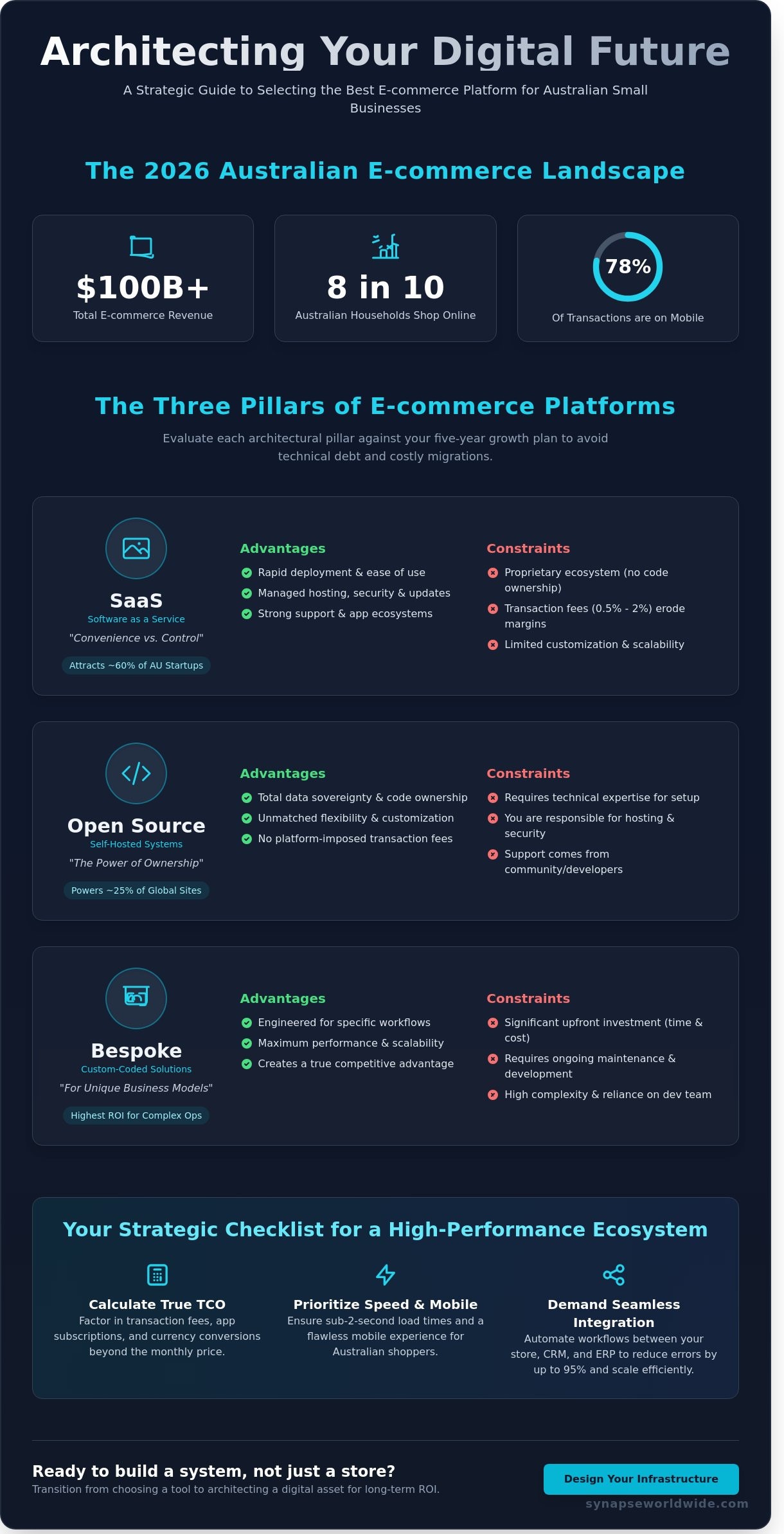
Australia’s digital economy has reached a critical tipping point. Total e-commerce revenue in the country has surpassed $100 billion, driven by a consumer base that demands seamless, high-speed interactions. For local SMEs, the stakes are higher than ever. Strategic growth no longer comes from simply having an online presence; it requires a sophisticated digital architecture. Selecting the best e-commerce platform for small business australia is a decision that dictates your operational capacity for the next five years. You aren’t just buying a website; you’re investing in the central nervous system of your company.

The market has moved away from isolated storefronts. We now see the rise of integrated digital ecosystems where every touchpoint is connected. A “good enough” solution often leads to fragmented data and manual errors, which can cost a business up to 20% in potential annual revenue. To remain competitive, your platform must handle complex tasks like real-time inventory tracking and personalized marketing triggers without human intervention. Understanding E-commerce at this foundational level helps owners transition from being mere vendors to becoming data-driven retailers. It’s about building a bespoke experience that scales with your ambition, whether you are selling physical products or offering professional services like Sit Means Sit Dog Training.

Mobile-First and Speed: The Non-Negotiables

Mobile commerce now dominates the Australian market, accounting for 78% of all online retail transactions in 2026. If your site doesn’t load in under two seconds, you’ve already lost the customer. Data shows a direct correlation here; every 100ms of latency results in a 7% drop in conversion rates. Local server locations in Sydney or Melbourne are essential to maintain the sub-50ms response times that Australian shoppers expect. Speed isn’t just a technical metric; it’s a core component of your user experience and SEO strategy. We prioritize platforms that offer robust global content delivery networks while maintaining a strong local footprint.

Integration as a Growth Lever

The best e-commerce platform for small business australia must serve as more than a checkout page. It needs to bridge the gap between your storefront and your back-office operations. Successful retailers are using automated workflows to connect their CRM and ERP systems directly to their sales channels. This level of synchronization ensures that stock levels are accurate across physical and digital locations, reducing the risk of overselling by 95%. Automated processes allow small teams to handle higher order volumes without increasing their headcount. This creates a scalable path to market dominance by removing the friction of manual data entry and logistics management.

Understanding the Three Pillars of E-commerce Platforms

Choosing the best e-commerce platform for small business australia involves evaluating three distinct architectural pillars against your five-year growth plan. The market is broadly categorized into Software as a Service (SaaS), Open Source, and Bespoke solutions. Each category offers varying degrees of control, scalability, and technical involvement. Understanding these fundamental differences is the first step toward building a robust digital presence that delivers a measurable return on investment.

  • SaaS: Subscription-based models designed for rapid deployment and ease of use.
  • Open Source: Self-hosted systems that offer total data sovereignty and flexibility.
  • Bespoke: Custom-coded solutions built from the ground up for unique business models.

Selecting the wrong pillar can lead to significant technical debt or expensive migration projects within 24 months of launch. A strategic decision today prevents a fragmented customer experience tomorrow.

SaaS Platforms: Convenience vs. Control

SaaS options like Shopify and BigCommerce attract approximately 60% of Australian startups due to their rapid deployment capabilities. These platforms handle hosting, security, and core updates, allowing owners to focus on sales. However, this convenience comes with constraints. You operate within a proprietary ecosystem where you don’t own the underlying code. High-volume merchants often face transaction fees ranging from 0.5% to 2% unless they use specific proprietary payment gateways. This can erode margins as your business scales beyond initial growth targets.

Open Source: The Power of Ownership

WooCommerce remains a dominant force for Australian SMEs, powering approximately 25% of all e-commerce sites globally. The primary benefit is total data sovereignty. You own the hosting environment and every line of code. According to the Australian e-commerce market overview, consumer expectations for personalized experiences are rising, and open-source flexibility allows brands to pivot quickly. While flexibility is high, you’re responsible for maintenance, security patches, and server optimization to maintain a 99.9% uptime.

For businesses with unique operational models or complex logistics, a bespoke solution provides a competitive edge. Custom builds eliminate the bloat of generic platforms, focusing strictly on high-performance needs and specific integrations. If your workflow requires a tailored digital strategy to integrate with complex ERP systems, a custom approach ensures your technology stack evolves with your vision. This level of investment is typically reserved for businesses reaching a specific maturity stage where generic tools no longer suffice. It’s about building a foundation that supports transformation and aggressive growth targets.

Best E-commerce Platform for Small Business Australia: 2026 Comparison Guide

Comparing the Best E-commerce Platforms for Australian Small Business

Selecting the best e-commerce platform for small business australia requires a strategic look at local infrastructure and long-term growth potential. By 2026, the distinction between simple storefronts and integrated digital ecosystems has sharpened. Data from the Australia Post eCommerce Report indicates that online shopping now accounts for a permanent shift in consumer behavior, with 82% of households making regular digital purchases. This reality demands a platform that handles local tax compliance, Australian payment gateways, and rapid SKU expansion without technical friction.

A side-by-side analysis reveals distinct paths for different business models. Shopify and BigCommerce offer managed environments, whereas WooCommerce and Magento provide open-source flexibility. While Magento caters to the enterprise tier with complex multi-store requirements, most Australian small businesses find the resource-heavy maintenance of Magento a barrier to profitability. Instead, the focus has shifted toward platforms that balance SEO performance with operational efficiency. Our evaluation prioritizes platforms that offer seamless integration with the local logistics landscape.

Shopify: The Market Leader for Ease of Use

Shopify remains the dominant choice for merchants prioritizing speed to market and intuitive design. Its out-of-the-box SEO capabilities provide a solid foundation, though rigid URL structures persist as a legacy constraint in 2026. The primary challenge for Australian merchants is the “app tax.” Essential features for local shipping logistics and advanced inventory management often require third-party subscriptions. These can increase monthly operating costs by 30% to 50% compared to the base price. Shopify is best suited for low-complexity retail brands with a heavy focus on social media marketing.

WooCommerce: The Versatile Australian Favourite

WooCommerce leverages the power of WordPress to deliver a content-rich e-commerce strategy. It’s the preferred option for businesses that view their website as a strategic asset rather than just a checkout page. Integration with local gateways like eWAY and CommBank is seamless, providing a localized checkout experience that builds trust. Because you control the hosting environment, you have 100% authority over technical SEO and site speed optimization. It’s the ideal platform for businesses requiring deep customization and a bespoke digital presence that scales without per-transaction platform fees.

BigCommerce: The SaaS Alternative for Scaling

BigCommerce positions itself as the robust alternative for businesses outgrowing basic SaaS limitations. It handles complex product filtering and multi-currency transactions natively, reducing the need for the extensive app libraries found in Shopify. For companies managing over 1,000 SKUs or running a B2B and B2C hybrid model, BigCommerce provides a more stable architecture. Its native SEO features allow for greater flexibility in URL naming and metadata management, ensuring your best e-commerce platform for small business australia remains competitive in search rankings as your product range expands.

Calculating Total Cost of Ownership (TCO) in Australia

Monthly subscription fees typically represent only 20% of your actual investment. The remaining 80% of your digital expenditure resides in transaction fees, app integrations, and the inevitable cost of technical debt. Selecting the best e-commerce platform for small business australia requires a strategic three-year financial forecast rather than a glance at a monthly pricing table. Your digital presence is a long-term asset; treating it as a recurring utility bill often leads to unforeseen fiscal bottlenecks.

Transaction fees and payment gateway margins can silently erode your profitability. While a platform might advertise a low entry price, they often impose a 0.5% to 2% “transaction fee” if you don’t use their proprietary payment processor. When combined with standard credit card fees of 1.75% plus 30 cents per order, your gross margin shrinks before you’ve even accounted for product costs. For businesses scaling past $100,000 in annual revenue, these percentage points represent thousands of dollars that could have been reinvested into customer acquisition.

Technical debt is the most expensive “hidden” cost. A 2024 analysis of small business web projects revealed that firms using low-cost, template-based builds spent 35% more on emergency maintenance and software patches over a 36-month period compared to those who invested in bespoke, robust architectures. Frequent mandatory software updates and security patches are essential for maintaining a secure digital landscape. Ignoring these leads to vulnerabilities that can cost an Australian business an average of $46,000 per cyber incident according to recent ACSC data.

Australian Compliance and Regulatory Costs

Your platform must automate GST compliance and generate tax-compliant invoicing for every sale. Australian Consumer Law (ACL) dictates strict requirements for returns, refunds, and warranties; your system needs the flexibility to handle these workflows without manual intervention. Data sovereignty is also becoming a critical differentiator. Storing customer data on Australian-based servers helps meet local privacy expectations and ensures your business remains resilient against shifting international data regulations.

Shipping and Logistics Integration

Managing logistics across the Australian continent requires integrated precision. The best e-commerce platform for small business australia must provide real-time quoting for Australia Post, StarTrack, and Sendle. Manual label generation is a scalability killer. Automating this process can save a small business up to 15 hours of administrative labor per week. If you operate multi-warehouse inventory, your platform must intelligently route orders to the closest fulfillment center to minimize transit times and shipping costs.

Ready to build a scalable foundation that avoids hidden technical debt? Consult with our strategic architects at Synapse Worldwide to design a high-performance e-commerce solution tailored to your growth goals.

Designing Your Strategic E-commerce Infrastructure

Selecting the best e-commerce platform for small business australia is only the first step in a much larger journey. Many entrepreneurs make the mistake of viewing their online store as a standalone tool rather than a comprehensive business system. This narrow focus often leads to technical debt and missed opportunities for scale. A digital architect approaches your online presence differently. They see a strategic infrastructure designed to capture data, automate workflows, and drive predictable revenue. You don’t just need a place to list products; you need a system that grows with your ambitions.

Bespoke integration outperforms cookie-cutter templates because it removes the friction inherent in generic software. When your store is built as a custom system, every touchpoint is optimized for your specific customer base. This isn’t just about aesthetics; it’s about engineering. A system that integrates natively with your existing supply chain or accounting software can reduce administrative overhead by 30 percent or more. By treating your platform as a revenue engine, you transform it from a monthly expense into a high-yield asset.

Bespoke Development for Competitive Advantage

Standard templates often force your business processes to fit within their rigid limitations. Bespoke development flips this dynamic. By creating unique user journeys, you can guide customers toward higher-value bundles and personalized recommendations. Data from 2024 e-commerce audits suggests that custom-engineered checkout experiences can boost conversion rates by 18 percent compared to stock platform checkouts. Integrating custom CRM and ERP solutions ensures that your inventory, customer data, and financial reporting remain synchronized in real time. This level of technical maturity future-proofs your store against the sudden policy changes or fee hikes that often plague platform-dependent businesses.

The Synapse Worldwide Advantage

Synapse Worldwide doesn’t just build websites; we architect growth engines. We understand that the best e-commerce platform for small business australia must be backed by a strategy that prioritizes long-term ROI. Our fixed-price project development model ensures budget certainty from day one, protecting your capital for marketing and inventory. We leverage deep national expertise in Australian consumer law, tax standards, and localized SEO to give you an immediate edge in the domestic market.

Our ongoing strategic consulting ensures your platform doesn’t just sit idle. We continuously optimize for performance to keep you at the forefront of your industry. If you’re ready to transition from a basic shopfront to a high-performance digital asset, enquire about your bespoke e-commerce project today.

Architect Your Digital Success in 2026

Navigating the Australian digital landscape requires a transition from basic online sales to a fully integrated commerce ecosystem. By 2026, the best e-commerce platform for small business australia must do more than display products; it has to synchronize your entire operation. You’ve identified how the three pillars of e-commerce and a precise calculation of total cost of ownership provide the stability needed for sustainable scaling. A strategic infrastructure isn’t just a technical requirement. It’s a competitive advantage that separates market leaders from those who merely exist online.

Synapse Worldwide has led this space since 2005, bringing over two decades of digital expertise to every partnership. We’re specialists in custom CRM and ERP integrations, ensuring your website communicates perfectly with your backend systems to eliminate data silos. Our commitment to fixed-price project fees provides the transparency you need for a results-oriented development process without the risk of budget creep. We don’t just build websites; we engineer growth engines that endure.

Partner with Synapse Worldwide for a strategic e-commerce solution that drives growth.

Your journey toward a more profitable digital presence starts with a single, decisive step toward a better architectural foundation.

Frequently Asked Questions

Which e-commerce platform has the lowest transaction fees in Australia?

WooCommerce typically offers the lowest transaction fees because it doesn’t charge a platform-specific commission on top of your payment processor costs. While Shopify charges between 0.5% and 2% for third-party gateways, WooCommerce users only pay the base rate of their chosen provider. Stripe Australia currently charges 1.75% plus 30 cents for domestic cards. This makes it a highly cost-effective choice for those seeking the best e-commerce platform for small business australia.

Do I need a local Australian developer to build my online store?

You don’t strictly require a local developer, but hiring an Australian agency ensures compliance with the Australian Consumer Law and local privacy regulations. Local experts understand the nuances of the 2023 Privacy Act amendments and regional shipping logistics. Working with a domestic partner eliminates time zone barriers and ensures your site is optimized for the specific browsing habits of Australian shoppers. This strategic alignment protects your brand from regional compliance risks.

How much should a small business spend on an e-commerce platform?

A small business should allocate between 3% and 5% of their projected annual revenue toward their e-commerce infrastructure. For a startup aiming for $100,000 in first-year sales, a budget of $3,000 to $5,000 covers hosting, premium plugins, and professional design. This investment ensures your platform remains scalable as your transaction volume increases. Avoid underfunding your digital foundation, as technical debt often costs 20% more to fix later.

Can I migrate my existing store from Shopify to WooCommerce easily?

You can migrate your store using automated tools like Cart2Cart or LitExtension, though complex data sets require manual oversight. These services typically move 99% of product data, customer records, and order history without downtime. SEO redirects must be mapped precisely to maintain your search rankings during the transition. A structured migration plan protects your historical data and ensures a seamless experience for your existing customer base.

What is the best platform for SEO in the Australian market?

WooCommerce is widely considered the best e-commerce platform for small business australia due to its deep integration with WordPress and advanced SEO plugins. It provides 100% control over URL structures, meta data, and schema markup. Recent 2025 performance data indicates that self-hosted platforms often achieve 15% faster indexing when optimized correctly. This granular control, often leveraged by digital growth experts like Patio SEO, allows businesses to target localized keywords more effectively than closed-ecosystem competitors.

Do these platforms support Australian payment methods like Afterpay and Zip?

Yes, all major platforms including Shopify, BigCommerce, and WooCommerce support Afterpay and Zip via official API integrations. Afterpay currently serves over 3.5 million active customers in Australia, making it a critical conversion tool for local retailers. You can install these payment gateways in under 10 minutes through the respective app stores. Offering “Buy Now, Pay Later” options has been shown to increase average order values by up to 18%.

How do I handle GST on my e-commerce store automatically?

You handle GST by configuring the tax settings within your platform to apply a 10% rate to all domestic transactions. Platforms like Shopify and BigCommerce use geolocation to identify Australian IP addresses and apply the tax automatically at checkout. For complex requirements, integrating accounting software like Xero or MYOB ensures your tax invoices comply with Australian Taxation Office standards. This automation reduces manual bookkeeping errors by approximately 40%.

Is it better to use a template or a custom e-commerce design?

A bespoke custom design is superior for businesses prioritizing long-term growth and brand authority. While templates offer a faster launch, they often include 30% more bloated code that slows down page load speeds. Custom solutions allow for integrated features tailored to your specific operational workflow. Strategic design choices ensure your store is unique, scalable, and optimized for the highest possible conversion rates in a competitive digital landscape.