

Tag Archives: Small Business


SEO KPIs for Small Business: The 2026 Strategic Guide to Measuring Growth

SEO KPIs for Small Business: The 2026 Strategic Guide to Measuring Growth

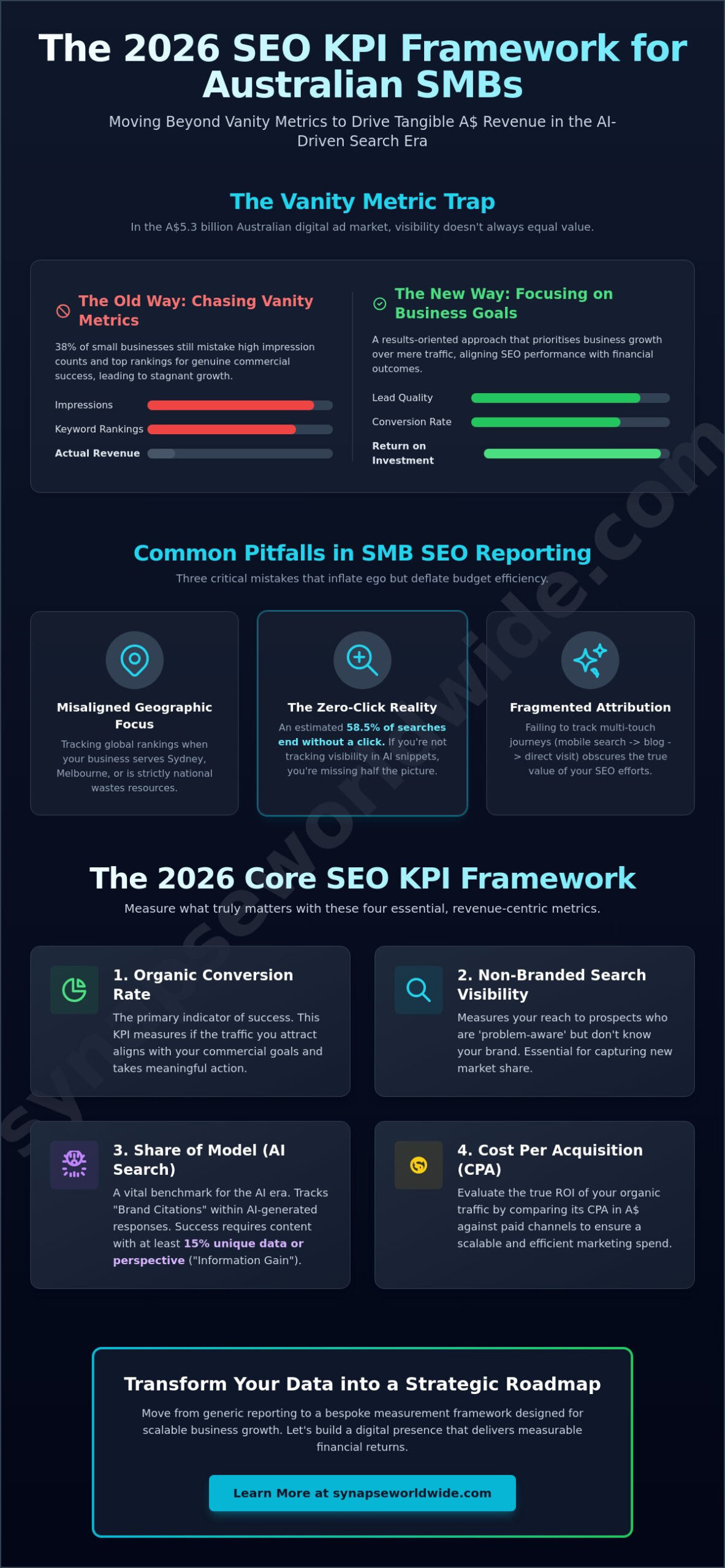
In the A$5.3 billion Australian digital advertising market, roughly 38% of small businesses still mistake high impression counts for genuine commercial success. It’s frustrating to watch your organic reach expand while your conversion rate remains stagnant; you know that vanity metrics don’t pay the bills. You need a more sophisticated way to measure seo kpis for small business that accounts for the rise of AI-driven search and shifting consumer habits. We understand that proving a return on investment to stakeholders requires more than a screenshot of a ranking report.

This guide empowers you to master the precise metrics that bridge the gap between search visibility and tangible A$ revenue in the 2026 landscape. You’ll move beyond surface-level data to embrace a results-oriented approach that prioritises business growth over mere traffic. We will outline a strategic dashboard of seven essential metrics that reduce your Cost Per Acquisition and provide the data-driven confidence needed to communicate success in clear, financial terms. Prepare to transform your digital presence into a scalable asset through clinical, evidence-based optimization.

Key Takeaways

  • Move beyond the “Vanity Metric Trap” by aligning your technical search performance with tangible revenue goals and long-term business growth.
  • Identify the most impactful seo kpis for small business in the 2026 landscape, including the critical “Share of Model” metric for AI-driven search visibility.
  • Evaluate the true ROI of your organic traffic by comparing Cost Per Acquisition (CPA) in A$ against paid channels to ensure a scalable and efficient marketing spend.
  • Implement a robust tracking setup within GA4 to capture precise “Key Events” that map directly to your specific Australian market objectives.
  • Transition from generic reporting to a bespoke measurement framework designed to transform raw data into a strategic roadmap for national expansion.

Beyond Vanity Metrics: Why Small Businesses Fail at SEO Tracking

For many Australian enterprises, search engine optimization often feels like a black box. You see numbers move, but the bank balance stays the same. To scale effectively in the current market, you must treat seo kpis for small business as the vital bridge between technical search performance and corporate revenue goals. Without this link, you’re simply collecting data without purpose.

Adopting the Digital Architect mindset means viewing SEO data as foundational infrastructure rather than a peripheral marketing expense. In the 2026 search landscape, traditional ranking reports no longer suffice. AI-driven search engines and generative overviews have changed how users interact with content. A business might rank first for a high-volume term, yet see zero traffic because an AI summary answered the query on the search results page. This shift requires a move away from the Vanity Metric Trap, where high impressions and keyword counts mask a stagnant return on investment.

The Difference Between Data and Insights

Raw data is noise; insights are signals that drive growth. Small businesses often drown in spreadsheets featuring thousands of keywords that don’t convert. You must prioritise quality over quantity by filtering out metrics that don’t impact your bottom line. An SEO KPI is a measurable value that demonstrates how effectively a company is achieving search objectives.

Common Pitfalls in SMB SEO Reporting

  • Misaligned Geographic Focus: Many Australian companies track global rankings when their service area is strictly national or limited to specific hubs like Sydney or Melbourne. This inflates ego but deflates budget efficiency.
  • The Zero-Click Reality: Recent industry data indicates that approximately 58.5% of searches now end without a click. If your reporting doesn’t account for brand visibility within AI snippets, you’re missing more than half the picture.
  • Fragmented Attribution: Small businesses frequently fail to attribute conversions across multi-touch digital journeys. A customer might find you via a mobile search on Monday, read a blog on Wednesday, and finally convert via a direct visit on Friday.

Strategic growth requires a bespoke approach to measurement. You don’t need more data; you need better clarity. By focusing on integrated metrics that reflect actual business outcomes, you transform SEO from a technical chore into a scalable engine for transformation. This professional rigour ensures your digital presence remains robust and results-oriented in an increasingly competitive Australian landscape.

The 2026 Core SEO KPI Framework: Measuring What Truly Matters

Effective digital strategy requires moving beyond vanity metrics. For Australian SMEs, the digital landscape in 2026 demands a focus on high-intent data that correlates directly with revenue. We prioritise the Organic Conversion Rate as the primary indicator of success. This metric tells us if the traffic we attract actually aligns with your commercial goals. A high volume of visitors is irrelevant if they don’t take action. We look for a steady climb in conversion percentages, ensuring your landing pages meet the specific needs of the Australian consumer.

Tracking non-branded search visibility is equally critical for sustainable growth. This KPI measures your reach among prospects who are “problem-aware” but don’t yet know your brand. If your traffic relies solely on your business name, your growth is capped. By monitoring how you rank for generic industry terms, we measure your ability to capture new market share. These seo kpis for small business provide a clear roadmap for expanding your influence beyond your existing customer base. Underpinning this entire process is a strategic approach to keyword research for beginners, which ensures you are targeting terms that reflect genuine purchase intent rather than simply chasing high-volume phrases.

Visibility in the Age of AI Search

The rise of AI Overviews has introduced “Share of Model” as a vital benchmark. We no longer just track blue links; we measure “Brand Citations” within AI-generated responses. Google’s algorithms now reward semantic relevance and topical authority over simple keyword density. Your content must demonstrate “Information Gain,” a concept solidified in Google’s 2024 core updates. This refers to the unique, additive value your content provides that doesn’t exist elsewhere on the web. We aim for at least 15% unique data or perspective in every piece of content to ensure AI models recognise your brand as an authoritative source. A unified content marketing SEO strategy is essential to consistently producing this kind of authoritative, AI-visible content at scale.

Technical Performance and User Experience

Technical health is a primary ranking signal that directly impacts your bottom line. Google’s transition to Interaction to Next Paint (INP) in March 2024 as a Core Web Vital highlight’s the importance of responsiveness. If a user clicks a button and waits more than 200 milliseconds for a visual response, your rankings and conversions will suffer. Mobile-first design is no longer a suggestion; it’s the standard for organic retention in the Australian market.

A robust technical foundation ensures that your SEO efforts aren’t wasted on a site that frustrates users. You can learn more about building a high-performance platform by exploring custom web design for small business, which explores the critical link between site architecture and search visibility. When your technical execution matches your content quality, you create a seamless journey that turns searchers into loyal clients. If you want to see how these metrics apply to your specific industry, request a strategic audit to identify your growth bottlenecks.

By integrating these advanced seo kpis for small business, we move away from guesswork. We focus on measurable technical precision and semantic depth, ensuring your business remains visible and authoritative in an AI-driven search environment.
SEO KPIs for Small Business: The 2026 Strategic Guide to Measuring Growth

Revenue-Centric SEO: Aligning Search Performance with Business ROI

Digital growth hinges on moving beyond simple traffic counts. For an Australian trade business or retail shop, the most critical seo kpis for small business involve direct financial outcomes. While a Google Ads campaign might offer an immediate Cost Per Acquisition (CPA) of A$80, a mature SEO strategy often reduces this to under A$20 over an 18 month period. This efficiency makes organic search the most scalable channel for long term profitability.

High performing SEO strategies focus on Customer Lifetime Value (CLV). Users who find a business through educational, non-branded search queries often demonstrate higher loyalty than those clicking on a transactional ad. This is because organic visibility builds foundational trust. To measure this, we track assisted conversions in GA4. SEO frequently serves as the first touchpoint in a multi stage journey. If a customer discovers your brand via a blog post but converts three weeks later through a direct visit, SEO deserves the credit for that initial engagement.

  • Organic Revenue Growth: We map specific search clusters to revenue streams to ensure every click has a commercial purpose.
  • CPA Comparison: We contrast the monthly SEO retainer against the equivalent spend required to buy that same traffic via PPC.
  • Assisted Conversion Value: This metric captures the 35% of revenue that typically originates from search but closes through other channels.

Calculating SEO ROI for Small Businesses

Measuring the success of your digital investment requires a clear financial lens. SEO ROI is calculated by subtracting the cost of SEO from the organic revenue generated, divided by the cost of SEO. Unlike the instant gratification of paid search, SEO requires a strategic patience. Most Australian small businesses see the “break even” point occur between months six and nine, after which the ROI begins to compound. We treat SEO as a robust capital investment rather than a monthly expense, focusing on the long term appreciation of your digital assets.

The Role of Branded vs. Non-Branded Traffic

A sophisticated seo kpis for small business framework distinguishes between discovery and retention. Non-branded traffic is your engine for new customer acquisition. These are users searching for solutions, such as “emergency plumber Sydney” or “bespoke jewellery Melbourne,” who don’t yet know your brand. Branded traffic, conversely, measures your market authority. When users search for your specific company name, it indicates that your offline marketing and digital reputation are working. We set separate targets for these: 70% of growth should typically come from non-branded discovery to ensure your business isn’t just “preaching to the choir.”

Implementing Your SEO Measurement Strategy: Tools and Best Practices

Execution without measurement is merely guesswork. To transform your digital presence into a predictable growth engine, you need a structured approach to data. Start by auditing your Google Analytics 4 (GA4) setup. In 2026, clean data is your most valuable asset. Ensure that cross-domain tracking and enhanced measurement are correctly configured to prevent fragmented user journeys. This step ensures that your seo kpis for small business are based on reality rather than technical glitches.

Next, define your “Key Events.” These have replaced traditional conversions in the Google ecosystem. For an Australian small business, these should map directly to revenue-generating activities like form submissions, phone clicks, or specific product interactions. Once these are active, integrate your Search Console data with your CRM. This creates a bridge between an anonymous organic click and a closed A$10,000 contract. Establishing a monthly reporting cadence is vital. Daily fluctuations in rankings are noise; focus on 30-day trends to understand the true trajectory of your organic growth.

The Essential 2026 SEO Tech Stack

Your toolkit must evolve beyond basic spreadsheets. GA4 and Search Console remain the foundation, providing raw organic performance data directly from the source. However, the rise of AI Overviews requires specialized tracking. Use AI-driven rank trackers that simulate search intent and monitor visibility within generative search results. A robust CRM integration ensures you aren’t just tracking traffic, but identifying which organic keywords actually drive high-value Australian customers to your door. We recommend bespoke dashboards, such as those built in Looker Studio, to visualize these complex data points for your leadership team.

Data Hygiene and Accuracy

Metrics are only useful if they’re accurate. Small businesses often see skewed data because of internal traffic or referral spam. Filter your office IP addresses and known bot signatures immediately to maintain integrity. You should also treat “Keyword Difficulty” scores from third-party tools with caution. These are estimates, not absolute truths. A keyword might show high difficulty but remain accessible if your content demonstrates superior topical authority. While AI can process vast datasets, human analysis is required to interpret the “why” behind the numbers. Automated reports can identify a drop in traffic, but a specialist identifies if that drop was due to a seasonal Australian holiday or a technical crawl error. This human oversight is what turns raw seo kpis for small business into actionable business intelligence.

Ready to turn your data into a strategic advantage? Consult with our digital architects to build a measurement framework that drives real ROI.

Bespoke SEO Strategy: Transforming Data into Scalable Business Growth

Generic dashboards often mislead Australian business owners by focusing on vanity metrics that don’t impact the bottom line. A one-size-fits-all approach ignores the fact that a boutique medical clinic in Perth operates under different market pressures than a national retail chain. Synapse Worldwide rejects cookie-cutter templates. We construct custom measurement frameworks that align directly with your national growth objectives. By tailoring seo kpis for small business, we ensure every data point serves a specific commercial purpose.

The shift from passive tracking to active optimization distinguishes market leaders from their competitors. Instead of merely recording monthly traffic changes, we use data to refine content and technical roadmaps. This transforms SEO from a recurring monthly expense into a high-yield long-term asset. When you treat your organic presence as digital real estate, the focus shifts to compounding returns rather than short-term spikes. It’s about building a robust foundation that supports scalable expansion across the Australian market.

The Strategic Growth Framework

Effective data analysis uncovers hidden revenue streams. By scrutinizing search intent and conversion patterns, we identify service gaps and emerging market opportunities that competitors often overlook. Our approach integrates these insights into a broader SEO for small business strategy. In one recent engagement, a data-driven pivot in keyword targeting led to a 34% increase in qualified leads for a specialist Australian consultancy within six months. This framework ensures your SEO efforts aren’t just visible, but profitable.

  • Identify high-intent search clusters that competitors ignore.
  • Align technical performance with Core Web Vitals to capture mobile-first users.
  • Utilize conversion rate data to refine landing page architecture.

Your Next Steps for Organic Dominance

Transitioning from passive monitoring to proactive execution is the key to outperforming the market. Success in 2026 requires a disciplined, results-oriented roadmap rather than reactive adjustments. The first step involves establishing a clear baseline through a professional audit. This process clarifies your current standing and highlights the exact seo kpis for small business that will drive your expansion. Don’t leave your digital growth to chance. Contact Synapse Worldwide for a bespoke SEO strategy audit to begin your journey toward market leadership and scalable revenue growth.

Transform Your Search Data into Scalable Business Assets

Navigating the 2026 search landscape requires a shift from tracking simple clicks to measuring high-impact revenue drivers. Australian firms that prioritise vanity metrics often miss the deeper insights needed for long-term stability. By adopting a framework focused on seo kpis for small business, you ensure your digital investment translates into measurable ROI. This strategic alignment is the difference between surviving the market and leading it. Since 2005, Synapse Worldwide has delivered over 20 years of digital expertise, crafting custom digital infrastructure that meets the rigorous demands of corporate and government clients nationwide. We focus on building robust, integrated solutions that turn complex data into clear growth trajectories. You don’t need a one-size-fits-all approach; you need a partner who understands the nuances of the Australian digital landscape and the technical precision required for high-performance results. It’s time to move beyond basic reporting and start building a digital legacy that scales with your ambitions.

Scale your organic growth with a bespoke SEO strategy from Synapse Worldwide

Your journey toward a more profitable digital presence starts with a single strategic decision today.

Frequently Asked Questions

What is the most important SEO KPI for a small business?

Organic conversions, such as qualified leads or direct sales, represent the ultimate SEO KPI for a small business. While traffic volume matters, your bottom line depends on visitors who take a specific action. In 2026, a high-performing Australian SME should target a conversion rate of 2% to 5% from organic search. Tracking this ensures your strategy aligns with revenue growth rather than just vanity metrics that don’t impact your bank balance.

How long does it take to see changes in SEO KPIs?

You’ll typically observe measurable shifts in your performance data within 4 to 6 months of implementing a bespoke strategy. Initial technical fixes might show results in 30 days, but sustainable growth in competitive Australian niches requires a longer horizon. Data from 2025 industry benchmarks suggests that 82% of successful campaigns hit their first major traffic milestone by the 180-day mark. Patience is vital for building a robust, scalable digital foundation.

Why is my organic traffic increasing but my sales are not?

Your traffic is likely increasing for non-commercial keywords that don’t drive purchase intent. If 70% of your visitors land on broad informational blog posts but your product pages remain stagnant, sales won’t follow. This often happens when content targets high-volume terms instead of the specific needs of your Australian customer base. Review your bounce rates and conversion paths to identify where potential buyers are dropping out of your digital sales funnel.

Can I track SEO KPIs for free using only Google tools?

You can track nearly all essential seo kpis for small business for free using Google Search Console and Google Analytics 4 (GA4). These platforms provide 100% of the data needed to monitor clicks, impressions, and user behaviour on your site. By setting up custom events in GA4, you can measure specific actions like A$0 checkout completions or contact form submissions. It’s a professional-grade solution that provides deep insights without monthly subscription costs.

How has AI search changed which KPIs I should track in 2026?

AI search evolution in 2026 has shifted the focus toward brand citations and “Share of Model” metrics. Traditional click-through rates are less reliable now that AI Overviews answer 40% of queries directly on the search results page. You should now track how often AI agents cite your brand as a recommended source. This requires a shift from simple keyword tracking to measuring your authority within specific Australian industry datasets and knowledge graphs.

What is a good conversion rate for organic search traffic?

A benchmark organic conversion rate for Australian small businesses ranges between 2% and 5% across most sectors. Professional service providers often see higher rates, sometimes reaching 10% for highly targeted local searches. If your current rate is below 1.5%, it indicates a strategic gap in your user experience or call-to-action placement. We focus on optimizing these touchpoints to ensure your digital landscape converts interest into tangible, measurable revenue for your business.

How often should I review my SEO performance reports?

Conduct a comprehensive review of your SEO performance reports every 30 days to identify long-term trends and strategic shifts. Monthly cycles allow enough time for data to stabilize and reveal the impact of your optimizations. You should also perform a 10-minute weekly health check to monitor for sudden ranking drops or technical errors. This disciplined rhythm ensures you remain proactive in the competitive Australian market without getting distracted by daily fluctuations.

What is the difference between an SEO metric and an SEO KPI?

An SEO metric is a raw data point like page load speed, while an SEO KPI is a strategic measurement tied directly to your business objectives. For instance, tracking 500 monthly impressions is a metric. Increasing your organic lead generation by 20% by December 2026 is a KPI. Understanding this distinction allows you to filter out noise and focus on the seo kpis for small business that actually drive transformation.

 

Best E-commerce Platform for Small Business Australia: 2026 Comparison Guide

Best E-commerce Platform for Small Business Australia: 2026 Comparison Guide

Selecting a platform based on ease of setup alone is often the fastest way to compromise your 2026 profit margins. You likely recognize that high transaction fees and fragmented shipping integrations can quietly erode your bottom line before you have even processed your first hundred orders. According to the 2024 Australia Post eCommerce Industry Report, 8 in 10 Australian households now shop online regularly, yet local retailers frequently lose up to 15% of their potential revenue to inefficient manual workflows and hidden costs.

Our objective is to help you secure a more profitable future. This guide provides the strategic framework to identify the best e-commerce platform for small business australia, ensuring you balance essential local requirements like GST compliance with the power of global scalability. We’ll explore how to build a robust, scalable store that leverages automated tax workflows and seamless payment integration. By the end of this comparison, you’ll have a clear roadmap to transform your digital presence into a high-performing asset that drives consistent growth and long-term transformation.

Key Takeaways

  • Navigate the evolution of the Australian digital retail market by moving beyond basic storefronts toward integrated, high-performance ecosystems.
  • Evaluate the best e-commerce platform for small business australia through a strategic framework that balances immediate deployment with global scalability.
  • Uncover the hidden variables in your Total Cost of Ownership, accounting for payment gateway margins and currency conversions unique to the local landscape.
  • Transition from merely choosing a software tool to architecting a bespoke digital system designed for long-term ROI and operational efficiency.
  • Gain a competitive edge by aligning your platform choice with the sophisticated consumer expectations and technological shifts of the 2026 marketplace.

The Australian E-commerce Landscape in 2026

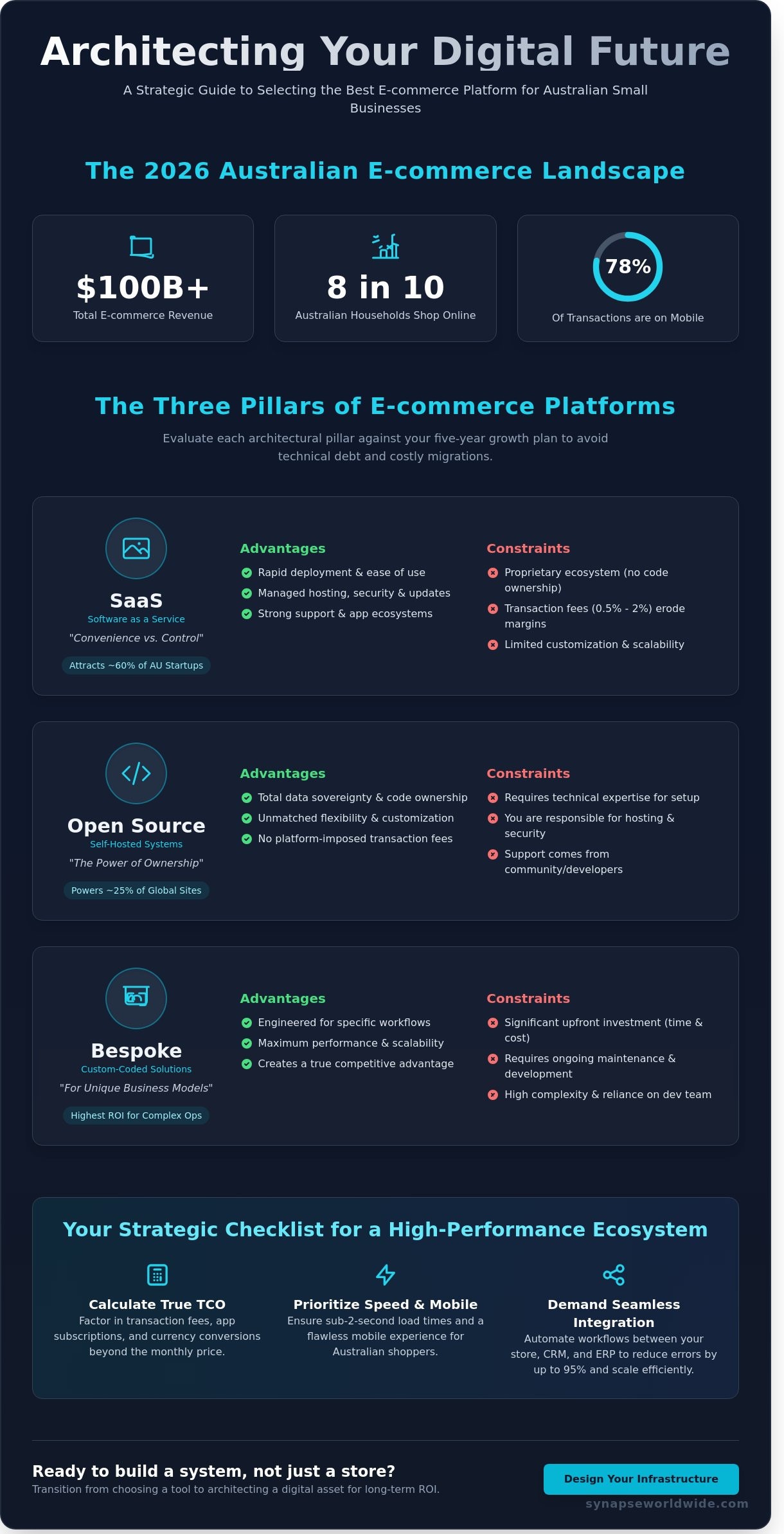
Australia’s digital economy has reached a critical tipping point. Total e-commerce revenue in the country has surpassed $100 billion, driven by a consumer base that demands seamless, high-speed interactions. For local SMEs, the stakes are higher than ever. Strategic growth no longer comes from simply having an online presence; it requires a sophisticated digital architecture. Selecting the best e-commerce platform for small business australia is a decision that dictates your operational capacity for the next five years. You aren’t just buying a website; you’re investing in the central nervous system of your company.

The market has moved away from isolated storefronts. We now see the rise of integrated digital ecosystems where every touchpoint is connected. A “good enough” solution often leads to fragmented data and manual errors, which can cost a business up to 20% in potential annual revenue. To remain competitive, your platform must handle complex tasks like real-time inventory tracking and personalized marketing triggers without human intervention. Understanding E-commerce at this foundational level helps owners transition from being mere vendors to becoming data-driven retailers. It’s about building a bespoke experience that scales with your ambition, whether you are selling physical products or offering professional services like Sit Means Sit Dog Training.

Mobile-First and Speed: The Non-Negotiables

Mobile commerce now dominates the Australian market, accounting for 78% of all online retail transactions in 2026. If your site doesn’t load in under two seconds, you’ve already lost the customer. Data shows a direct correlation here; every 100ms of latency results in a 7% drop in conversion rates. Local server locations in Sydney or Melbourne are essential to maintain the sub-50ms response times that Australian shoppers expect. Speed isn’t just a technical metric; it’s a core component of your user experience and SEO strategy. We prioritize platforms that offer robust global content delivery networks while maintaining a strong local footprint.

Integration as a Growth Lever

The best e-commerce platform for small business australia must serve as more than a checkout page. It needs to bridge the gap between your storefront and your back-office operations. Successful retailers are using automated workflows to connect their CRM and ERP systems directly to their sales channels. This level of synchronization ensures that stock levels are accurate across physical and digital locations, reducing the risk of overselling by 95%. Automated processes allow small teams to handle higher order volumes without increasing their headcount. This creates a scalable path to market dominance by removing the friction of manual data entry and logistics management.

Understanding the Three Pillars of E-commerce Platforms

Choosing the best e-commerce platform for small business australia involves evaluating three distinct architectural pillars against your five-year growth plan. The market is broadly categorized into Software as a Service (SaaS), Open Source, and Bespoke solutions. Each category offers varying degrees of control, scalability, and technical involvement. Understanding these fundamental differences is the first step toward building a robust digital presence that delivers a measurable return on investment.

  • SaaS: Subscription-based models designed for rapid deployment and ease of use.
  • Open Source: Self-hosted systems that offer total data sovereignty and flexibility.
  • Bespoke: Custom-coded solutions built from the ground up for unique business models.

Selecting the wrong pillar can lead to significant technical debt or expensive migration projects within 24 months of launch. A strategic decision today prevents a fragmented customer experience tomorrow.

SaaS Platforms: Convenience vs. Control

SaaS options like Shopify and BigCommerce attract approximately 60% of Australian startups due to their rapid deployment capabilities. These platforms handle hosting, security, and core updates, allowing owners to focus on sales. However, this convenience comes with constraints. You operate within a proprietary ecosystem where you don’t own the underlying code. High-volume merchants often face transaction fees ranging from 0.5% to 2% unless they use specific proprietary payment gateways. This can erode margins as your business scales beyond initial growth targets.

Open Source: The Power of Ownership

WooCommerce remains a dominant force for Australian SMEs, powering approximately 25% of all e-commerce sites globally. The primary benefit is total data sovereignty. You own the hosting environment and every line of code. According to the Australian e-commerce market overview, consumer expectations for personalized experiences are rising, and open-source flexibility allows brands to pivot quickly. While flexibility is high, you’re responsible for maintenance, security patches, and server optimization to maintain a 99.9% uptime.

For businesses with unique operational models or complex logistics, a bespoke solution provides a competitive edge. Custom builds eliminate the bloat of generic platforms, focusing strictly on high-performance needs and specific integrations. If your workflow requires a tailored digital strategy to integrate with complex ERP systems, a custom approach ensures your technology stack evolves with your vision. This level of investment is typically reserved for businesses reaching a specific maturity stage where generic tools no longer suffice. It’s about building a foundation that supports transformation and aggressive growth targets.

Best E-commerce Platform for Small Business Australia: 2026 Comparison Guide

Comparing the Best E-commerce Platforms for Australian Small Business

Selecting the best e-commerce platform for small business australia requires a strategic look at local infrastructure and long-term growth potential. By 2026, the distinction between simple storefronts and integrated digital ecosystems has sharpened. Data from the Australia Post eCommerce Report indicates that online shopping now accounts for a permanent shift in consumer behavior, with 82% of households making regular digital purchases. This reality demands a platform that handles local tax compliance, Australian payment gateways, and rapid SKU expansion without technical friction.

A side-by-side analysis reveals distinct paths for different business models. Shopify and BigCommerce offer managed environments, whereas WooCommerce and Magento provide open-source flexibility. While Magento caters to the enterprise tier with complex multi-store requirements, most Australian small businesses find the resource-heavy maintenance of Magento a barrier to profitability. Instead, the focus has shifted toward platforms that balance SEO performance with operational efficiency. Our evaluation prioritizes platforms that offer seamless integration with the local logistics landscape.

Shopify: The Market Leader for Ease of Use

Shopify remains the dominant choice for merchants prioritizing speed to market and intuitive design. Its out-of-the-box SEO capabilities provide a solid foundation, though rigid URL structures persist as a legacy constraint in 2026. The primary challenge for Australian merchants is the “app tax.” Essential features for local shipping logistics and advanced inventory management often require third-party subscriptions. These can increase monthly operating costs by 30% to 50% compared to the base price. Shopify is best suited for low-complexity retail brands with a heavy focus on social media marketing.

WooCommerce: The Versatile Australian Favourite

WooCommerce leverages the power of WordPress to deliver a content-rich e-commerce strategy. It’s the preferred option for businesses that view their website as a strategic asset rather than just a checkout page. Integration with local gateways like eWAY and CommBank is seamless, providing a localized checkout experience that builds trust. Because you control the hosting environment, you have 100% authority over technical SEO and site speed optimization. It’s the ideal platform for businesses requiring deep customization and a bespoke digital presence that scales without per-transaction platform fees.

BigCommerce: The SaaS Alternative for Scaling

BigCommerce positions itself as the robust alternative for businesses outgrowing basic SaaS limitations. It handles complex product filtering and multi-currency transactions natively, reducing the need for the extensive app libraries found in Shopify. For companies managing over 1,000 SKUs or running a B2B and B2C hybrid model, BigCommerce provides a more stable architecture. Its native SEO features allow for greater flexibility in URL naming and metadata management, ensuring your best e-commerce platform for small business australia remains competitive in search rankings as your product range expands.

Calculating Total Cost of Ownership (TCO) in Australia

Monthly subscription fees typically represent only 20% of your actual investment. The remaining 80% of your digital expenditure resides in transaction fees, app integrations, and the inevitable cost of technical debt. Selecting the best e-commerce platform for small business australia requires a strategic three-year financial forecast rather than a glance at a monthly pricing table. Your digital presence is a long-term asset; treating it as a recurring utility bill often leads to unforeseen fiscal bottlenecks.

Transaction fees and payment gateway margins can silently erode your profitability. While a platform might advertise a low entry price, they often impose a 0.5% to 2% “transaction fee” if you don’t use their proprietary payment processor. When combined with standard credit card fees of 1.75% plus 30 cents per order, your gross margin shrinks before you’ve even accounted for product costs. For businesses scaling past $100,000 in annual revenue, these percentage points represent thousands of dollars that could have been reinvested into customer acquisition.

Technical debt is the most expensive “hidden” cost. A 2024 analysis of small business web projects revealed that firms using low-cost, template-based builds spent 35% more on emergency maintenance and software patches over a 36-month period compared to those who invested in bespoke, robust architectures. Frequent mandatory software updates and security patches are essential for maintaining a secure digital landscape. Ignoring these leads to vulnerabilities that can cost an Australian business an average of $46,000 per cyber incident according to recent ACSC data.

Australian Compliance and Regulatory Costs

Your platform must automate GST compliance and generate tax-compliant invoicing for every sale. Australian Consumer Law (ACL) dictates strict requirements for returns, refunds, and warranties; your system needs the flexibility to handle these workflows without manual intervention. Data sovereignty is also becoming a critical differentiator. Storing customer data on Australian-based servers helps meet local privacy expectations and ensures your business remains resilient against shifting international data regulations.

Shipping and Logistics Integration

Managing logistics across the Australian continent requires integrated precision. The best e-commerce platform for small business australia must provide real-time quoting for Australia Post, StarTrack, and Sendle. Manual label generation is a scalability killer. Automating this process can save a small business up to 15 hours of administrative labor per week. If you operate multi-warehouse inventory, your platform must intelligently route orders to the closest fulfillment center to minimize transit times and shipping costs.

Ready to build a scalable foundation that avoids hidden technical debt? Consult with our strategic architects at Synapse Worldwide to design a high-performance e-commerce solution tailored to your growth goals.

Designing Your Strategic E-commerce Infrastructure

Selecting the best e-commerce platform for small business australia is only the first step in a much larger journey. Many entrepreneurs make the mistake of viewing their online store as a standalone tool rather than a comprehensive business system. This narrow focus often leads to technical debt and missed opportunities for scale. A digital architect approaches your online presence differently. They see a strategic infrastructure designed to capture data, automate workflows, and drive predictable revenue. You don’t just need a place to list products; you need a system that grows with your ambitions.

Bespoke integration outperforms cookie-cutter templates because it removes the friction inherent in generic software. When your store is built as a custom system, every touchpoint is optimized for your specific customer base. This isn’t just about aesthetics; it’s about engineering. A system that integrates natively with your existing supply chain or accounting software can reduce administrative overhead by 30 percent or more. By treating your platform as a revenue engine, you transform it from a monthly expense into a high-yield asset.

Bespoke Development for Competitive Advantage

Standard templates often force your business processes to fit within their rigid limitations. Bespoke development flips this dynamic. By creating unique user journeys, you can guide customers toward higher-value bundles and personalized recommendations. Data from 2024 e-commerce audits suggests that custom-engineered checkout experiences can boost conversion rates by 18 percent compared to stock platform checkouts. Integrating custom CRM and ERP solutions ensures that your inventory, customer data, and financial reporting remain synchronized in real time. This level of technical maturity future-proofs your store against the sudden policy changes or fee hikes that often plague platform-dependent businesses.

The Synapse Worldwide Advantage

Synapse Worldwide doesn’t just build websites; we architect growth engines. We understand that the best e-commerce platform for small business australia must be backed by a strategy that prioritizes long-term ROI. Our fixed-price project development model ensures budget certainty from day one, protecting your capital for marketing and inventory. We leverage deep national expertise in Australian consumer law, tax standards, and localized SEO to give you an immediate edge in the domestic market.

Our ongoing strategic consulting ensures your platform doesn’t just sit idle. We continuously optimize for performance to keep you at the forefront of your industry. If you’re ready to transition from a basic shopfront to a high-performance digital asset, enquire about your bespoke e-commerce project today.

Architect Your Digital Success in 2026

Navigating the Australian digital landscape requires a transition from basic online sales to a fully integrated commerce ecosystem. By 2026, the best e-commerce platform for small business australia must do more than display products; it has to synchronize your entire operation. You’ve identified how the three pillars of e-commerce and a precise calculation of total cost of ownership provide the stability needed for sustainable scaling. A strategic infrastructure isn’t just a technical requirement. It’s a competitive advantage that separates market leaders from those who merely exist online.

Synapse Worldwide has led this space since 2005, bringing over two decades of digital expertise to every partnership. We’re specialists in custom CRM and ERP integrations, ensuring your website communicates perfectly with your backend systems to eliminate data silos. Our commitment to fixed-price project fees provides the transparency you need for a results-oriented development process without the risk of budget creep. We don’t just build websites; we engineer growth engines that endure.

Partner with Synapse Worldwide for a strategic e-commerce solution that drives growth.

Your journey toward a more profitable digital presence starts with a single, decisive step toward a better architectural foundation.

Frequently Asked Questions

Which e-commerce platform has the lowest transaction fees in Australia?

WooCommerce typically offers the lowest transaction fees because it doesn’t charge a platform-specific commission on top of your payment processor costs. While Shopify charges between 0.5% and 2% for third-party gateways, WooCommerce users only pay the base rate of their chosen provider. Stripe Australia currently charges 1.75% plus 30 cents for domestic cards. This makes it a highly cost-effective choice for those seeking the best e-commerce platform for small business australia.

Do I need a local Australian developer to build my online store?

You don’t strictly require a local developer, but hiring an Australian agency ensures compliance with the Australian Consumer Law and local privacy regulations. Local experts understand the nuances of the 2023 Privacy Act amendments and regional shipping logistics. Working with a domestic partner eliminates time zone barriers and ensures your site is optimized for the specific browsing habits of Australian shoppers. This strategic alignment protects your brand from regional compliance risks.

How much should a small business spend on an e-commerce platform?

A small business should allocate between 3% and 5% of their projected annual revenue toward their e-commerce infrastructure. For a startup aiming for $100,000 in first-year sales, a budget of $3,000 to $5,000 covers hosting, premium plugins, and professional design. This investment ensures your platform remains scalable as your transaction volume increases. Avoid underfunding your digital foundation, as technical debt often costs 20% more to fix later.

Can I migrate my existing store from Shopify to WooCommerce easily?

You can migrate your store using automated tools like Cart2Cart or LitExtension, though complex data sets require manual oversight. These services typically move 99% of product data, customer records, and order history without downtime. SEO redirects must be mapped precisely to maintain your search rankings during the transition. A structured migration plan protects your historical data and ensures a seamless experience for your existing customer base.

What is the best platform for SEO in the Australian market?

WooCommerce is widely considered the best e-commerce platform for small business australia due to its deep integration with WordPress and advanced SEO plugins. It provides 100% control over URL structures, meta data, and schema markup. Recent 2025 performance data indicates that self-hosted platforms often achieve 15% faster indexing when optimized correctly. This granular control, often leveraged by digital growth experts like Patio SEO, allows businesses to target localized keywords more effectively than closed-ecosystem competitors.

Do these platforms support Australian payment methods like Afterpay and Zip?

Yes, all major platforms including Shopify, BigCommerce, and WooCommerce support Afterpay and Zip via official API integrations. Afterpay currently serves over 3.5 million active customers in Australia, making it a critical conversion tool for local retailers. You can install these payment gateways in under 10 minutes through the respective app stores. Offering “Buy Now, Pay Later” options has been shown to increase average order values by up to 18%.

How do I handle GST on my e-commerce store automatically?

You handle GST by configuring the tax settings within your platform to apply a 10% rate to all domestic transactions. Platforms like Shopify and BigCommerce use geolocation to identify Australian IP addresses and apply the tax automatically at checkout. For complex requirements, integrating accounting software like Xero or MYOB ensures your tax invoices comply with Australian Taxation Office standards. This automation reduces manual bookkeeping errors by approximately 40%.

Is it better to use a template or a custom e-commerce design?

A bespoke custom design is superior for businesses prioritizing long-term growth and brand authority. While templates offer a faster launch, they often include 30% more bloated code that slows down page load speeds. Custom solutions allow for integrated features tailored to your specific operational workflow. Strategic design choices ensure your store is unique, scalable, and optimized for the highest possible conversion rates in a competitive digital landscape.