
Tag Archives: Business Automation


Full-Service Digital Marketing Agency Australia: The 2026 Strategic Growth Framework

Full-Service Digital Marketing Agency Australia: The 2026 Strategic Growth Framework

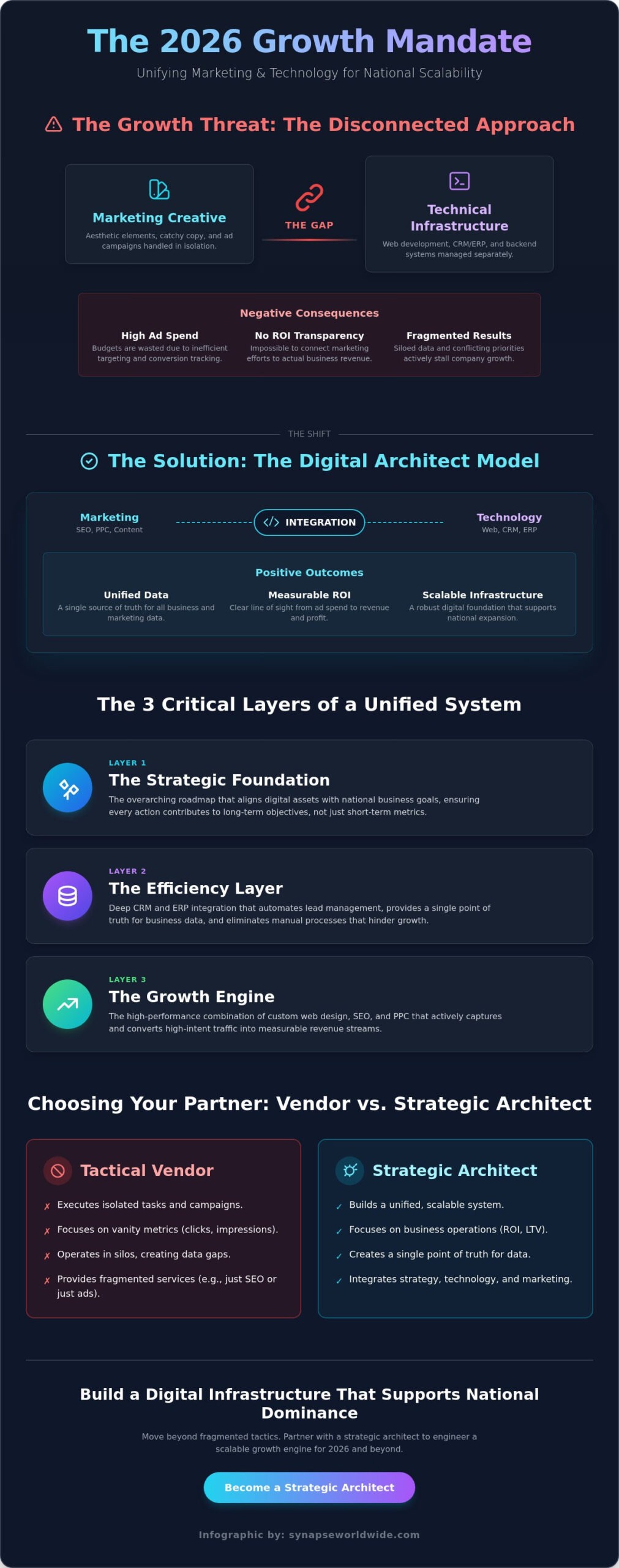
In 2026, the traditional divide between your marketing creative and your technical infrastructure has become the single greatest threat to your company’s scalability. You’ve likely felt the friction of disconnected digital tools that refuse to communicate, leaving you with high ad spend and a frustrating lack of transparency regarding your actual ROI. Many agencies handle the aesthetic elements well but fail when it comes to the complex technical backend integration your national growth requires.

Bridging this gap requires a visionary approach to your digital architecture. This article reveals how a premier full-service digital marketing agency australia can align your custom web design, SEO, and CRM integration into a single, accountable growth engine. You’ll discover a strategic framework designed to turn fragmented tactics into a scalable infrastructure that supports your 2026 objectives. We’ll preview how unifying your search visibility with robust business automation creates the measurable results and long-term stability your brand deserves.

Key Takeaways

  • Learn why the 2026 growth model requires a total alignment of digital strategy, technical infrastructure, and marketing execution to avoid fragmented results.
  • Discover how a premier full-service digital marketing agency australia synchronizes custom web design with SEO and PPC to build a high-performance conversion engine.
  • Understand why marketing automation fails without deep CRM and ERP integration to provide a single point of truth for your business data.
  • Master a framework for evaluating potential partners based on their ability to act as strategic architects rather than mere tactical vendors.
  • Identify the core elements of a scalable digital infrastructure that supports national expansion and ensures long-term ROI for Australian business leaders.

What Defines a Full-Service Digital Marketing Agency in Australia for 2026?

By 2026, the definition of a full-service digital marketing agency australia has transitioned from a simple creative shop to a sophisticated technical partner. Success no longer relies solely on catchy copy or high-bid advertising. Instead, it exists at the intersection of high-level strategy, advanced technology, and precision marketing. To grasp the complexity of this shift, one must first understand What is Digital Marketing? in its modern, integrated form; it’s an engineering discipline where data and design are inseparable.

Many Australian firms are abandoning the fragmented model of hiring separate vendors for SEO, web design, and social media. This siloed approach creates data gaps and conflicting priorities that stall growth. A 2026 agency acts as a digital architect, ensuring every component of the ecosystem supports a unified business objective. We define this model through three critical layers:

  • The Strategic Foundation: The overarching roadmap that aligns digital assets with national business goals.
  • The Efficiency Layer: CRM integration and ERP solutions that automate lead management and provide a single point of truth.
  • The Growth Engine: High-performance custom web design, SEO, and PPC management that captures and converts high-intent traffic.

The distinction between a “vendor” and an “architect” is clear. A vendor executes a task; an architect builds a system. This systemic approach is what allows businesses to move beyond simple lead generation toward sustainable, scalable expansion.

The Shift from Tactical to Strategic Partnerships

Agencies in 2026 must understand your balance sheet, not just your click-through rate. A tactical vendor focuses on vanity metrics, but a strategic partner focuses on business operations. This shift is vital for national scaling. When expanding across diverse Australian markets, from Sydney’s competitive finance sector to Perth’s industrial hubs, you need a unified data view. Without this connectivity, your marketing spend remains a gamble rather than a calculated investment. A strategic partner ensures that your digital infrastructure is ready to handle the weight of increased traffic and complex customer journeys.

Core Capabilities: More Than Just Advertising

Modern digital dominance requires a blend of creative excellence and technical consulting. It’s not enough to run ads if your website isn’t optimized for conversion or if your leads vanish into a manual spreadsheet. A premier full-service digital marketing agency australia provides a suite of integrated services including custom web design, e-commerce development, and social media marketing. By linking these with CRM integration and ERP solutions, the agency ensures brand consistency and operational transparency. This holistic view allows for technical backend integration that supports, rather than hinders, your marketing ambitions.

Engineering the Growth Engine: SEO, PPC, and High-Performance Web Design

Your digital presence is only as strong as its weakest connection. For businesses aiming for national dominance, a full-service digital marketing agency australia must treat the website not as a static brochure, but as a high-performance conversion hub. In 2026, the growth engine relies on the seamless integration of custom web design, organic search equity, and precision-targeted paid acquisition. These elements don’t function in isolation; they form a unified system where technical performance directly dictates your marketing efficiency.

Achieving national reach in the Australian market requires a nuanced SEO strategy that recognizes regional search behaviors while maintaining broad authority. Your infrastructure must be mobile-first and exceptionally fast. Google’s Core Web Vitals remain the benchmark for visibility, and even a one-second delay can significantly erode your conversion rates. This technical baseline is non-negotiable for scaling across multiple territories. Additionally, ensuring your promotional tactics align with Australian advertising regulations is essential for maintaining brand integrity and consumer trust as you grow.

Custom Web Design as a Growth Engine

Bespoke development has moved from a luxury to a technical necessity. Standardized templates often carry legacy code that throttles page speed and compromises mobile user experience. A visionary architect understands that custom web design for small business provides the foundational agility needed to outpace competitors. By mapping every design element to specific user journeys, you ensure that traffic from all sources finds a frictionless path to conversion. This tailored approach allows for deeper integration with your backend systems, turning your website into a proactive sales tool rather than a passive asset.

Integrated Search Strategies: SEO and PPC Synergy

Organic and paid search are two sides of the same coin. While seo for small business builds long-term digital equity and reduces your reliance on rented attention, ppc management services provide the immediate visibility required for rapid market testing. A unified agency shares data between these teams. High-converting keywords from your paid campaigns should immediately inform your organic content strategy. Conversely, high organic rankings can lower your paid acquisition costs by improving landing page relevance and quality scores. This synergy is the hallmark of a sophisticated digital strategy that prioritizes total return on investment over individual channel metrics. If you’re ready to unify your search presence, exploring a strategic digital partnership can provide the clarity your brand needs to thrive.
Full-Service Digital Marketing Agency Australia: The 2026 Strategic Growth Framework

The Efficiency Layer: Integrating Marketing with CRM and ERP Infrastructure

The most persistent question business leaders ask is simple: “How do I know my marketing is actually making money?” If your agency only reports on clicks, impressions, or “engagement,” they aren’t providing a complete answer. In 2026, a truly full-service digital marketing agency australia must look beyond the top of the funnel. We believe that marketing success is a data problem as much as a creative one. To prove ROI, your marketing activities must be digitally tethered to your actual sales outcomes through robust CRM and ERP infrastructure.

Technical infrastructure is the secret sauce that separates high-performing enterprises from those stuck in a cycle of speculative spending. Marketing automation might generate thousands of leads, but without a clean CRM integration, those leads often stall in a fragmented sales process. By building a bridge between your digital assets and your operational backend, you create a transparent ecosystem. This connectivity allows you to see exactly which search terms, social ads, or email campaigns resulted in a finalized invoice, transforming marketing from an expense into a predictable investment.

CRM Integration: Closing the Loop on Lead Generation

Closing the loop means ensuring your website and your sales team speak the same language. We focus on automating lead flow directly from your custom web design into your sales pipelines. This eliminates manual data entry, which is often the primary cause of lead leakage and sales team frustration. Beyond simple lead capture, custom CRM hooks allow you to track lifetime customer value (LTV) back to the original acquisition source. When you understand the long-term value of a customer acquired through a specific channel, you can make more aggressive, confident decisions about your scaling strategy. It’s about moving from “guessing” to “knowing” with absolute certainty.

ERP and E-commerce: Scaling Operations Nationally

For Australian enterprises with complex logistics, scaling requires more than just more orders; it requires the ability to fulfill them. This is where ecommerce website development must account for your backend operational reality. Off-the-shelf tools often fail when you need to connect real-time inventory, multi-warehouse logistics, and national shipping providers into a single front-end experience. ERP solutions ensure that your marketing engine doesn’t outpace your fulfillment capacity. By integrating these systems, you provide customers with accurate stock levels and delivery times, which are critical factors for conversion and brand trust. Bespoke software solutions ensure that your growth isn’t limited by the technical constraints of generic platforms.

Evaluating Your Partner: A Framework for Australian Business Leaders

Selecting a partner for your digital transformation is a high-stakes strategic decision. In 2026, the Australian market is crowded with providers claiming comprehensive capabilities, yet only a handful possess the technical sophistication to act as true architects. Identifying a premier full-service digital marketing agency australia requires a fundamental shift in how you evaluate expertise. You aren’t just hiring a team to manage ads; you’re choosing the engineers who will build and maintain your company’s digital nervous system.

A reliable evaluation framework must distinguish between “Strategic Architects” and “Tactical Vendors.” While a vendor might offer lower entry costs, they often lack the technical depth required to integrate your marketing with your business operations. This gap leads to the very pains we’ve discussed: disconnected tools and a lack of conversion transparency. Your partner should be able to demonstrate a clear understanding of national market dynamics and how to navigate the specific regulatory environment in Australia, including the latest consumer protections and data privacy standards.

The “Architect” vs. The “Vendor” Comparison

The primary difference lies in the focus of the engagement. Tactical vendors focus on short-term tasks like monthly blog posts or basic ad management. They often rely on standardized templates that limit your ability to scale. Conversely, strategic architects focus on long-term infrastructure. They prioritize deep technical consulting, ensuring that your custom web design and CRM integration are built to handle future growth. If an agency cannot explain the intricacies of your technical backend or how they will manage complex API integrations, they aren’t equipped to lead a national expansion. Scale requires a partner who understands that every line of code is a business asset.

Transparency, Ownership, and Security

Ownership of your digital assets is a non-negotiable standard. In the 2026 landscape, some vendors still attempt to use “closed” proprietary systems that make it difficult to migrate or update your own site. You must ensure you own the code, the data, and the accounts. Furthermore, your partner must provide clear answers regarding hosting security and uptime. With the increased scrutiny from the ACCC and the strict requirements of the Privacy Act 1988, your agency must be a guardian of your brand’s legal and ethical standing. Ask these critical questions during your vetting process:

  • Data Sovereignty: Where is my customer data stored, and how is it protected under Australian law?
  • Asset Ownership: Do I have full administrative access and legal ownership of all custom code and marketing accounts?
  • Technical Depth: Can the agency manage custom ERP solutions and CRM hooks in-house, or do they outsource technical work?
  • Pricing Alignment: Does the agency offer fixed-price project fees and value-based retainers that align with my ROI goals?

If you’re ready to move beyond tactical tasks and build a scalable digital foundation that drives measurable growth, consult with our strategic architects to begin your 2026 growth journey.

Synapse Worldwide: Your Strategic Architect for National Digital Dominance

The transition from fragmented digital tactics to a unified growth framework requires more than just a vendor; it demands a strategic architect. Synapse Worldwide occupies a unique position as a premier full-service digital marketing agency australia by bridging the gap between high-level business strategy and intricate technical execution. We don’t just manage your digital presence. We engineer it. By aligning your custom web design, search visibility, and backend automation, we transform your digital assets into a single, high-performance engine capable of supporting national expansion.

Our foundation is built on a 20-year legacy of reliability. Established in 2005, Synapse Worldwide has navigated every major shift in the digital landscape, providing our clients with the stability and expertise needed to thrive in a mature market. This longevity is a testament to our results-oriented approach. We’ve spent two decades refining the “secret sauce” of digital growth: the seamless integration of ERP and CRM solutions with award-winning marketing strategies. This allows our clients to move away from the frustration of managing disconnected tools and toward the clarity of executing a cohesive vision.

A Legacy of Custom Excellence

Our history in custom software development is what sets us apart from agencies that only handle “the pretty stuff.” We possess the technical depth to build what other agencies can only buy off the shelf. This capability informs every marketing strategy we deploy. When we design an e-commerce platform or a lead generation site, we do so with a deep understanding of the underlying code and how it interacts with your CRM and ERP systems. This technical precision ensures that your growth engine is robust, secure, and infinitely scalable. We remain committed to fixed-price transparency, ensuring that our partnerships are built on mutual trust and a shared commitment to your long-term ROI. We believe that your digital infrastructure should be an asset, not a bottleneck.

Ready to Scale Nationally?

If you’re ready to stop guessing and start growing, the next step is a comprehensive audit of your digital architecture. Our consulting-first approach is designed to identify the hidden growth opportunities within your current systems and map out a clear path to national dominance. We look beyond surface-level metrics to evaluate how your technical backend supports your marketing ambitions. Whether you need to refine your SEO for small business or implement complex CRM integration, our team provides the discipline and vision required to reach the next level of success. Your journey toward a unified, scalable digital presence begins with a single strategic conversation. Consult with our strategic architects today to secure your brand’s future in the 2026 landscape.

Building Your 2026 Digital Legacy

The Australian market in 2026 demands more than just online visibility; it requires deep synchronization between your business operations and your digital presence. We’ve explored how a premier full-service digital marketing agency australia acts as a strategic architect, bridging the gap between custom web design and complex technical integrations. Success now depends on moving beyond disconnected tools toward a unified ecosystem where every lead is traceable and every asset is fully owned by your brand. Fragments are the enemy of scale.

Since 2005, Synapse Worldwide has specialized in this exact intersection of technology and growth. Our expertise in custom ERP and CRM integrations ensures that your marketing engine doesn’t just generate traffic but drives measurable revenue. We operate with a firm commitment to fixed-price project transparency and a strategic reach that supports your national ambitions. It’s time to stop managing fragmented platforms and start executing a visionary growth strategy that scales with your ambition.

Partner with Australia’s Strategic Digital Architects and secure your path to transformation today. We’re ready to help you reach the next level of business success.

Frequently Asked Questions

What does a full-service digital marketing agency actually do?

A full-service agency unifies strategy, technology, and marketing into a single growth engine. In 2026, this means managing everything from custom web design and SEO to technical CRM integration and PPC management. They act as strategic architects who ensure your digital infrastructure supports your business objectives rather than just running isolated campaigns. This holistic approach provides a single point of accountability for your entire digital presence.

Why is custom web design better than using a template for my business?

Custom web design provides the technical agility and unique architecture required to outperform generic competitors. Templates often include bloated legacy code that slows down page speeds and limits your ability to integrate complex ERP solutions. Bespoke development ensures your site is mobile-first and tailored specifically to your customer’s conversion journey. It creates a foundation for scalable growth that templates simply can’t support.

How long does it take to see results from an integrated SEO and PPC strategy?

You can expect immediate visibility through PPC management while organic search equity typically begins to compound within three to six months. By integrating both, you use paid data to refine your SEO strategy, which helps lower your total acquisition costs over time. This dual approach ensures you capture high-intent traffic today while building long-term digital authority for the future. It’s about balancing immediate wins with sustainable growth.

Do I really need CRM or ERP integration for my marketing to work?

Yes, integration is essential if you want to move beyond vanity metrics and track actual business revenue. Connecting your website to your CRM or ERP systems allows you to automate lead flow and monitor lifetime customer value. Without this connectivity, your marketing remains a speculative expense because you lack a clear view of which campaigns are driving finalized sales. Integration turns your data into a strategic asset.

How do full-service agencies charge for their services in Australia?

Most Australian agencies utilize a combination of fixed-price project fees for initial builds and value-based retainers for ongoing management. These models ensure that the agency’s incentives are aligned with your business outcomes rather than just hourly output. You should check with potential partners to see if they offer transparent, outcome-focused pricing that accounts for both technical maintenance and active marketing execution. This structure supports long-term partnership stability.

Can a full-service digital marketing agency australia help with national business expansion?

A full-service digital marketing agency australia is specifically equipped to manage the complexities of scaling across multiple regional markets. They provide the unified data view and technical infrastructure needed to maintain brand consistency from Sydney to Perth. By leveraging national SEO strategies and scalable e-commerce development, an agency partner ensures your digital presence grows alongside your physical operations. They act as the technical backbone of your expansion.

What is the difference between a digital agency and a traditional marketing agency?

A digital agency focuses on technical infrastructure and online conversion paths, whereas traditional agencies prioritize broad brand awareness through offline channels. In 2026, the distinction lies in a digital partner’s ability to handle custom software, CRM hooks, and data-driven search strategies. Digital agencies act as architects of your online ecosystem, ensuring every click is measurable and every lead is captured. They prioritize technical performance over mere aesthetic appeal.

How do I measure the ROI of a full-service digital partnership?

You measure ROI by tracking the direct correlation between your digital spend and finalized revenue in your CRM or ERP systems. Instead of looking at clicks or likes, you should focus on metrics like Customer Acquisition Cost and Lifetime Value. A strategic partner provides transparent reporting that shows exactly how your search visibility and automation efforts contribute to your company’s bottom line. This transparency ensures your marketing is a predictable investment.

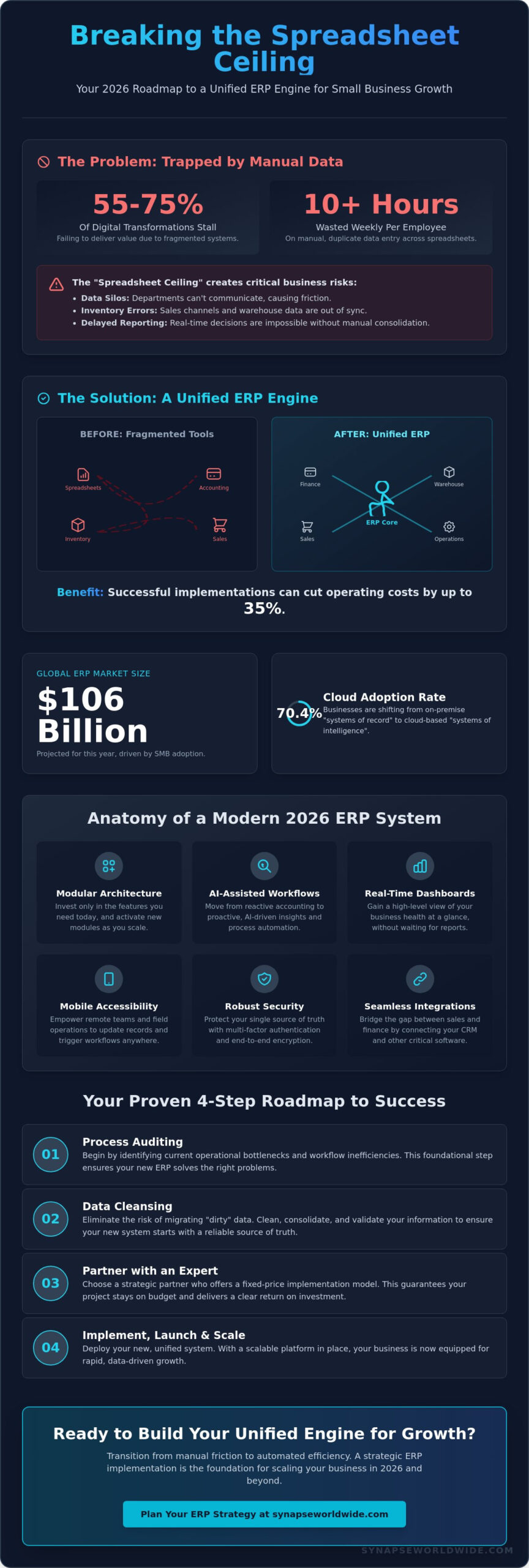
 

ERP for Small Business: The 2026 Strategic Guide to Choosing Scalable Solutions

ERP for Small Business: The 2026 Strategic Guide to Choosing Scalable Solutions

Why do 55% to 75% of digital transformations stall before they deliver value, while others manage to cut operating costs by 35% almost overnight? The difference lies in moving beyond basic software to a strategic erp for small business that acts as a unified engine for growth. If you’re currently managing inventory and cash flow through a fragmented web of spreadsheets, you already know the friction of manual data entry. It’s a bottleneck that limits your vision and stalls your momentum.

It’s natural to feel concerned about high implementation costs or the risk of project failure. You want a single source of truth that simplifies your operations rather than adding more complexity. This guide promises to show you how to transition to a scalable platform that automates your workflows and provides real-time visibility into every corner of your company. We’ll explore the latest 2026 releases from industry leaders like Microsoft and NetSuite, examine how AI-assisted workflows are redefining efficiency, and provide a clear roadmap for choosing a solution that scales alongside your ambitions.

Key Takeaways

  • Break through the “Spreadsheet Ceiling” by shifting from manual data entry to a unified architecture that supports rapid, data-driven decision making.
  • Learn how a modular erp for small business provides a customizable dashboard for real-time analytics without the burden of paying for unnecessary features.
  • Compare the scalability of major ERP players against custom integrated solutions that leverage middleware to bridge the gap between sales and finance.
  • Follow a proven 2026 roadmap that prioritizes process auditing and data cleansing to eliminate the risk of migrating “dirty” data into your new system.
  • See why a fixed-price implementation model from a strategic partner ensures your digital transformation stays on budget and delivers a clear return on investment.

The Spreadsheet Ceiling: Why Your Business Needs an ERP in 2026

Growth follows a predictable path until it hits a hard limit. We call this the “Spreadsheet Ceiling.” It’s the moment when your manual data management stops being a cost-saving measure and starts stunting your revenue. For a modern organization, Enterprise resource planning (ERP) represents a transition from fragmented tools to a unified data architecture. It’s not just a software upgrade; it’s a foundational change in how your business breathes. By consolidating every department into a single digital nervous system, you move away from the chaos of disconnected files.

In 2026, an erp for small business is no longer a luxury reserved for the enterprise tier. The global market for these systems is projected to reach $106 billion this year, driven by a fundamental shift in how data is used. While traditional accounting software tells you what happened last month, a modern ERP uses AI-driven insights to tell you what’s likely to happen next week. This shift from reactive accounting to proactive resource planning is what allows small teams to punch above their weight class and compete with much larger entities.

Signs You Have Outgrown Your Accounting Software

If your team spends more time reconciling data than analyzing it, you’ve hit the ceiling. You’ll notice frequent errors in inventory levels because your sales channels aren’t talking to your warehouse. Real-time financial reporting becomes impossible without hours of manual consolidation in Excel. Industry data suggests that team members in growing companies often waste over 10 hours every week on duplicate data entry. These aren’t just inconveniences. They’re direct drains on your profitability and primary indicators that your current infrastructure is failing to support your scale.

The Core Business Value of Centralised Data

Centralization is the antidote to departmental silos. When sales, warehouse, and finance operate from a single source of truth, the friction that slows down your operations disappears. This connectivity directly improves the customer experience through faster order processing and pinpoint-accurate shipping updates. Most importantly, a centralized system creates the essential foundation for business process automation. By removing the human element from repetitive tasks, you reduce error rates and free your staff for high-value strategic work that actually moves the needle.

The 2026 landscape demands a “system of intelligence” rather than just a “system of record.” With 70.4% of businesses now adopting cloud-based ERP solutions, the standard for operational speed has increased. If you’re still relying on manual updates, you aren’t just moving slower; you’re operating with a significant informational disadvantage. Transitioning to an integrated ecosystem ensures that every decision you make is backed by real-time data rather than historical guesswork.

Essential Features of a Modern SMB ERP System

The architecture of a modern erp for small business has evolved from a rigid, all-or-nothing software package into a flexible, modular ecosystem. This shift is critical for growing companies because it allows you to invest only in the specific functionalities you need today, while retaining the ability to activate new modules as your operations expand. According to a leading industry perspective on ERP, the primary value of these systems lies in their ability to scale without requiring a total infrastructure overhaul. You might start with core finance and inventory, then layer on advanced logistics or human resources as your headcount increases.

Visibility is the cornerstone of effective leadership. Modern systems prioritize real-time analytics and customizable dashboards that provide a high-level view of your business health at a glance. You shouldn’t have to wait for end-of-month reports to understand your cash flow or inventory turnover. This data must be accessible anywhere; mobile accessibility is now a standard requirement for remote teams and field operations. Whether your staff is in a warehouse or on a client site, they need the ability to update records and trigger workflows instantly. Protecting this data is equally vital. Robust security protocols, including multi-factor authentication and end-to-end encryption, are non-negotiable in an environment where digital threats are increasingly sophisticated.

CRM and Sales Management Integration

Revenue growth depends on how well you manage your pipeline. Implementing website CRM integration is often the first strategic step toward full ERP success. By connecting your sales efforts directly to your back-office systems, you can track the entire customer journey from the initial lead generation to the final invoice. This connectivity allows for automated follow-ups and personalized marketing, ensuring that no revenue opportunities are missed due to human oversight. If you are looking to bridge these gaps, our team specializes in creating seamless ERP solutions that align your sales and operations.

Inventory and Supply Chain Optimisation

For businesses selling across multiple platforms, manual inventory tracking is a recipe for disaster. A modern ERP provides multi-channel inventory sync, ensuring that your stock levels are accurate across your website, Amazon, and eBay simultaneously. Automated reorder points prevent the dual risks of stockouts and overstocking, which directly preserves your working capital. Integrated supplier management modules also allow you to track performance and lead times, giving you the leverage needed to optimize your supply chain and maintain consistent fulfillment standards.

ERP for Small Business: The 2026 Strategic Guide to Choosing Scalable Solutions

Comparing ERP Solutions: Off-the-Shelf vs. Custom Integrated

Selecting an erp for small business requires a cold-eyed analysis of your long-term operational costs. On one side, industry giants like Microsoft Dynamics 365 and Sage Intacct offer a sense of security and a vast array of features. These platforms are designed to be comprehensive. However, that comprehensiveness often translates into complexity that a smaller team simply doesn’t need. When you evaluate the total cost of ownership (TCO) over a five-year period, the initial appeal of a standard subscription can fade. Licensing fees often increase as you add users or modules, and the cost of forcing the software to fit your specific niche can become a significant financial burden.

Alternatively, the concept of “Custom Integrated Solutions” has gained massive traction in 2026. This approach uses robust APIs and middleware to connect individual, high-performing tools into a unified ecosystem. It allows you to build a system that is as flexible as your business model. If you pivot your strategy, you aren’t fighting against the rigid logic of a legacy platform. Instead, you’re adjusting a modular architecture that was designed to evolve. This path ensures your technology stack remains an asset rather than a constraint as you reach new levels of success.

The Pitfalls of Rigid ‘Big Name’ ERPs

The most common mistake growing companies make is forcing their unique business processes into a software’s pre-set mould. Standardized ERPs are built for the “average” company, but your competitive advantage usually lies in what makes you different. When you adopt a rigid system, you often end up paying high licensing fees for a suite of features your team will never touch. Additionally, finding specialized support for niche industry requirements within a massive ecosystem can be both difficult and expensive. You shouldn’t have to change how you win just to satisfy a software’s constraints.

The Strategic Advantage of Customised Architecture

A customized architecture acts as a digital mirror of your existing successful workflows. It doesn’t ask you to change; it asks how it can help you move faster. One of the most significant benefits is the ability to connect your ecommerce website development directly to your back-office operations. This ensures that every online sale triggers the correct inventory, shipping, and accounting actions without human intervention. By avoiding the bloat of “per-user” licensing models, you can achieve lower long-term costs while maintaining a system that feels like it was built specifically for your brand’s future.

The 2026 Roadmap to a Successful ERP Implementation

Success in deploying an erp for small business depends on the rigor of your preparation rather than the price of your subscription. Verified data indicates that 55% to 75% of ERP projects fail to meet their key performance indicators, often due to poor planning or technical misalignment. To avoid becoming a statistic, you must treat the implementation as a strategic overhaul rather than a simple software installation. This begins with a deep discovery phase where you audit existing processes to identify exactly where your current bottlenecks reside. You can’t automate a broken process; you have to fix the workflow first.

Data cleansing is the most overlooked step in this journey. Migrating “dirty” data, such as duplicate customer records or outdated inventory counts, into a new system ensures only one thing: you’ll make mistakes faster than before. Your team must scrub every record to ensure your new “single source of truth” is actually truthful. Once the data is ready, you move into User Acceptance Testing (UAT). This phase allows your staff to stress-test the system in a sandbox environment, ensuring the workflows actually solve their daily challenges before a full rollout. Post-launch, the focus shifts to ongoing training and technical support to ensure the platform remains a high-performing asset.

Phase 1: Process Mapping and Requirements Gathering

Your digital architecture must be built around your people. Involving department heads early ensures the system addresses real-world friction rather than theoretical problems. During this phase, you should define clear KPIs for what success looks like six months after launch, such as achieving the 36% faster decision-making rate seen by other successful ERP adopters. Consulting with experts in custom software development at this stage is vital for assessing technical feasibility and ensuring your vision is achievable within your budget.

Phase 2: Integration and Automation Setup

The true power of a unified system is unlocked through connectivity. This phase involves developing automated lead management hooks that sync your marketing efforts directly with your sales and finance modules. By establishing robust API connections between your website, CRM, and ERP, you eliminate the need for manual data transfer across platforms. Finally, set up automated reporting triggers so stakeholders receive real-time updates on inventory and cash flow without needing to request them manually. If you’re ready to build a foundation for growth, our team can help you design and deploy these ERP solutions tailored to your unique needs.

Partnering for Success: Why Custom ERP Strategy Wins

The successful deployment of an erp for small business is rarely about the software alone. It’s about the partnership that guides the integration. At Synapse Worldwide, we position ourselves as the visionary architect of your digital infrastructure. We don’t just hand over a login; we build a customized ecosystem that bridges the gap between your high-level business goals and technical execution. One of the most significant barriers to ERP adoption is the fear of budget creep. To eliminate this uncertainty, we utilize a fixed-price project model. This approach ensures your investment is protected and that we remain focused on delivering the promised results without unexpected financial shifts.

As a local Australian partner, we provide national support that understands the specific nuances of the domestic market. This proximity allows for a more collaborative relationship, ensuring your system isn’t just functional, but optimized for your specific operational environment. Your ERP success is inextricably linked to your broader digital presence. Whether it’s feeding data into your e-commerce development or providing the analytical backbone for your SEO strategy, a unified system ensures every part of your business is moving in the same direction.

Beyond Software: A Holistic Growth Partnership

We believe that a truly effective ERP must be a living part of your company. This requires a holistic approach where we manage the intricate details of technical execution while you focus on scaling. Our commitment extends beyond the initial launch. We prioritize system longevity through dedicated maintenance and high-performance hosting, ensuring your infrastructure remains secure and responsive. As your marketing and sales strategies evolve, your ERP should adapt alongside them. This continuous alignment prevents the “Spreadsheet Ceiling” from ever returning, keeping your data fluid and your insights actionable.

Taking the Next Step Toward Efficiency

The journey to operational excellence begins with clarity. Before selecting a platform, it’s essential to conduct a comprehensive technical audit of your current stack. This process uncovers hidden inefficiencies and defines the exact requirements for your future architecture. We invite you to request a strategic consultation to evaluate your current processes and discover how a tailored integration can transform your bottom line. By looking at the big picture, we ensure that your technology stack becomes a catalyst for reaching the next level of business success.

Ready to scale? Consult with our ERP integration experts today and take the first step toward a more efficient, data-driven future.

Building Your Digital Foundation for 2026 and Beyond

The transition from fragmented manual processes to a unified digital architecture is the single most important move your company can make to secure its future. By breaking through the spreadsheet ceiling, you unlock the ability to make decisions with absolute clarity and reclaim hours of productivity every week. Choosing the right erp for small business isn’t just about selecting software; it’s about designing a scalable ecosystem that mirrors your unique workflows and integrates seamlessly with your existing sales and finance operations.

A successful rollout requires more than just a software license. It demands a strategic roadmap that prioritizes data integrity, user adoption, and long-term technical feasibility. With over 20 years of digital infrastructure expertise, Synapse Worldwide specializes in delivering custom CRM and ERP integrations that drive measurable growth. Our fixed-price project model ensures budget certainty while we build the foundation for your next level of success.

Streamline your operations with a strategic ERP solution from Synapse Worldwide.

Your business deserves a system that works as hard as you do. Let’s build the architecture that turns your ambitious vision into a sustainable, high-performing reality.

Frequently Asked Questions

What is the average cost of an ERP for a small business in 2026?

Subscription fees for cloud-based ERP software typically range from $40 to $150 per user per month in 2026. This cost varies depending on the specific modules your business requires and the total number of active users. You must also consider the investment for initial setup and staff training, which are separate from the recurring monthly subscription fees.

How long does a typical ERP implementation take for an SMB?

A typical implementation for a small to medium business takes between three and nine months to complete. This timeline includes the essential phases of process mapping, data cleansing, and user acceptance testing. The total duration depends heavily on the complexity of your current workflows and how many external systems require integration.

Can an ERP system replace my current accounting software like Xero?

An erp for small business can fully replace standalone accounting software like Xero or QuickBooks. While these tools handle basic bookkeeping, an ERP integrates those financial records with inventory, sales, and warehouse management. This creates a single source of truth that eliminates the need for manual data reconciliation between different platforms.

Do I need a dedicated IT department to manage a small business ERP?

You don’t need a dedicated IT department to manage a modern cloud-based system. The software provider or your strategic partner handles all technical maintenance, including security patches and server updates. This makes high-level enterprise technology accessible to smaller teams without the overhead of maintaining physical hardware or local servers.

What is the difference between a Cloud ERP and an On-Premise ERP?

Cloud ERPs are hosted remotely and accessed via the web, whereas on-premise systems are installed on your company’s local servers. Cloud adoption has reached 70.4% because it offers superior scalability and lower upfront capital requirements. On-premise solutions often involve significant hardware costs and require more hands-on technical management from your internal staff.

How does ERP integration improve my website’s e-commerce performance?

Integration boosts e-commerce performance by automating the flow of data between your online storefront and your back-office operations. It ensures that stock levels are updated instantly across all channels, which prevents the risk of overselling. This connectivity also allows for faster order fulfillment and more accurate customer communication throughout the shipping process.

What are the biggest risks of ERP implementation and how can I avoid them?

The primary risks are poor data migration and low employee engagement, which lead to many projects failing to meet their goals. You can avoid these issues by conducting a thorough audit of your current data and ensuring it’s cleaned before the transition. Providing comprehensive training for your team ensures they understand how to use the system to improve their daily efficiency.

Is a custom ERP solution better than an off-the-shelf system for a growing company?

A custom erp for small business is generally superior for companies with specialized workflows that don’t fit into a standard software mould. Off-the-shelf systems often require you to change your successful business processes to match the software’s limitations. Custom architecture allows you to build a system that mirrors your unique operations while avoiding the high licensing fees associated with big-name brands.


Synapse Worldwide Services: A Strategic Guide to Bespoke Digital Solutions

Synapse Worldwide Services: A Strategic Guide to Bespoke Digital Solutions

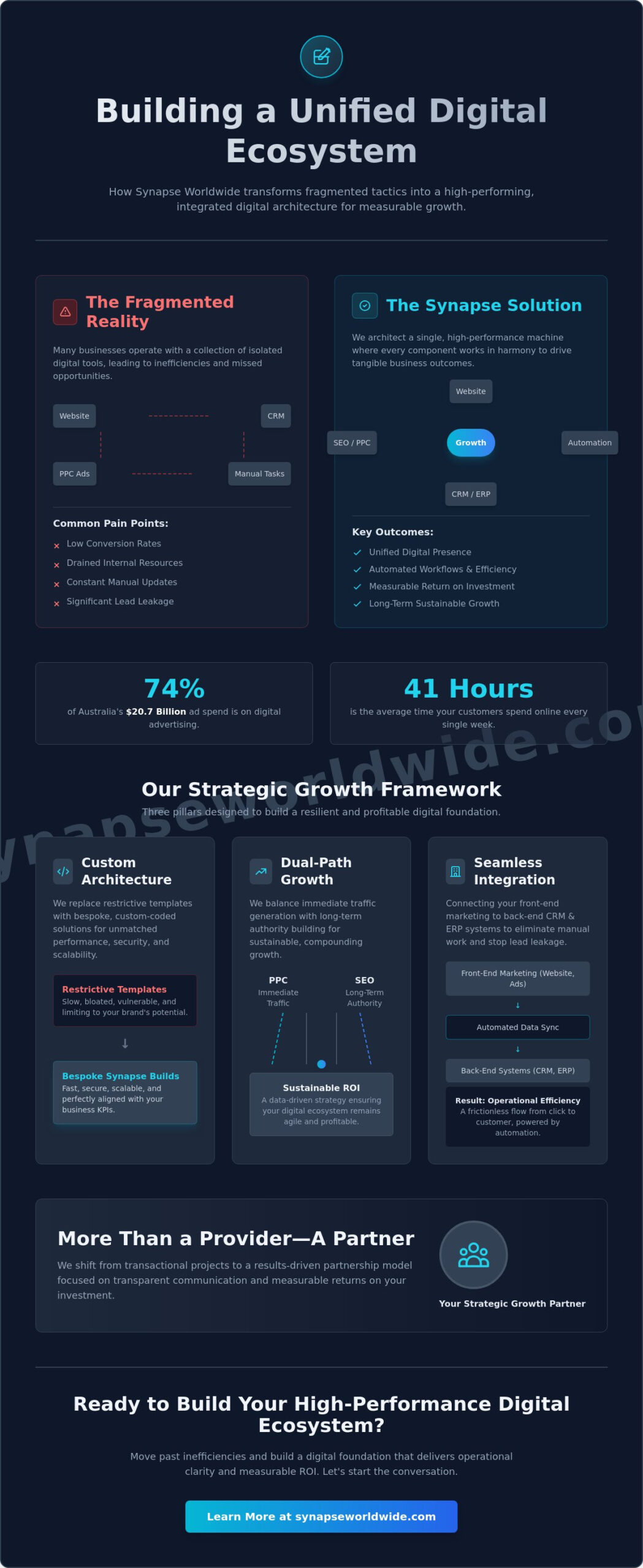
Did you know that digital advertising now accounts for 74% of the $20.7 billion total ad spend in Australia? This massive investment reflects a reality where your customers spend an average of 41 hours every week online. Yet, many organizations still struggle with a fragmented digital presence and manual processes that drain internal resources. Synapse worldwide services bridge this gap by transforming isolated tactics into a unified, high-performing digital architecture. We believe a website is only as strong as the integrated ecosystem supporting it.

You probably recognize the frustration of seeing low conversion rates despite a consistent marketing budget. It’s common to feel overwhelmed by the need for constant manual updates across disconnected platforms. This guide promises to show you how to move past these inefficiencies to build a digital ecosystem that drives measurable ROI and operational clarity. We’ll explore how integrating custom web design, CRM solutions, and precision SEO creates a seamless, automated path toward sustainable business growth and long-term success.

Key Takeaways

  • Replace restrictive templates with bespoke, custom-coded architectures designed to optimize every stage of the user journey.
  • Learn how synapse worldwide services unify your digital presence by seamlessly connecting front-end marketing to back-end CRM and ERP systems.
  • Adopt a dual-path growth strategy that balances immediate traffic from PPC with the sustainable, long-term authority of technical SEO.
  • Automate manual workflows and eliminate lead leakage through strategic business process integrations that prioritize operational efficiency.
  • Shift from transactional projects to a results-driven partnership model focused on transparent communication and measurable investment returns.

Defining the Synapse Worldwide Service Ecosystem

Many businesses treat digital growth as a series of isolated experiments. They buy a website here, run an ad campaign there, and hope the pieces eventually fit together. Synapse worldwide services operate on a fundamentally different premise. We view your digital presence as a living ecosystem where web design, SEO, and backend automation function as a single, high-performance machine. This holistic approach ensures that every dollar invested in digital marketing translates into a tangible business outcome rather than just a vanity metric.

Our philosophy centers on strategic architecture. We’ve moved beyond the era of generic, off-the-shelf templates that restrict your brand’s potential and compromise security. Instead, we prioritize custom-coded solutions. This bespoke methodology allows us to turn clicks into customers by removing the technical friction that often plagues standardized platforms. While our roots are firmly planted in the Australian market, we maintain international standards of delivery. This ensures our clients can compete effectively on a global stage while benefiting from local expertise.

Custom Digital Architecture

A website shouldn’t just look good; it has to perform under pressure. Custom builds offer a level of security and scalability that templates simply can’t match. By writing clean, purposeful code, we eliminate the bloat that slows down site speed and creates unnecessary vulnerabilities. In 2026, the stakes for web design and branding alignment are higher than ever. Your technical infrastructure must reflect your brand’s maturity, providing a stable foundation that adapts as your user behaviors shift. We tailor every technical solution to your specific KPIs, ensuring the architecture supports your unique operational flow.

Strategic Growth Framework

Success isn’t accidental. It’s the result of aligning digital assets with clear, long-term business objectives. Synapse worldwide services utilize data-driven insights to move beyond guesswork. This is particularly vital when formulating a digital marketing strategy for SMBs, where resources must be allocated with precision. We don’t just act as a service provider; we step in as a strategic growth partner. This means we’re constantly analyzing performance data to refine your trajectory. This ensures your digital ecosystem remains agile and profitable in an increasingly competitive landscape.

High-Performance Web and Ecommerce Development

A website shouldn’t just exist as a digital brochure. In an era where Australians spend an average of 41 hours per week online, your digital presence must function as a high-performance engine for conversion. Synapse worldwide services focus on engineering web applications that solve specific operational challenges while providing a frictionless user journey. We don’t just build sites; we architect environments where UI/UX design directly influences your bottom line. By integrating secure payment gateways and real-time inventory management, we ensure your technical infrastructure is robust enough to handle the complexities of modern trade.

Efficiency at this level requires more than just a pretty interface. Business process automation is the invisible force that powers our most successful builds. When your website automatically syncs with your internal systems, you eliminate the manual errors that stall growth. This mobile-first, automation-heavy approach ensures that whether a customer finds you through a search engine or a social media ad, their experience is fast, secure, and intuitive.

Bespoke Web Design

Templates often act as a ceiling for growing brands, limiting both aesthetic expression and technical capability. We move beyond these constraints to create unique brand identities that are search engine ready from day one. Our focus remains on the critical pillars of site speed, accessibility, and clean code architecture. Bespoke web design is the strategic process of building a unique, high-performance digital foundation that reflects a brand’s specific identity while outperforming standardized competitors in speed, security, and search engine visibility. This level of customization ensures your site can scale as your business evolves.

Scalable Ecommerce Solutions

Modern online stores must manage high volume and complex product catalogues without sacrificing performance. Our ecommerce development includes sophisticated features like multi-currency support, custom checkout flows, and direct ERP syncing. We’re looking ahead to the 2026 landscape, where headless commerce options allow for even greater flexibility in how you present your products across different devices. If you’re ready to transform your online store into a scalable asset, you can explore our custom development solutions to see how we bridge the gap between complex backend operations and elegant frontend experiences. This ensures that as your traffic grows, your infrastructure remains stable and profitable.

Synapse Worldwide Services: A Strategic Guide to Bespoke Digital Solutions

Sustainable Growth through SEO and PPC Management

Traffic is the lifeblood of any digital architecture. While the previous sections detailed how we build high-performance platforms, synapse worldwide services ensure those platforms are visible to the right audience at the exact moment of intent. We employ a dual-path approach to growth. This strategy balances the immediate visibility of paid campaigns with the enduring authority of organic search. Understanding the strategic nuance between SEO and PPC Management allows us to allocate your budget with clinical precision. We ensure you don’t overspend on temporary clicks while ignoring the long-term equity found in organic rankings.

The Australian digital market is highly competitive. With digital advertising accounting for 74% of the total $20.7 billion ad spend in the country, standing out requires more than just participation. It requires a sophisticated understanding of how search engines and social platforms interact to drive brand discovery. We monitor algorithm shifts continuously, adjusting your strategy to maintain a competitive edge as the digital environment matures.

Organic Search Visibility (SEO)

Search engines are undergoing a fundamental transformation. With the rise of AI overviews and zero-click searches in 2026, appearing at the top of a list is no longer sufficient. Your brand must be the authoritative source that AI tools cite. Our SEO framework addresses this by focusing on technical excellence and content relevance. We build industry leadership by creating high-quality assets that satisfy both complex human intent and evolving algorithmic requirements. This future-proofing ensures your visibility remains stable even as search platforms shift their primary delivery models.

Targeted Paid Search (PPC)

Paid search offers a different, immediate advantage. It provides instant access to high-intent users who are ready to convert. Our PPC management moves beyond vanity metrics like impressions to focus strictly on ROI and lead generation. We integrate these efforts with a sophisticated b2b social media marketing strategy to capture prospects at every stage of the sales funnel. Through rigorous A/B testing and landing page optimization, we refine every touchpoint to maximize conversion. This ensures that every dollar spent on Google Ads or social platforms is a calculated investment in your company’s measurable growth.

Business Process Automation: CRM and ERP Integration

A sophisticated digital presence creates demand, but operational efficiency determines whether you can fulfill it profitably. Many Australian businesses suffer from a “leaky bucket” syndrome. This happens when high-quality leads generated by SEO or PPC are lost due to disconnected internal systems. Synapse worldwide services resolve this friction by bridging the gap between front-end marketing and back-end operations. By implementing custom CRM and ERP integrations, we ensure that every customer interaction is captured, tracked, and utilized to drive business intelligence. This connectivity transforms your website from a simple lead generator into a fully integrated business tool.

Operational silos are the enemy of scalability. When your sales data doesn’t talk to your inventory management, or your marketing team can’t see customer lifetime value, you’re making decisions in the dark. ERP solutions centralize these functions, providing a unified view of finance, sales, and logistics. This integration significantly reduces the time spent on cross-referencing spreadsheets and manual reporting. The result is a sharper, more agile organization that responds to market changes with confidence. By removing these technical barriers, you create a foundation for sustainable, long-term growth.

Streamlining Operations

Manual data entry is a significant bottleneck that introduces human error and slows down growth. We eliminate these hurdles through seamless API connections that allow different software platforms to communicate in real-time. While generic third-party plugins might offer a quick fix, they often lack the security and specific tailoring required for complex business models. Our custom automation workflows are built to match your exact operational needs. This ensures your customer follow-up sequences are as unique as your brand. By utilizing synapse worldwide services for automation, you ensure that your technical debt remains low while your productivity stays high.

Data-Driven Decision Making

Integrated data provides a single source of truth for your entire organization. We create unified dashboards that offer real-time tracking of business performance. These tools allow you to see exactly which marketing channels are driving the highest lifetime value. This integrated approach makes it possible to forecast growth with accuracy and identify operational bottlenecks before they become critical issues. We also prioritize data security and privacy compliance, ensuring that your customer information is protected across every system in your ecosystem. This level of oversight turns raw data into a strategic asset.

If your current systems feel disconnected, you can consult with our integration experts to build a more efficient, automated future for your business.

The Partnership Model: Implementation and ROI

The transition from a visionary strategy to a live digital ecosystem requires more than technical skill. It demands a disciplined partnership. At the core of synapse worldwide services is a structured implementation process that moves seamlessly from project discovery to final deployment. We don’t believe in “set and forget” solutions. Instead, we act as a proactive project management partner, ensuring that every milestone is met with transparency and precision. This approach eliminates the ambiguity that often stalls complex digital transformations, providing you with a clear roadmap toward your objectives.

We measure our success through the lens of your revenue growth. While technical metrics like site speed and search rankings are vital indicators, the ultimate validation of our work is the impact on your bottom line. This commitment to ROI is why we prioritize evidence-based strategies over speculative tactics. We maintain a long-term perspective, offering the technical maintenance and support necessary to ensure your systems remain secure and high-performing as your business scales. This ensures that your initial investment continues to yield returns long after the initial launch phase is complete.

Fixed-Price vs. Retainer Models

Financial predictability is essential for Australian enterprises managing complex budgets. We offer two primary engagement structures to suit different business needs. Fixed-price models are ideal for defined project development, such as a custom web build or a specific ecommerce integration. This model provides a clear scope and a set fee, allowing for precise capital allocation. Conversely, monthly retainers are the most effective choice for ongoing digital marketing, social media management, and SEO. Retainers allow for the continuous optimization and agility required to stay ahead of market shifts and algorithm updates. Choosing the right model depends on whether you’re building a new asset or accelerating the growth of an existing one.

Support and Maintenance Subscriptions

A digital ecosystem is only as valuable as its reliability. Annual web hosting and maintenance subscriptions are a necessity, not an option, for businesses that prioritize security and user trust. These subscriptions cover the essential “invisible work” of keeping software updated, patches applied, and servers optimized. We also provide ad-hoc technical consulting to help you navigate new challenges as your operational needs evolve. Proactive maintenance is the most effective way to prevent the costly downtime that results from neglected system updates or security vulnerabilities. By investing in consistent support, you ensure your digital architecture remains a stable foundation for your daily operations.

Architecting Your Digital Future

Digital success in 2026 isn’t built on isolated tactics. It’s the result of a cohesive, high-performance architecture that prioritizes conversion and operational efficiency. By integrating custom web development with automated CRM and ERP systems, you eliminate the manual friction that stalls growth. Synapse worldwide services provide the strategic depth needed to transform your digital presence into a scalable business asset.

With over 20 years of expertise and more than 11,500 successfully managed deliverables, we specialize in the complex e-business solutions that drive measurable ROI. Since 2005, we’ve helped Australian enterprises move beyond generic templates to embrace bespoke digital ecosystems. It’s time to stop managing disconnected platforms and start leading a unified growth engine.

If you’re ready to reach the next level of operational maturity, you can book a discovery meeting to discuss your custom project today. Let’s build a digital foundation that supports your most ambitious business goals.

Frequently Asked Questions

What industries do Synapse Worldwide services cater to?

We provide strategic solutions for a diverse range of sectors, with a particular focus on B2B enterprises, complex ecommerce operations, and service-based businesses. Our expertise is most effective for organizations that require high-level data integration and custom digital workflows. Whether you’re in manufacturing, professional services, or retail, we tailor our technical architecture to meet your specific industry challenges and growth objectives.

How does Synapse Worldwide handle custom CRM and ERP integrations?

Our process begins with a deep-dive discovery phase to map your existing operational workflows and identify data silos. We then develop custom API connections that bridge the gap between your front-end marketing platforms and back-end management systems. This ensures that lead data, inventory levels, and financial records sync in real-time. This eliminates the need for manual data entry and provides a single source of truth for your business intelligence.

What is the difference between your fixed-price and hourly consulting fees?

Fixed-price models are typically utilized for projects with a clearly defined scope and set deliverables, such as a custom web design or a new ecommerce build. This provides budget certainty for your capital investment. Hourly consulting or monthly retainers are better suited for ongoing synapse worldwide services like SEO and PPC management. These models allow for the strategic flexibility needed to respond to changing market data and algorithm updates.

Do you provide ongoing support after a website or application launch?

Yes, we offer comprehensive support and maintenance subscriptions designed to protect your digital investment. These plans include essential security patches, server optimization, and technical consulting to help your systems evolve alongside your business. We believe in building long-term partnerships. Our team remains available to ensure your platform stays fast, secure, and aligned with the latest web standards long after the initial deployment.

How long does a typical custom web development project take?

Timelines for bespoke projects vary depending on the technical complexity, but most custom builds are completed within 8 to 16 weeks. This duration accounts for the entire lifecycle, including strategic planning, UI/UX design, custom coding, and rigorous quality assurance testing. We provide a detailed project roadmap during the discovery phase so you can coordinate the launch with your broader marketing and operational schedules.

Can you help with digital marketing if my website was built by another agency?

We frequently take over the management of existing digital assets to drive better performance and ROI. Synapse worldwide services include a comprehensive technical audit of your current site to ensure it can support advanced SEO and PPC strategies. If the underlying foundation is stable, we focus on optimizing your conversion paths and expanding your search visibility. If technical debt is hindering your growth, we’ll provide a clear plan to resolve those issues first.

What makes Synapse Worldwide different from other Australian digital agencies?

Our differentiator is the depth of our technical architecture and our 20-year history of managing complex e-business projects. Unlike agencies that rely on restrictive templates, we build custom-coded solutions that offer superior security and scalability. We act as both high-level strategic consultants and practical execution partners. This dual role ensures that your digital strategy is visionary yet grounded in technical reality.

How do you ensure the security of custom-built applications?

Security is a foundational element of our development process. We utilize clean coding practices and avoid the bloated third-party plugins that often create vulnerabilities in standardized platforms. Every application undergoes thorough testing and utilizes encrypted data transfers to protect sensitive information. By building bespoke systems, we significantly reduce your attack surface and ensure your data remains under your direct control.


Website CRM Integration: The Strategic Guide to Seamless Business Growth in 2026

Website CRM Integration: The Strategic Guide to Seamless Business Growth in 2026

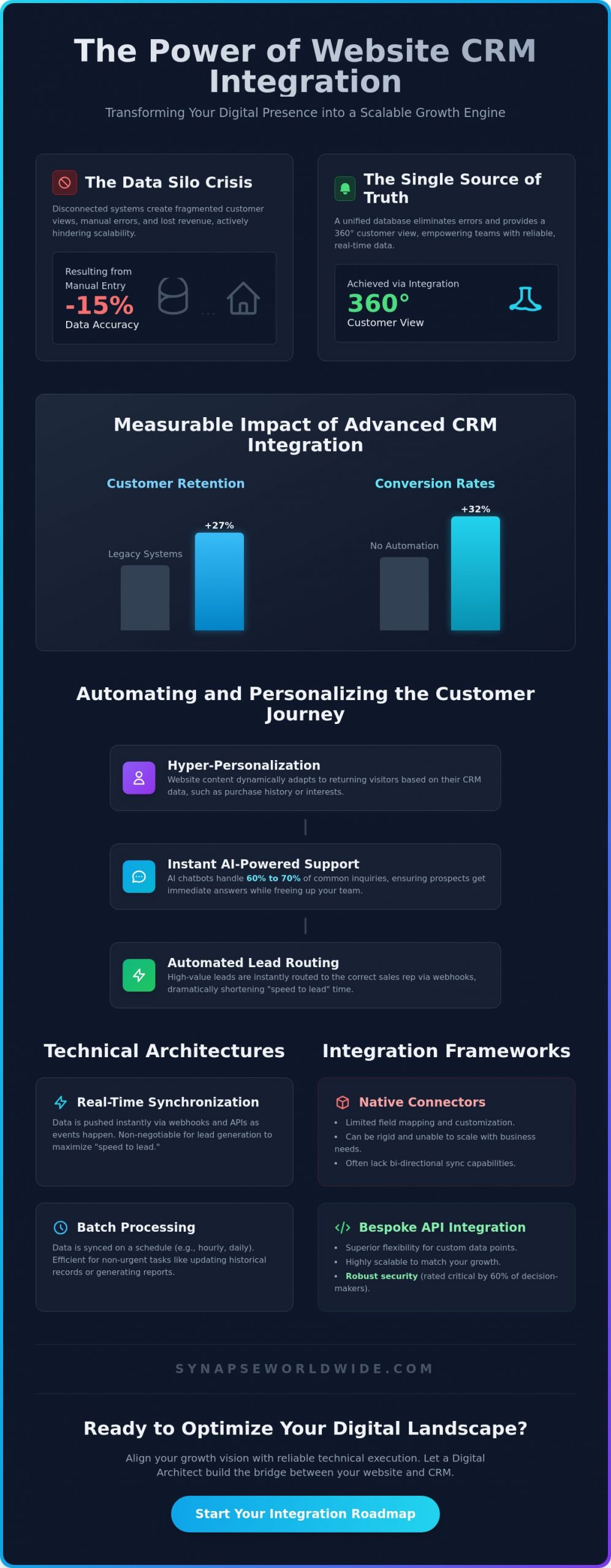
Companies leveraging advanced CRM features report 27% higher customer retention rates and 32% improved conversion rates compared to those relying on legacy systems. You likely recognize the drain of manual lead entry errors and the friction caused by disconnected data silos. It’s difficult to scale when you lack visibility into the customer journey. Strategic website crm integration is no longer an optional upgrade. It is the architectural foundation of a digital-first business that ensures every interaction counts.

You’re right to feel that your current setup should be doing more to support your growth. This guide will show you how to transform your website from a simple brochure into a powerful data engine through strategic CRM integration. We’ll explore the steps to automate your lead management and build a scalable digital infrastructure that serves as a single source of truth for your customer data. We’ll cover everything from meeting the January 2026 CCPA regulations regarding neural data to leveraging AI chatbots that handle 70% of common inquiries. It’s time to move beyond fragmented processes and reach the next level of business success.

Key Takeaways

  • Transform your digital presence by bridging the gap between front-end user experience and back-end business operations to eliminate costly data silos.
  • Determine whether real-time synchronization or batch processing is the most effective technical architecture for your unique website crm integration requirements.
  • Compare the limitations of native, out-of-the-box connectors against the high-performance benefits of bespoke integration frameworks designed for scalability.
  • Follow a strategic roadmap to audit your current digital assets and define precise data objectives for a seamless, automated workflow.
  • Leverage the expertise of a Digital Architect to align your high-level growth vision with reliable, hands-on technical execution.

Beyond the Form: Why Website CRM Integration is a Strategic Growth Engine

Website CRM integration is the vital bridge between your digital user experience and your internal business operations. Many organizations treat their website as a standalone entity, yet this creates a “Data Silo Crisis” that actively hinders scalability. In 2026, disconnected systems lead to fragmented customer identities and lost revenue. By unifying these platforms, you achieve a 360-degree view of your customer, ensuring that every touchpoint informs the next. Website CRM integration is a strategic business architecture that powers growth, not merely a technical synchronization of data fields.

High-growth companies use their digital presence to feed a robust Customer Relationship Management (CRM) system. This connection transforms passive visitors into actionable data points. It ensures that the marketing team understands exactly which campaigns drive the highest lifetime value, rather than just tracking clicks.

The Single Source of Truth

A unified database is the only way to generate reliable reporting for your leadership team. When your website and CRM exist in isolation, manual data entry errors become inevitable. These errors often lead to a 15% decrease in data accuracy across the organization. Eliminating these manual steps ensures your sales team works with high-quality information. This data consistency builds deep trust. When sales reps know that lead data is current and accurate, they pursue opportunities with greater confidence. Companies utilizing advanced CRM features already report 27% higher customer retention rates because they have the “single source of truth” required to serve clients effectively.

Enhancing the Customer Journey

Strategic integration allows you to personalize the web experience based on existing CRM data. If a returning client visits your site, the content can shift to reflect their specific interests or purchase history. This level of hyper-personalization is now a 2026 standard for competitive markets. Automated lead routing also plays a critical role by shortening response times. By implementing automated lead management, businesses can improve conversion rates by up to 32%. AI chatbots can now handle 60% to 70% of common inquiries instantly. This ensures your prospects never feel ignored while your team focuses on high-value strategic tasks.

Technical Architectures: How Your Website and CRM Communicate

The mechanism of data synchronization in 2026 relies on precision and speed. A successful website crm integration functions as the nervous system of your business, ensuring that every digital interaction reflects accurately in your central database. Understanding the opportunities and challenges of a CRM architecture is essential before committing to a technical path. You must decide between real-time synchronization and batch processing based on your operational needs. Real-time sync is non-negotiable for lead generation, as “speed to lead” remains a primary driver of conversion. Batch processing, conversely, is often more efficient for non-urgent tasks like updating historical purchase records or generating weekly reports.

Webhooks play a critical role in this ecosystem by triggering instant sales notifications. When a high-value prospect completes a specific action on your site, a webhook pushes that data to your CRM immediately. This eliminates the lag time associated with traditional polling methods. To maintain a truly cohesive digital landscape, your integration must be bi-directional. This ensures that if a sales rep updates a lead’s status in the CRM, the website experience can adapt accordingly, perhaps by showing the user a “client-only” portal or specific onboarding content. If you’re unsure which architecture fits your growth goals, consulting with a specialist in CRM integration can clarify your roadmap.

API-First Integration Strategies

Modern architectures favor RESTful APIs for their superior flexibility and scalability. Unlike generic plugins that offer limited field mapping, custom API development allows you to sync bespoke data points unique to your business model. Security is the highest priority here. With 60% of sales and marketing decision-makers rating security as critical, you must secure your API endpoints with robust encryption and authentication protocols. This protects sensitive customer data and ensures compliance with 2026 privacy standards. A custom-built API doesn’t just move data; it protects your brand’s reputation.

Middleware and Connector Tools

Connector tools like Zapier or Make serve as useful bridges for simple, linear tasks. They’re excellent for startups using entry-level tiers of HubSpot or Zoho. However, these third-party connectors often reveal significant limitations as your business scales. They can struggle with complex logic, high data volumes, or deep bi-directional syncing. A cost-benefit analysis often shows that while middleware has lower upfront costs, the long-term subscription fees and potential for “integration debt” make direct, bespoke integration a more stable investment for established enterprises. Choosing the right framework now prevents technical bottlenecks during your next growth phase.

Website CRM Integration: The Strategic Guide to Seamless Business Growth in 2026

Bespoke vs. Native Integration: Selecting the Right Framework

Choosing between a native connector and a bespoke solution is the difference between a temporary patch and a permanent foundation. Native integrations, such as the standard plugins offered by platforms like Zoho or Pipedrive, provide a fast entry point for businesses with basic requirements. They’re often “one-click” setups that handle simple contact forms effectively. However, these out-of-the-box solutions frequently hit a “breaking point” as your data complexity grows. Bespoke website crm integration is the hallmark of a high-performance digital landscape because it prioritizes your specific business logic over generic templates.

Custom frameworks offer superior scalability and granular security controls. With 60% of decision-makers rating security as their top priority in 2026, the ability to control every data endpoint is a significant competitive advantage. You shouldn’t settle for a system that forces your business processes to fit within the constraints of a plugin’s limited field mapping. A strategic approach ensures that your technical infrastructure supports your growth rather than creating new bottlenecks.

The Limitations of Cookie-Cutter Plugins

Generic plugins often rely on bloated code that can degrade your website’s loading speed. This negative impact on performance can directly hurt your SEO rankings and user experience. These tools also use generic data mapping. If your sales process requires unique business insights or custom field logic, a standard plugin won’t capture that information accurately. There’s also the persistent risk of plugin obsolescence. If a third-party developer stops providing updates, your entire lead pipeline could become a security vulnerability overnight. This creates a fragile digital environment that is difficult to scale with confidence.

The Case for Custom Software Development

Custom solutions allow you to tailor the data flow to match your exact operational requirements. This is especially critical for organizations with complex ERP or CRM needs that require deep synchronization across multiple departments. By investing in custom software development, you ensure your infrastructure is built to scale. You’re not just solving today’s data silos; you’re future-proofing your business for the evolving digital landscape of 2026 and beyond. This approach provides the flexibility to integrate new AI tools or conversational interfaces without rebuilding your entire system from scratch. It positions your brand as a proactive participant in its own growth strategy.

The Strategic Roadmap: Planning a Seamless System Integration

Successful system integration is never an accident. It’s the result of a disciplined, architectural approach to your digital landscape. To begin, you must conduct a comprehensive audit of your current digital assets and data flow. This involves identifying every entry point where a customer interacts with your brand, from landing page forms to e-commerce checkout sequences. Once you’ve mapped these touchpoints, define your objectives with surgical precision. You need to decide exactly which data points must be synced to drive your sales process, whether that’s basic contact info or complex behavioral triggers. Selecting the right website crm integration method depends entirely on your projected growth trajectory over the next three to five years.

Before moving to a full-scale launch, you must develop a robust testing phase. Data integrity is the lifeblood of your sales team. If the synchronization fails or duplicates records, you risk alienating prospects and wasting marketing spend. A phased rollout allows you to monitor performance in a controlled environment and optimize the connection for maximum efficiency. If you’re ready to move from planning to execution, our team can help you build a bespoke CRM integration strategy tailored to your enterprise.

Data Mapping and Field Alignment

Precision in data mapping ensures that your web forms and CRM entries speak the same language. You must identify essential fields like names, emails, and custom lead sources while ensuring format compatibility across both platforms. This is the stage where you clean “dirty data” before it enters your sales ecosystem. Inconsistent entries, such as varying phone number formats or misspelled city names, can disrupt automated workflows. By standardizing these inputs at the point of capture, you maintain a high-quality database that your sales team can actually use for targeted outreach.

Security and Compliance Protocols

Security is no longer just a technical requirement; it’s a legal mandate. As of January 1, 2026, new CCPA regulations have significantly expanded the definition of sensitive personal information to include neural data. Your integration must adhere to these national and global privacy standards to avoid heavy penalties. Implementing SSL/TLS encryption for all data in transit is the baseline. Beyond encryption, you must establish clear user access levels within the CRM to ensure that sensitive information is only available to authorized personnel. Since consumers can now request all personal information collected since January 1, 2022, your system must be capable of retrieving and managing this data efficiently. Protecting your customer’s privacy is the most effective way to build long-term brand trust.

Optimizing Your Digital Landscape with Synapse Worldwide

Synapse Worldwide functions as your Digital Architect, providing the vision and technical discipline required to automate your business at scale. We don’t just connect software; we build integrated ecosystems where your digital presence and operational tools work in perfect harmony. Achieving a seamless website crm integration requires more than a simple technical plugin. It demands a sophisticated understanding of how data flow influences customer retention and conversion rates in the 2026 landscape. Our team bridges the gap between high-level business strategy and practical, hands-on execution.

Starting with a custom web design for small business ensures your site is architected for integration from the very first line of code. This proactive approach prevents the performance lags and security gaps common with generic, cookie-cutter templates. We’re committed to delivering robust, scalable solutions that provide a measurable return on investment for our global partners. Every project we undertake is designed to evolve alongside your business, ensuring your digital infrastructure never becomes a bottleneck during rapid expansion.

Our Bespoke Integration Process

Our process begins with a deep discovery and strategy phase. We align your technical choices with your specific growth goals, ensuring every synchronized data point serves a clear operational purpose. Implementation is handled exclusively by senior developers who understand the nuances of bi-directional data flow and RESTful API security. We don’t believe in “set and forget” solutions that leave your team vulnerable to technical debt. Our team provides ongoing support and maintenance to ensure 100% uptime for your lead capture systems. This reliability is essential, especially as 57% of CRM users now consider their software critical to their daily operations. We ensure your data remains accurate, accessible, and compliant with the latest privacy standards.

Transforming Your Operations Today

Transitioning from manual data entry to automated precision is the fastest way to reclaim your team’s time and energy. By eliminating the friction of disconnected systems, you allow your sales professionals to focus on high-value interactions rather than clerical tasks. Pairing your CRM integration with a broader business process automation strategy amplifies these efficiency gains across every department. This integrated data also fuels advanced digital marketing strategies that drive real results. With a clear, 360-degree view of the customer journey, you can deploy hyper-personalized campaigns that resonate with your audience’s actual behavior. It’s time to stop managing data silos and start leading a data-driven enterprise. Contact our experts today for a strategic system audit to identify the optimization opportunities within your digital landscape and reach the next level of business success.

Architect Your Future for Scalable Growth

Strategic website crm integration serves as the foundation for a business that operates with automated precision. You’ve seen how moving beyond generic plugins allows for a secure, bi-directional flow of data that meets the rigorous 2026 compliance standards. By choosing a bespoke framework, you eliminate the technical debt that often stalls growth during rapid expansion. This transformation ensures your website is no longer a static brochure but a high-performance engine for lead generation and customer retention.

Synapse Worldwide has served as a trusted Digital Architect for global clients since 2005. We specialize in fixed-price project delivery, ensuring your digital transformation remains predictable, transparent, and results-oriented. Our expert team is ready to bridge the gap between your high-level vision and complex technical execution. Book a Strategic Consultation for Your CRM Integration today to audit your systems and identify your next level of growth. We’re committed to building a robust partnership that turns your digital landscape into a sustainable competitive advantage.

Frequently Asked Questions

What is the primary benefit of website CRM integration?

The primary benefit is the elimination of manual lead entry and the creation of a single source of truth for your customer data. By automating the data flow, you ensure that 100% of leads are captured and routed to the correct sales representative instantly. This visibility allows your team to prioritize high-value prospects and reduces the risk of human error during the lead capture process.

How much does it cost to integrate a website with a CRM in 2026?

CRM software costs vary based on the platform and user count. As of May 2026, HubSpot CRM offers a free tier, while paid plans start at $15 per user per month. Salesforce begins at $25 per user per month, and Zoho CRM offers paid plans starting at $14 per user per month. The cost of the actual website crm integration depends on whether you choose a native connector or a bespoke API solution.

Can I integrate my CRM with a custom-built website?

You can absolutely integrate a CRM with a custom-built website using RESTful APIs or webhooks. Custom sites often provide a superior foundation for website crm integration because they aren’t hindered by the bloated code found in generic templates. This flexibility allows you to sync unique data points that are specific to your business logic, ensuring your digital architecture remains fully scalable as you grow.

How long does a typical CRM integration project take?

A professional integration project typically takes between 4 and 12 weeks to complete. This timeline includes the initial strategic audit, data mapping, technical development, and a rigorous testing phase. While simple native connections might be established faster, bespoke enterprise solutions require a more deliberate approach to ensure data integrity and full compliance with the latest 2026 privacy regulations.

Is my customer data safe during the integration process?

Your data is secure when you implement enterprise-grade encryption and strict security protocols. We conduct risk assessments before sharing any personal information, as required by the 2026 CCPA updates. Since 60% of decision-makers now rank security as their top priority, we focus on securing API endpoints and implementing SSL/TLS encryption for all data in transit to protect your brand’s reputation and customer trust.

Do I need a developer for CRM integration, or can I use a plugin?

Plugins work for basic needs, but a developer is essential for high-performance, bespoke systems. Plugins often create technical debt and can slow down your website’s loading speed. A professional developer ensures a robust, bi-directional sync that handles complex data logic while maintaining 100% uptime. This approach is necessary for businesses that have outgrown the limited field mapping of cookie-cutter tools.

What happens to existing data when I connect my website to a CRM?

Existing data is audited, cleaned, and mapped to ensure compatibility with the new integration framework. We standardize formats to prevent duplicates and “dirty data” from entering your sales ecosystem. This process ensures that your historical records remain intact while new leads flow seamlessly into the correct categories. It’s a critical step for maintaining a reliable record of the entire customer journey.

Which CRM platforms are best for small to medium businesses?

HubSpot, Zoho, and Pipedrive are excellent choices for small to medium businesses in 2026. Pipedrive starts at $14 per user per month, while Zoho CRM offers a free tier for up to 3 users. These platforms provide the essential features needed for business automation without the extreme complexity of high-end enterprise systems. For organizations also managing inventory, finances, and operations, pairing your CRM with a dedicated erp for small business solution can deliver a truly unified operational foundation. They offer a scalable path for organizations looking to reach the next level of success.


B2B Payment Gateway Solutions Australia: The 2026 Strategic Buying Guide

B2B Payment Gateway Solutions Australia: The 2026 Strategic Buying Guide

How much of your 2025 revenue was eroded by the hidden cost of manual bank reconciliation and friction in high-value transfers? For many Australian wholesalers, the answer is often upwards of 3.5% in administrative overhead alone. You likely understand that relying on traditional bank transfers for five-figure orders creates a bottleneck that stifles your scale. Finding the right b2b payment gateway solutions australia is no longer just a technical checkbox; it’s a strategic move to reclaim your team’s time and protect your margins.

In this guide, you’ll discover how to select and integrate the most robust B2B payment gateways to streamline high-value transactions and automate your Australian business operations. We’ll examine the specific technologies that bridge the gap between your digital storefront and your ERP system to ensure every invoice is tracked, paid, and reconciled without human intervention. From reducing transaction fees on A$50,000 orders to implementing seamless PayID and automated credit terms, we’re outlining the exact roadmap to a friction-free financial ecosystem for 2026.

Key Takeaways

  • Understand the shift from traditional bank transfers to real-time digital ecosystems designed specifically for the unique complexities of Australian B2B commerce.
  • Identify critical features of b2b payment gateway solutions australia, including multi-currency support and advanced fraud protocols tailored for high-value transactions.
  • Learn how to evaluate fee structures like interchange-plus versus flat-rate to ensure your payment infrastructure remains cost-effective as your volume scales.
  • Discover the strategic advantages of bespoke API-driven integrations that connect your gateway directly to ERP and CRM systems for automated operational efficiency.
  • Explore a proven methodology for designing robust, scalable payment architectures that transform your e-commerce platform into a powerful engine for business growth.

The Evolution of B2B Payment Gateway Solutions in Australia

The Australian B2B ecosystem has undergone a fundamental transformation since the 2018 launch of the New Payments Platform. For decades, local enterprises relied on manual Electronic Funds Transfer (EFT) and Bulk Electronic Clearing System (BECS) processes that often delayed settlement for up to three business days. By 2026, these legacy methods have become a liability. Modern b2b payment gateway solutions australia now provide the real-time infrastructure necessary to maintain liquidity in a high-velocity market. This shift isn’t merely about speed; it’s about the strategic integration of data and finance.

The landscape shifted dramatically following the implementation of The Evolution of B2B Payment Gateway Solutions in Australia, which introduced real-time clearing and settlement capabilities. For a business managing A$500,000 in monthly payables, the move from T+3 settlement to instantaneous transfers represents a significant boost to working capital. A “set and forget” gateway is no longer sufficient for competitive Australian enterprises. You need a proactive system that optimizes every touchpoint of the transaction lifecycle.

B2B vs. B2C: Why Your Gateway Needs a Different Engine

Retail gateways prioritize speed and high-volume, low-value security. Conversely, b2b payment gateway solutions australia must facilitate high-value transaction limits, often exceeding A$100,000 per single payment, without triggering automated fraud blocks that stall operations. The integration of PayTo has revolutionized this space. It allows businesses to automate recurring agreements and real-time authorisations directly from a client’s bank account. This bespoke logic supports complex checkout requirements, such as tiered wholesale volume discounts and split-payment terms, which standard B2C engines simply can’t process.

The Regulatory Landscape for Australian Payments in 2026

Compliance in the current market requires more than a basic SSL certificate. Australian Treasury guidelines now emphasize digital payment safety through rigorous oversight. Businesses must adhere to the updated PCI-DSS v4.0 standards, which demand continuous monitoring rather than annual snapshots. The adoption of ISO 20022 messaging standards is equally critical. This global standard enables data-rich payments, allowing remittance information to travel with the fund transfer. It reduces manual reconciliation errors by approximately 40% for mid-market firms. Staying compliant ensures your enterprise avoids the heavy penalties associated with the Australian Privacy Act and maintains its reputation as a secure, reliable partner.

Critical Features for High-Volume B2B Payment Gateways

High-volume B2B transactions demand a robust infrastructure that mirrors complex corporate logic. For Australian firms scaling internationally, multi-currency support is a non-negotiable requirement. Your gateway must handle A$ alongside major trading currencies like NZD, SGD, and EUR to mitigate exchange rate volatility. This capability allows you to settle in local currency while presenting costs to your global partners in their own denominations.

Security protocols must also evolve beyond standard consumer-grade protection. Advanced fraud protocols specifically tuned for B2B patterns help identify suspicious bulk orders or unusual shipping redirects that standard filters might miss. By implementing tokenisation, you enable secure, one-click reordering for repeat wholesale clients. This technology stores sensitive data in a secure vault, replacing it with a unique identifier. It removes friction from the procurement process and ensures your business remains PCI compliant without storing raw card data on your servers.

Cash flow management remains a primary concern for local enterprises. Standard T+2 settlements don’t always align with complex corporate accounting cycles. When Evaluating the Top B2B Payment Providers in Australia, look for partners that offer flexible settlement windows. Customising when funds are deposited into your accounts helps you maintain liquidity for payroll and inventory replenishment.

Wholesale Pricing and Credit Management

Modern b2b payment gateway solutions australia must integrate real-time credit checks directly into the payment flow. This prevents over-extension to high-risk accounts before the transaction is even processed. Sophisticated systems manage dynamic pricing tiers based on specific customer login history. If a Tier-1 distributor logs in, they see their bespoke rates immediately. You should also consider automating “Buy Now, Pay Later” (BNPL) options tailored for vendors. This allows you to offer net-30 or net-60 terms while the gateway provider assumes the underlying credit risk, ensuring you receive your A$ payment upfront.

Reporting and Reconciliation Automation

Manual reconciliation is a significant drain on administrative resources. Top-tier gateways generate tax-compliant invoices automatically upon successful authorisation, meeting all Australian Taxation Office (ATO) standards. Real-time data feeds provide instant visibility into accounts receivable, which is vital for maintaining an accurate balance sheet. By using custom metadata fields to track project codes or purchase order numbers, your finance team can reconcile thousands of transactions in minutes. This level of bespoke digital integration transforms the payment gateway from a simple utility into a strategic business asset. Every transaction becomes a data point that fuels your broader growth strategy.

B2B Payment Gateway Solutions Australia: The 2026 Strategic Buying Guide

Evaluating the Top B2B Payment Providers in Australia

Selecting the right b2b payment gateway solutions australia requires a shift from retail-centric thinking to a strategic focus on high-value, high-frequency settlement. While Stripe and Eway dominate the general market with their user-friendly interfaces, B2B specialists often provide deeper integration for complex invoice reconciliation. High-volume users should scrutinize fee structures closely. Flat-rate pricing offers simplicity for smaller firms, but interchange-plus models typically provide better cost-efficiency for enterprises processing over A$250,000 monthly. This granular pricing reveals the actual cost of the card network fee plus the provider’s margin, often saving businesses between 0.2% and 0.5% on total transaction costs.

A robust API isn’t just a technical requirement; it’s the bridge that allows your custom e-commerce environment to communicate with your ERP system for seamless reconciliation. Modern B2B systems must leverage the New Payments Platform (NPP) to facilitate real-time, data-rich transfers that traditional credit card rails cannot match. This infrastructure ensures that large-scale B2B transactions settle within seconds rather than days, significantly improving cash flow for the vendor. Technical support also remains a critical pillar. Relying on a global ticket-based system can lead to costly delays during a checkout failure. Local, Australian-based support teams provide the immediate response necessary for mission-critical infrastructure.

Domestic vs. Global Gateways: Which Fits Your Growth Strategy?

Australian-born gateways like Eway provide superior local support and a deep understanding of the local GST environment. Global giants like Adyen or Airwallex excel for cross-border B2B operations, handling over 150 currencies. However, international transactions often carry hidden costs, including currency conversion margins that can reach 3% above the mid-market rate. Choosing a domestic provider often avoids these “cross-border” surcharges for local trade, keeping your margins intact as you scale within the Australian market.

Security and Uptime: The Non-Negotiables

Reliability is the foundation of any digital architecture. Top-tier Australian providers offer Service Level Agreements (SLAs) guaranteeing 99.99% uptime. Many B2B firms now implement secondary “failover” gateways to prevent revenue loss during rare outages. PCI-DSS Level 1 compliance is the gold standard for Australian B2B gateways, ensuring that sensitive financial data remains encrypted and secure against evolving threats. Without this certification, your business assumes immense liability for every b2b payment gateway solutions australia transaction processed.

Strategic Integration: Connecting Gateways to ERP and CRM Systems

Integration isn’t just a technical convenience; it’s a strategic imperative for high-growth firms. Moving beyond simple, off-the-shelf plugins to bespoke API-driven integrations allows your business to function as a single, cohesive unit. In the Australian B2B landscape, 62% of finance leaders cite manual data reconciliation as their primary operational bottleneck. By adopting the “Digital Architect” approach, you build a scalable payment stack where every transaction informs your broader business intelligence. This methodology ensures your b2b payment gateway solutions australia aren’t just processing tools, but active drivers of efficiency.

Eliminating manual data entry through bidirectional ERP synchronisation transforms your finance department. When your gateway communicates directly with systems like NetSuite, Microsoft Dynamics 365, or SAP, data flows both ways. This ensures that an A$20,000 invoice paid online updates your ledger, tax obligations, and cash flow forecasts instantly. It removes the risk of human error that costs Australian businesses an average of 3% in annual revenue leakage. Your payment stack becomes a robust foundation for global expansion, managing complex multi-entity reporting without additional headcount.

Bridging the Gap Between Sales and Finance

Seamless CRM connectivity directly improves customer lifetime value (CLV) by providing sales teams with real-time financial context. When your gateway integrates with Salesforce or HubSpot, “Paid” statuses update automatically, triggering project kick-offs or shipping workflows. This transparency is vital for managing custom projects that require partial payments or deposit structures. It also ensures inventory levels across multiple B2B sales channels remain accurate to the minute, preventing over-selling and maintaining brand reputation. A unified view of the customer journey allows for more strategic account management and proactive retention efforts.

Custom Middleware vs. Native Integrations

Native gateway apps are often sufficient for smaller operations, but they frequently limit growth as business logic becomes more complex. Custom middleware serves as a sophisticated bridge, allowing for bespoke rules that native apps can’t handle. This approach future-proofs your infrastructure for the next decade of digital commerce. If you decide to pivot your ERP or add new payment methods in 2027, the middleware layer protects your core operations from disruption. It provides the stability required to handle high-volume transactions while maintaining the flexibility to adapt to changing Australian market regulations.

Ready to transform your financial infrastructure with a bespoke integration strategy? Consult with our Digital Architects today to build a scalable payment ecosystem.

Optimising Your B2B Infrastructure with Synapse Worldwide

Synapse Worldwide views payment architecture as the critical backbone of B2B scalability. We don’t just implement software; we design bespoke e-commerce environments where the payment gateway functions as a fully integrated engine within your business. Our methodology follows a “Digital Architect” approach. This ensures every transaction aligns with your broader fiscal strategy and technical requirements. We focus on creating a seamless flow between your storefront, your back-office, and your bank.

Integrating complex ERP systems like NetSuite, SAP, or Microsoft Dynamics with b2b payment gateway solutions australia requires a deep understanding of ledger synchronisation. We specialise in eliminating the 15 to 20 hours per week that Australian finance teams often lose to manual reconciliation. By automating the data path from invoice generation to final settlement, we help businesses accelerate cash flow and reduce the average age of the Debtors Ledger by up to 18%. This focus on ROI ensures that your digital transformation pays for itself through reduced administrative friction and improved liquidity.

Bespoke Solutions for Complex B2B Requirements

Since 2004, we’ve navigated the evolving Australian digital landscape to solve unique payment hurdles that off-the-shelf plugins cannot handle. For example, a recent project for a national medical wholesaler involved building a custom portal that managed complex split-payments across multiple cost centres. This bespoke development eliminated a four-day delay in their standard order processing cycle. Our commitment to fixed-price project delivery and transparent timelines removes the financial uncertainty usually associated with high-level technical shifts. You receive a robust, scalable solution delivered on schedule, backed by over two decades of local expertise.

  • Custom API orchestration for legacy ERP systems
  • Automated surcharging and tax calculation for AU compliance
  • Real-time inventory and payment status synchronisation
  • High-security vaulting for recurring wholesale billing

Ready to Transform Your Payment Operations?

The first step toward a more efficient infrastructure is a Synapse Worldwide digital audit. Our strategic consultants perform a deep dive into your current technical stack to identify bottlenecks in your b2b payment gateway solutions australia setup. We look beyond the surface to find opportunities for automation and cost reduction. We aren’t interested in one-off transactions; we aim for long-term partnerships that support your business as it grows and adapts to new market demands in 2026 and beyond.

Our team provides the clarity and technical discipline needed to execute complex digital shifts without disrupting your daily operations. We bridge the gap between high-level strategy and hands-on execution to ensure your business remains competitive. Partner with Synapse Worldwide for your bespoke B2B payment solution and take the next step in your digital evolution.

Future-Proof Your Australian B2B Operations

Navigating the complex landscape of b2b payment gateway solutions australia demands more than just a plug-and-play tool. Success in 2026 hinges on deep ERP and CRM integration to eliminate manual data silos and ensure your high-volume transactions remains secure. You need a system that scales as your enterprise grows, transforming your payment infrastructure from a cost center into a strategic asset. Efficiency isn’t just about speed; it’s about the precision of your digital architecture.

Synapse Worldwide has been at the forefront of this evolution since 2005. With over 20 years of Australian digital expertise, we specialize in building the scalable e-commerce infrastructure that modern enterprises require. We don’t believe in cookie-cutter fixes. Instead, we focus on bespoke integrations that connect your financial data directly to your growth engines. Our proven track record across the Australian market ensures your business is equipped for the next level of digital transformation. It’s time to refine your workflow and secure your competitive edge.

Consult with our Digital Architects for a custom B2B payment strategy

Your journey toward a more profitable, streamlined business starts with the right strategic partner by your side.

Frequently Asked Questions

What is the best B2B payment gateway for Australian small businesses?

Stripe and Airwallex are currently the top-tier choices for Australian small businesses seeking a balance of functionality and ease of use. Stripe offers a robust API that integrates with almost any software stack, while Airwallex provides competitive international FX rates and local AUD global accounts. These platforms allow you to scale your operations without the technical debt associated with legacy banking systems.

How do B2B payment gateways handle high-value transactions?

Leading b2b payment gateway solutions australia utilize advanced risk engine monitoring and 3D Secure 2.0 protocols to manage transactions that often exceed A$10,000. They typically route these through the New Payments Platform (NPP) or direct entry to avoid the high percentage-based fees of traditional credit cards. This strategic approach ensures that high-ticket settlements remain both secure and cost-effective for your enterprise.

Can I integrate my payment gateway with my existing ERP system?

You can achieve seamless synchronization between your gateway and major ERP systems like NetSuite, SAP, or Microsoft Dynamics 365 using bespoke API connectors. This integration automates the flow of financial data, which eliminates manual reconciliation and reduces administrative overhead by up to 40 percent. It’s a critical step for businesses looking to maintain a single source of truth across their digital landscape.

Are there specific B2B payment gateways that support PayTo in Australia?

Modern Australian providers like Monoova, Zepto, and Azupay have fully integrated PayTo to offer real-time, mandate-based payment options. Since its launch by NPP Australia in 2022, PayTo has enabled businesses to gain instant authorization for bank transfers, replacing the slower, traditional direct debit system. It’s an essential feature for managing recurring B2B subscriptions with greater certainty and speed.

What are the typical transaction fees for B2B gateways in Australia?

Domestic credit card fees in Australia generally range from 1.4% to 1.75% plus a fixed fee of A$0.30 per transaction. For high-volume B2B users, direct debit fees are often more economical, frequently capped at a flat rate or a low 1% fee. Many providers will offer tailored enterprise pricing once your monthly processing volume exceeds A$100,000, allowing for significant cost optimization.

How long does it take to settle funds into an Australian business bank account?

Standard settlement cycles in the Australian market typically follow a T+2 timeframe, meaning funds are available two business days after the transaction occurs. However, gateways leveraging the New Payments Platform can provide near-instant settlement, even on weekends and public holidays. Rapid settlement is a vital component for maintaining healthy cash flow and supporting aggressive business growth strategies.

What security certifications should I look for in an Australian B2B gateway?

You must ensure your provider maintains PCI DSS Level 1 compliance, as this is the gold standard for protecting cardholder data. It’s also wise to look for SOC2 Type II and ISO 27001 certifications, which validate the gateway’s internal security controls and data management practices. These certifications prove that the provider can defend your sensitive corporate information against the evolving global threat landscape.

Do I need a separate merchant account to use a B2B payment gateway?

You don’t need a separate merchant account if you partner with a modern payment aggregator like Stripe or Square, as they provide an all-in-one solution. Traditional banking models still require you to apply for a standalone merchant account, which involves more complex underwriting and longer setup times. Opting for an integrated solution simplifies your financial stack and accelerates your speed to market.