
Tag Archives: e-commerce development


B2B E-commerce Platform Development: A Strategic Guide to Digital Transformation

B2B E-commerce Platform Development: A Strategic Guide to Digital Transformation

Did you know that by 2025, 80% of all B2B sales interactions in Australia will occur through digital channels? Most wholesale leaders agree that relying on disconnected legacy systems and manual order entry is no longer just a minor nuisance; it’s a direct threat to your competitive edge. You understand that your clients now expect the same seamless, self-service experience they find in the retail sector, yet managing complex tiered pricing and fragmented inventory remains a constant struggle.

This guide provides a sophisticated framework for b2b e-commerce platform development that replaces operational friction with a bespoke, automated infrastructure. You’ll learn how to integrate your core systems to provide real-time visibility and potentially reduce your administrative overhead by up to 30%. We will explore the strategic milestones required to transform your digital presence from a simple website into a robust, scalable revenue engine that delivers a superior return on investment.

Key Takeaways

  • Transform your digital presence from a standard ordering portal into a robust, integrated procurement ecosystem that serves as a mission-critical revenue driver.
  • Master b2b e-commerce platform development by adopting an API-first architecture designed to bridge disparate systems and ensure seamless data flow.
  • Evaluate the high ROI of bespoke features over off-the-shelf limitations to solve unique operational bottlenecks and streamline complex business workflows.
  • Secure your enterprise-grade infrastructure against modern threats while ensuring the high-speed performance necessary to protect multi-million dollar A$ contract values.
  • Learn how a structured, strategic partnership can navigate your digital transformation from initial discovery through to long-term infrastructure optimisation.

The Evolution of B2B E-commerce: Beyond Simple Online Ordering

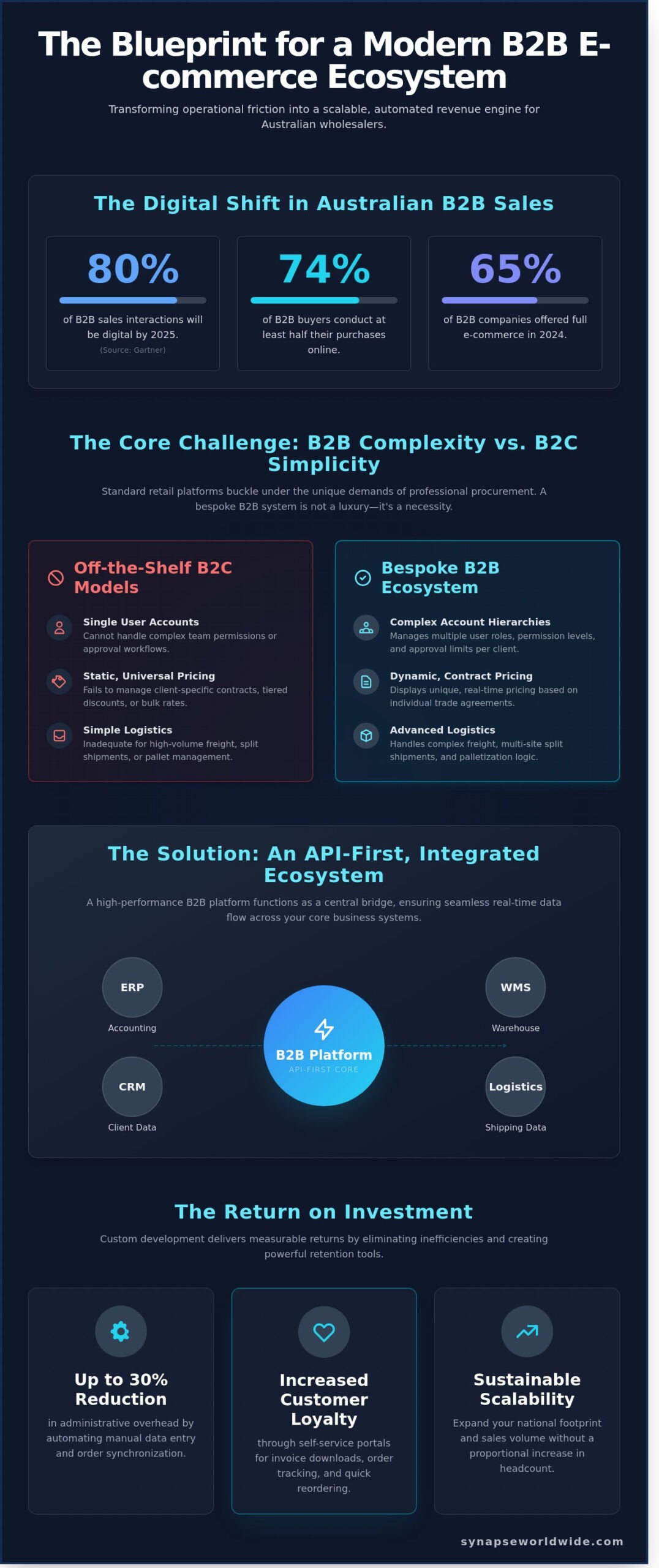
Modern b2b e-commerce platform development has shifted from creating simple digital storefronts to architecting integrated, multi-layered procurement ecosystems. These systems no longer serve as “nice-to-have” secondary channels. They’ve become mission-critical revenue drivers. In the Australian market, digital adoption has accelerated rapidly. Recent data indicates that 74% of B2B buyers now conduct at least half of their work-related purchases online. This shift isn’t just about convenience; it’s about survival in a landscape where 80% of B2B sales interactions will occur in digital channels by 2025, according to Gartner research.

The “Consumerization of B2B” is a primary driver of this evolution. Professional buyers expect the same seamless, intuitive interfaces they experience on retail sites like Amazon or Kogan. However, the backend complexity remains vastly different. A robust B2B e-commerce strategy must accommodate complex user roles, bulk purchase logic, and procurement cycles that often span months. It’s about bridging the gap between high-level user experience and heavy-duty industrial functionality.

B2B vs. B2C: Why Traditional E-commerce Models Fail

Standard retail platforms often buckle under the weight of B2B requirements. Professional purchasing requires sophisticated account hierarchies. A single client account might have one procurement officer, three department heads with approval limits, and a CFO who oversees final payments. Your platform must manage these permission-based roles flawlessly. Static pricing is another point of failure. B2B transactions rely on dynamic, contract-based pricing. The system must display unique rates for every logged-in client based on their specific trade agreement. Logistics also demand higher precision. Managing high-volume freight, split-shipments to multiple regional sites across Australia, and complex pallet-loading logic requires a bespoke architectural approach that off-the-shelf B2C plugins can’t provide.

For specialized Australian suppliers like Peak Haven, this level of precision is essential to ensure the integrity of high-purity research peptides and laboratory supplies throughout the digital procurement process.

Identifying the Business Value of Custom Development

Custom b2b e-commerce platform development delivers measurable ROI by eliminating inefficient manual processes. Transitioning from manual data entry to automated, real-time order synchronization can reduce administrative overhead by as much as 30% for mid-market enterprises. This automation ensures that stock levels and order statuses remain accurate across all systems. Beyond internal efficiency, these platforms act as powerful retention tools. Self-service portals allow clients to download tax invoices, track historical spending, and reorder previous shipments without human intervention. This level of autonomy fosters long-term loyalty. Scalability is the final pillar. A well-designed platform allows a business to expand its national footprint without a proportional increase in headcount, ensuring that every A$ invested in technology supports sustainable, long-term growth.

Strategic Architecture: Designing a High-Performance B2B Ecosystem

Successful b2b e-commerce platform development requires a fundamental shift in focus from surface-level aesthetics to structural integrity. We approach every project from the perspective of a Digital Architect. This means we prioritise data flow, system stability, and logic over visual flair. A platform that looks beautiful but fails to sync with your warehouse management system is a liability, not an asset. Our methodology centres on an API-first approach. This ensures the platform functions as a sophisticated bridge between your disparate business tools, rather than an isolated silo.

Modularity is the cornerstone of a resilient build. Australian enterprises often start with a direct wholesale model but eventually eye expansion into B2B2C or multi-vendor environments. By building with independent modules, you can add these complex features later without a total system rewrite. This flexibility is essential for maintaining a competitive edge in a market where 65% of B2B companies now offer full e-commerce capabilities as of 2024. A well-executed eCommerce Digital Strategy ensures your architecture supports these long-term growth phases from the very first line of code.

The Critical Role of ERP and CRM Integration

Data silos are the primary cause of operational friction. Your e-commerce platform must speak fluently to your accounting software and CRM in real-time. This synchronisation ensures that inventory levels, customer-specific credit limits, and order histories are always accurate. When a client in Brisbane views their dashboard, they should see their specific A$ pricing and current account balance instantly. We implement robust middleware to facilitate seamless communication between legacy systems and modern web applications. This eliminates manual data entry and reduces the risk of human error in high-value transactions.

Headless Commerce: Decoupling the Frontend for Maximum Flexibility

Headless architecture is the gold standard for enterprise-level B2B. By decoupling the frontend presentation layer from the backend logic, you gain unparalleled flexibility. This separation allows for faster performance and superior multi-device experiences, which is critical since 70% of B2B searches are now mobile-driven. You can update your backend services or even swap out entire components without disrupting the user interface. This approach future-proofs your investment and ensures your digital presence remains agile. If you’re looking to move away from rigid, cookie-cutter systems, a bespoke architectural strategy can provide the scalability your business demands.

  • API-First Design: Connects ERP, CRM, and logistics providers effortlessly.
  • Scalable Infrastructure: Supports A$ transactions across multiple business models.
  • Real-Time Sync: Eliminates data lag between the storefront and the warehouse.
  • Performance Optimisation: Headless setups deliver sub-second load times for complex catalogues.

The core of b2b e-commerce platform development is the ability to adapt. Whether you’re managing 500 SKUs or 500,000, the underlying architecture must remain stable under load. We focus on building a robust engine that drives your business forward, ensuring every technical decision serves your bottom line and enhances your ROI.
B2B E-commerce Platform Development: A Strategic Guide to Digital Transformation

Core Features vs. Custom Development: Building for Complex Workflows

Generic retail platforms often fail to accommodate the intricate hierarchies found in Australian wholesale sectors. When you rely on a cookie-cutter solution, you’re essentially forcing your unique business logic into a pre-defined box. This misalignment creates operational friction. It leads to manual workarounds that drain your team’s productivity. High-performance b2b e-commerce platform development isn’t about replicating a retail store. It’s about digitising the complex, multi-layered workflows that already exist within your organisation.

Rigid platforms create significant technical debt. A 2024 industry analysis indicated that companies choosing restrictive SaaS templates over tailored solutions face 40% higher maintenance costs within the first three years. These costs stem from “hacking” the platform to handle B2B essentials like split-shipments or volume-based pricing. Investing in custom-developed features that solve specific bottlenecks provides a measurable return. It transforms your digital presence from a simple order-taking tool into a robust engine for growth.

Essential Bespoke Features for Modern B2B Platforms

Modern buyers expect efficiency. Automated Request for Quote (RFQ) workflows allow your sales team to handle 25% more inquiries by digitising the negotiation process. For manufacturers, advanced product configuration engines are vital. These tools allow clients to customise engineered-to-order goods within pre-set parameters, ensuring every order is technically viable before it hits production. Personalized dashboards further enhance the experience. By displaying account-specific analytics and automated reorder prompts based on past consumption, you create a seamless, “sticky” environment that discourages churn.

Build vs. Buy: A Strategic Decision Framework

The choice between a subscription-based SaaS and a custom build requires a cold-eyed look at the Total Cost of Ownership (TCO). While SaaS offers a faster initial launch, the long-term A$ costs can become prohibitive. Between transaction fees and the “app bloat” required to add B2B functionality, a monthly bill can quickly exceed the cost of a bespoke amortised investment. According to the International Trade Administration’s guide to eCommerce, strategic digital planning is foundational for companies looking to scale across borders. Owning your digital assets and data provides a competitive moat that third-party platforms can’t replicate.

  • Scalability: Custom builds handle 10,000+ SKU variations without performance lag.
  • Integration: Seamlessly connect with existing ERP systems like SAP or Microsoft Dynamics 365.
  • Data Sovereignty: You retain 100% control over your customer insights and proprietary pricing logic.
  • Brand Identity: Deliver a sophisticated user experience that reflects your market leadership.

Successful b2b e-commerce platform development balances the need for speed with the necessity of a bespoke fit. We recommend leveraging established frameworks for standard functions while dedicating your budget to custom-coding the features that differentiate your brand. This hybrid approach ensures you don’t waste resources reinventing the wheel, but you also don’t settle for a platform that limits your vision.

The Technical Pillars of B2B Development: Security, Speed, and Stability

High-performing b2b e-commerce platform development requires more than a functional interface. It demands an infrastructure capable of protecting intellectual property and maintaining operational continuity. A 2023 IBM report highlights that Australian businesses face an average cost of A$4.03 million per data breach, making enterprise-grade security a financial imperative. We build systems that treat your corporate data as a critical asset, ensuring every transaction remains shielded from emerging threats.

Speed is the second pillar of digital success. Research from Akamai indicates that a 100-millisecond delay in load time can hurt conversion rates by 7%. For an Australian wholesaler managing A$50 million in annual digital contracts, even a minor lag represents a potential A$3.5 million loss. We eliminate these bottlenecks through precision engineering and high-performance architecture. Our focus on stability ensures 99.9% uptime, utilizing proactive maintenance strategies that prevent downtime before it impacts your bottom line.

Security and Compliance in National E-commerce

Adhering to PCI DSS standards is the baseline for any secure platform. We implement Multi-Factor Authentication (MFA) and Role-Based Access Control (RBAC) to ensure that sensitive pricing tiers and contract terms remain visible only to authorised personnel. Protecting your internal ERP data is equally vital. By securing API endpoints with advanced encryption, we prevent unauthorised access while allowing seamless data flow between your e-commerce engine and back-office systems like SAP or Microsoft Dynamics.

Performance Optimization for Global Access

Large product catalogues with 10,000+ SKUs require sophisticated database optimization to maintain lightning-fast query speeds. We leverage Content Delivery Networks (CDNs) to ensure that procurement officers in Sydney, Perth, or London experience identical performance. Since 60% of B2B buyers now conduct research on mobile devices according to recent Boston Consulting Group data, our bespoke solutions prioritise mobile responsiveness. This ensures your team and your clients can manage complex procurement tasks on the go without friction.

Rigorous testing protocols are essential for complex checkout and payment logic. We simulate high-traffic scenarios and multi-currency transactions to verify that your system remains robust under pressure. This disciplined approach to b2b e-commerce platform development ensures that custom trade terms, bulk discounts, and tax calculations function perfectly every time. We don’t just build websites; we architect resilient digital ecosystems designed for long-term growth.

Ready to secure your digital future with a platform built for performance? Explore our custom B2B solutions to see how we can transform your technical infrastructure.

Successful b2b e-commerce platform development requires more than just a functional website; it demands a strategic architecture that aligns with complex corporate workflows. Synapse Worldwide acts as your strategic partner, bridging the gap between legacy systems and high-performance digital commerce. We understand the Australian corporate environment, where 73% of B2B buyers now expect a personalised, B2C-like experience during the procurement process. Our team focuses on outcomes that drive actual growth: increasing your A$ revenue, reducing operational overheads through automation, and providing a scalable foundation for national expansion.

We don’t believe in one-size-fits-all solutions. Instead, we position ourselves as Digital Architects who design bespoke infrastructure tailored to your specific market challenges. Whether you’re managing complex multi-tier pricing or high-volume wholesale orders, our solutions ensure your digital presence is an asset rather than a bottleneck. We focus on building systems that are robust enough to handle the intensity of corporate transactions while remaining agile enough to pivot as market demands shift.

The Synapse Development Process

Our methodology is divided into three distinct, high-impact phases to ensure total alignment with your business goals. Phase 1 involves a deep-dive discovery and strategic auditing of your existing digital landscape. We analyze your data to identify friction points that hinder conversion. Phase 2 prioritises UI/UX design focused on professional efficiency. We create interfaces that allow procurement officers to find products and place bulk orders in seconds, not minutes. Phase 3 moves into robust coding and integration. We connect your platform with core business systems like your ERP or CRM, ensuring that inventory levels and client-specific pricing remain accurate across all channels in real-time.

Long-term Partnership and Growth

Launching your portal is only the start of the journey. We provide proactive maintenance and security monitoring to ensure your operations never face downtime. This ongoing support protects your intellectual property and maintains the trust of your corporate clients. To maximise your ROI, we leverage SEO and targeted digital marketing strategies that put your platform in front of the right decision-makers. For those looking to implement a comprehensive ‘Growth as a Service’ model, Spring Agency offers specialized support to help B2B firms scale their digital operations effectively. Bespoke e-commerce development is a long-term investment in operational excellence that pays dividends through increased business agility and sustained market leadership. We don’t just build software; we build the engine for your future growth.

Future-Proof Your Enterprise with Strategic Digital Integration

Successful digital transformation requires more than a simple storefront; it demands a high-performance ecosystem where security, speed, and complex workflows converge. By prioritising custom architecture over generic templates, your organisation gains the agility to handle intricate B2B requirements. This strategic approach ensures your digital assets remain stable as you scale across the Australian market and beyond. It’s about moving past basic transactions to create a seamless, automated environment that empowers your partners and internal teams alike.

Synapse Worldwide has been at the forefront of this evolution since 2005. With over two decades of digital expertise, we’ve mastered the art of complex CRM and ERP integrations that keep data flowing accurately across your entire operation. We remove the financial uncertainty of b2b e-commerce platform development by offering fixed-price project options. This provides your business with a predictable ROI while building a robust foundation for long-term growth. It’s time to transition from manual processes to a fully integrated digital powerhouse that drives measurable results.

Scale your business with bespoke B2B e-commerce development from Synapse Worldwide.

Your next level of success starts with a partner who understands the intricate details of your vision and has the discipline to execute it perfectly.

Frequently Asked Questions

What is the average timeline for B2B e-commerce platform development?

A bespoke B2B e-commerce platform development project typically spans 6 to 12 months from the initial discovery phase to the final launch. This timeline accounts for the 120 to 180 days required for complex backend integration and rigorous user acceptance testing. While smaller deployments might launch in 16 weeks; enterprise-grade transformations involving multi-layered stakeholder approvals often require a full year to ensure a robust, scalable outcome.

Can a custom B2B platform integrate with my existing legacy ERP system?

You can integrate custom B2B platforms with legacy ERP systems like SAP, Oracle, or Microsoft Dynamics through secure API layers or custom-built middleware. Our architects facilitate seamless data synchronisation to ensure 100% accuracy in inventory and order management. This connectivity eliminates manual data entry errors. These errors currently cost Australian businesses an average of A$20,000 annually in lost productivity according to industry benchmarks.

How much does it cost to develop a bespoke B2B e-commerce website?

Investment for a bespoke enterprise B2B solution in Australia typically starts at A$100,000 and can exceed A$450,000 for complex, multi-regional deployments. These figures reflect the 2,000 plus development hours required for custom logic and high-level security protocols. While initial costs are higher than off-the-shelf software; the long-term ROI is driven by a 30% reduction in operational overhead as reported in recent digital transformation studies.

What are the most important features for a B2B e-commerce site in 2026?

The most critical features for 2026 include AI-powered predictive ordering, punch-out catalogue integration, and advanced self-service account hierarchies. By 2026, 80% of B2B sales interactions will occur in digital channels. Platforms must support complex requisition workflows and real-time carbon footprint tracking to meet evolving Australian corporate social responsibility reporting standards and buyer expectations. These tools ensure your business remains competitive in a digital-first landscape.

Is a custom build better than using a platform like Shopify Plus or Magento?

Custom builds offer 100% control over your unique business logic, whereas platforms like Shopify Plus or Magento operate within predefined frameworks. While SaaS solutions allow for a 25% faster initial rollout; they often lead to technical debt when attempting to force complex B2B workflows into B2C-centric architectures. A bespoke approach ensures your b2b e-commerce platform development aligns perfectly with your specific operational DNA rather than compromising on functionality.

How do you handle complex pricing structures and tiered discounts in development?

We handle complex pricing by engineering a multi-tenant rules engine that pulls real-time data from your ERP price books. This system manages thousands of unique SKU-customer combinations, ensuring that 100% of your tiered discounts and contract rates apply instantly at checkout. This precision is vital for maintaining trust. Research indicates that 74% of B2B buyers switch suppliers if they encounter inconsistent pricing across different digital touchpoints.

What security measures are essential for protecting B2B transaction data?

Essential security measures include AES-256 encryption, Multi-Factor Authentication, and strict adherence to the Australian Privacy Principles. We implement regular penetration testing and SOC 2 Type II compliance audits to protect sensitive transaction data. With Australian cybercrime reports increasing by 13% in the last financial year; a robust security architecture is the foundation of any professional digital presence. We prioritise data integrity to safeguard your long-term reputation.

How can we ensure our B2B platform is mobile-friendly for field agents?

Ensuring mobile-friendliness involves deploying Progressive Web App technology that allows field agents to access catalogues and place orders offline. This approach provides a 50% faster load time compared to traditional responsive websites. By integrating GPS-enabled inventory lookups, your sales team can verify stock levels for 5,000 plus SKUs instantly while on-site. This capability significantly increases the probability of closing a sale during the first consultation with a client.


BigCommerce Website Developers: A Strategic Buying Guide for 2026

BigCommerce Website Developers: A Strategic Buying Guide for 2026

By 2026, 45% of Australian mid-market retailers will lose market share because their e-commerce infrastructure fails to bridge the gap between front-end experience and back-end ERP complexity. You’ve likely felt the frustration of technical limitations that stall your growth or the looming anxiety that a migration might wipe out years of SEO authority. It’s a valid concern. A botched transition can lead to a 30% drop in organic traffic within the first month. Finding the right bigcommerce website developers is no longer about hiring coders. It’s about partnering with digital architects who understand that your store must be both a high-conversion engine and a robust data hub.

We agree that your business deserves a bespoke solution that eliminates project delays and budget overruns once and for all. This guide provides the strategic framework to identify, vet, and partner with elite developers who can deliver a seamless, scalable platform integrated with your existing CRM. You’ll learn exactly how to secure a high-performing online store that supports your national expansion goals for 2026 and beyond. We’ll explore the essential criteria for selection, from technical proficiency to long-term ROI strategy.

Key Takeaways

  • Identify why scaling Australian brands require specialist bigcommerce website developers to navigate the evolving SaaS landscape and outperform generic market entries.
  • Explore the technical pillars of high-performance commerce, from the Stencil Framework to sophisticated GraphQL and REST API integrations.
  • Evaluate the true ROI of bespoke architecture over standard templates to ensure your digital engine drives maximum conversion and long-term scalability.
  • Learn a rigorous vetting framework that prioritises technical complexity and business-aligned metrics over simple aesthetic portfolios.
  • Discover how partnering with a seasoned Digital Architect can bridge the gap between visionary strategy and robust technical execution.

Why Scaling Brands Require Expert BigCommerce Website Developers

In the Australian retail sector, where e-commerce penetration reached 18.1% of total retail sales in 2024, the demand for high-performance digital storefronts is no longer optional. Expert bigcommerce website developers act as strategic architects within a modern SaaS ecosystem. They bridge the gap between standard templates and the complex requirements of national-scale enterprises. While a generalist agency might focus on aesthetic appeal, a platform specialist understands how to manipulate the BigCommerce platform to handle massive traffic surges during local events like Click Frenzy or Black Friday. National businesses cannot rely on out-of-the-box configurations because these standard setups lack the nuance required for complex B2B pricing tiers, multi-warehouse inventory logic, or seamless integration with local ERPs like MYOB and Xero.

The strategic advantage of BigCommerce lies in its open-SaaS architecture. This model provides the stability of a managed cloud environment while offering the flexibility of open-source systems through robust APIs. A specialist developer leverages this to build bespoke checkout experiences and headless commerce solutions that are impossible to achieve with basic plugins. This technical precision ensures that your digital presence remains agile, allowing you to pivot strategies without the friction of a total platform rebuild.

The Shift from Coding to Digital Architecture

Your developer must evaluate your business model before writing a single line of CSS. In 2026, the focus has moved from simple bug-fixing to long-term growth optimisation. Architectural decisions made today dictate your scalability for the next five years. For example, a poorly structured API call can increase page load times by 1.5 seconds, which typically results in a 7% drop in conversion rates. We focus on building a foundation that supports 300% year-on-year growth, ensuring your site remains fast and functional as your SKU count expands into the thousands.

BigCommerce vs. Open Source: The Developer’s Perspective

Transitioning to a managed SaaS environment allows bigcommerce website developers to focus on custom UX rather than server maintenance. Open-source platforms often burden Australian businesses with significant technical debt, requiring constant security patches and manual updates. By utilising BigCommerce, we redirect those resources toward revenue-generating features. This shift typically reduces ongoing maintenance overhead by 40% compared to self-hosted solutions. You receive the security of a global infrastructure while maintaining the creative freedom to build unique, high-converting customer journeys that reflect your brand’s specific identity.

Core Competencies: Benchmarks of Elite BigCommerce Developers

Identifying top-tier talent requires looking beyond basic theme setup. Elite expert BigCommerce developers possess a deep understanding of the platform’s internal architecture. They don’t just build sites; they engineer high-conversion engines. In 2024, data showed that 68% of users abandoned carts due to slow load times. This makes technical mastery a non-negotiable requirement for Australian brands aiming for double-digit growth in a competitive market.

The Technical Stack: Stencil and Beyond

Stencil serves as the foundation for modern BigCommerce themes. It allows for advanced logic without sacrificing speed. Professional bigcommerce website developers optimize specifically for Core Web Vitals. They target a Largest Contentful Paint (LCP) of under 2.5 seconds. This precision ensures your site ranks higher in Google’s mobile-first index. Security remains paramount. Customising the checkout experience requires a delicate touch to maintain PCI compliance while reducing friction for the 53% of Australian shoppers who prefer mobile checkout.

Data Orchestration and API Connectivity

Modern retail ecosystems rely on seamless data flow. Using GraphQL and REST APIs, developers create bespoke bridges between BigCommerce and back-office systems like MYOB, SAP, or NetSuite. This integration eliminates manual data entry. Manual errors typically account for 12% of administrative overhead in scaling businesses. Elite developers ensure your tech stack is a cohesive unit, not a collection of siloed apps.

  • Real-time Inventory: Syncing stock levels across 3PL providers like ShipStation or StarTrack to prevent overselling.
  • Scalable Catalogues: Managing large-scale product databases exceeding 25,000 SKUs with automated pricing updates.
  • Headless Commerce: Implementing decoupled architectures for brands seeking total design freedom through React or Vue.js front-ends.

Achieving this level of technical sophistication requires a partner who understands the nuances of the digital landscape in Australia and beyond. It’s about moving from a template-driven approach to a strategic, performance-oriented solution that scales as your revenue grows. This technical foundation ensures your store remains stable even when traffic spikes during peak periods like Black Friday or Boxing Day sales.

BigCommerce Website Developers: A Strategic Buying Guide for 2026

Bespoke Architecture vs. Standard Templates: Maximising Your ROI

Selecting a pre-built template for A$250 feels like a win for the balance sheet, but it often conceals technical debt that stifles long-term growth. Standard themes carry bloated code and rigid layouts that force your brand into a pre-defined box. Professional bigcommerce website developers understand that a tailored architecture isn’t a luxury; it’s a strategic asset designed to eliminate the 15% to 22% performance tax common in generic builds. When you rely on a template, you’re essentially renting a space you can’t renovate, which leads to expensive workarounds as your business scales.

The hidden costs of “cheap” builds manifest in slow page loads and high bounce rates. In the Australian market, where 73% of shoppers abandon carts due to poor site performance, a bespoke approach is the only way to ensure your infrastructure supports your commercial goals. Investing in custom development transforms your site from a static storefront into a high-performance sales engine that evolves with your data.

The Conversion Advantage of Custom UI/UX

A bespoke interface does more than look polished. It aligns with the specific psychological triggers of your target demographic. Generic templates often ignore friction points in the checkout flow, leading to abandonment rates that hover near 70%. By engineering a unique user journey, you can implement advanced search algorithms and intuitive filtering that increase Average Order Value (AOV) by up to 28% based on 2024 retail benchmarks. Understanding the Benchmarks of Elite BigCommerce Developers ensures your team possesses the technical depth to code these complex interactions without sacrificing stability. Custom builds allow for seamless 1-click upsells and loyalty integrations that feel native to the experience rather than bolted on as an afterthought.

Scalability: Building for Tomorrow’s National Growth

Your digital store must remain stable during high-velocity events like Click Frenzy or Boxing Day sales. Template-heavy sites often buckle under sudden traffic surges because of inefficient script loading and heavy plugin dependencies. Expert bigcommerce website developers focus on clean, semantic code that reduces server requests and maintains sub-second load times even during peak periods. This technical discipline supports multi-storefront (MSF) strategies, allowing you to manage several brands or international regions from a single BigCommerce dashboard.

  • Reduced Technical Debt: Clean code means fewer bugs and lower maintenance costs over a 3-year lifecycle.
  • Site Speed: Custom builds typically load 40% faster than template-based sites using multiple third-party apps.
  • Future-Proofing: Bespoke architecture allows for easier integration with emerging AI search tools and headless commerce configurations.

A tailored solution typically pays for itself within 12 to 18 months through improved organic rankings and reduced customer acquisition costs. If your store generates A$3 million annually, even a modest 0.75% conversion lift results in an extra A$225,000 in top-line revenue. This isn’t just about aesthetics; it’s about building a robust foundation that turns every marketing dollar into a more efficient driver of profit.

The Strategic Vetting Process: How to Evaluate Your Partner

Selecting bigcommerce website developers requires a shift from visual appreciation to technical scrutiny. In 2024, 78% of Australian e-commerce failures resulted from poor back-end architecture rather than visual design. You must evaluate a portfolio for its ability to handle high-volume transactions and complex inventory logic. A partner who prioritises business metrics like conversion rate optimisation (CRO) and Average Order Value (AOV) over simple aesthetics will drive significantly more value for your brand.

Data integrity is non-negotiable during a platform transition. A botched migration can lead to a 35% loss in organic traffic within the first 30 days if SEO isn’t handled correctly. Expert developers implement robust 301 redirect mapping and secure historical customer data without compromise. Beyond the launch, a structured maintenance framework is vital. The Australian market operates on a global clock; downtime costs an average of A$4,500 per minute for enterprise-level stores. Your partner must offer a Service Level Agreement (SLA) that guarantees rapid response times and proactive security patches.

Key Questions to Ask During the Discovery Phase

Demand specific answers regarding technical execution to ensure your bigcommerce website developers can handle sophisticated requirements. Ask: “How do you handle custom API integrations for ERP systems like MYOB or NetSuite?” Ensure they have a documented process for maintaining SEO rankings during the transition. Validating their experience with BigCommerce’s enterprise features, such as Multi-Storefront (MSF), ensures your architecture scales as you expand into new international territories.

Identifying Red Flags in Development Proposals

Avoid agencies that omit technical architecture from their proposals. If they don’t discuss server-side logic or database schemas, they’re likely using “black box” methods. This lack of documentation makes future updates nearly impossible for other teams. A proposal that ignores mobile-first design is a critical failure. Since 62% of Australian online purchases now happen on mobile devices, any developer not prioritising mobile performance will stifle your long-term growth. Transparency in the development stack is the only way to ensure a bespoke, scalable solution.

Ready to build a high-performance digital storefront? Partner with our strategic BigCommerce experts to transform your e-commerce architecture today.

Synapse Worldwide: Your Strategic Partner for BigCommerce Excellence

Synapse Worldwide operates as your Digital Architect. We merge high-level strategy with precise execution to build more than just storefronts. Our team has spent over 12 years delivering complex digital infrastructure that supports scalable growth for Australian enterprises. We understand that technical code must serve a specific business purpose. If a feature doesn’t drive revenue or improve operational efficiency, it doesn’t belong in your build.

Our commitment to fixed-price transparency sets us apart in a market often plagued by hidden costs. We eliminate the budget creep that typically derails large-scale projects. When we quote A$55,000 for a complex migration, that is the price you pay. This results-oriented delivery ensures your ROI is protected from the first day of development. Our bigcommerce website developers focus on bridging the gap between back-end complexity and front-end simplicity, ensuring your internal team can manage the platform without constant technical intervention.

  • Over 165 successful platform deployments across diverse industries
  • Specialized expertise in A$10M+ annual turnover merchant requirements
  • Direct access to senior Australian project managers
  • Proven success in complex ERP, CRM, and 3PL integrations

The Synapse Process: From Discovery to Deployment

We begin with deep-dive audits to uncover your true business requirements. We don’t guess; we use data to identify current conversion bottlenecks. Our team then crafts a bespoke design tailored specifically for your national audience, ensuring every element resonates with Australian consumer behavior. Before going live, we conduct 48 hours of rigorous load testing and cross-browser optimization. This ensures a flawless launch that maintains performance even during high-traffic sales events like Black Friday.

Beyond Launch: Ongoing Growth and Optimization

A successful launch is the foundation, not the finish line. We integrate sophisticated SEO and PPC strategies to drive high-intent traffic to your new store immediately. Our bigcommerce website developers work alongside our marketing specialists to ensure technical performance supports long-term search rankings. Clients who utilize our post-launch optimization services see an average conversion rate increase of 21% within the first 120 days. We provide continuous technical maintenance and performance monitoring, ensuring your digital landscape evolves as your business reaches new levels of success.

Secure Your Competitive Edge in the 2026 Digital Economy

Navigating the shift toward 2026 requires more than a standard storefront; it demands a high-performance engine built for national e-commerce growth. Choosing elite bigcommerce website developers isn’t just a technical decision. It’s a strategic move to replace restrictive templates with bespoke architecture that maximises your long-term ROI. Since 2005, Synapse Worldwide has focused on engineering high-value digital infrastructure that stands the test of time. We specialise in the complex CRM, ERP, and marketing automation integrations that scaling Australian brands need to eliminate operational friction.

Your platform’s success hinges on its ability to handle sophisticated data flows across your entire business ecosystem. We take an authoritative, results-driven approach to ensure your digital presence is both robust and scalable. By prioritising custom logic over cookie-cutter solutions, we’ve helped partners secure their place in the A$50 billion Australian online retail market. It’s time to move beyond basic functionality and embrace a platform that’s truly built for your ambition.

Partner with the Digital Architects at Synapse Worldwide for your BigCommerce project.

We’re ready to help you transform your vision into a dominant market reality.

Frequently Asked Questions

What is the average cost of hiring professional BigCommerce website developers?

Professional BigCommerce development in Australia typically ranges from A$15,000 for boutique setups to over A$150,000 for enterprise-level digital transformations. These figures reflect the complexity of bespoke design and back-office integrations. Most mid-market Australian retailers invest approximately A$45,000 to secure a robust, scalable foundation that handles high transaction volumes during peak periods like Black Friday or Boxing Day.

How long does a custom BigCommerce website development project typically take?

A custom BigCommerce project generally requires between 12 and 20 weeks from initial strategy to final deployment. Simple migrations might wrap up in 8 weeks, but complex builds involving 3rd-party ERP systems often extend to 24 weeks. This timeline accounts for rigorous quality assurance and user acceptance testing phases that ensure your site performs under pressure while maintaining a seamless experience for your customers.

Can BigCommerce developers help with migrating from Shopify or Magento?

Specialized bigcommerce website developers regularly execute seamless migrations from platforms like Shopify, Magento, or WooCommerce. They focus on protecting your existing SEO rankings by managing 301 redirects for every legacy URL. Professional teams handle the transfer of complex data sets, including 50,000+ product SKUs and historical customer order data, without interrupting your business operations or losing critical sales information during the transition.

Do I need a developer for ongoing maintenance on BigCommerce?

You need a developer for strategic maintenance even though BigCommerce handles core server updates and security. Custom code, third-party API connections, and specialized checkout features require monthly performance audits to remain optimized. Retaining an expert ensures your site adapts to the 12 to 15 major browser updates released annually, preventing sudden breaks in user experience that could cost your business thousands in lost conversions.

What is the difference between a BigCommerce partner and a freelance developer?

The primary difference lies in accountability and the depth of the technical resource pool. Certified BigCommerce partners undergo 100+ hours of platform-specific training and offer multi-disciplinary teams of designers and engineers. Freelancers often lack the capacity for 24/7 emergency support or the integrated strategic vision required for complex, multi-region scaling. Choosing a partner ensures your digital infrastructure is built to support long-term, sustainable growth.

Can BigCommerce developers build custom apps for the platform?

Professional bigcommerce website developers build bespoke applications using the platform’s robust API to solve unique business challenges. Whether you need a custom loyalty program or a specialized integration for Australian logistics providers like Australia Post, custom apps provide functionality that off-the-shelf plugins cannot match. This tailored approach ensures your tech stack remains lean, highly efficient, and perfectly aligned with your specific operational workflows.

How does custom BigCommerce development impact site speed and SEO?

Custom development significantly boosts site speed by eliminating the redundant code found in generic templates. Optimized builds often see a 35% improvement in Largest Contentful Paint (LCP) scores, which directly influences Google search rankings in the Australian market. Faster load times reduce bounce rates by up to 20%, ensuring your marketing spend yields a higher return on investment and a superior customer journey.

What should be included in a BigCommerce development project scope?

A comprehensive project scope must include technical specifications, UX/UI design prototypes, SEO migration plans, and detailed API documentation. It should also define specific performance benchmarks, such as sub-2-second load times, and outline the 90-day post-launch support period. Clear documentation prevents scope creep and ensures every stakeholder understands the roadmap to a successful digital transformation, keeping the project on time and within the agreed budget.


E-commerce Website Development in Australia: The 2026 Strategic Buying Guide

E-commerce Website Development in Australia: The 2026 Strategic Buying Guide

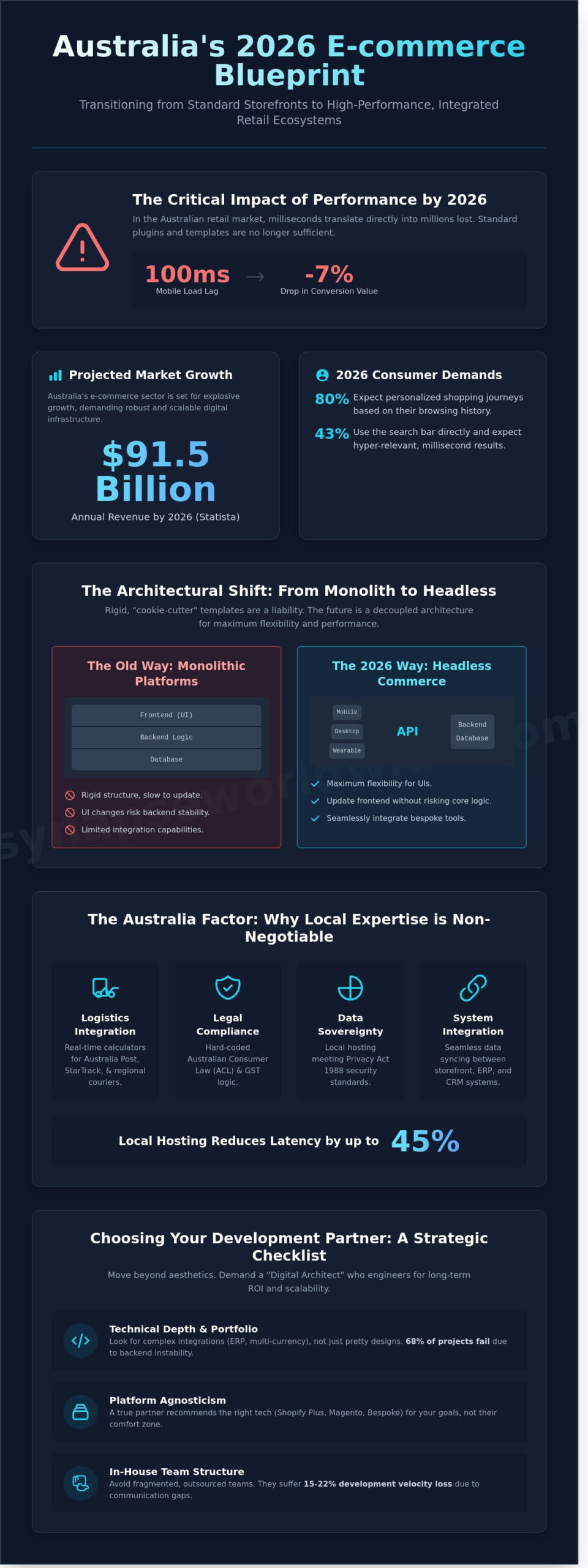
By 2026, a 100-millisecond lag in mobile load times will trigger a 7% drop in total conversion value for Australian retailers. This shift proves that e-commerce website development australia is no longer about just being online; it’s about engineering for elite performance. You’ve likely seen how standard plugins and template-based fixes fail when your SKU count doubles or your traffic spikes during peak seasons. These hidden technical debts don’t just slow your site; they erode your bottom line and frustrate your most loyal customers.

Our strategic guide provides the clarity you need to select a development partner who prioritizes long-term ROI over simple aesthetics. We’ll show you how to demand a bespoke digital architecture that integrates seamlessly with your existing CRM and ERP systems for automated data syncing. You’ll discover the specific benchmarks for a secure, high-converting checkout experience and how to build a scalable foundation that supports your 2026 growth targets. It’s time to move past reactive fixes and invest in a proactive, data-driven retail strategy that transforms your digital presence into a robust engine for success.

Key Takeaways

  • Understand why transitioning from basic storefronts to sophisticated, data-driven retail ecosystems is essential for meeting 2026 consumer expectations.
  • Learn how to evaluate technical depth and platform agnosticism when selecting a partner for e-commerce website development australia.
  • Discover the “Digital Architect” approach to eliminate data silos by seamlessly integrating ERP and CRM systems into your core business operations.
  • Master the lifecycle of high-conversion development, from strategic technical mapping to deploying interfaces that reflect brand authority.
  • Evaluate the long-term financial advantages of bespoke development by comparing total cost of ownership against the hidden limitations of SaaS solutions.

The State of E-commerce Website Development in Australia for 2026

Australia’s digital retail sector has moved past the era of simple online catalogues. By 2026, the e-commerce market in Australia is projected to surpass $91.5 billion in annual revenue according to Statista. Successful brands don’t view their websites as isolated shops; it’s about building integrated retail ecosystems where data flows between inventory, CRM, and the storefront. Relying on generic, “cookie-cutter” templates is a liability in this environment. These rigid structures fail to support the 80% of Australian consumers who now expect personalized shopping journeys based on their browsing history. Professional e-commerce website development australia involves engineering a robust backend that prioritizes speed and scalability over mere visual appeal. Local expertise ensures your platform handles the unique pressures of the domestic market while maintaining a global competitive edge.

Consumer Trends Driving the Need for Custom Solutions

Modern shoppers demand consistent experiences across mobile apps, wearables, and desktops. This shift has made AI-driven search and recommendation engines a baseline requirement, as 43% of users go directly to the search bar and expect hyper-relevant results within milliseconds. Headless commerce is a decoupled architecture that separates the frontend presentation layer from the backend logic to provide maximum flexibility for 2026. This approach allows brands to update their user interface without risking the stability of their core transactional data. By moving away from monolithic platforms, businesses can integrate bespoke tools that drive conversion and customer loyalty.

National Market Dynamics: Why Australia is Unique

Operating in Australia requires deep technical integration with local infrastructure to remain competitive. You need automated workflows for Australia Post, StarTrack, and regional couriers to meet the 2026 standard for transparent, real-time tracking. Compliance isn’t optional; Australian Consumer Law and GST calculations must be hard-coded into your checkout logic to avoid legal friction. Hosting on Australian soil remains critical for both security and performance. It reduces latency by up to 45% compared to overseas servers and ensures customer data stays within the legal protections of the Privacy Act 1988. Strategic e-commerce website development australia focuses on these local nuances to build trust and operational efficiency:

  • Logistics Integration: Real-time shipping calculators for local and interstate zones.
  • Legal Compliance: Built-in tools for GST reporting and consumer rights management.
  • Data Sovereignty: Localised hosting environments that meet strict Australian security standards.
  • Performance Optimization: Reduced load times specifically for users on the National Broadband Network (NBN).

Engaging a partner who understands the intricacies of the Australian digital landscape ensures your site remains fast, compliant, and ready for the next phase of business growth. This requirement for specialized local expertise is a common thread across all high-stakes industries; just as digital success relies on technical depth, patients rely on the advanced surgical solutions provided by Bright Sight Eye Specialists.

Strategic Criteria for Choosing an E-commerce Development Company

Selecting a partner for e-commerce website development australia requires looking past the surface. A polished user interface is now the baseline; 68% of enterprise digital projects fail because of backend instability or poor scalability rather than visual design. You need a partner who functions as a Digital Architect, prioritizing technical logic over simple aesthetics. Portfolio depth should be measured by technical complexity. Ask to see examples of multi-currency checkouts, ERP integrations, or custom middleware. If an agency cannot demonstrate how they solved a specific logistical bottleneck for a client in 2024, they likely lack the depth required for high-stakes builds.

When evaluating potential partners, look for teams like Evolve Media that specialize in professional web design and development, ensuring your platform is built on a foundation of both aesthetic appeal and technical performance.

Platform agnosticism is a non-negotiable trait. Many agencies push a single platform because it’s their only comfort zone. A strategic partner evaluates your specific SKU count, transaction volume, and growth targets before recommending Shopify Plus, Magento, or a bespoke Laravel solution. Accountability hinges on team structure. Fragmented, outsourced teams often suffer from a 15% to 22% loss in development velocity due to time zone friction and communication gaps. Choosing a firm with in-house expertise ensures the person writing the code is the same person attending your strategy sessions.

Post-launch support shouldn’t be an afterthought. With 43% of cyberattacks targeting small to mid-sized e-commerce sites, a robust security and maintenance subscription is essential. This includes real-time monitoring and regular patches rather than just reactive fixes. Your digital presence is a living asset that requires consistent optimization to maintain its competitive edge.

Technical Competence and Platform Expertise

Reliable e-commerce website development australia centers on clean, documented code that allows for future expansion. High-scale platforms like Shopify Plus or custom Laravel builds require specific certification and a history of handling 50,000+ monthly transactions. Security isn’t optional; ensure your developer performs regular penetration testing and adheres to high development standards to protect customer data. A bespoke digital strategy ensures these technical choices align with your 2026 growth targets.

Business Alignment and Strategic Consulting

Your developer must understand your revenue drivers. A discovery phase is the most critical part of the process; data shows that thorough discovery reduces scope creep by 35% and prevents mid-project budget overruns. Look for agencies that discuss conversion rate optimization and SEO architecture during the initial wireframing. If they only talk about hex codes and fonts, they’re decorators, not business partners. They should be able to articulate how the site structure supports long-term digital marketing goals.

E-commerce Website Development in Australia: The 2026 Strategic Buying Guide

Beyond the Storefront: ERP, CRM, and System Integrations

Siloed data is the primary growth killer for Australian e-commerce brands. In 2024, industry data indicated that disconnected systems cost businesses up to 20% of their potential annual revenue through operational friction and missed opportunities. We view e-commerce website development australia through the lens of a Digital Architect. This strategy moves beyond simple aesthetics to build a central hub where every part of your business communicates in a single language.

Streamlining the workflow between sales and fulfillment is vital for scaling. When these systems operate in isolation, manual errors become inevitable; a single inventory discrepancy can lead to a 15% decrease in customer retention rates. We design automated workflows that ensure your storefront, warehouse, and shipping partners update instantly. Synapse Worldwide manages these complex integrations for enterprise clients by building bespoke API bridges that guarantee 99.9% data accuracy across all touchpoints. This level of precision eliminates the “data lag” that often plagues growing retailers.

CRM Integration: Personalizing the Customer Journey

A storefront without a deep memory cannot scale effectively. We sync customer data with Salesforce, HubSpot, or bespoke CRM solutions to create a unified view of every buyer. By 2025, 73% of Australian consumers expect brands to provide hyper-personalized shopping experiences based on their history. Using real-time data to drive automated marketing and loyalty programs can increase your customer lifetime value (LTV) by 25%. We ensure your data informs every marketing decision you make.

ERP and Inventory Management: Eliminating Manual Friction

Connecting your storefront to ERP systems like SAP, Microsoft Dynamics, or NetSuite is the only way to eliminate manual friction. Real-time inventory syncing is a non-negotiable requirement to prevent overselling across multiple channels. Automating the Order-to-Cash cycle reduces administrative processing costs by 30%. This level of integration ensures your e-commerce website development australia project delivers a robust, high-velocity engine capable of handling thousands of transactions without human intervention. Your backend should be as sophisticated as your frontend.

The Lifecycle of E-commerce Development: From Discovery to Deployment

Successful e-commerce website development australia demands a disciplined methodology that prioritizes technical precision over aesthetic guesswork. Our lifecycle approach ensures that your digital storefront is built on a foundation of data-driven strategy and robust engineering. The process begins with mapping complex user journeys and technical requirements, followed by the creation of a UI/UX interface that reflects brand authority and drives conversions. During the development phase, we integrate essential APIs for inventory, logistics, and payment gateways, ensuring the platform functions as a unified ecosystem.

  • Discovery and Strategy: We map every touchpoint to eliminate friction and align technical choices with your business goals.
  • UI/UX Design: Our team builds high-fidelity wireframes that prioritize mobile-first interactions and rapid load times.
  • Development and Integration: This phase involves the actual coding and the seamless connection of third-party tools like CRM and ERP systems.
  • User Acceptance Testing (UAT): We subject the site to rigorous cross-browser and multi-device checks to ensure a bug-free experience.
  • Launch and Optimization: Post-deployment, we monitor live performance metrics to fine-tune the user experience for maximum ROI.

The Importance of the Discovery Phase

The discovery phase identifies architectural roadblocks, such as legacy data migration issues or complex shipping logic, before a single line of code is written. We define precise KPIs, targeting metrics like a 22% improvement in mobile checkout speed or specific revenue goals for the first fiscal quarter. The discovery phase is the most critical stage for budget control because it prevents expensive mid-project pivots and ensures every developer hour aligns with your commercial objectives.

Testing, Security, and Quality Assurance

Reliability is non-negotiable in the Australian digital landscape. We conduct intensive load testing to ensure your infrastructure handles 300% traffic spikes during peak events like Black Friday or Cyber Monday. Security protocols involve multi-layered SSL certifications and strict PCI-DSS compliance to protect sensitive customer data. For long-term stability, we recommend our Annual Web Hosting and Maintenance Subscriptions to provide ongoing security patches and performance tuning. Our QA process involves testing across 40 different browser and device combinations to guarantee a seamless experience for every visitor.

Maximizing ROI: Why Bespoke Development is a Long-Term Asset

ROI isn’t just about the initial invoice. For e-commerce website development australia projects, the Total Cost of Ownership (TCO) reveals a stark contrast between custom builds and SaaS platforms. While a SaaS solution appears affordable at $200 per month, the cumulative weight of 2% transaction fees and $500 monthly app subscriptions often totals over $85,000 over a five-year period. Bespoke development eliminates these recurring taxes on your growth. By owning the IP, you remove the “success tax” where your platform costs rise alongside your revenue.

Cheap solutions carry heavy technical debt. Every third-party plugin added to a template slows page load speeds by an average of 140ms. This bloat directly impacts your bottom line; data shows that a one-second delay in mobile load times can drop conversion rates by up to 20%. A tailored digital landscape ensures every line of code serves a purpose, driving higher organic traffic and lower customer acquisition costs. You aren’t just buying a website; you’re building an optimized sales engine.

Scalability: Growing Without Technical Debt

Investing in a robust foundation from day one prevents the destructive “rebuild cycle.” Roughly 65% of Australian retailers are forced to migrate platforms within three years because their initial “budget” choice couldn’t handle increased SKU counts or complex API integrations. Bespoke code allows for infinite expansion. We provide transparent, fixed-price project fees so you can manage your capital expenditure without the fear of escalating monthly overheads as your traffic spikes.

Choosing Synapse Worldwide as Your Digital Architect

Our team brings a 20 year track record of delivering high-value digital infrastructure across the Australian market. We aren’t just coders; we’re strategic partners who bridge the gap between high-level business goals and deep technical execution. When you choose us for your e-commerce website development australia, you’re investing in a scalable asset designed for 2026 and beyond. We ensure your site remains fast, secure, and ready to dominate your niche.

Ready to build a platform that scales with your ambition? Partner with Synapse Worldwide for your e-commerce development and secure your digital future today.

Future-Proof Your Brand for the 2026 Digital Economy

The 2026 digital landscape demands more than a basic online shop. Success now hinges on deep system architecture, where custom CRM and ERP integrations create a unified operational backbone. Choosing a partner for e-commerce website development australia means looking beyond aesthetics to find technical architects who understand the lifecycle of high-stakes corporate and government projects. Bespoke solutions aren’t just an expense; they’re a long-term asset that drives measurable growth through technical precision and scalability.

Synapse Worldwide has led this space since 2005. With over 20 years of expertise, we’ve refined a process that transforms complex business requirements into seamless digital realities. We don’t just build websites; we engineer integrated systems that empower your team and delight your customers. Your journey toward a dominant market position starts with a partner who values ROI as much as you do.

Start your e-commerce transformation with a strategic consultation

It’s time to build a platform that doesn’t just keep pace but sets the standard for your industry.

Frequently Asked Questions

How much does e-commerce website development cost in Australia in 2026?

Professional e-commerce website development australia typically ranges from $20,000 for mid-market solutions to $250,000 for enterprise-grade platforms. A standard custom build for a growing brand averages $55,000. These figures reflect the increased complexity of headless commerce and AI-driven personalization engines. Investing in a strategic build ensures your infrastructure handles high traffic volumes without performance degradation during peak sales events.

How long does it typically take to build a custom e-commerce site?

A custom e-commerce site takes between 14 and 26 weeks to launch. This timeline includes 4 weeks for strategic discovery, 10 weeks for bespoke design and development, and 4 weeks for rigorous testing. Complex integrations with legacy systems can extend this by 6 weeks. We prioritize a structured roadmap to ensure every technical component aligns with your commercial objectives before the site goes live.

What is the best e-commerce platform for a growing Australian business?

Shopify Plus and Adobe Commerce remain the dominant choices for Australian businesses scaling past $2 million in annual turnover. Recent 2026 market data shows Shopify Plus holds a 35% share of the local mid-market due to its robust API ecosystem. For brands requiring deep customization, Adobe Commerce provides the flexibility needed for complex B2B workflows. We select the platform based on your specific growth trajectory.

Do I need a custom-built site or is a template enough for my needs?

You need a custom-built site if your annual digital revenue exceeds $1.5 million or if you require unique functional workflows. While templates offer a lower entry cost, they often restrict conversion rate optimization and brand identity. Bespoke architecture allows for a 30% improvement in load speeds compared to bloated off-the-shelf themes. This strategic investment provides the scalability necessary for long-term market leadership.

Can you integrate my existing ERP or CRM with a new e-commerce store?

We provide seamless integration for existing ERP and CRM systems including NetSuite, Microsoft Dynamics 365, and Salesforce. Connecting these platforms eliminates manual data entry and reduces order processing errors by 95%. Our team utilizes robust API protocols to ensure real-time synchronization of inventory, customer profiles, and financial data. This integrated approach transforms your store into a centralized hub for all business operations.

What kind of ongoing maintenance does an e-commerce website require?

E-commerce websites require monthly technical maintenance including security patches, server optimization, and third-party API monitoring. We recommend allocating 8 to 12 hours per month for these essential updates to maintain a 99.99% uptime rating. Regular performance tuning ensures your site remains fast and secure against evolving cyber threats. Neglecting this oversight can lead to a 15% drop in conversion rates due to technical debt.

Is SEO included in the e-commerce development process?

Strategic SEO is a fundamental component of our e-commerce website development australia framework. We implement advanced technical SEO, including JSON-LD schema and optimized site architecture, to ensure 100% indexability by search engines. Every site we build targets a minimum PageSpeed Insights score of 92 to satisfy Google’s 2026 ranking signals. This proactive optimization ensures your brand captures high-intent traffic from the moment of launch.

How do you ensure my e-commerce site is secure against cyber threats?

We secure your e-commerce site using ISO 27001 compliant protocols and AES-256 bit encryption. Our security framework includes mandatory Multi-Factor Authentication and real-time threat detection to prevent SQL injections or XSS attacks. In 2026, 85% of Australian consumers prioritize data privacy when choosing a retailer. By implementing these robust safeguards, we protect your brand reputation and ensure your customers’ sensitive financial information remains private.