

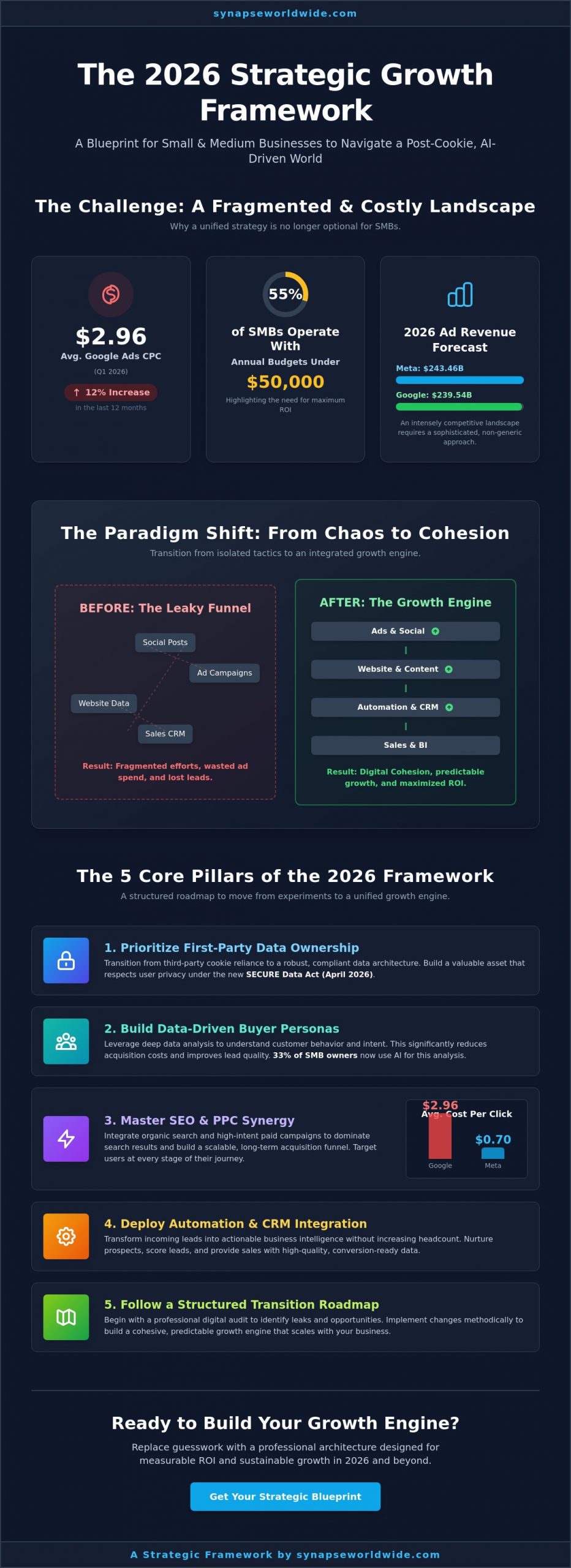
With Google Ads search costs hitting an average of $2.96 per click in the first quarter of 2026, small businesses are paying 12% more for traffic than they did just twelve months ago. It’s a challenging environment where 55% of SMBs are attempting to scale with annual budgets under $50,000. If you feel like your marketing efforts are fragmented and your customer acquisition costs are spiraling, you aren’t alone. Developing a cohesive digital marketing strategy smb isn’t about spending more; it’s about building a professional architecture where your website, ads, and sales data work in total unison.
You deserve a roadmap that replaces guesswork with measurable ROI and sustainable organic growth. This guide provides the 2026 Strategic Growth Framework, a bespoke approach designed to integrate high-level consulting with practical execution. We’ll examine how to navigate the new SECURE Data Act regulations introduced on April 22, 2026, while leveraging the latest GA4 AI tools to ensure your digital presence is both compliant and highly profitable.
Key Takeaways
- Transition from fragmented tactics to a bespoke blueprint that prioritizes first-party data ownership in the post-cookie landscape of 2026.
- Leverage data-driven buyer personas and brand alignment to significantly reduce customer acquisition costs and improve lead quality.
- Master the synergy between organic SEO and high-intent PPC to build a scalable digital marketing strategy smb that dominates search results.
- Deploy marketing automation and CRM integration to transform incoming leads into actionable business intelligence without increasing your headcount.
- Follow a structured transition roadmap that begins with a professional digital audit to move from isolated experiments to a unified growth engine.
What is a Digital Marketing Strategy for SMBs in 2026?
A digital marketing strategy smb is no longer a luxury or a side project; it’s the primary architectural blueprint for your revenue generation. In 2026, the distinction between having a website and owning a market has never been sharper. Digital marketing has evolved from simple online visibility into a complex ecosystem where every touchpoint must be intentional. With the introduction of the SECURE Data Act on April 22, 2026, the landscape has shifted permanently toward first-party data ownership. You can’t rely on third-party cookies to track users anymore. Success now requires a transition from fragmented tactical execution to a robust strategic architecture that captures, nurtures, and converts high-value leads with precision.
The core of a modern strategy lies in its ability to turn digital spend into a predictable growth engine. While many businesses still focus on isolated tactics like occasional social posts or disconnected ad campaigns, a professional framework integrates these elements into a single, cohesive unit. This approach ensures that your marketing efforts talk to each other, sharing data to lower your acquisition costs and maximize the value of every visitor.
The Evolution of SMB Marketing: From Presence to Performance
The days of the static brochure website are over. Modern SMBs must view their digital presence as a high-performance engine that operates with a national-scale perspective, even if their service area is local. This shift involves moving beyond mere online presence to a state of constant performance optimization. Digital strategy is the alignment of technology, data, and creative messaging. With the average marketing spend for a small business currently sitting at 8.11% of total revenue, there’s no room for waste. By treating your digital footprint as an integrated asset, you move from passive outreach to sophisticated lead nurturing that respects the 2026 consumer’s demand for privacy and relevance.
Why ‘Cookie-Cutter’ Solutions Fail in a Competitive Landscape
Generic, template-based marketing approaches are facing rapidly diminishing returns. When Meta is forecasted to reach $243.46 billion in ad revenue this year, surpassing Google’s $239.54 billion, the sheer volume of noise makes cookie-cutter solutions invisible. A bespoke digital marketing strategy smb creates a defensive moat around your business by building unique, non-replicable value for your audience. We call this Digital Cohesion. It’s the seamless integration of every channel to ensure that a lead generated on social media is nurtured through automated email sequences and converted by a data-informed sales team. This cohesion ensures that your $2.96 average cost-per-click investment isn’t lost to a leaky funnel, but is instead captured in a CRM system designed for long-term growth.
Building the Foundation: Audience Intelligence and Brand Alignment
Precision is the new currency for small businesses. With Google Search costs rising to $2.96 per click in the first quarter of 2026, you can’t afford to target a broad, undefined audience. High customer acquisition costs often stem from a fundamental lack of brand alignment. When your messaging doesn’t match the specific intent of the user, you’re essentially paying for curiosity rather than conversion. A professional Web Design and Branding Alignment ensures that your identity resonates instantly with high-value prospects. This isn’t just about aesthetics; it’s about building a digital marketing strategy smb that scales by establishing authority before the first sales call occurs.
Effective audience intelligence in 2026 relies on more than just basic demographics. 33% of small business owners now use AI for deep data analysis, allowing them to build personas based on actual behavioral patterns. This intelligence informs a comprehensive digital marketing strategy that prioritizes first-party data. By understanding the specific challenges your customers face, you can position your brand as the bespoke solution they’ve been searching for, effectively creating a defensive moat against lower-cost, cookie-cutter competitors.
Mapping the Modern Customer Journey
The journey from search to sale is no longer linear. A prospect might discover your brand through a Meta ad (where traffic costs average $0.70 per click) but won’t convert until they’ve interacted with your email content or read an authoritative blog post. Omnichannel consistency is vital. You must identify high-intent signals, such as multiple visits to a case study page or engagement with a “Task Assistant” on your site. These signals tell you exactly when to transition from automated awareness to direct sales outreach, ensuring you capture the 53% of SMB customers who prioritize businesses with a seamless digital experience.
The Strategic Intersection of Design and Trust
Trust is a technical requirement in the 2026 digital landscape. A custom web design for small business acts as the anchor for your entire growth framework. Template-based sites often feel fragile or generic, which triggers immediate skepticism in B2B and B2C buyers alike. To audit your current brand-web alignment, consider these critical factors:
- Visual Cohesion: Does your social media presence mirror the sophisticated UI of your website?
- Privacy-First UX: Are you meeting the new SECURE Data Act standards for consent and data transparency?
- Authority Markers: Are your specific business outcomes and data-driven claims integrated directly into the narrative flow?
When these elements align, your website transforms from a static page into a strategic growth engine. If your current digital presence feels fragmented, a bespoke design strategy can help you reclaim your authority and lower your overall marketing spend.
The Core Pillars: Integrating Content, Search, and Paid Channels
Siloed marketing is a legacy of the past. To build a truly scalable digital marketing strategy smb, you must treat your organic, paid, and social channels as a single, integrated ecosystem. Relying on just one pillar is a high-risk gamble. While 53% of small businesses currently utilize SEO, the most successful firms in 2026 are those that use paid data to accelerate their organic growth. This synergy allows you to capture high-intent traffic from Google Ads search campaigns, which currently boast an average conversion rate of 7.04%, while simultaneously building an organic asset that reduces your long-term reliance on rising ad costs.
Relationship-based growth is particularly critical for businesses with longer sales cycles. Implementing a sophisticated b2b social media marketing framework allows you to nurture prospects who aren’t yet ready to buy. With Meta projected to surpass Google in ad revenue for the first time in 2026, reaching $243.46 billion, the platform’s role in the B2B funnel has shifted from mere awareness to a primary lead generation tool. Authoritative content fuels this funnel, ensuring that when a prospect is finally ready to search, your brand is already the trusted authority.
Search Engine Optimization as a Long-Term Asset
Think of SEO as a strategic capital investment rather than a monthly marketing expense. In 2026, site architecture and technical health are the baseline requirements for visibility, not the finish line. We use content clusters to build topical authority, signaling to search engines that your business is a definitive source of truth in your industry. This long game strategy creates a sustainable flow of organic traffic that compounds over time, providing a vital buffer against the 12% year-over-year increase in search CPCs we’ve seen this year.
Precision PPC: Driving Sustainable Traffic
Precision in PPC means moving beyond basic keyword matching to AI-optimized bidding and bespoke landing pages. The automation trends in Google and Meta for 2026 require a higher level of strategic oversight than ever before. You cannot just set and forget your campaigns. By aligning your ad copy with your core brand values and driving traffic to high-performance landing pages, you ensure that every dollar of your digital spend is optimized for conversion. This paid data then flows back into your digital marketing strategy smb, highlighting exactly which topics deserve deep-dive content development based on real-world conversion data.
Operational Excellence: Automation, CRM, and Data Integration
Marketing success is often won or lost in the engine room of your business. While many focus on the top of the funnel, a truly scalable digital marketing strategy smb prioritizes what happens after the click. In 2026, manual lead handling is a liability. With 27% of small business owners planning to adopt AI for campaign management this year, the competitive advantage has shifted to those who can scale their operations without a linear increase in headcount. Operational excellence requires a transition from isolated spreadsheets to a robust, integrated digital architecture where your marketing spend is directly visible within your sales and operational data.
Integrated systems solve the common objection that modern marketing is too complex to manage. By connecting your digital presence to a CRM and ERP, you turn raw data into actionable business intelligence. This level of integration ensures that your marketing team isn’t just chasing traffic, but is instead focused on high-margin opportunities that align with your current inventory and operational capacity. It’s the difference between a fragmented series of ads and a cohesive growth engine that powers your entire enterprise. Exploring the full range of Synapse Worldwide services, from custom web design to CRM integration and precision SEO, reveals how each component works together to eliminate these inefficiencies at scale.
The Power of Integrated Lead Management
The journey from a website inquiry to a CRM record must be instantaneous and invisible. When a lead enters your system, automated follow-up sequences should trigger immediately. Data from 2026 shows that automated emails, such as welcome or nurture sequences, achieve a 31.4% open rate, significantly higher than the 21.33% industry average for general broadcasts. This automation prevents lead leakage and ensures that your $27.66 average cost per lead on Meta platforms isn’t wasted due to slow response times. Closed-loop reporting then allows you to trace every dollar of revenue back to the specific ad or keyword that generated it, providing the clarity needed for true optimization.
Scaling Through Business Process Automation
Common bottlenecks, such as manual data entry or disconnected inventory systems, can be eliminated through business process automation solutions. When your ERP is integrated into your digital framework, you gain a real-time view of marketing profitability. You can see exactly how a spike in search traffic affects your operational load and adjust your strategy accordingly. Automation is the bridge between marketing effort and operational efficiency. It allows your team to focus on high-level strategy and relationship building while the system handles the repetitive tasks of data synchronization and lead routing. To see how these systems can transform your workflow, explore our bespoke automation and CRM integration services.
Implementation and Scaling: Your 2026 Strategic Roadmap
Transitioning from fragmented tactics to a unified digital marketing strategy smb requires a shift in perspective. It’s not about running more ads; it’s about building a professional framework that scales with your ambition. In 2026, where email marketing is expected to generate $17.9 billion in global revenue, your roadmap must prioritize high-value channels while maintaining operational discipline. This transformation begins by moving away from a “test and see” mentality toward a state of data-driven conviction. By positioning yourself as a proactive participant in your digital architecture, you ensure that your marketing spend is an investment in a durable business asset.
Setting scalable KPIs is the next step in this evolution. Move beyond vanity metrics like “likes” or “impressions” and focus on data that reflects real business growth. In 2026, this means tracking the cost per qualified lead and the lifetime value of customers acquired through integrated channels. With the three most used channels being social media, SEO, and email, your metrics must show how these pillars interact to drive revenue. A professional roadmap replaces guesswork with a structured flow that guides your business from initial interest to a state of sustained market leadership.
The Discovery and Audit Phase
Every successful build starts with a discovery phase. A professional digital audit analyzes your existing technical architecture, from your GA4 “Generated insights” setup to your compliance with the SECURE Data Act introduced on April 22, 2026. We identify low-hanging fruit, such as unoptimized Google Business Profiles or broken lead paths, which can provide immediate performance gains. This phase ensures that your digital goals are perfectly aligned with your corporate objectives, creating a stable foundation for the complex technical details that follow. We don’t just look at what’s broken; we look at what’s possible when your technology and strategy are in total unison.
Executing the Bespoke Growth Framework
Executing a bespoke framework is a deliberate, phased process. We start with the core architecture, such as custom web development and CRM integration, before layering on sophisticated automation. This isn’t a one-off transaction but a continuous optimization cycle. We use tools like the GA4 Task Assistant, released on April 29, 2026, to monitor property configuration and refine tactics in real time. This “Monitor, Analyze, Refine” loop ensures your strategy remains robust as market conditions change. Partnering with a Digital Architect provides the visionary oversight and disciplined management needed to turn this framework into a long-term engine for success. For a professional audit of your current digital presence, connect with our strategic consulting team today.
Architecting Your Path to Sustained Digital Growth
The 2026 digital landscape demands a shift from isolated marketing experiments to a unified, professional architecture. By integrating your website, paid channels, and back-end systems, you create a robust ecosystem that reduces acquisition costs and captures high-value leads with precision. Owning your first-party data and leveraging automation aren’t just technical upgrades; they’re essential components of a digital marketing strategy smb that thrives in a privacy-first environment.
Success requires a partner who understands both the high-level strategy and the intricate technical details of execution. Since 2005, Synapse Worldwide has provided over two decades of digital expertise to businesses looking to reach the next level of success. We specialize in custom ERP and CRM integrations that turn fragmented data into seamless operations. Our proven track record of delivering scalable digital infrastructure across diverse industries ensures your business is built on a foundation of reliability and authoritative growth.
Partner with Synapse Worldwide to architect your bespoke digital growth strategy. Your business is ready for its next transformation. Let’s build a presence that doesn’t just participate in the market but leads it.
Frequently Asked Questions
What is the most effective digital marketing strategy for an SMB in 2026?
The most effective approach is an integrated digital marketing strategy smb that prioritizes first-party data and cross-channel synergy. In 2026, relying on a single platform is a high-risk gamble. You must align your organic content with paid search and email automation to ensure every touchpoint captures intent. This multi-channel framework creates a resilient ecosystem that adapts to shifting privacy laws and rising ad costs.
How much should a small business spend on digital marketing strategy?
Small businesses typically allocate an average of 8.11% of their total revenue to marketing efforts. While 55% of SMBs maintain annual budgets under $50,000, those partnering with professional agencies often invest in monthly retainers between $1,000 and $10,000. Your specific investment should reflect your growth targets and the competitive density of your industry. It’s an investment in your business’s scalable infrastructure.
Should I focus on SEO or PPC first for my small business?
You should ideally launch both simultaneously to balance immediate traffic with long-term asset building. PPC provides instant high-intent leads, with Google Ads search campaigns currently averaging a 7.04% conversion rate. This paid data identifies the most profitable keywords, which you can then target through your organic SEO efforts to reduce your future cost-per-acquisition. This integrated method ensures you aren’t waiting months for your first lead.
How long does it take to see results from a digital marketing strategy?
Paid campaigns can deliver results within 24 to 48 hours of launch. In contrast, a robust SEO strategy typically requires 3 to 6 months to demonstrate significant organic ranking improvements. This timeline depends on your site’s technical health and the quality of your content clusters. Consistency is the key to seeing these efforts compound into sustainable market authority and a lower overall cost per lead.
Why do small businesses need a custom website for their marketing strategy?
A custom website provides the technical infrastructure needed for advanced tracking and SECURE Data Act compliance. Template sites often lack the flexibility for deep CRM integration and bespoke user journeys. Since your website is the final destination for all your traffic, a professional UI/UX design is vital to convert visitors into leads at a higher rate than generic, cookie-cutter competitors.
Can marketing automation really help a small business scale?
Automation is the primary driver for scaling operations efficiently without a linear increase in headcount. By deploying automated nurture sequences, which currently see a 31.4% open rate, you can manage thousands of leads with minimal manual intervention. It ensures that no inquiry is ignored and allows your team to focus exclusively on closing high-value deals rather than performing repetitive administrative tasks.
How do I measure the ROI of my digital marketing efforts?
You measure ROI by integrating your website data with a CRM to track the full journey from click to closed sale. Using GA4 “Generated insights,” you can calculate the exact cost-per-lead and customer lifetime value. This closed-loop reporting shows you which channels are driving actual revenue versus those that only generate vanity metrics like impressions or clicks. It turns your digital marketing strategy smb into a predictable growth engine.
Is social media marketing still relevant for B2B SMBs in 2026?
Social media remains highly relevant for B2B SMBs as a tool for authority building and lead nurturing. With Meta ads offering an average CPC of $0.70 for traffic campaigns, it’s a cost-effective way to stay top-of-mind with decision-makers. A strong social presence validates your expertise and shortens the sales cycle by building trust before the initial consultation occurs.

