

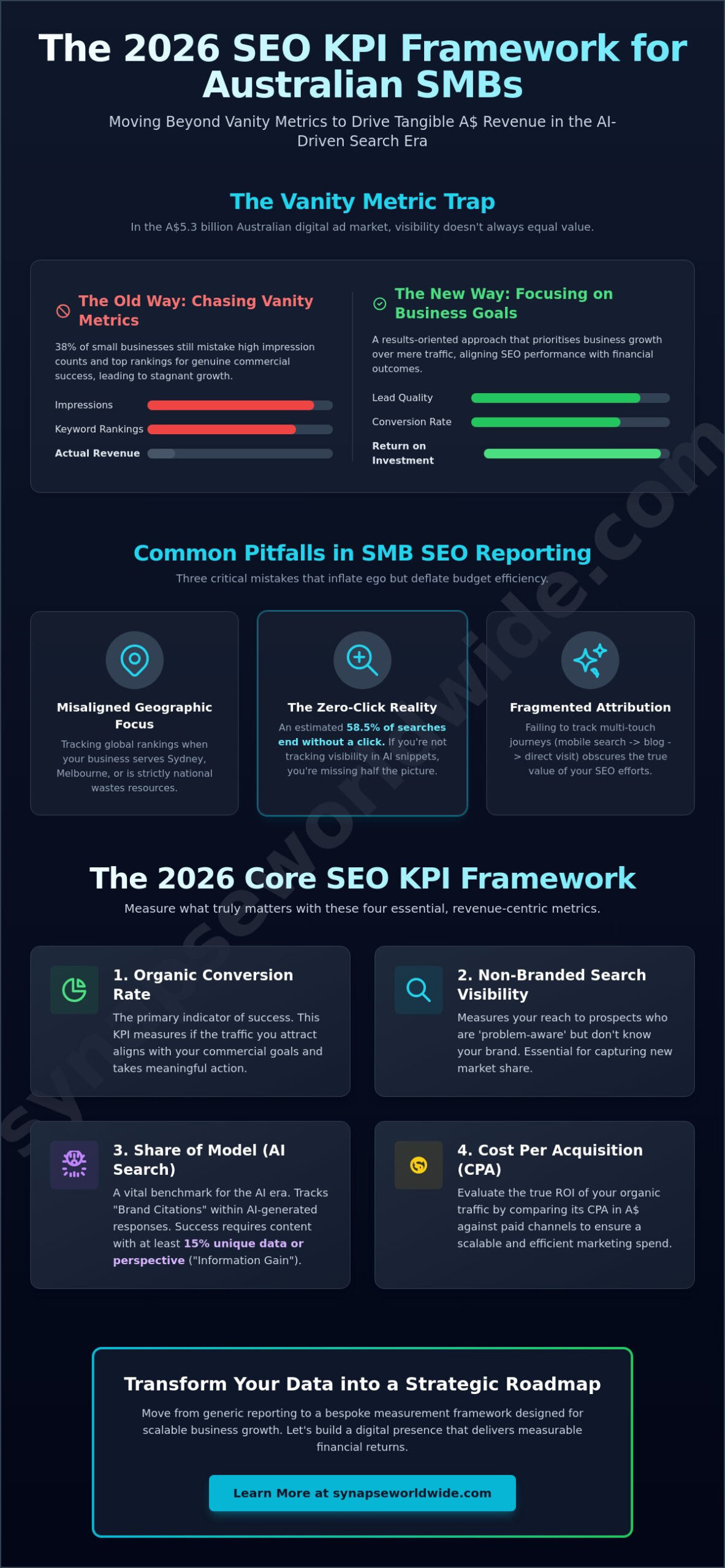
In the A$5.3 billion Australian digital advertising market, roughly 38% of small businesses still mistake high impression counts for genuine commercial success. It’s frustrating to watch your organic reach expand while your conversion rate remains stagnant; you know that vanity metrics don’t pay the bills. You need a more sophisticated way to measure seo kpis for small business that accounts for the rise of AI-driven search and shifting consumer habits. We understand that proving a return on investment to stakeholders requires more than a screenshot of a ranking report.
This guide empowers you to master the precise metrics that bridge the gap between search visibility and tangible A$ revenue in the 2026 landscape. You’ll move beyond surface-level data to embrace a results-oriented approach that prioritises business growth over mere traffic. We will outline a strategic dashboard of seven essential metrics that reduce your Cost Per Acquisition and provide the data-driven confidence needed to communicate success in clear, financial terms. Prepare to transform your digital presence into a scalable asset through clinical, evidence-based optimization.
Key Takeaways
- Move beyond the “Vanity Metric Trap” by aligning your technical search performance with tangible revenue goals and long-term business growth.
- Identify the most impactful seo kpis for small business in the 2026 landscape, including the critical “Share of Model” metric for AI-driven search visibility.
- Evaluate the true ROI of your organic traffic by comparing Cost Per Acquisition (CPA) in A$ against paid channels to ensure a scalable and efficient marketing spend.
- Implement a robust tracking setup within GA4 to capture precise “Key Events” that map directly to your specific Australian market objectives.
- Transition from generic reporting to a bespoke measurement framework designed to transform raw data into a strategic roadmap for national expansion.
Beyond Vanity Metrics: Why Small Businesses Fail at SEO Tracking
For many Australian enterprises, search engine optimization often feels like a black box. You see numbers move, but the bank balance stays the same. To scale effectively in the current market, you must treat seo kpis for small business as the vital bridge between technical search performance and corporate revenue goals. Without this link, you’re simply collecting data without purpose.
Adopting the Digital Architect mindset means viewing SEO data as foundational infrastructure rather than a peripheral marketing expense. In the 2026 search landscape, traditional ranking reports no longer suffice. AI-driven search engines and generative overviews have changed how users interact with content. A business might rank first for a high-volume term, yet see zero traffic because an AI summary answered the query on the search results page. This shift requires a move away from the Vanity Metric Trap, where high impressions and keyword counts mask a stagnant return on investment.
The Difference Between Data and Insights
Raw data is noise; insights are signals that drive growth. Small businesses often drown in spreadsheets featuring thousands of keywords that don’t convert. You must prioritise quality over quantity by filtering out metrics that don’t impact your bottom line. An SEO KPI is a measurable value that demonstrates how effectively a company is achieving search objectives.
Common Pitfalls in SMB SEO Reporting
- Misaligned Geographic Focus: Many Australian companies track global rankings when their service area is strictly national or limited to specific hubs like Sydney or Melbourne. This inflates ego but deflates budget efficiency.
- The Zero-Click Reality: Recent industry data indicates that approximately 58.5% of searches now end without a click. If your reporting doesn’t account for brand visibility within AI snippets, you’re missing more than half the picture.
- Fragmented Attribution: Small businesses frequently fail to attribute conversions across multi-touch digital journeys. A customer might find you via a mobile search on Monday, read a blog on Wednesday, and finally convert via a direct visit on Friday.
Strategic growth requires a bespoke approach to measurement. You don’t need more data; you need better clarity. By focusing on integrated metrics that reflect actual business outcomes, you transform SEO from a technical chore into a scalable engine for transformation. This professional rigour ensures your digital presence remains robust and results-oriented in an increasingly competitive Australian landscape.
The 2026 Core SEO KPI Framework: Measuring What Truly Matters
Effective digital strategy requires moving beyond vanity metrics. For Australian SMEs, the digital landscape in 2026 demands a focus on high-intent data that correlates directly with revenue. We prioritise the Organic Conversion Rate as the primary indicator of success. This metric tells us if the traffic we attract actually aligns with your commercial goals. A high volume of visitors is irrelevant if they don’t take action. We look for a steady climb in conversion percentages, ensuring your landing pages meet the specific needs of the Australian consumer.
Tracking non-branded search visibility is equally critical for sustainable growth. This KPI measures your reach among prospects who are “problem-aware” but don’t yet know your brand. If your traffic relies solely on your business name, your growth is capped. By monitoring how you rank for generic industry terms, we measure your ability to capture new market share. These seo kpis for small business provide a clear roadmap for expanding your influence beyond your existing customer base. Underpinning this entire process is a strategic approach to keyword research for beginners, which ensures you are targeting terms that reflect genuine purchase intent rather than simply chasing high-volume phrases.
Visibility in the Age of AI Search
The rise of AI Overviews has introduced “Share of Model” as a vital benchmark. We no longer just track blue links; we measure “Brand Citations” within AI-generated responses. Google’s algorithms now reward semantic relevance and topical authority over simple keyword density. Your content must demonstrate “Information Gain,” a concept solidified in Google’s 2024 core updates. This refers to the unique, additive value your content provides that doesn’t exist elsewhere on the web. We aim for at least 15% unique data or perspective in every piece of content to ensure AI models recognise your brand as an authoritative source. A unified content marketing SEO strategy is essential to consistently producing this kind of authoritative, AI-visible content at scale.
Technical Performance and User Experience
Technical health is a primary ranking signal that directly impacts your bottom line. Google’s transition to Interaction to Next Paint (INP) in March 2024 as a Core Web Vital highlight’s the importance of responsiveness. If a user clicks a button and waits more than 200 milliseconds for a visual response, your rankings and conversions will suffer. Mobile-first design is no longer a suggestion; it’s the standard for organic retention in the Australian market.
A robust technical foundation ensures that your SEO efforts aren’t wasted on a site that frustrates users. You can learn more about building a high-performance platform by exploring custom web design for small business, which explores the critical link between site architecture and search visibility. When your technical execution matches your content quality, you create a seamless journey that turns searchers into loyal clients. If you want to see how these metrics apply to your specific industry, request a strategic audit to identify your growth bottlenecks.
By integrating these advanced seo kpis for small business, we move away from guesswork. We focus on measurable technical precision and semantic depth, ensuring your business remains visible and authoritative in an AI-driven search environment.
Revenue-Centric SEO: Aligning Search Performance with Business ROI
Digital growth hinges on moving beyond simple traffic counts. For an Australian trade business or retail shop, the most critical seo kpis for small business involve direct financial outcomes. While a Google Ads campaign might offer an immediate Cost Per Acquisition (CPA) of A$80, a mature SEO strategy often reduces this to under A$20 over an 18 month period. This efficiency makes organic search the most scalable channel for long term profitability.
High performing SEO strategies focus on Customer Lifetime Value (CLV). Users who find a business through educational, non-branded search queries often demonstrate higher loyalty than those clicking on a transactional ad. This is because organic visibility builds foundational trust. To measure this, we track assisted conversions in GA4. SEO frequently serves as the first touchpoint in a multi stage journey. If a customer discovers your brand via a blog post but converts three weeks later through a direct visit, SEO deserves the credit for that initial engagement.
- Organic Revenue Growth: We map specific search clusters to revenue streams to ensure every click has a commercial purpose.
- CPA Comparison: We contrast the monthly SEO retainer against the equivalent spend required to buy that same traffic via PPC.
- Assisted Conversion Value: This metric captures the 35% of revenue that typically originates from search but closes through other channels.
Calculating SEO ROI for Small Businesses
Measuring the success of your digital investment requires a clear financial lens. SEO ROI is calculated by subtracting the cost of SEO from the organic revenue generated, divided by the cost of SEO. Unlike the instant gratification of paid search, SEO requires a strategic patience. Most Australian small businesses see the “break even” point occur between months six and nine, after which the ROI begins to compound. We treat SEO as a robust capital investment rather than a monthly expense, focusing on the long term appreciation of your digital assets.
The Role of Branded vs. Non-Branded Traffic
A sophisticated seo kpis for small business framework distinguishes between discovery and retention. Non-branded traffic is your engine for new customer acquisition. These are users searching for solutions, such as “emergency plumber Sydney” or “bespoke jewellery Melbourne,” who don’t yet know your brand. Branded traffic, conversely, measures your market authority. When users search for your specific company name, it indicates that your offline marketing and digital reputation are working. We set separate targets for these: 70% of growth should typically come from non-branded discovery to ensure your business isn’t just “preaching to the choir.”
Implementing Your SEO Measurement Strategy: Tools and Best Practices
Execution without measurement is merely guesswork. To transform your digital presence into a predictable growth engine, you need a structured approach to data. Start by auditing your Google Analytics 4 (GA4) setup. In 2026, clean data is your most valuable asset. Ensure that cross-domain tracking and enhanced measurement are correctly configured to prevent fragmented user journeys. This step ensures that your seo kpis for small business are based on reality rather than technical glitches.
Next, define your “Key Events.” These have replaced traditional conversions in the Google ecosystem. For an Australian small business, these should map directly to revenue-generating activities like form submissions, phone clicks, or specific product interactions. Once these are active, integrate your Search Console data with your CRM. This creates a bridge between an anonymous organic click and a closed A$10,000 contract. Establishing a monthly reporting cadence is vital. Daily fluctuations in rankings are noise; focus on 30-day trends to understand the true trajectory of your organic growth.
The Essential 2026 SEO Tech Stack
Your toolkit must evolve beyond basic spreadsheets. GA4 and Search Console remain the foundation, providing raw organic performance data directly from the source. However, the rise of AI Overviews requires specialized tracking. Use AI-driven rank trackers that simulate search intent and monitor visibility within generative search results. A robust CRM integration ensures you aren’t just tracking traffic, but identifying which organic keywords actually drive high-value Australian customers to your door. We recommend bespoke dashboards, such as those built in Looker Studio, to visualize these complex data points for your leadership team.
Data Hygiene and Accuracy
Metrics are only useful if they’re accurate. Small businesses often see skewed data because of internal traffic or referral spam. Filter your office IP addresses and known bot signatures immediately to maintain integrity. You should also treat “Keyword Difficulty” scores from third-party tools with caution. These are estimates, not absolute truths. A keyword might show high difficulty but remain accessible if your content demonstrates superior topical authority. While AI can process vast datasets, human analysis is required to interpret the “why” behind the numbers. Automated reports can identify a drop in traffic, but a specialist identifies if that drop was due to a seasonal Australian holiday or a technical crawl error. This human oversight is what turns raw seo kpis for small business into actionable business intelligence.
Ready to turn your data into a strategic advantage? Consult with our digital architects to build a measurement framework that drives real ROI.
Bespoke SEO Strategy: Transforming Data into Scalable Business Growth
Generic dashboards often mislead Australian business owners by focusing on vanity metrics that don’t impact the bottom line. A one-size-fits-all approach ignores the fact that a boutique medical clinic in Perth operates under different market pressures than a national retail chain. Synapse Worldwide rejects cookie-cutter templates. We construct custom measurement frameworks that align directly with your national growth objectives. By tailoring seo kpis for small business, we ensure every data point serves a specific commercial purpose.
The shift from passive tracking to active optimization distinguishes market leaders from their competitors. Instead of merely recording monthly traffic changes, we use data to refine content and technical roadmaps. This transforms SEO from a recurring monthly expense into a high-yield long-term asset. When you treat your organic presence as digital real estate, the focus shifts to compounding returns rather than short-term spikes. It’s about building a robust foundation that supports scalable expansion across the Australian market.
The Strategic Growth Framework
Effective data analysis uncovers hidden revenue streams. By scrutinizing search intent and conversion patterns, we identify service gaps and emerging market opportunities that competitors often overlook. Our approach integrates these insights into a broader SEO for small business strategy. In one recent engagement, a data-driven pivot in keyword targeting led to a 34% increase in qualified leads for a specialist Australian consultancy within six months. This framework ensures your SEO efforts aren’t just visible, but profitable.
- Identify high-intent search clusters that competitors ignore.
- Align technical performance with Core Web Vitals to capture mobile-first users.
- Utilize conversion rate data to refine landing page architecture.
Your Next Steps for Organic Dominance
Transitioning from passive monitoring to proactive execution is the key to outperforming the market. Success in 2026 requires a disciplined, results-oriented roadmap rather than reactive adjustments. The first step involves establishing a clear baseline through a professional audit. This process clarifies your current standing and highlights the exact seo kpis for small business that will drive your expansion. Don’t leave your digital growth to chance. Contact Synapse Worldwide for a bespoke SEO strategy audit to begin your journey toward market leadership and scalable revenue growth.
Transform Your Search Data into Scalable Business Assets
Navigating the 2026 search landscape requires a shift from tracking simple clicks to measuring high-impact revenue drivers. Australian firms that prioritise vanity metrics often miss the deeper insights needed for long-term stability. By adopting a framework focused on seo kpis for small business, you ensure your digital investment translates into measurable ROI. This strategic alignment is the difference between surviving the market and leading it. Since 2005, Synapse Worldwide has delivered over 20 years of digital expertise, crafting custom digital infrastructure that meets the rigorous demands of corporate and government clients nationwide. We focus on building robust, integrated solutions that turn complex data into clear growth trajectories. You don’t need a one-size-fits-all approach; you need a partner who understands the nuances of the Australian digital landscape and the technical precision required for high-performance results. It’s time to move beyond basic reporting and start building a digital legacy that scales with your ambitions.
Scale your organic growth with a bespoke SEO strategy from Synapse Worldwide
Your journey toward a more profitable digital presence starts with a single strategic decision today.
Frequently Asked Questions
What is the most important SEO KPI for a small business?
Organic conversions, such as qualified leads or direct sales, represent the ultimate SEO KPI for a small business. While traffic volume matters, your bottom line depends on visitors who take a specific action. In 2026, a high-performing Australian SME should target a conversion rate of 2% to 5% from organic search. Tracking this ensures your strategy aligns with revenue growth rather than just vanity metrics that don’t impact your bank balance.
How long does it take to see changes in SEO KPIs?
You’ll typically observe measurable shifts in your performance data within 4 to 6 months of implementing a bespoke strategy. Initial technical fixes might show results in 30 days, but sustainable growth in competitive Australian niches requires a longer horizon. Data from 2025 industry benchmarks suggests that 82% of successful campaigns hit their first major traffic milestone by the 180-day mark. Patience is vital for building a robust, scalable digital foundation.
Why is my organic traffic increasing but my sales are not?
Your traffic is likely increasing for non-commercial keywords that don’t drive purchase intent. If 70% of your visitors land on broad informational blog posts but your product pages remain stagnant, sales won’t follow. This often happens when content targets high-volume terms instead of the specific needs of your Australian customer base. Review your bounce rates and conversion paths to identify where potential buyers are dropping out of your digital sales funnel.
Can I track SEO KPIs for free using only Google tools?
You can track nearly all essential seo kpis for small business for free using Google Search Console and Google Analytics 4 (GA4). These platforms provide 100% of the data needed to monitor clicks, impressions, and user behaviour on your site. By setting up custom events in GA4, you can measure specific actions like A$0 checkout completions or contact form submissions. It’s a professional-grade solution that provides deep insights without monthly subscription costs.
How has AI search changed which KPIs I should track in 2026?
AI search evolution in 2026 has shifted the focus toward brand citations and “Share of Model” metrics. Traditional click-through rates are less reliable now that AI Overviews answer 40% of queries directly on the search results page. You should now track how often AI agents cite your brand as a recommended source. This requires a shift from simple keyword tracking to measuring your authority within specific Australian industry datasets and knowledge graphs.
What is a good conversion rate for organic search traffic?
A benchmark organic conversion rate for Australian small businesses ranges between 2% and 5% across most sectors. Professional service providers often see higher rates, sometimes reaching 10% for highly targeted local searches. If your current rate is below 1.5%, it indicates a strategic gap in your user experience or call-to-action placement. We focus on optimizing these touchpoints to ensure your digital landscape converts interest into tangible, measurable revenue for your business.
How often should I review my SEO performance reports?
Conduct a comprehensive review of your SEO performance reports every 30 days to identify long-term trends and strategic shifts. Monthly cycles allow enough time for data to stabilize and reveal the impact of your optimizations. You should also perform a 10-minute weekly health check to monitor for sudden ranking drops or technical errors. This disciplined rhythm ensures you remain proactive in the competitive Australian market without getting distracted by daily fluctuations.
What is the difference between an SEO metric and an SEO KPI?
An SEO metric is a raw data point like page load speed, while an SEO KPI is a strategic measurement tied directly to your business objectives. For instance, tracking 500 monthly impressions is a metric. Increasing your organic lead generation by 20% by December 2026 is a KPI. Understanding this distinction allows you to filter out noise and focus on the seo kpis for small business that actually drive transformation.

