
Tag Archives: ROI


Strategic Website Management: A Guide for Australian Business Growth in 2026

Strategic Website Management: A Guide for Australian Business Growth in 2026

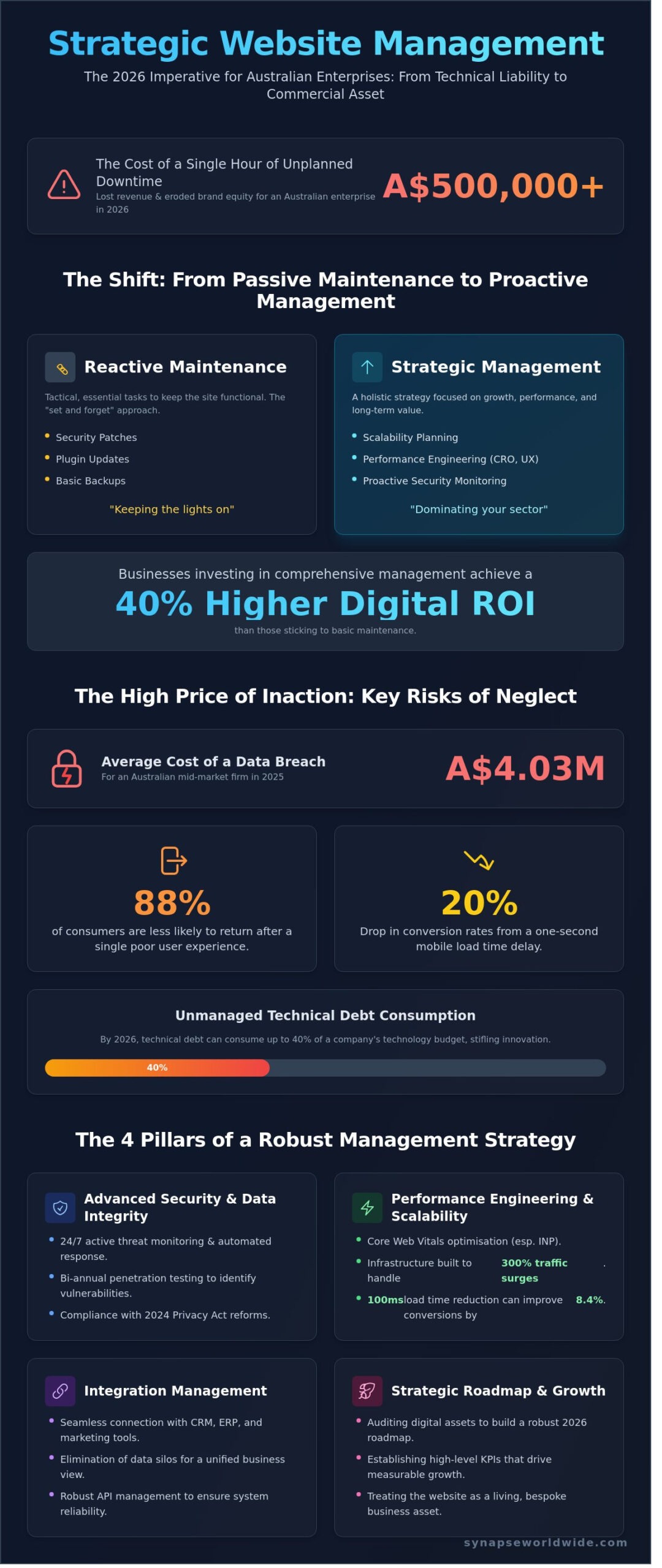
A single hour of unplanned downtime in 2026 can cost an Australian enterprise upwards of A$500,000 in lost revenue and eroded brand equity. You likely recognize that your digital presence has evolved beyond a simple brochure; it’s now the primary engine for your commercial success. Yet, when security vulnerabilities or sluggish load times compromise your SEO rankings, that vital asset quickly transforms into a significant liability for your internal teams.

Strategic website management is the catalyst that turns a static site into a bespoke, high-performance engine built for measurable growth. This guide demonstrates how a sophisticated approach to digital infrastructure secures your data, optimizes speed, and ensures your platform is ready to scale alongside your ambitions. We’ll explore the shift from reactive technical tasks to a long-term partnership that delivers a consistent, high-level ROI for your Australian business.

Key Takeaways

  • Transition from a passive “set and forget” mentality to a proactive strategy that eliminates technical debt and secures long-term scalability.
  • Master the core pillars of security and performance to ensure your digital presence exceeds evolving Core Web Vitals and compliance standards.
  • Evaluate the strategic cost-benefit of internal hiring versus a specialised agency for professional website management in the Australian landscape.
  • Build a robust 2026 roadmap by auditing current digital assets and establishing high-level KPIs that drive measurable business growth.
  • Discover why treating your website as a living, bespoke business asset provides a significant ROI over standard, cookie-cutter maintenance.

The Evolution of Website Management: Beyond Keeping the Lights On

Effective website management represents a transition from passive survival to active growth. It’s the strategic oversight of your firm’s entire digital ecosystem, ensuring every component aligns with your 2026 commercial objectives. Many Australian business owners still fall into the ‘set and forget’ trap. This approach is the primary driver of technical debt. By the start of 2026, industry data indicates that unmanaged technical debt can consume up to 40% of a company’s technology budget. We see a clear shift in the market. Successful firms don’t wait for a site to crash. They invest in proactive performance optimisation to maintain a competitive edge.

Professional management serves as the bedrock for every digital marketing campaign you launch. Whether it’s a high-spend Google Ads campaign or a long-term SEO strategy, the results depend on the health of your site. If your platform isn’t optimised for speed, security, and user experience, your marketing spend is effectively subsidising your competitors. A bespoke management plan ensures your infrastructure is robust enough to convert the traffic your marketing generates.

Maintenance vs. Management: Understanding the Difference

Maintenance is tactical. It involves essential but basic tasks like security patches, backups, and plugin updates. It’s about keeping the site functional. Strategic website management is different. It focuses on scalability planning, UX refinement, and conversion rate optimisation. Data from Deloitte Access Economics highlights that businesses investing in comprehensive management achieve a 40% higher digital ROI than those sticking to basic maintenance. It’s the difference between merely existing online and dominating your sector.

The Cost of Neglect in a Modern Digital Landscape

Neglect carries a heavy price tag. A one-second delay in mobile load times can slash conversion rates by up to 20% in the Australian e-commerce sector. Beyond immediate revenue loss, there’s the reputational risk. In 2025, the average cost of a data breach for an Australian mid-market firm reached A$4.03 million. Technical debt also creates a glass ceiling. It prevents you from integrating the latest AI-driven marketing tools, leaving your brand stuck in a legacy framework while competitors scale. Common risks include:

  • SEO Erosion: Search engines penalise sites with poor Core Web Vitals and outdated security protocols.
  • Integration Failure: Legacy code prevents the seamless connection of modern CRM and automation tools.
  • Customer Churn: 88% of online consumers are less likely to return to a site after a single poor user experience.

Investing in a managed digital presence isn’t an overhead; it’s a safeguard for your brand’s future. By treating your website as a dynamic asset rather than a static brochure, you position your business for sustainable transformation.

Core Pillars of a Robust Website Management Strategy

A successful website management strategy in 2026 relies on four foundational pillars that convert a static digital presence into a high-performing business asset. Australian enterprises must move beyond reactive maintenance; they need a framework that prioritises security, speed, brand integrity, and technical stability. This holistic approach ensures that hosting environments, DNS configurations, and API integrations function as a unified engine for growth.

Advanced Security and Data Integrity

Security has evolved far beyond the basic SSL certificate. By late 2025, approximately 68% of Australian mid-market firms had adopted automated incident response protocols to counter sophisticated AI-driven threats. Active threat monitoring must operate 24/7, identifying anomalies before they escalate into costly breaches. Regular penetration testing, conducted at least bi-annually, remains the gold standard for identifying vulnerabilities within the local digital landscape. Following the 2024 Privacy Act reforms, maintaining data integrity is both a technical requirement and a legal mandate for protecting your brand’s reputation.

Performance Engineering and Scalability

Performance engineering is a proactive methodology focused on optimising speed and responsiveness at every layer of the technology stack. This approach ensures that Core Web Vitals, particularly Interaction to Next Paint (INP), remain within the “Good” threshold even during peak traffic periods. Research from 2024 indicates that a 100-millisecond reduction in mobile load times can improve retail conversion rates by up to 8.4%. Scalability requires continuous monitoring of server response times and database query efficiency. Preparing for growth means your infrastructure should handle a 300% traffic surge without latency, ensuring your site remains a reliable revenue driver during high-demand campaigns.

Integration Management: CRM, ERP, and Beyond

Bespoke website management ensures that your digital front-end communicates perfectly with backend systems like Salesforce, Microsoft Dynamics, or SAP. Data silos are the enemy of growth; seamless data flow between your website and CRM is essential for real-time lead processing and accurate customer insights. Managing third-party API updates is critical, as a single deprecated endpoint can break checkout flows or secure customer portals. For complex enterprise sites, tailored integration support provides the technical oversight needed to manage these dependencies without risking site-wide failures or data loss.

Strategic Website Management: A Guide for Australian Business Growth in 2026

Operational Models: In-House vs. Managed Agency

Choosing the right operational structure for your digital presence dictates your scaling velocity. Australian businesses often oscillate between hiring an internal “webmaster” and partnering with a managed service provider. While direct control feels reassuring, the mathematical reality of maintaining a modern tech stack suggests a different strategic path. Effective website management in 2026 requires more than a single pair of hands; it demands a multidisciplinary approach that few single hires can provide.

The Hidden Costs of In-House Management

The financial burden of an internal hire extends far beyond the base salary. By 2026, a senior full-stack developer in Australian metropolitan hubs like Sydney or Melbourne commands a base salary between A$155,000 and A$190,000. When you factor in the 12% statutory superannuation, payroll tax, and recruitment fees (averaging 18% of the annual salary), the Total Cost of Employment (TCE) frequently exceeds A$220,000. Relying on one individual also creates a single point of failure. If your lead developer departs, they take years of institutional knowledge with them, leaving your infrastructure vulnerable. Internal teams should focus on high-level business innovation rather than the repetitive cycle of security patches and server optimisations.

  • Recruitment Lag: It takes an average of 45 days to fill a technical role in the Australian market.
  • Skill Gaps: A single hire rarely masters UX design, technical SEO, and server-side security simultaneously.
  • Infrastructure Overhead: In-house teams require expensive software licences and continuous professional development budgets.

The Agency Advantage: Access to the Digital Architect

Partnering with a managed agency provides immediate access to a “Digital Architect” model. This structure replaces the lone webmaster with a collective of specialists. Your website management strategy benefits from the shared intelligence of developers, SEO analysts, and UX designers who manage diverse portfolios across the Australian digital landscape. This cross-pollination of data means your site stays ahead of algorithm shifts and security threats before they impact your bottom line. Understanding how a modern web agency approaches digital architecture in 2026 can help you identify the right long-term partner for your enterprise.

Managed services offer professional accountability through Service Level Agreements (SLAs). These contracts guarantee 99.9% uptime and specific response times, often providing 24/7 monitoring that an in-house staffer cannot realistically maintain. You trade the illusion of direct oversight for the reality of guaranteed performance. This shift allows your leadership team to stop managing tickets and start measuring ROI. We ensure your technology supports your growth targets without the friction of personnel management or technical debt.

Building Your 2026 Website Management Roadmap

A management roadmap is a strategic document that outlines the evolution of your digital presence to drive long-term business growth. Successful Australian enterprises don’t treat their digital presence as a static asset; they view it as a living system requiring a structured evolution. By 2026, the complexity of integrated ecosystems means that a reactive approach will lead to technical debt that stifles up to 15% of annual revenue potential. Effective website management requires a forward-looking plan that balances immediate stability with aggressive feature development.

The Audit: Identifying Vulnerabilities and Opportunities

Your roadmap begins with a forensic analysis of your current infrastructure. We examine site architecture and code quality to identify legacy scripts that increase latency. In 2024, data from Sitemorse indicated that 72% of corporate sites carried significant technical debt; by 2026, this will be the primary barrier to AI integration. Our audit process focuses on three critical pillars:

  • Integration Health: Evaluating how your CMS communicates with ERP and CRM systems to ensure data flows without friction.
  • User Journey Heatmaps: Utilizing tools like Hotjar or Microsoft Clarity to identify where 30% or more of users drop off in the enquiry funnel.
  • Infrastructure Scalability: Assessing if your current hosting can handle a 400% traffic surge during peak Australian retail events like Click Frenzy or seasonal sales.

Setting Measurable Management Goals

Traditional metrics like 99.9% uptime are now baseline requirements, not competitive advantages. Your 2026 goals must pivot toward tangible business outcomes. We focus on Core Web Vitals and lead quality, ensuring every technical update serves a commercial purpose. If your page load speed improves by just 0.5 seconds, research shows a correlated 10% increase in mobile conversion rates for Australian e-commerce sectors. We align technical KPIs with your revenue targets to ensure your website management partner is accountable for growth, not just maintenance.

Budgeting for this growth requires a bifurcated approach. We recommend allocating 60% of your digital budget to platform stability and security, while 40% is reserved for bespoke feature enhancements. This ensures your platform remains robust while you continue to innovate. For a mid-sized Australian firm, this might involve a quarterly strategic review to reallocate an estimated A$15,000 to A$45,000 toward high-impact UI/UX updates. Establishing the right CMS and digital strategy alignment for your 2026 roadmap is essential to ensuring your platform investments deliver scalable, revenue-generating results. Establish a monthly cadence for security patches and a quarterly cadence for deep-dive strategic performance reviews to remain agile.

Ready to eliminate technical debt and scale? Explore our bespoke website management solutions to secure your digital future.

Synapse Worldwide: Bespoke Management for Complex Digital Ecosystems

Synapse Worldwide treats your digital presence as a living, breathing business asset rather than a static expense. Effective website management requires more than occasional plugin updates or server reboots. We focus on bespoke solutions because cookie-cutter maintenance packages often ignore the unique friction points of a growing Australian enterprise. Generic plans might keep a site online, but they don’t drive it forward or adapt to shifting market demands.

Our methodology integrates SEO, e-commerce logistics, and custom software development into a unified operational flow. This synergy prevents the technical silos that often lead to data leaks or performance bottlenecks. When your backend systems and front-end marketing work in harmony, you gain a competitive edge that off-the-shelf solutions can’t replicate. We ensure that every line of code serves a specific business objective, whether that’s reducing cart abandonment or automating lead distribution.

A Results-Oriented Partnership Model

Australian enterprises trust Synapse as a long-term partner because we prioritize stability and scalability. Our annual subscription models provide technical peace of mind and financial predictability, allowing you to budget for growth without fearing surprise repair costs. You gain access to strategic consultants who act as your digital architects. For example, a Sydney-based logistics firm saw a 38% improvement in operational efficiency after we integrated their proprietary tracking software into their main site architecture.

  • Proactive infrastructure audits to eliminate technical debt before it impacts performance.
  • Direct access to senior consultants who understand the Australian regulatory environment.
  • Documented growth; we’ve helped clients achieve up to a 22% increase in organic traffic through meticulous backend optimization.

Next Steps: Elevating Your Digital Presence

Transitioning from reactive maintenance to a managed strategic model is a critical step for any maturing business. It’s a shift from fixing problems to preventing them. During the initial Synapse discovery phase, we conduct a comprehensive audit of your existing tech stack to identify vulnerabilities. This onboarding process typically spans 14 days and results in a tailored roadmap designed for the 2026 digital economy.

Master Your Digital Evolution for 2026

The transition from passive maintenance to proactive website management represents the most significant shift for Australian enterprises heading into 2026. Success no longer depends on merely staying online. It requires a sophisticated integration of complex CRM systems and high-performance E-commerce architectures that drive measurable ROI. By moving away from fragmented in-house attempts toward a robust, managed roadmap, your business secures the scalability needed to dominate an increasingly competitive market.

Synapse Worldwide has served as an authoritative strategic consultant for Australian enterprises since 2005, bringing over 20 years of digital expertise to every partnership. We specialize in navigating the intricate technical requirements of modern digital ecosystems, ensuring your platform remains a high-yielding asset rather than a technical burden. It’s time to elevate your brand’s performance and transform your digital presence into a catalyst for sustainable growth.

Secure Your Digital Future with Expert Website Management

Your journey toward digital excellence is just beginning, and the potential for your business to lead the Australian market has never been greater.

Frequently Asked Questions

What is included in professional website management?

Professional website management encompasses security patches, performance tuning, uptime monitoring, and strategic content updates. Our bespoke approach ensures your digital infrastructure remains robust through weekly software updates and 24/7 threat detection. We prioritize a seamless user experience by managing your integrated systems, allowing your business to scale without technical friction.

How much does website management cost in Australia for 2026?

Standard website management in Australia for 2026 typically ranges from A$250 to A$2,500 per month. Small business packages usually start at A$300; however, complex e-commerce platforms requiring intensive optimization often exceed A$1,500. These figures reflect the rising costs of cybersecurity protocols and the specialized expertise required to maintain a competitive digital landscape in the Australian market.

Do I need website management if I have a small business site?

Every Australian business requires active management because 43% of all cyberattacks target small enterprises. A static site is a vulnerable site. Without a dedicated plan, your business risks data breaches that can cost an average of A$3.35 million per incident according to recent Australian cyber security reports. Professional oversight ensures your site remains a reliable asset rather than a liability.

Can website management improve my SEO rankings?

Effective website management directly impacts SEO by optimizing Core Web Vitals and page load speeds. Google’s recent algorithm updates heavily weight technical performance; a 0.1 second improvement in mobile load time can boost conversion rates by 8.4%. By maintaining clean code and fast server response times, we ensure your site ranks higher in search results, driving measurable growth.

What is the difference between web hosting and website management?

Web hosting provides the server space where your site lives, while website management is the proactive service that keeps that site healthy and secure. Think of hosting as the land and management as the architect and property manager combined. While a host keeps the lights on, management ensures the building is modern, secure, and performing at peak efficiency to drive your ROI.

How often should a website be updated and audited?

Security patches and plugin updates should occur weekly to mitigate vulnerabilities. We recommend a comprehensive strategic audit every 90 days to evaluate performance metrics and alignment with your 2026 business goals. This quarterly rhythm allows for data-driven adjustments that keep your digital presence ahead of competitors and responsive to shifting market demands.

Is it better to hire a freelancer or an agency for website management?

An agency provides a scalable team of specialists, whereas a freelancer represents a single point of failure. Agencies offer 24/7 monitoring and a multidisciplinary approach that includes SEO, security, and strategic consulting. For Australian businesses targeting significant growth, the agency model provides the professional stability and global perspective needed to manage complex digital ecosystems effectively.

What happens if my website goes down and I don’t have a management plan?

Unmanaged downtime can cost Australian businesses upwards of A$500 per hour in lost revenue and emergency restoration fees. Without a plan, you’ll likely face extended outages while searching for a developer to fix the issue. A managed service prevents this through redundant backups and instant recovery protocols, ensuring your brand’s reputation remains untarnished and your sales funnel stays open.


The Strategic Guide to Apps and Mobile Apps for Business in 2026

The Strategic Guide to Apps and Mobile Apps for Business in 2026

What if your most ambitious digital investment is actually a silent drain on your 2026 profit margins? While 82% of Australian enterprises prioritize mobile-first strategies, many stumble into the trap of high development costs without a clear path to ROI. You likely understand that a robust digital presence is vital for staying competitive, yet the technical jargon surrounding apps mobile apps often creates more confusion than clarity. Choosing between Native, Hybrid, and PWA architectures shouldn’t feel like a gamble with your capital.

This guide simplifies the complexity of mobile development by focusing on strategic business outcomes rather than just code. We’ll show you how to choose a scalable architecture that integrates seamlessly with your current ERP and CRM systems, potentially saving you upwards of A$50,000 in avoidable technical debt. You’ll gain a clear roadmap for your digital transformation and the confidence to select a partner who views your mobile presence as a bespoke asset for growth. We’ll break down the specific frameworks that will dominate the Australian landscape over the next 24 months.

Key Takeaways

  • Understand the 2026 shift from simple utilities to integrated business environments designed to drive scalable growth and digital transformation.
  • Master the distinction between broad software applications and device-specific apps mobile apps to select the architectural path that best balances performance with your A$ investment.
  • Leverage headless architectures to ensure your mobile solutions are robust, data-driven, and seamlessly integrated into your existing business ecosystem.
  • Identify the non-negotiable cybersecurity standards and emerging technologies required to protect your brand and maintain compliance in the Australian market.
  • Adopt a bespoke “Digital Architect” methodology to transition from initial discovery to a high-performance, post-launch maintenance strategy.

Understanding the 2026 Landscape of Apps and Mobile Apps

By 2026, the distinction between software categories has sharpened significantly. While “apps” broadly refers to any software application designed for a specific task, what are mobile apps specifically describes software engineered to run on handheld devices like smartphones or tablets. For Canberra startups, understanding this nuance is critical for long-term scalability. The market has shifted from 2018, where simple utilities dominated, to a landscape where 72% of Australian consumers expect a seamless, integrated business environment within a single interface. Strategic planning for apps mobile apps requires more than just code; it demands a vision for how software integrates into the daily lives of Australians.

The evolution of these tools has been dramatic. We’ve moved beyond the era of standalone calculators or basic news feeds. Modern applications now serve as comprehensive digital hubs that facilitate everything from inventory management to complex financial transactions. In the current Australian market, generic templates no longer suffice. By 2025, over 3.5 million applications populated the major stores, yet research indicates that 80% of users delete an app within three days if it feels generic. Bespoke quality isn’t a luxury; it’s a strategic necessity. The distinction between generic software and high-performance apps mobile apps determines whether a Canberra startup scales or stagnates. Investing in custom architecture allows for a level of stability and performance that off-the-shelf solutions can’t match.

Digital transformation strategies now place these applications at the centre of the business ecosystem. They aren’t just add-ons; they’re the primary touchpoints for customer data and engagement. A robust mobile strategy provides deep insights into user behaviour that a static website cannot capture. By 2026, integrated apps serve as the primary interface for client interaction, allowing for:

  • Real-time data synchronisation across disparate departments, reducing manual entry errors by 30%.
  • Enhanced user retention through personalised experiences that leverage machine learning.
  • Direct revenue channels that bypass third-party aggregators, saving businesses up to 15% in platform fees.

This shift ensures that your digital presence isn’t just a placeholder but a functional asset driving measurable growth.

The Distinction Between Web Apps and Mobile Apps

Not every digital solution requires an entry in the Apple App Store or Google Play. Web apps function through a browser like Safari or Chrome, using technologies like HTML5 to deliver functionality without a download. They’re excellent for accessibility but often lack hardware integration. Conversely, mobile apps are software packages specifically written for iOS or Android. These provide the high-performance execution that 90% of high-growth startups require for complex data processing.

Why Your Business Needs a Dedicated Mobile Presence

Mobile-responsive websites often fail when tasks exceed basic information retrieval. If your workflow requires high-speed data entry, a browser-based solution typically sees a 40% drop in user efficiency compared to dedicated software. Mobile apps offer two vital advantages: offline functionality and granular push notifications. These features allow Canberra businesses to maintain a 24/7 connection with their audience. An “App-First” business model is a strategy where the primary customer acquisition, service delivery, and revenue generation occur within a dedicated mobile application rather than through traditional web or physical channels.

The Architectural Spectrum: Native, Hybrid, and Progressive Web Apps

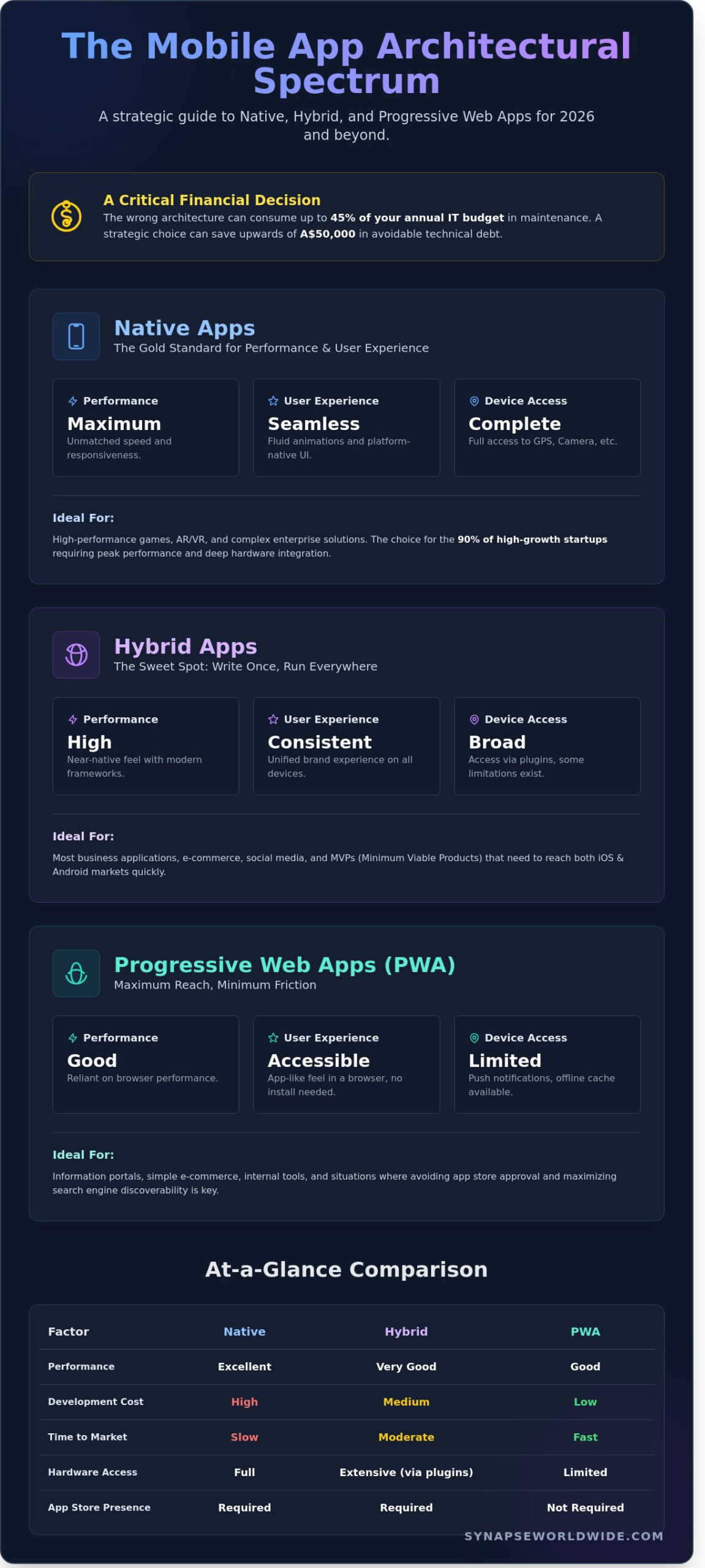
Canberra startups must weigh technical debt against immediate market entry. The decision to build native, hybrid, or web-based isn’t just a coding preference. It’s a strategic financial choice. Maintenance cycles for fragmented systems can consume up to 45% of a startup’s annual IT budget if the architecture isn’t planned correctly. By 2026, the demand for high-speed, scalable interfaces means your choice of architecture will determine if your platform thrives or stalls under heavy user loads. Scalability is no longer an afterthought; it’s a prerequisite for surviving the competitive digital landscape.

Native App Development: Maximum Performance

Native apps remain the gold standard for raw power and responsiveness. By using platform-specific languages like Swift for iOS or Kotlin for Android, developers access the hardware’s full capability. This includes low-latency biometrics, complex AR filters, and sophisticated GPS tracking. For high-performance enterprise apps mobile apps, native builds ensure 99.9% crash-free sessions. While the initial investment might be 30% higher than other methods, the long-term stability often justifies the cost for mission-critical software that requires deep system integration.

Hybrid and Cross-Platform Solutions

Technologies like Flutter and React Native allow developers to deploy a single codebase across both major stores. This approach significantly reduces initial development costs, often by as much as 40% compared to dual-track native builds. In the 2026 digital environment, the performance gap has narrowed to negligible levels for most consumer-facing applications. Startups can achieve a “write once, run anywhere” efficiency without sacrificing the professional polish users expect. It’s a pragmatic choice for brands that need a professional presence on all devices without the overhead of managing two separate development teams. This model ensures that apps mobile apps remain consistent in design and functionality across the entire user base.

Progressive Web Apps (PWAs): The Middle Ground

Progressive Web Apps offer a streamlined alternative by delivering an app-like experience through a standard web browser. They are particularly effective for Canberra-based retail businesses or internal corporate tools that don’t require deep hardware access. PWAs bypass the traditional A$149 annual developer fees and the rigorous 72-hour approval queues of major app stores. Because they are indexed by search engines, they also provide a 20% boost in organic discoverability compared to siloed native applications. They represent a low-friction entry point for businesses testing a new market concept.

Success in the mobile space requires more than just clean code. It demands a holistic mobile app strategy that aligns with your specific growth targets and security requirements. Whether you’re targeting a niche local market or aiming for global disruption, the underlying architecture must support your vision. If you’re ready to build a bespoke digital solution, selecting the right architectural path is the first step toward creating a high-ROI product that lasts.

The Strategic Guide to Apps and Mobile Apps for Business in 2026

Strategic Integration: Connecting Apps to Your Business Ecosystem

A mobile application is only as powerful as the data it can access. Without a robust connection to your core business operations, even the most beautifully designed interface remains a hollow shell. Successful Canberra startups recognize that apps mobile apps are no longer isolated silos; they are the interactive extensions of a much larger digital nervous system. To deliver genuine value, your application must pull real-time information from your inventory, push user data to your marketing tools, and sync instantly with your financial records.

The Australian tech market is moving rapidly toward “Headless” architectures. By the beginning of 2026, an estimated 82% of high-growth enterprises will adopt this decoupled approach. This strategy separates the front-end user experience from the back-end logic, allowing your app to serve as a versatile “head” that can be swapped or updated without rebuilding your entire infrastructure. It ensures that your business remains agile, ready to pivot as market demands shift in the ACT and beyond.

Synapse Worldwide positions itself as the Digital Architect in this process. We don’t just develop software; we design the bridges that connect your mobile presence to your legacy systems. Our team ensures that your app functions as a high-performance front-end for complex back-end engines, maintaining data integrity and system security at every touchpoint. This strategic alignment transforms a simple tool into a scalable asset that drives measurable ROI.

CRM and ERP Integration for Mobile

Empowering your sales team requires more than just a digital brochure. Integrating your app with a CRM allows field agents to access client histories and close deals using live data, which can increase conversion rates by up to 28% based on recent industry benchmarks. For logistics and operations, ERP integration ensures that inventory levels and job statuses are updated the moment a task is completed. Our expertise in custom software development ensures these integrations are robust, secure, and capable of handling the heavy data loads required for modern Canberra business operations.

API-First Development Strategies

APIs are the connective tissue of the modern mobile environment. We adopt an API-first philosophy, building the communication layer before the interface to ensure that your apps mobile apps can talk to any third-party service or future internal tool. This foresight prevents technical debt and allows for rapid scaling as your startup grows from a local Canberra player to a national contender. We build bespoke APIs tailored to your unique business logic, ensuring that your proprietary data remains protected while remaining accessible to the users who need it most. Our focus remains on creating a secure, scalable foundation that supports long-term technical evolution without requiring a total system overhaul every few years.

  • Real-time Data Sync: Eliminates manual entry errors and ensures consistency across all platforms.
  • Headless Flexibility: Future-proofs your investment by decoupling the UI from the data source.
  • Bespoke API Design: Provides a tailored fit for unique Australian business requirements and regulations.
  • Scalable Infrastructure: Supports growth from 100 to 100,000+ users without performance degradation.

The 2026 Mobile Roadmap: Emerging Tech and Security

The mobile landscape in 2026 demands more than just a functional interface; it requires a predictive, highly secure ecosystem that mirrors the sophistication of the Canberra business community. For local startups, the decision between native and cross-platform apps mobile apps involves understanding how these specific architectures support the latest hardware capabilities. Success no longer depends on mere digital presence. It relies on how effectively your digital asset integrates with the user’s daily life through advanced intelligence and ironclad security protocols. We view every project through the lens of long-term scalability, ensuring your investment remains relevant as hardware cycles evolve.

AI-First Mobile Experiences

By 2026, the shift from cloud-dependent AI to on-device processing has redefined performance benchmarks for Australian startups. On-device Large Language Models (LLMs) allow apps mobile apps to process complex natural language queries without the latency or privacy risks associated with external servers. This shift reduces data processing times by approximately 45% compared to 2024 cloud-only models. Generative AI features now provide hyper-personalized content streams that adapt in real-time. Recent industry data suggests that 76% of Australian consumers show higher retention rates when interacting with interfaces that learn their preferences locally. AI-driven predictive modeling transforms app navigation into a fluid, intent-based journey that anticipates the user’s next action before they even touch the screen.

Australian Cybersecurity Standards for Apps

Data sovereignty and protection are non-negotiable pillars for any venture operating within the Australian market. With the average cost of a data breach in Australia reaching A$4.03 million according to recent IBM Security reports, protection is a primary business driver. Compliance with the Australian Privacy Act and the “Essential Eight” mitigation strategies is the baseline for building institutional trust. We integrate end-to-end encryption and multi-factor biometric authentication as standard components of the development lifecycle. Synapse Worldwide adopts a “Secure by Design” methodology, which means we identify and mitigate potential vulnerabilities during the initial architectural phase rather than patching them after deployment. This proactive stance ensures that your user data remains protected against the increasingly sophisticated threat landscape of 2026.

Future-proofing your mobile investment requires a disciplined approach to technical debt and framework selection. The A$1.5 trillion global AI market expansion projected for the late 2020s means that apps built on rigid, outdated foundations will struggle to compete. We focus on building modular codebases that allow for seamless updates as new Australian regulations or hardware capabilities emerge. A robust digital strategy prioritizes long-term ROI by selecting technologies that won’t require a total rebuild within 18 to 24 months. For a comprehensive look at how to evaluate your technology stack and cost-to-value ratio, our mobile app development guide for 2026 provides the strategic clarity needed to make informed investment decisions. Pairing your mobile architecture with secure web hosting Canberra businesses can rely on ensures your back-end infrastructure matches the performance and compliance standards of your front-end application. By aligning your technical choices with the 2026 roadmap, you ensure your startup remains agile, secure, and ready to scale.

Ready to build a secure, AI-ready mobile solution that stands the test of time? Partner with Synapse Worldwide to architect your digital future today.

Executing Your Mobile Vision: The Synapse Methodology

Synapse Worldwide operates as your Digital Architect. We don’t just build software; we engineer growth engines. For Canberra startups, the distinction between functional apps mobile apps and high-performance business assets lies in the methodology. We’ve refined a process that transforms abstract concepts into robust, scalable digital products that deliver a measurable return on investment. Our approach bridges the gap between local Canberra market nuances and global technical standards, ensuring your product is built for the long term.

We prioritize business outcomes over mere technical output. Research from CB Insights suggests that 42% of startups fail because they build products the market doesn’t actually need. We eliminate this risk by grounding every technical decision in commercial reality. Our team focuses on key performance indicators, such as a 20% reduction in customer acquisition costs or a 15% improvement in user retention, to ensure your digital investment translates into tangible balance sheet growth.

Discovery and UI/UX Design

Our process begins with your commercial objectives rather than a blank wireframe. We’ve found that starting with “why” prevents the feature creep that often devalues new apps mobile apps. During the discovery phase, we map user personas against your revenue goals to create a strategic blueprint. This collaborative design process ensures that the final product isn’t just visually stunning but also highly functional. Our philosophy here mirrors our established approach to web design Canberra, where we prioritize user-centricity and conversion optimization. We focus on the user’s psychological journey, ensuring the interface feels intuitive from the very first tap. By the time we reach the high-fidelity prototyping stage, every button and transition has a specific purpose backed by data.

Deployment, Hosting, and Maintenance

Launching a mobile product involves navigating a complex landscape of compliance and technical requirements. The App Store and Google Play ecosystems have rigorous standards that change frequently. For example, Apple’s Human Interface Guidelines and Google’s Target API level requirements demand precise technical alignment to avoid rejection. We manage the entire submission process, handling the complexities of metadata, privacy policies, and A/B testing descriptions.

Post-launch, the work shifts to stability and security. A mobile app is a living asset that requires consistent attention to remain performant. Consider these critical factors for post-launch success:

  • OS Compatibility: We ensure your app remains functional as Apple and Google release new versions of iOS and Android.
  • Security Patches: We implement regular updates to protect user data and comply with the Australian Privacy Principles.
  • Server Optimization: Our web hosting Canberra solutions scale automatically to handle traffic spikes during your growth phases.
  • Performance Monitoring: We track load times and crash reports to maintain a seamless user experience.

The Australian market demands reliability. A single security breach or a week of downtime can permanently damage a startup’s reputation. Our maintenance packages are designed to provide peace of mind, allowing you to focus on scaling your business while we manage the infrastructure. Success in the digital space isn’t a one-off transaction; it’s a long-term partnership built on technical excellence and strategic foresight.

Ready to transform your concept into a market-leading digital product? Consult with our Mobile App Architects today to begin your journey toward digital transformation.

Future-Proof Your Business for the 2026 Digital Economy

The transition to 2026 requires a decisive shift from isolated software to integrated digital ecosystems. Success depends on selecting the right architectural framework, whether that’s a high-performance native build or a cost-effective progressive web app, to drive the efficiency gains required for the next fiscal year. Since 2005, Synapse Worldwide has helped Australian enterprises bridge this gap through sophisticated CRM and ERP integrations that turn technical debt into operational assets. Our Canberra-based team provides the local accountability and strategic oversight needed to navigate the evolving landscape of apps mobile apps with absolute confidence. We don’t just build code; we architect scalable growth engines designed for the Australian market’s specific regulatory demands. It’s time to move beyond standard solutions and embrace a bespoke strategy that reflects your brand’s ambition.

Partner with Synapse for Bespoke Mobile App Development

Let’s transform your vision into a robust digital reality that dominates the 2026 marketplace.

Frequently Asked Questions

What is the average cost of developing a mobile app in Australia in 2026?

Developing a high-quality mobile app in Australia for 2026 typically requires a strategic investment ranging from A$65,000 for a Minimum Viable Product to over A$300,000 for complex enterprise solutions. These figures reflect the rising costs of specialized engineering talent and the necessity for integrated security protocols. Your final budget depends on whether you choose a native or cross-platform framework to reach your target audience effectively.

How long does it take to build a bespoke mobile app from scratch?

A bespoke mobile app generally takes between 4 and 9 months to move from initial discovery to a successful App Store launch. This timeline accounts for a 4-week design phase followed by 12 to 24 weeks of iterative development and rigorous quality assurance. Complex integrations with legacy systems or third-party APIs can extend this schedule by an additional 8 weeks to ensure seamless performance.

Do I need a mobile app if I already have a responsive website?

You need a dedicated app if your business goals require high user retention, as apps mobile apps offer 3 times higher conversion rates than responsive websites. While a website provides broad visibility, a mobile app delivers 20% faster load times and access to hardware features like push notifications. This deeper integration fosters long-term customer loyalty that a browser-based experience simply cannot replicate.

What is the difference between an app and a mobile app?

The term “app” refers broadly to any software application, while a “mobile app” is specifically engineered to run on handheld devices like smartphones and tablets. Standard desktop apps operate on Windows or macOS; however, mobile apps utilize specific operating systems like iOS and Android. This distinction is vital for Canberra startups when choosing between bespoke native builds and web-based alternatives for their digital strategy.

Which is better for a startup: iOS or Android development?

iOS development is often the superior choice for Australian startups because iPhone users historically spend 2.5 times more on in-app purchases than Android users. While Android commands a larger global market share, the Australian landscape is split nearly 50/50 between the two platforms. Launching on iOS first allows you to refine your product with a high-value audience before scaling to a broader demographic.

How do I protect my app idea before starting development?

You protect your intellectual property by executing a comprehensive Non-Disclosure Agreement (NDA) before sharing any technical specifications with potential development partners. Ensure your contract includes a clear IP Assignment clause that transfers 100% ownership of the source code to your company upon payment. Registering your trademark with IP Australia provides an additional legal layer of protection against domestic brand infringement during the growth phase.

Can a mobile app work offline without an internet connection?

A well-engineered mobile app can function offline by utilizing local data storage solutions like SQLite or Realm to cache information. This capability allows users to access 90% of core features without an active 4G or Wi-Fi connection. Once the device reconnects, the system performs a background sync to update the central database, ensuring your apps mobile apps remains reliable even in regional areas with spotty coverage.