

Tag Archives: Small Business Marketing


PPC Budget for Small Business: The 2026 Strategic Architecture for Growth

PPC Budget for Small Business: The 2026 Strategic Architecture for Growth

What if your marketing spend wasn’t a gamble, but a strategic data acquisition that fuels predictable growth? For many entrepreneurs, setting a ppc budget for small business feels like lighting money on fire while hoping for a miracle. You’ve likely felt the frustration of inconsistent results or the confusion of complex bidding models that seem designed to drain your bank account. It’s a common pain point, but it doesn’t have to be your reality.

This guide provides the professional framework you need to master the science of PPC budgeting in 2026. You’ll learn how to manage critical platform shifts, such as Google’s new 37-month data retention policy and the June 2026 transition to AI-driven asset reporting. We’ll show you how to eliminate wasted spend and transform your ad account into a scalable lead generation engine. We’ll break down the exact math behind high-level growth, giving you a clear understanding of the relationship between your spend and your revenue.

Key Takeaways

  • Learn how to structure a ppc budget for small business as a strategic fuel source rather than a simple expense by separating media spend from strategy.
  • Understand the financial commitment required to navigate the AI learning phase and achieve the algorithmic maturity necessary for predictable lead generation.
  • Master a step-by-step framework to calculate your ideal investment based on target Cost Per Acquisition and real-time 2026 performance benchmarks.
  • Identify the core differences between Search Intent and Interruption Marketing to allocate capital where it aligns best with your specific customer journey.
  • Discover how integrating PPC data with CRM and ERP systems enables closed-loop reporting to eliminate waste and maximize your total return on investment.

Defining the Strategic Architecture of a PPC Budget

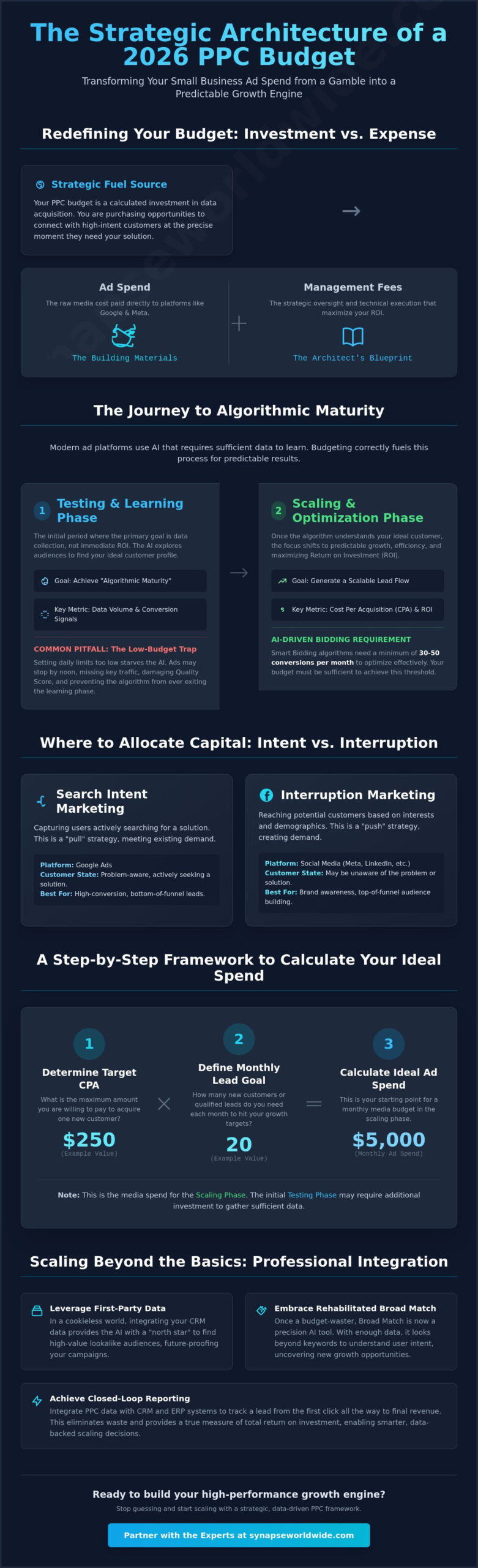
View your ppc budget for small business as the strategic fuel for a high-performance digital growth engine. It’s not a static line item or a cost to be minimized. Instead, it’s a calculated investment in data acquisition. In the 2026 landscape, Pay-per-click (PPC) has evolved from simple keyword bidding into a sophisticated system of intent-based audience targeting. You’re no longer just buying clicks; you’re purchasing the opportunity to present your brand to a specific individual at the exact moment their intent aligns with your solution.

Successful architecture requires a clear distinction between “Ad Spend” and “Management Fees.” Ad spend is your raw media cost paid directly to platforms like Google or Meta. Management fees represent the strategic oversight, technical execution, and continuous optimization that ensure your media spend isn’t wasted. Think of ad spend as the building materials and management fees as the architect’s blueprints. Without the strategy, you’re just piling bricks in a field.

What is a realistic PPC budget for small business in 2026?

A realistic budget recognizes two distinct stages: the testing phase and the scaling phase. During the testing phase, your primary goal is to achieve “Algorithmic Maturity.” Modern ad platforms rely on machine learning to identify your ideal customer. If your budget is too thin, the algorithm never receives enough data to finish its learning phase. This leads to erratic performance and a high cost per lead. Professional ppc management services act as the bridge here, ensuring your initial investment is sufficient to trigger these automated efficiencies.

Why do most small business PPC campaigns fail to scale?

The most common pitfall is the “low-budget trap.” When a daily limit is set too low, your ads might stop showing by noon, missing high-intent searches that occur later in the day. This inconsistency damages your Quality Score, making every click more expensive over time. Scaling requires a steady hand and a commitment to high converting ad copy. Compelling creative does more than just attract clicks; it improves your engagement metrics, which lowers your costs and allows your budget to stretch further. If you don’t feed the engine enough fuel to run consistently, it will never reach the momentum needed for true growth.

The Mechanics of 2026 Paid Search: Data, AI, and Clicks

The machinery driving modern paid search has undergone a fundamental transformation. In 2026, Google Ads functions less like a directory and more like a predictive engine. It uses sophisticated machine learning to analyze billions of signals in real time, identifying users most likely to convert. This shift means your ppc budget for small business is no longer just buying space; it’s buying the processing power of an advanced algorithm. Aligning your spend with Small Business Administration marketing budget guidelines ensures you have the foundational capital to compete in these high-intent auctions.

One of the most notable shifts is the rehabilitation of “Broad Match.” Previously dismissed as a way to waste money on irrelevant clicks, Broad Match is now a precision tool when backed by a healthy budget. It allows the AI to look beyond the literal words a user types to understand their underlying intent. However, this only works if the system has enough data to learn. This is why a “Learning Phase” is unavoidable. During this period, the algorithm explores different audience segments to see what sticks. If you pull the plug or starve the budget too early, you’ll never see the ROI that comes with algorithmic maturity.

First-party data has become the lifeblood of successful campaigns in a cookieless environment. By integrating your customer data directly into the platform, you provide the AI with a “north star” to find similar high-value prospects. This level of technical integration is a hallmark of professional PPC management, ensuring that your digital strategy remains resilient against privacy-driven industry changes.

How does AI-driven bidding affect your daily budget?

Smart Bidding is the primary 2026 mechanism for ROI, but it requires a specific volume of data to function effectively. Most algorithms need a minimum of 30 to 50 conversions per month to optimize properly. If your budget only allows for five conversions, the AI remains in a perpetual state of guesswork. Google also uses “Budget Pacing” to distribute your spend across the week, sometimes spending up to double your daily limit on high-traffic days to capture peak opportunities. This flexibility is essential for capturing leads when they are most active.

The role of Quality Score in budget efficiency

A high Quality Score is your best defense against rising ad costs. It acts as a discount on your Cost Per Click (CPC), allowing you to win better positions for less money. This score is heavily influenced by the relevance of your ads and the experience users have after they click. Implementing a ppc landing page optimization strategy is the most effective way to improve these metrics. When your landing page perfectly matches the user’s intent, the “waste” in your ad spend evaporates, and your budget achieves significantly higher efficiency.
PPC Budget for Small Business: The 2026 Strategic Architecture for Growth

Strategic Allocation: Google Ads vs Social Media Advertising

Distributing your ppc budget for small business requires a sophisticated understanding of how different platforms interact with the customer journey. You must distinguish between “Search Intent” and “Interruption Marketing.” Google Ads excels at capturing users who are actively hunting for a solution. They’ve identified a problem and are ready to engage. Conversely, social media advertising functions by interrupting a user’s browsing experience to introduce a brand or offer. While both are valuable, their roles in your strategic architecture are distinct. For a granular breakdown of these differences, explore our google ads vs social ads comparison guide.

A hybrid approach often demands a more robust total investment, but it typically delivers a more sustainable Customer Acquisition Cost (CAC). By capturing high-intent traffic through search and then nurturing those prospects through social retargeting, you create a cohesive digital presence that mirrors modern buying habits. This multi-channel strategy ensures that no lead is left behind, maximizing the utility of every dollar in your ppc budget for small business.

When should a small business prioritise Google Ads?

High-intent industries where the customer need is urgent or specific should lead with Google Ads. Sectors such as legal services, emergency trades, or specialized B2B software rely on search because the user is already at the bottom of the funnel. In these competitive spaces, you’ll encounter a higher budget “floor.” You aren’t just paying for a click; you’re paying to jump to the front of a line of people ready to purchase. This immediate lead generation is the primary driver of revenue for businesses that solve specific, time-sensitive problems.

Allocating budget for Social Media awareness and retargeting

Social media platforms are the ideal environment for building brand equity and executing retargeting campaigns. While social ads often provide a lower Cost Per Click (CPC), they usually require more “touchpoints” to convert a stranger into a customer. This makes the visual quality of your creative assets a non-negotiable part of your budget. You must invest in high-impact imagery and video to stop the scroll. Retargeting is particularly efficient, as it focuses your spend on individuals who have already interacted with your brand, significantly increasing the likelihood of an eventual conversion without the high cost of cold acquisition.

Calculating Your Ideal PPC Spend: A Step-by-Step Framework

Setting a ppc budget for small business requires shifting from a “what can I afford” mindset to a “what does the data require” mindset. To build a predictable lead generation engine, you must treat your budget as a mathematical formula rather than a discretionary expense. This framework ensures your investment is sufficient to trigger the platform’s machine learning capabilities while protecting your bottom line.

  • Step 1: Determine your target Cost Per Acquisition (CPA). Analyze your profit margins and customer lifetime value to decide exactly how much you can spend to acquire a single lead or sale.
  • Step 2: Estimate industry average CPC. Use 2026 benchmark data to set expectations. For example, Google Search Ads currently average between $1 and $3 per click, while LinkedIn remains higher at $5 to $10.
  • Step 3: Calculate required traffic. Divide your goal of 30 conversions by your website’s conversion rate. If you convert at 3%, you need approximately 1,000 clicks to hit your target.
  • Step 4: Multiply traffic by average CPC. This provides your “Monthly Floor,” the minimum amount needed to maintain presence in the auction.
  • Step 5: Factor in a 20% “Testing & Experimentation” buffer. This capital is dedicated to trying new asset types or audience segments without risking your core performance.

If you’re unsure how these variables apply to your specific industry, our team can help you design a customized PPC strategy that aligns with your growth goals.

The 30-Conversion Rule: Why it dictates your budget

In the 2026 advertising environment, data volume is the only path to efficiency. Without at least 30 conversions per month, the platform’s algorithm cannot effectively distinguish between a high-value buyer and a casual browser. For a service business facing a $2 CPC and a 5% conversion rate, you would need 600 clicks to reach 30 leads, resulting in a floor of $1,200 before the testing buffer. “In 2026, your budget is the fee you pay for the data that eventually makes your ads profitable.”

Adjusting for industry competitiveness and geographic scope

Your geographic targeting significantly impacts your required investment. A national campaign competes in a much larger pool than a local one, requiring a higher budget to maintain a healthy “Impression Share.” If you find yourself in a high-CPC industry with limited capital, the solution isn’t to spread your budget thin across many keywords. Instead, focus on niche targeting. By dominating a specific, long-tail segment of the market, you can achieve algorithmic maturity within a smaller geographic or topical scope, ensuring your spend isn’t diluted by broad, expensive competition.

Scaling Beyond the Basics: Professional Management and Automation

Allocating a ppc budget for small business is only the first step in a much larger strategic journey. Once the financial floor is established, the focus must shift toward maximizing the efficiency of every dollar spent. Professional ppc management services provide the technical oversight necessary to transform raw ad spend into a high-performance growth engine. By refining targeting and optimizing creative assets, expert management reduces the inherent waste that plagues unmonitored accounts. Synapse Worldwide acts as the visionary architect in this process, building the digital infrastructure required to support long-term scalability.

The true power of a modern budget lies in its connectivity. Integrating your PPC data with CRM and ERP systems creates a “Closed-Loop” reporting environment. This allows you to see exactly how an ad click translates into a signed contract or a repeat customer. When your marketing automation handles lead follow-up instantly, the return on ad spend (ROAS) for your initial budget increases exponentially. You’re no longer just buying traffic; you’re fueling a systematic process that converts interest into revenue.

When is it time to move from DIY to professional management?

There is a specific break-even point where the cost of professional fees is entirely offset by the savings generated through reduced ad-spend waste. While some suggest DIY for minimal budgets, the complexity of 2026 tracking makes this approach increasingly risky. Implementing Server-side GTM and Enhanced Conversions requires a level of technical discipline that goes beyond basic campaign setup. “Set and forget” strategies are the most expensive way to run a campaign, as they ignore the daily fluctuations in auction dynamics that can drain a budget in hours. If your account spend isn’t being actively managed, you’re likely overpaying for every lead you acquire.

Integrating PPC with your business automation ecosystem

A sophisticated ppc budget for small business leverages CRM integration to move beyond superficial metrics. Instead of bidding on “Leads” which may or may not be qualified, you can instruct the algorithm to bid on “Sales” or “Qualified Opportunities.” This strategic advantage allows you to identify which specific keywords drive your highest-value contracts. By seeing the full journey from click to cash, you can allocate capital with total confidence. Synapse Worldwide remains committed to delivering these ROI-driven, sophisticated digital solutions that bridge the gap between marketing spend and tangible business success.

Architecting Your Digital Dominance in 2026

Mastering your ppc budget for small business is no longer about guessing a monthly figure. It’s about respecting the mathematical requirements of modern algorithms and ensuring your data volume reaches the threshold for maturity. By shifting from a cost-minimization mindset to a strategic investment framework, you position your brand to capture high-intent traffic while competitors struggle with fragmented data. We’ve explored how the integration of CRM systems and AI-driven bidding transforms simple clicks into a predictable lead generation engine.

Synapse Worldwide has been at the forefront of this evolution since 2005. With over 20 years of digital expertise, we specialize in building the high-value digital infrastructure that corporate and government entities rely on for growth. Our results-oriented approach ensures that every tactical decision is anchored in long-term client ROI. It’s time to stop treating your marketing as an expense and start building your legacy. Request a Strategic PPC Audit and Budget Framework today to secure your place in the future of search. Your next level of success is within reach.

Frequently Asked Questions

What is a typical PPC budget for a small business in Australia?

A typical monthly ad spend for an Australian small business usually ranges between $1,000 and $10,000 depending on the industry and competitive landscape. Some highly competitive sectors like legal services or construction might require a higher entry point to maintain consistent visibility. It’s essential to align this investment with your specific revenue targets and local market conditions to ensure the spend is sustainable.

How long does it take for a PPC budget to start showing a return?

You should expect to see measurable data within the first 30 days, but a consistent ROI usually develops after the initial 90-day learning phase. This period allows the platform’s AI to gather enough conversion signals to optimize bidding strategies effectively. Patience during this stage is critical for building a stable lead generation engine that scales over time rather than providing a one-off spike.

Can I start with a $500 monthly PPC budget?

Starting with $500 is technically possible but often leads to the low-budget trap where the algorithm lacks sufficient data to learn. With such a limited ppc budget for small business, you risk reaching your daily limit by midday, which prevents you from capturing high-intent traffic later in the evening. Focusing on a very narrow niche or a tiny geographic area is the only way to make this level of spend viable.

Should I spend more on Google Ads or Facebook Ads?

Your choice depends on whether you need to capture existing demand or create brand awareness. Google Ads is the superior choice for high-intent search queries where users are ready to buy immediately. Facebook Ads excels at reaching specific demographic segments and nurturing leads who aren’t yet searching for your solution but fit your ideal customer profile perfectly.

How do I know if my PPC budget is being wasted?

Waste is typically identified by a high click-through rate coupled with a very low conversion rate or poor lead quality. If your ads are showing for irrelevant search terms or your landing pages have high bounce rates, your budget isn’t being used efficiently. Regular audits of your search term reports and conversion tracking setup are necessary to ensure your capital is driving tangible business outcomes.

Does the PPC budget include the cost of creating the ads?

No, the PPC budget typically refers to the media spend paid directly to the advertising platform like Google or Meta. The cost of strategic planning, copywriting, and graphic design for high-impact creative is usually handled separately as a management fee. Investing in professional creative is vital, as the quality of your assets directly impacts your Quality Score and overall cost per click.

What happens if I stop my PPC budget for a month?

Stopping your campaigns causes the platform’s algorithm to lose the momentum it gained during the learning phase. When you restart, the system often has to go through a period of re-learning, which can lead to temporary fluctuations in performance and higher costs. Consistent activity is the key to maintaining a low cost per acquisition and a stable presence in the digital auction.

How often should I review or change my PPC budget?

You should conduct a high-level review of your ppc budget for small business every quarter to ensure it aligns with seasonal trends and business goals. While daily optimizations are necessary for bid management and keyword performance, major budget shifts should be based on at least 30 to 90 days of data. This approach prevents knee-jerk reactions to short-term market volatility and ensures long-term stability.

 

SEO for Small Business: The 2026 Strategic Growth Framework

SEO for Small Business: The 2026 Strategic Growth Framework

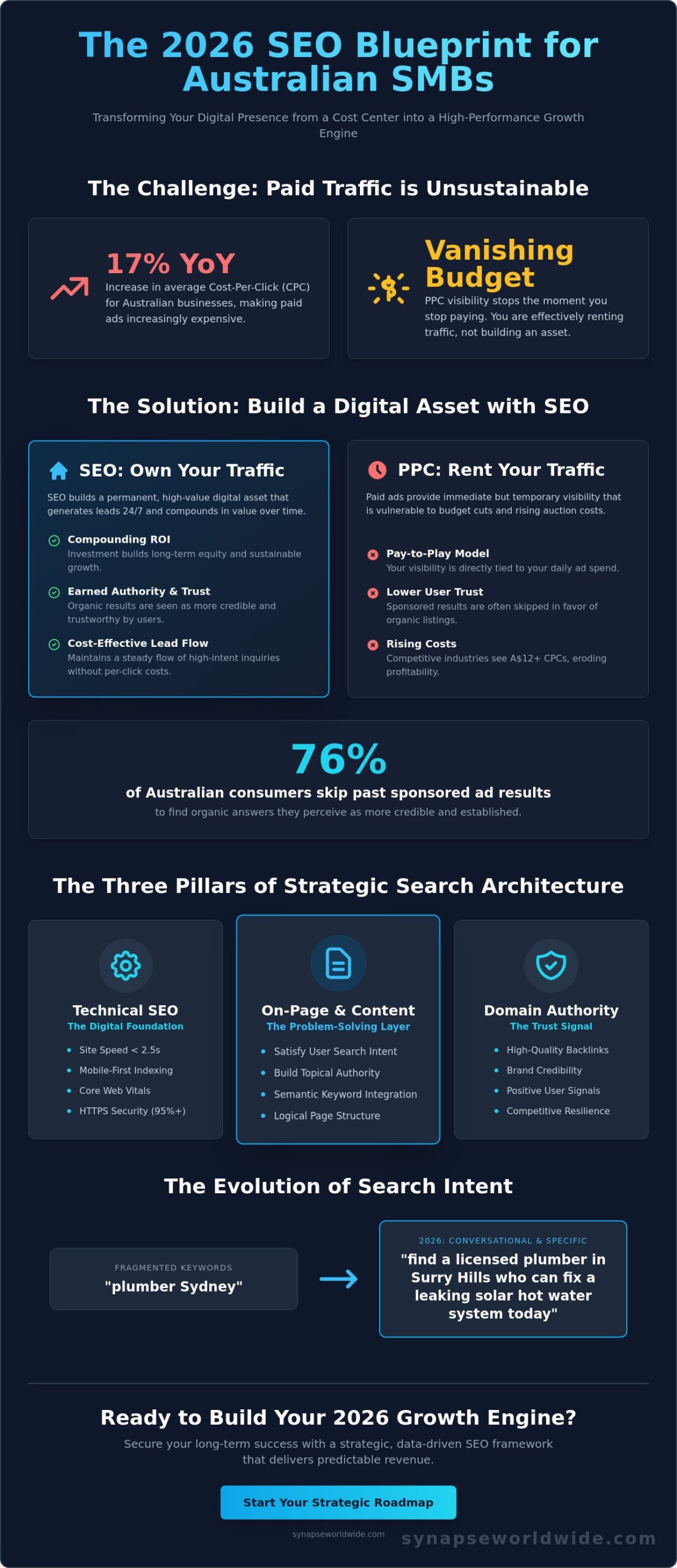
With Australian businesses now facing a 17% year-on-year increase in average cost-per-click according to 2024 industry benchmarks, relying solely on paid traffic is no longer a sustainable strategy for 2026. You’ve likely noticed that managing seo for small business feels increasingly like chasing a moving target as search algorithms become more sophisticated and time-consuming. It’s frustrating to watch your marketing budget vanish into PPC auctions while your organic visibility remains stagnant.

We believe your digital presence should be a high-performance growth engine, not a technical burden. This article will show you how to transform search engine optimization into a robust, scalable asset that generates predictable organic leads and outpaces the competition. We’ll break down the 2026 Strategic Growth Framework, a bespoke roadmap designed to build a digital presence that compounds in value over time. You’ll discover how to move beyond basic keywords to a sophisticated, data-driven strategy that secures your long-term success in the Australian market.

Key Takeaways

  • Recognise search engine optimisation as a robust, long-term digital asset that secures sustainable organic visibility and serves as the most cost-effective growth lever for Australian SMBs.
  • Understand the critical synergy between technical architecture, high-value content, and domain authority to ensure your digital strategy remains both scalable and resilient.
  • Evaluate the strategic ROI of seo for small business by comparing cost-per-acquisition (CPA) metrics against traditional PPC spends within the Australian landscape.
  • Implement a bespoke 2026 roadmap that prioritises data-driven sequences to transform your search performance into a predictable and high-performance revenue stream.
  • Discover how to seamlessly integrate search insights into your wider business infrastructure and CRM systems to bridge the gap between organic traffic and qualified lead conversion.

What is SEO for Small Business in 2026?

Strategic SEO is a high-yield digital asset that builds equity over time. It’s no longer a technical afterthought or a series of tricks to “game” the system. For an Australian enterprise, What is SEO? It’s the process of engineering your website to serve as a primary growth lever. By 2026, the era of “keyword stuffing” has been replaced by sophisticated Search Architecture. This foundation ensures your site isn’t just found; it’s trusted by both AI-driven algorithms and human users. We view this as a bespoke construction project, where every page serves as a scalable pillar for your brand’s future.

Organic visibility remains the most cost-effective strategy for SMBs. Unlike paid advertisements that stop delivering results the moment your budget hits zero, seo for small business provides a compounding return on investment. Successful firms focus on building a robust digital footprint that generates leads 24/7 without the rising costs of A$12+ per click often seen in competitive Australian industries like legal services or specialized trades. This shift toward a permanent digital presence allows you to own your audience rather than renting it from tech giants.

The Evolution of Search Intent

Users in 2026 search with incredible nuance. They use voice-activated devices and AI assistants to ask complex questions rather than typing fragmented three-word phrases. The shift from “plumber Sydney” to “find a licensed plumber in Surry Hills who can fix a leaking solar hot water system today” is definitive. Search Intent is the primary ranking factor in 2026, requiring content that answers specific, multi-layered user needs with absolute precision. Your content must demonstrate immediate utility to satisfy these conversational queries.

Why Small Businesses Cannot Ignore Organic Traffic

PPC costs in Australia have risen by approximately 18% since 2024, making “pay-to-play” models increasingly unsustainable for local firms. Organic rankings signal deep authority. Data indicates that 76% of Australian consumers skip past sponsored results to find organic answers they perceive as more credible and established. This visibility acts as a critical buffer during economic fluctuations. While competitors may be forced to cut ad spend, businesses with integrated seo for small business strategies maintain a steady flow of high-intent inquiries because their foundation is built on earned trust rather than temporary spend.

The Three Pillars of Strategic Search Architecture

Achieving sustainable growth requires a shift away from fragmented tactics. A holistic approach treats seo for small business as an integrated ecosystem where technical health, content relevance, and domain authority work in unison. Relying on a single pillar creates a fragile presence. For example, high-quality content cannot compensate for a site that fails to load in under 2.5 seconds, just as a fast site without authoritative backlinks will struggle to outrank established competitors. This framework serves as the definitive blueprint for a custom web design for small business, ensuring every line of code serves a commercial objective.

Technical SEO: The Digital Foundation

Search engines prioritise user experience above all else. Technical SEO ensures your site meets these rigorous standards by focusing on site speed, mobile-first indexing, and Core Web Vitals. Clean, efficient code allows Google’s bots to crawl and index your pages without friction. Security remains a primary trust signal; data from 2024 indicates that over 95% of traffic on Google is now encrypted via HTTPS. Without a robust technical base, your marketing efforts will yield a diminishing return on investment. Every bespoke site we architect prioritises these backend efficiencies to prevent crawl errors that stall growth.

On-Page SEO and Content Strategy

Content must do more than just exist, it must solve specific problems for your audience. Modern search algorithms use natural language processing to understand how SEO works in relation to user intent rather than simple keyword matching. Integrating metadata, logical header structures, and semantic keywords creates a clear roadmap for search engines. A sophisticated content marketing seo strategy establishes topical authority, positioning your brand as the definitive answer to your customers’ most pressing questions. This alignment between user needs and search visibility is what transforms a website into a lead-generation engine.

Off-Page SEO: Building Authority and Trust

Off-page signals act as digital votes of confidence from the wider web. While high-quality backlinks from reputable Australian domains remain the gold standard, brand mentions and digital PR have become critical components of seo for small business in 2026. These external signals validate your expertise and protect your rankings from sudden algorithm volatility. Building a diverse backlink profile ensures your business remains visible even as search patterns evolve. A robust off-page presence functions as a protective moat for your brand. If you’re ready to scale your reach, consider how a bespoke digital strategy can solidify your market position.

SEO for Small Business: The 2026 Strategic Growth Framework

SEO vs. PPC: Calculating the Real ROI for Small Businesses

Small business owners often ask why they should invest in a long-term strategy when paid ads offer immediate visibility. It’s a valid question. If you spend A$1,000 on Google Ads today, you’ll likely see traffic by this afternoon. However, relying solely on paid channels creates a “pay-to-play” trap. The moment your budget stops, your leads vanish. Effective seo for small business builds a foundation that doesn’t disappear when the credit card is removed.

When we analyse the cost-per-acquisition (CPA) over a 12-month period, the data tells a compelling story. In the first three months, PPC often shows a lower CPA because SEO requires an initial investment in technical audits and content creation. By month six, the lines begin to cross. By month 12, organic leads typically cost 65% to 80% less than paid leads. This shift happens because your organic rankings work 24/7 without a per-click fee attached to every visitor. To ensure these gains are measurable, tracking the right seo kpis for small business is essential for proving ROI to stakeholders and refining your strategy over time.

Ad fatigue is another critical factor. Recent industry data indicates that 42.7% of internet users globally use ad-blocking software, and Australian consumers are increasingly prone to “banner blindness.” SEO provides a permanent safety net against these rising costs and changing user behaviours. A strategic hybrid approach uses PPC for immediate data and SEO for sustainable scale. We use paid campaigns to identify which keywords actually drive sales, then we double down on those terms within your organic strategy. This eliminates guesswork and ensures your seo for small business efforts are focused on high-intent revenue drivers.

The Short-Term Win: Pay-Per-Click Management

PPC is the superior choice for time-sensitive goals. If you’re launching a new product or running a seasonal promotion for the end of the financial year (EOFY), ads provide the necessary surge in volume. Without professional ppc management services, small businesses often see 25% of their budget wasted on irrelevant search terms. Expert management ensures your daily budget reaches the right Australian audience rather than being drained by broad, non-converting queries.

The Long-Term Asset: Organic Search Success

Think of SEO as the “Snowball Effect.” Initially, the gains are incremental, but as your domain authority grows, the momentum becomes unstoppable. High organic rankings lower your overall blended marketing cost by providing a steady stream of traffic that complements your paid efforts. Unlike an ad that expires, a well-optimised blog post remains a digital asset. A 2024 analysis showed that evergreen content can continue to generate leads for over 24 months after the initial publication date. This permanence provides a robust defence against platform volatility and rising auction prices in the Australian digital landscape.

Your 2026 SEO Roadmap for Small Business

A successful SEO strategy isn’t a static document; it’s a living framework that demands precision and agility. For small businesses in Australia, the margin for error has narrowed as competition for the first page of results intensifies. You can’t rely on intuition when data provides a clear path to growth. The 2026 Audit-Optimise-Measure cycle is a continuous loop that identifies technical friction, refines content for evolving user intent, and validates every adjustment against hard conversion data.

Phase 1: Discovery and Technical Audit

Your journey begins by identifying the invisible barriers holding your site back. We focus on “low-hanging fruit,” such as keywords currently ranking in positions 11 through 20 that only require minor technical or content adjustments to break into the top ten. A comprehensive audit also involves benchmarking against local Australian competitors to identify market gaps they’ve overlooked. You must establish a robust data foundation immediately. Setting up Google Search Console and custom GA4 events allows you to track specific user interactions, ensuring every decision you make is backed by evidence rather than guesswork. Understanding the fundamentals of keyword research for beginners is an essential first step in identifying which search terms will deliver the highest commercial value for your Australian market.

Phase 2: Content Optimisation and AI Integration

By 2026, AI has become an essential partner in the research phase, though it cannot replace the human element required for high-level E-E-A-T. Use AI tools to analyse vast datasets and identify content clusters, but ensure your final output reflects genuine experience and expertise. Updating legacy content is often more effective than creating new pages. Industry data suggests that refreshing 12-month-old articles can lead to a 40% increase in organic traffic. We focus on aligning your existing assets with current search intent while reinforcing the trustworthiness that Australian consumers demand from seo for small business initiatives.

Phase 3: Authority Building and Performance Scaling

Building authority in a niche requires a bespoke approach to link acquisition. Rather than chasing volume, we target high-quality, relevant links from authoritative Australian domains that signal your business’s legitimacy to search engines. As your visibility grows, monitoring KPIs like organic impressions and conversion rates becomes paramount. Scaling isn’t just about more traffic; it’s about better traffic. This is where the synergy between search and sales becomes clear. Professional ecommerce website development plays a critical role here, ensuring your site architecture can handle increased load and convert search users into loyal customers. Effective seo for small business ensures your digital storefront is both visible and persuasive.

Ready to transform your search presence into a predictable revenue engine? Partner with an SEO architect at Synapse Worldwide to build your bespoke growth framework today.

Integrating SEO into Your Business Infrastructure

SEO isn’t a standalone marketing tactic to be checked off a list. It’s the central nervous system of your digital presence. By 2026, the distinction between search data and business intelligence has vanished. Australian firms that treat seo for small business as a core infrastructure component see significantly better results than those that treat it as a siloed monthly task. When you embed search insights into your operational DNA, you’re no longer guessing what the market wants; you’re responding to documented demand.

Connecting search data to your CRM system transforms lead nurturing from a generic process into a precision strike. If a prospect enters your funnel via a high-intent keyword like “commercial solar installation costs Sydney,” your sales team already knows their primary pain point. This integration allows for 30% more relevant follow-up communications, as reported in recent mid-market digital transformation studies. It’s about using the data people volunteer through their search queries to serve them better. Understanding which seo kpis for small business to connect to your CRM ensures that organic traffic translates directly into qualified pipeline and measurable revenue outcomes.

Strategic SEO also informs product development and customer service. If your search analytics reveal a 25% year-on-year increase in queries regarding a specific product feature you don’t yet offer, your roadmap is already written. Synapse Worldwide positions itself as the Digital Architect that builds this integrated framework. We ensure your search data flows seamlessly into every department, turning organic visibility into a scalable business asset.

The Synergy of SEO and Business Automation

Modern automation thrives on high-quality data triggers. Search intent can initiate specific automated marketing workflows, ensuring a user who finds you via a “how-to” guide receives different nurturing than one who lands on a pricing page. For ecommerce ventures, the benefits extend to the warehouse. Integrating SEO trends with your ERP inventory management allows you to adjust stock levels based on rising search volumes before the peak buying season hits. This alignment reduces overhead and maximises liquidity.

Choosing a Strategic SEO Partner

Secure Your Competitive Advantage in the Australian Market

The 2026 digital landscape demands more than just visibility; it requires a robust, scalable architecture that converts search intent into measurable revenue. We’ve explored how integrating search strategy into your core business infrastructure creates a compounding asset that outpaces the temporary gains of PPC. Effective seo for small business hinges on this long-term ROI focus, moving beyond simple rankings to achieve genuine market transformation and sustainable growth.

Since 2005, Synapse Worldwide has functioned as a high-level strategic consultant and execution partner for ambitious brands. With over two decades of digital expertise, we specialize in bespoke solutions that bridge the gap between custom development and integrated marketing. Our framework ensures your digital presence isn’t just a cost center but a high-value driver of growth. You’ve seen the roadmap; now it’s time to build the engine that carries your brand forward.

Request your bespoke SEO strategy from Synapse Worldwide

Your journey toward market leadership starts with a single strategic decision. We’re ready to help you reach the next level of success.

Frequently Asked Questions

How long does it take for a small business to see results from SEO in 2026?

You should expect to see measurable progress within 4 to 9 months of launching a dedicated campaign. While technical fixes can trigger minor improvements in 30 days, the competitive Australian market requires time for search engines to validate your site’s authority. Data from 2025 performance reviews shows that 78% of businesses achieving top-three rankings maintained a consistent strategy for at least 6 months before seeing a peak in their ROI.

Can I do SEO for my small business myself or should I hire an agency?

You can manage basic on-page tasks yourself, but scaling requires the sophisticated technical expertise of a professional agency. Small business owners typically lose 12 hours of operational time per week trying to navigate algorithm shifts. If you want to improve your own technical literacy to better oversee these processes, you can explore One-on-One Digital Coaching to build your digital confidence. A bespoke seo for small business strategy allows you to focus on your core operations while experts handle complex data integration and architectural optimizations that drive long-term growth.

How much should a small business realistically spend on SEO per month?

A realistic monthly budget for professional SEO services in Australia ranges from A$1,500 to A$5,000 depending on your industry’s competitiveness. Industry benchmarks from 2024 indicate that firms spending less than A$1,200 often struggle to outpace established competitors. Investing at this level ensures you receive a high-level strategic consultant who delivers integrated solutions rather than just basic, cookie-cutter link building.

Is SEO still relevant with the rise of AI search engines like ChatGPT?

SEO is more critical than ever because AI search engines and Large Language Models (LLMs) use indexed web content as their primary data source. Recent 2026 search statistics indicate that 42% of consumers use AI-powered snapshots to make purchasing decisions. To appear in these AI-generated answers, your website must maintain a robust technical structure and high-quality, authoritative content that these systems can easily crawl and trust.

What is the most important SEO factor for a small business website?

Topical authority backed by a seamless user experience is the most influential ranking factor in the current landscape. Google’s latest algorithm updates prioritize sites that demonstrate deep expertise through structured, high-value content. For a successful seo for small business framework, your site must load in under 2.5 seconds and provide clear, verifiable answers to the specific problems your Australian customers are trying to solve.

How do I know if my current SEO strategy is actually working?

Success is measured by an increase in organic conversion rates and total revenue rather than just vanity metrics like keyword positions. You should monitor your Google Analytics 4 data to track a 15% to 20% year-on-year growth in qualified leads. If your organic traffic is rising but your phone isn’t ringing, your strategy lacks the necessary alignment between search intent and your business goals.

What is the difference between SEO and Local SEO for small businesses?

Traditional SEO focuses on national or global visibility, while Local SEO targets customers in specific geographic areas like Sydney or Melbourne. Statistics show that 46% of all Google searches have local intent, making Google Business Profile optimization essential for brick-and-mortar stores. Local strategies focus on “near me” queries and map rankings, ensuring your business captures high-intent traffic within your immediate 20-kilometre service radius.