
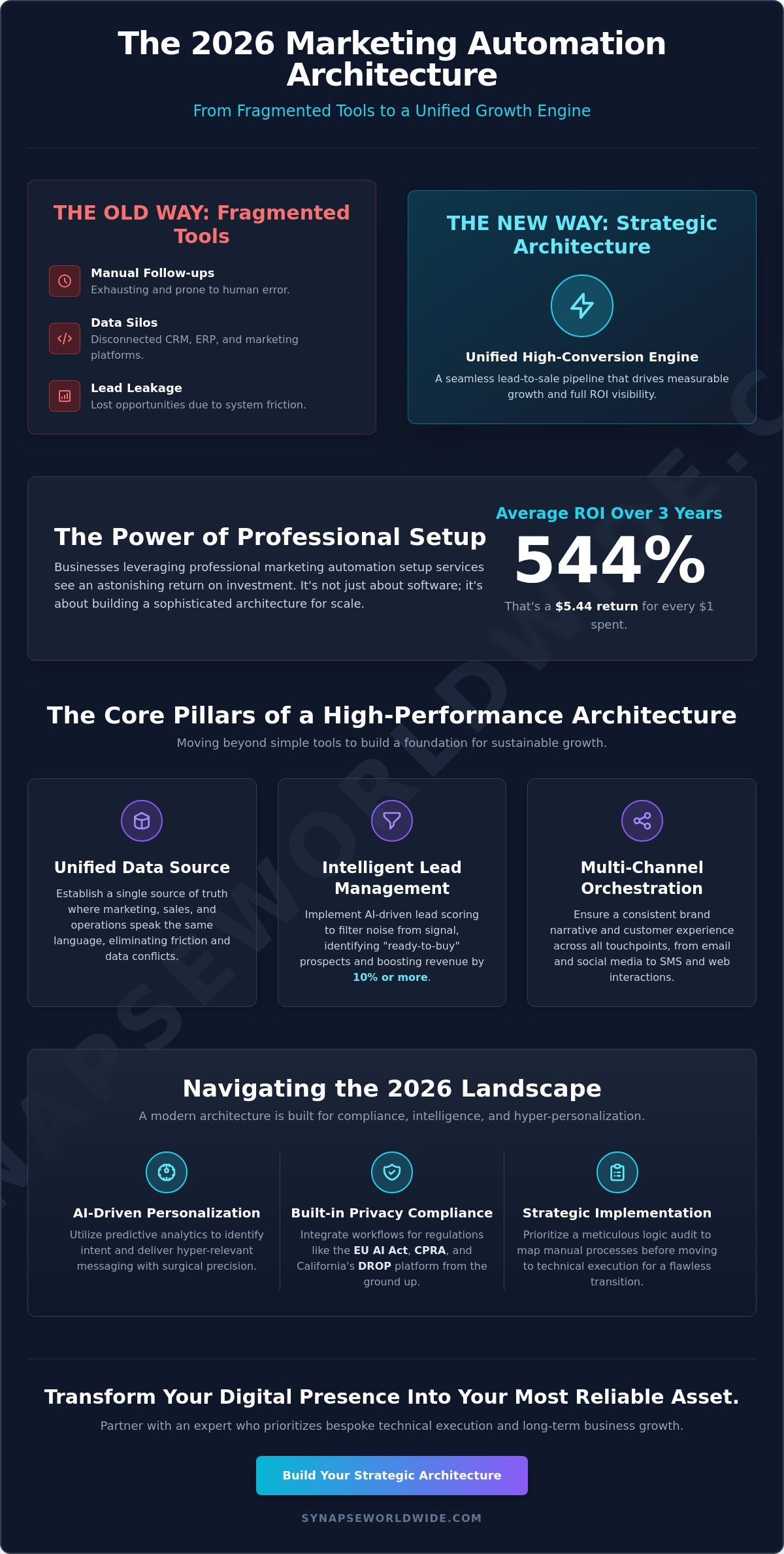
Did you know that businesses leveraging automation see an average ROI of 544% over three years? That is a $5.44 return for every dollar spent. Yet, most organizations fail to capture this value because they treat software as a standalone tool rather than a strategic foundation. When you invest in professional marketing automation setup services, you aren’t just buying a subscription; you’re building a sophisticated architecture for scale. You likely recognize the deep frustration of lead leakage and the friction caused by persistent data silos between your marketing and sales teams. It’s exhausting to manage manual follow-ups while your CRM and ERP systems remain disconnected and out of sync.
We’ll show you how to transform these fragmented efforts into a unified, high-conversion engine. By moving beyond basic email blasts, you’ll build a seamless lead-to-sale pipeline that drives clear, measurable growth. This article explores the 2026 strategic architecture required to integrate your digital tools, comply with evolving privacy regulations like the EU AI Act, and finally achieve full visibility into your marketing ROI. We’ll examine how a visionary approach to connectivity and customization can turn your digital presence into your most reliable asset for long-term success.
Key Takeaways
- Shift your perspective from viewing automation as a set of isolated tools to a strategic infrastructure that orchestrates sophisticated, multi-channel customer journeys.
- Learn how professional marketing automation setup services establish a ‘Unified Data Source’ where marketing, sales, and operations finally speak the same language.
- Resolve the silo effect by integrating your CRM and ERP systems to eliminate fragmented communication and capture every lead opportunity.
- Master a framework that starts with meticulous logic auditing to map manual processes before moving into technical implementation.
- Discover the competitive advantage of a visionary partnership that prioritizes bespoke technical execution and long-term business growth over simple software installation.
Redefining Marketing Automation Setup Services in 2026
Marketing is no longer a series of disconnected campaigns; it’s a structural discipline. As we move through 2026, Marketing automation has transitioned from a supplementary tool to the central nervous system of the modern enterprise. Successful organizations don’t just “buy” software. They invest in marketing automation setup services to build a resilient, scalable architecture. This shift moves away from simple email triggers and toward AI-driven multi-channel orchestration. It requires a visionary architect who understands how to bridge the gap between front-end engagement and back-end operational data.
When you approach your digital strategy with this mindset, you transform your marketing department from a cost center into a high-performance revenue engine. A professional setup ensures that every technical decision aligns with your long-term growth objectives. It’s about seeing the big picture while maintaining a disciplined focus on the intricate technical details that make or break a lead-to-sale pipeline.
Beyond Software: The Strategic Value of Professional Setup
Infrastructure is the foundation of scale. Industry data suggests that a vast majority of automation projects fail to meet their objectives because they lack a professional implementation roadmap. Without a strategic guide, businesses often end up with “fragmented automation,” where tools exist but don’t communicate. Professional setup services prioritize custom data mapping to ensure your systems remain scalable as your contact database grows. This process moves your business from a “set and forget” mentality to a dynamic, data-driven growth framework. It ensures that your CRM and ERP systems aren’t just connected; they’re synchronized to provide a 360-degree view of the customer journey.
The 2026 Landscape: AI, Data Privacy, and Personalization
The regulatory environment in 2026 has fundamentally changed how we handle consumer information. Modern setup services must now account for the EU AI Act enforcement that began in early 2026, which imposes strict transparency obligations on marketing applications. Additionally, under California’s CPRA regulations, your business is required to conduct rigorous risk assessments for automated technologies. We also see the emergence of California’s “Delete and Opt-Out Platform” (DROP), which processes deletion requests every 45 days. A professional setup builds these compliance workflows directly into your architecture. This allows you to transition from generic blasts to hyper-personalized customer experiences while maintaining total data integrity. By integrating predictive analytics into your standard stack, you can identify “ready-to-buy” prospects with surgical precision, ensuring your messaging is always relevant and timely.
The Core Pillars of a High-Performance Automation Architecture
Establishing a high-performance architecture requires moving beyond simple tool connections. It demands a Unified Data Source where every department shares a single version of truth. When your marketing, sales, and operations teams speak the same language, you eliminate the friction that typically stalls growth. Professional marketing automation setup services focus on architecting this logic first. We design the lead scoring systems that filter noise from signal, identifying prospects who are genuinely ready to buy based on behavioral data rather than guesswork. Companies that automate lead management in this way often see a revenue increase of 10% or more within just nine months.
Effective marketing automation strategy relies on multi-channel synchronization. Your brand narrative must remain consistent whether a customer interacts via email, social media, or SMS. This orchestration ensures that a lead doesn’t receive a generic discount code via text minutes after they’ve already purchased through your site. Achieving this level of precision starts with a robust digital foundation. For many organizations, investing in custom web design for small business serves as the essential data capture engine. It provides the structured environment necessary to track user intent long before the first form is submitted. This foundational work allows for the 451% increase in qualified leads that top-tier automation can provide.
CRM and ERP Synergy: The Back-Office Connection
True scalability happens when front-end engagement meets back-end efficiency. By leveraging business process automation, you bridge the critical gap between a captured lead and a fulfilled order. We specialize in synchronizing inventory levels and service availability with your live marketing campaigns. This prevents the costly mistake of promoting out-of-stock items or overbooking service slots. Sophisticated API integrations eliminate manual data entry, allowing your team to focus on high-value strategic tasks rather than administrative upkeep. If your current systems feel disjointed, our experts can help you design a more cohesive CRM integration strategy to unify your operations.
Conversion-Centric Web Infrastructure
Your website is the primary entry point for your automation ecosystem. High-performance landing pages must do more than just look professional; they must function as intelligent data entry points. We implement custom tracking protocols to monitor the entire user journey. This ensures your ecommerce website development fully supports complex automation triggers, such as abandoned cart sequences or personalized product recommendations. By building these triggers into the site architecture, you ensure that no lead falls through the cracks of a manual follow-up process.
Overcoming the Silo Effect: Why Integration Trumps Isolated Tools
Owning a suite of marketing tools isn’t the same as having a functional automation system. Many leaders express frustration because they’ve invested in a top-tier CRM and an expensive email platform, yet their results remain stagnant. This usually happens because the tools exist in isolation. When your tech stack is fragmented, your brand voice becomes inconsistent and leads slip through the gaps. Professional marketing automation setup services solve this by moving beyond the “tool-first” mentality. We focus on the business logic that connects these systems, ensuring that data flows bi-directionally and in real-time.
Out-of-the-box integrations often fall short of enterprise-level requirements. They might sync basic contact info but fail to carry over the complex behavioral data needed for sophisticated triggers. This is where bespoke APIs and custom middleware become essential. By architecting a solution that mirrors your specific internal workflows, you ensure that your sales team isn’t just getting more leads; they’re getting the right context at the right time. This level of connectivity turns a collection of software into a unified, high-conversion engine.
The Hidden Costs of DIY Automation Setup
Attempting a DIY setup often leads to significant technical debt. Poorly mapped data structures might work for a month, but they eventually break as you scale, leading to expensive cleanup projects later. Inaccurate lead scoring is another silent killer of productivity. If your system incorrectly flags cold prospects as “ready-to-buy,” your sales team wastes hours on dead-end calls. There is also a security risk to consider. Many businesses rely on “free” third-party plugins to bridge gaps, but these often lack the rigorous updates required to stay ahead of modern vulnerabilities. Investing in a professional roadmap from the start protects your data and your reputation.
Bespoke vs. Standardised Solutions
Standard SaaS integrations are fine for basic tasks, but they rarely support long-term growth. You need a partner who understands the intersection of technical development and high-level strategy. For instance, your automation should work in tandem with your SEO for small business efforts. When your search strategy brings in high-intent traffic, your automation must be ready to capture and nurture that specific intent through custom code if necessary. Future-proofing your stack means building an architecture that isn’t tied to the limitations of a single platform. This flexibility allows you to adapt as new technologies emerge, ensuring your digital presence remains an asset rather than a liability.
A Strategic Framework for Implementing Enterprise-Grade Automation
Implementing enterprise-grade automation isn’t a weekend project; it’s a phased deployment that requires precision at every turn. While many competitors suggest starting with a simple email template, our marketing automation setup services begin with a rigorous Discovery and Logic Audit. We map your existing manual customer journey to uncover exactly where potential revenue is leaking. This architectural approach ensures that your technical stack supports your business goals rather than dictating them. Once the logic is sound, we define the technical architecture, selecting the integration points that will sustain your growth for years to come.
A high-performance engine requires high-quality fuel. The third step in our framework involves deep data migration and cleaning. We ensure no legacy errors or duplicate records disrupt your new workflows, as “hidden costs” in automation often stem from contact overages caused by messy databases. Following this, we move into campaign building and logic testing. We deploy your workflows in a controlled environment to verify every trigger and branch before they go live. Finally, we focus on optimization. By leveraging sophisticated ppc management services, you can feed your new automation engine with high-intent traffic, creating a self-sustaining cycle of growth and conversion.
Phase 1: Mapping the Customer Lifecycle
Mapping the customer lifecycle allows us to identify specific friction points in your sales funnel where automation can have the most immediate impact. Perhaps leads are stalling at the mid-funnel stage, or your sales team is overwhelmed by low-quality inquiries that haven’t been properly vetted. We define your Ideal Customer Profile (ICP) within the database logic to ensure your automation prioritizes the most valuable opportunities. Our primary goal is often singular and impactful: “Reducing lead response time to under 5 minutes.” This clarity ensures every automated sequence serves a distinct purpose in moving the prospect toward a sale.
Phase 2: Technical Execution and Integration
Technical execution creates the “Digital Handshake” between your website and CRM. This isn’t a simple form-to-email link. It is a deep integration that captures source attribution, behavioral cues, and intent signals. We implement advanced tracking codes that allow for precise attribution modeling, so you know exactly which touchpoint triggered a conversion. Automated reporting dashboards then provide real-time visibility into your marketing ROI. This gives you the confidence to scale your budget where it works best. Ready to build your scalable architecture? Explore our CRM integration solutions to start unifying your data today.
Partnering for Success: Custom Automation Solutions by Synapse Worldwide
Synapse Worldwide treats every digital project as a bespoke architectural challenge. We don’t just install software; we engineer growth engines. Our marketing automation setup services focus on the deep connectivity between your front-end engagement and back-end operations. This visionary strategy ensures that every automated trigger serves a specific business outcome. By moving away from standardized, low-cost templates, we provide the stability and quality required for long-term success. We believe that true digital transformation requires a sophisticated balance between high-level strategy and meticulous technical execution.
A partnership with our team is an investment in continuous transformation. Unlike a one-off software installation that quickly becomes obsolete, our approach adapts to your evolving business needs. We bridge the gap between national market reach and localized business requirements, ensuring your digital presence remains relevant across diverse audiences. This commitment to client ROI is what transforms a simple technical process into a long-term strategic asset. You can finally move from the struggle of manual lead management to a state of automated, predictable growth.
Why Experience Matters in Automation Architecture
Success in digital infrastructure isn’t accidental. It’s the result of leveraging over 20 years of expertise in building resilient systems for diverse industries. We manage your entire digital ecosystem, from custom web design to complex ERP solutions. This holistic view allows us to deliver highly individualized, evidence-based solutions that standardized agencies simply cannot match. We don’t guess what works; we use data to validate every integration point in your architecture. This disciplined focus ensures that your automation stack remains a proactive participant in your business strategy rather than a technical burden.
Next Steps: Your Roadmap to Automated Growth
Preparing your team for automated workflows is a critical step in the transition. It requires a shift in mindset from reactive tasks to proactive logic management. During a Synapse discovery session, we’ll deep-dive into your current processes to identify the most impactful opportunities for orchestration. We’ll examine your lead flow, data hygiene, and existing tech stack to build a roadmap that prioritizes immediate wins and long-term scalability. It’s time to stop letting leads slip through the cracks of manual follow-ups. Take the first step toward a unified, high-conversion engine and Book a Strategic Automation Audit to see how we can elevate your digital presence.
Architecting Your Future Growth
Success in the digital landscape of 2026 demands more than just adopting new software; it requires a disciplined commitment to structural integrity. We have examined how a unified data source and the strategic orchestration of customer journeys can turn fragmented marketing efforts into a high-performance revenue engine. By prioritizing logic auditing and technical synchronization, you move beyond the limitations of isolated tools to create a resilient foundation for scale.
Professional marketing automation setup services provide the bridge between high-level strategic consulting and meticulous hands-on execution. Synapse Worldwide leverages over 20 years of technical excellence to deliver custom-built CRM and ERP integrations tailored to your specific business logic. We don’t just solve today’s problems; we help you anticipate tomorrow’s opportunities through results-oriented strategy. It’s time to stop managing manual friction and start driving measurable ROI. Scale your business with expert marketing automation setup services today. Your journey toward a transformed, highly automated digital presence starts with a single visionary step. We are ready to help you reach the next level of business success.
Frequently Asked Questions
What is included in a professional marketing automation setup service?
A professional service includes deep discovery, logic auditing, and custom technical integration between your digital presence and sales tools. We focus on architecting a lead-to-sale pipeline that reflects your unique business workflows. This process ensures that your marketing automation setup services result in a scalable growth engine rather than just a collection of triggered emails. We prioritize custom data mapping to ensure your systems remain resilient as your database expands.
How long does it typically take to see ROI from marketing automation?
Organizations that automate lead management typically see a revenue increase of 10% or more within six to nine months. Long-term data shows that businesses using these systems achieve an average ROI of 544% over three years. This equates to a return of $5.44 for every dollar invested. These results depend on a sound initial architecture that eliminates lead leakage and manual friction from the start.
Do I need to replace my current CRM to implement advanced automation?
You don’t necessarily need to replace your existing CRM to achieve high-level results. Our approach focuses on sophisticated CRM integration to bridge the gap between your marketing data and sales activity. We evaluate your current stack to ensure it can handle the advanced API calls and data mapping required for 2026 growth strategies. If your current system has limitations, we build custom middleware to ensure seamless connectivity.
Can marketing automation help with B2B lead nurturing and long sales cycles?
Automation is essential for managing the complexity of B2B sales cycles. It allows you to maintain consistent, personalized communication with prospects over months or even years without manual intervention. By using behavioral triggers, you can identify exactly when a long-term lead is ready for a direct sales conversation. This prevents lead leakage and ensures your sales team focuses only on high-intent opportunities.
What is the difference between an email marketing tool and a full automation setup?
An email tool is a tactical delivery system, while a full automation setup is a strategic infrastructure. While email tools primarily send messages to lists, full automation orchestrates multi-channel journeys based on real-time user behavior. It integrates your website, CRM, and ERP to ensure every touchpoint is informed by the customer’s entire history with your brand. This creates a unified narrative rather than isolated messages.
How does marketing automation integrate with my existing ERP system?
Integration with your ERP system happens through custom-built APIs and secure middleware. This connection allows your marketing campaigns to respond to live operational data, such as inventory levels or service availability. This ensures your marketing automation setup services provide a seamless flow from the initial lead capture to the final fulfilled order. It eliminates the need for manual data entry and reduces the risk of human error.
Is marketing automation setup a one-time project or an ongoing service?
The initial technical architecture is an intensive project, but the most successful businesses treat automation as an ongoing strategic asset. You need a long-term partnership to optimize workflows, adapt to new privacy regulations like the EU AI Act, and refine your lead scoring logic. This continuous improvement ensures your engine stays efficient as your business scales and as consumer behaviors shift in the digital marketplace.
What are the most common mistakes businesses make when setting up automation?
The most frequent error is adopting a tool-first mentality that ignores underlying business logic. Many organizations also suffer from poor data hygiene, which leads to inaccurate lead scoring and wasted sales efforts. Skipping the discovery phase often results in a fragmented system that fails to provide a clear view of marketing ROI. A professional roadmap avoids these pitfalls by prioritizing strategy and data integrity before technical deployment.