

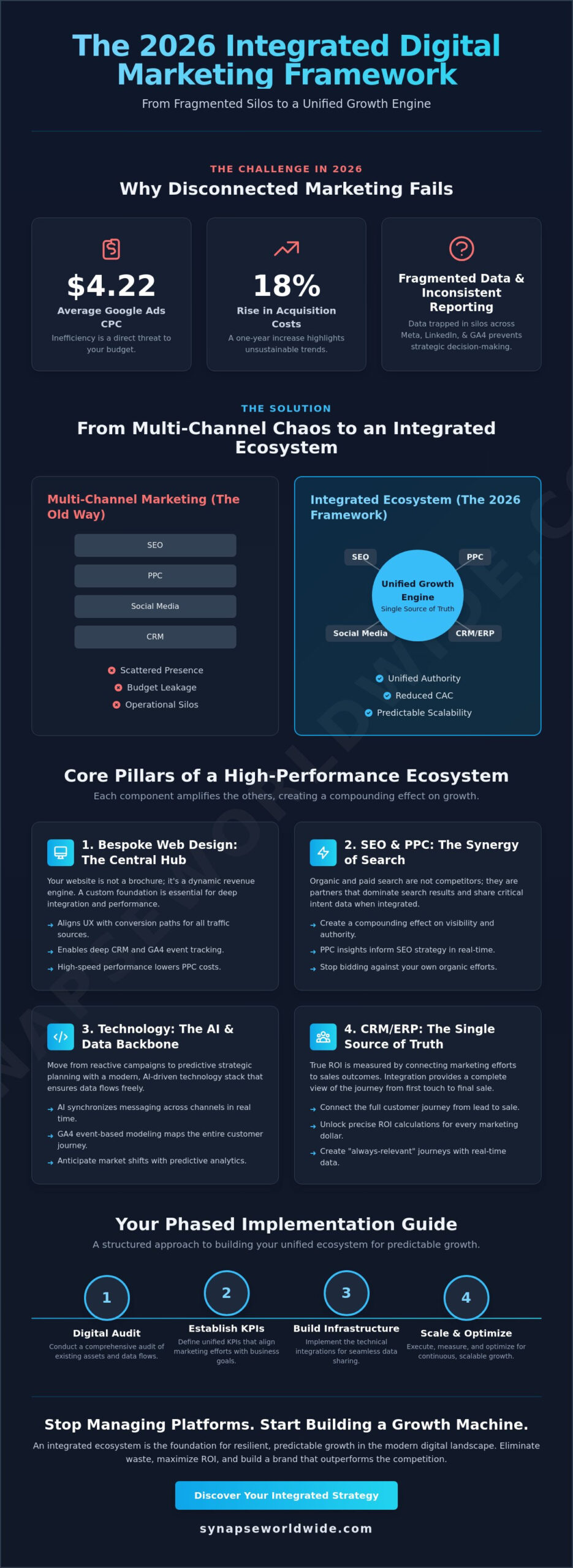
With the average Google Ads cost-per-click hitting $4.22 in 2026, your marketing budget is likely under more strain than ever before. It’s frustrating to watch acquisition costs rise by 18% in a single year while your data remains trapped in disconnected silos. You’re likely tired of the friction caused by inconsistent reporting across Meta and LinkedIn, which makes it nearly impossible to execute a high-performance integrated digital marketing strategy. This fragmentation doesn’t just waste money; it prevents your business from reaching its full potential and reaching the next level of success.
We believe your digital presence should function as a unified ecosystem rather than a collection of competing experiments. This guide introduces the 2026 framework for scalable growth designed to eliminate waste and maximize every dollar spent. You’ll discover how to align your SEO, PPC management, and CRM integration into a single engine that respects the latest CCPA privacy mandates. We’ll walk through the technical architecture needed to automate your operations, streamline your data via GA4, and turn fragmented touchpoints into a predictable path for business transformation. It’s time to stop managing individual platforms and start building a cohesive growth machine.
Key Takeaways
- Transition from fragmented multi-channel tactics to a unified digital ecosystem that eliminates operational silos and prevents budget leakage.
- Discover the architectural blueprint for an integrated digital marketing strategy that synchronizes SEO, PPC, and social media into a single growth engine.
- Understand how CRM and ERP integrations provide a single source of truth for your ROI by connecting the entire customer journey from lead to sale.
- Follow a phased implementation guide to conduct a comprehensive digital audit and establish the unified KPIs necessary for predictable scalability.
- Learn why bespoke web design and customized technical solutions are essential for building a resilient brand that outperforms standardized competitors.
The Strategic Evolution of Integrated Digital Marketing in 2026
By 2026, the definition of digital success has shifted from mere visibility to total architectural cohesion. In a market where the average Google Ads cost-per-click has climbed to $4.22, an 18% increase from just a year ago, inefficiency is no longer just a nuisance; it’s a threat to your scalability. Fragmentation acts as a silent drain on your resources. When your SEO efforts don’t communicate with your PPC management, you’re essentially bidding against yourself or missing critical intent signals. A robust integrated digital marketing strategy ensures that every touchpoint reinforces the next, turning your website from a static digital brochure into a dynamic revenue engine. This evolution demands a shift toward “always-relevant” journeys where personalization is driven by real-time data rather than historical assumptions.
Integrated vs. Multi-Channel: The Critical Distinction
Market leadership in this decade isn’t earned by simply being present on every platform. While multi-channel marketing spreads your message wide, it often lacks the connective tissue required for high-level conversion. True integration is rooted in the principles of integrated marketing communications, where a consistent brand voice acts as the anchor across disparate platforms. This synergy directly impacts your bottom line by reducing customer acquisition costs (CAC). When your social media marketing and search strategies work in tandem, you create a compounding effect that drives efficiency and streamlines the path to purchase. It’s about moving from a scattered presence to a unified authority that commands attention.
The 2026 Digital Landscape: AI and Predictive Integration
The modern landscape relies on AI to do more than just generate content; it synchronizes messaging across SEO and paid search in real time. We’ve moved beyond reactive campaigns that look at last month’s performance. Today’s high-performance frameworks use predictive strategic planning to anticipate market shifts before they happen. This requires a seamless flow of data between your CRM integration and automated marketing funnels. By leveraging GA4’s event-based modeling, businesses can now interpret the entire customer journey with precision. This transition from reactive to predictive is the hallmark of a sophisticated integrated digital marketing strategy, allowing you to act on data intelligence before your competitors even recognize the trend. Establishing this real-time data flow is the first step toward building a resilient, self-optimizing growth engine.
Core Pillars of a High-Performance Integrated Ecosystem
A high-performance ecosystem isn’t a collection of disparate tools. It’s a synchronized engine where every component amplifies the others. To achieve scalable growth, your integrated digital marketing strategy must be anchored by four core pillars: bespoke web design, strategic SEO, high-performance PPC, and cohesive content marketing. When these elements operate in isolation, they create friction that slows your momentum. When they’re unified, they create a compounding effect that drives your business toward its next level of success. This structural integrity is what separates market leaders from those who are simply “online.”
Web Design as a Strategic Growth Engine
Your website is the central hub of your digital world. Off-the-shelf templates often struggle to handle the complex requirements of a modern growth strategy, such as deep CRM integration or advanced event tracking in GA4. Investing in custom web design for small business ensures your technical foundation is built specifically to support your unique marketing goals. A well-architected site aligns user experience with conversion paths, ensuring that traffic from your social media marketing or search campaigns doesn’t hit a dead end. High-speed, mobile-optimized pages aren’t just for users; they provide the technical performance required to maintain high quality scores for your paid media landing pages, which effectively lowers your overall acquisition costs.
The Synergy of SEO and Paid Search
In 2026, the most successful brands don’t choose between organic and paid visibility. They use them together to dominate the search engine results pages. By analyzing data from your paid search campaigns, you can identify high-converting keywords in real-time and feed those insights directly into your seo for small business strategy. This data sharing allows you to focus your organic efforts on terms that are proven to drive revenue rather than just empty traffic. This dual-threat approach ensures that your brand captures attention regardless of whether a user clicks an ad or an organic listing. It’s a sophisticated way to optimize ad spend while building long-term authority in your niche.
Content marketing serves as the narrative thread that connects these pillars. It isn’t just about writing articles; it’s about creating a consistent message that resonates from the first social media interaction to the final sale. When your messaging is unified, the customer journey feels seamless and intuitive, which builds the trust necessary for high-value conversions. If you’re looking to build a more resilient digital presence, you might consider how bespoke digital solutions can bridge the gaps in your current framework. Building this level of connectivity requires precision, but the return on investment is undeniable for businesses aiming for serious transformation.
Eliminating Silos: Why Technical Infrastructure is the Backbone
Many businesses mistakenly treat integration as a creative or messaging challenge. In reality, it’s a technical one. Without a robust data layer, your integrated digital marketing strategy is essentially a series of educated guesses. We see growth stall most often when marketing teams can’t see what happens after a lead enters the pipeline. Infrastructure is the connective tissue that allows data to flow from a social media click to a final sale, providing the clarity needed to scale with confidence. Moving away from disconnected spreadsheets toward a unified dashboard isn’t just about organization; it’s about gaining a competitive edge through real-time intelligence.
Data centralization creates a single source of truth for your entire organization. ERP solutions play a critical role here, especially for national enterprises looking to streamline lead-to-sale workflows. By automating the feedback loop between sales data and marketing spend, you can identify exactly which channels produce the highest lifetime value customers. This level of visibility allows you to cut waste instantly and reallocate budget to high-performing segments. It’s a shift from reactive reporting to proactive optimization that ensures your digital presence is always working at peak efficiency.
CRM and Marketing Automation Integration
Connecting your website directly to your lead management systems eliminates the manual entry lag that often kills high-value conversions. It’s not enough to just capture a name; you need to personalize the user experience based on specific CRM data touchpoints. Custom API bridges and system bridges allow your marketing automation to respond to a prospect’s behavior in real time. When your systems talk to each other, the customer journey feels fluid and intentional. This technical harmony reduces friction for the user while providing your team with the granular data needed for sophisticated attribution modeling.
Scalable E-commerce Architecture
For brands selling online, the technical requirements are even more demanding. Sophisticated ecommerce website development requires a deep integration mindset from the start. You must connect inventory management directly with your real-time advertising feeds to ensure you aren’t wasting budget promoting out-of-stock items. Building for future growth means choosing a scalable digital infrastructure that can handle traffic surges without compromising performance. It’s about creating a resilient, interconnected foundation that supports your long-term vision for business transformation and reaches the next level of profitability.
Building Your Framework: A Step-by-Step Implementation Guide
Moving from a conceptual vision to a functional reality requires a disciplined, multi-phase approach. Building a high-performance integrated digital marketing strategy isn’t a weekend project; it’s a structural overhaul of how your business interacts with the digital world. The transition begins by stripping away assumptions and looking at raw data. Success in 2026 depends on your ability to execute these five phases with precision:
- Phase 1: Conduct a Comprehensive Digital Audit to identify where your budget is leaking.
- Phase 2: Define Unified KPIs that prioritize revenue over vanity metrics.
- Phase 3: Execute Technical Synchronization between your website, CRM, and GA4 analytics.
- Phase 4: Launch Content and Campaign Orchestration to ensure a singular brand voice.
- Phase 5: Commit to Continuous Optimization to protect your ROI as market conditions shift.
This phased approach ensures that your growth is built on a stable foundation. By addressing technical debt and data silos early, you prevent the friction that typically slows down national enterprises. Each phase builds upon the last, creating a compounding effect that accelerates your transformation.
The Audit: Identifying Fragmented Touchpoints
A successful framework starts with a cold, hard look at your current assets. You can’t fix what you haven’t measured. We look for budget leaks where channels are competing rather than collaborating. For instance, if your social media marketing is driving traffic to pages with high bounce rates, it’s often a sign of a technical health failure or a messaging mismatch. Mapping your current customer journey against a desired state reveals the gaps in your funnel. This phase ensures your foundation is solid before you layer on additional spend. It’s about finding the “single source of truth” that has likely been missing from your previous reports.
Measurement: Tracking What Truly Matters
Vanity metrics like “likes” or “impressions” don’t pay the bills. In an era where Google Ads costs have risen significantly, every click must be accountable. You need revenue-based attribution that shows exactly how an initial search query eventually becomes a closed deal in your CRM. Implementing cross-channel tracking provides a 360-degree view of your ROI. Utilizing professional ppc management services allows for rapid data gathering during this phase, providing the insights needed to refine your long-term strategy. This data-first mindset ensures that every decision is backed by evidence rather than intuition. Ready to eliminate the silos holding your business back? Book a strategic consultation to begin your comprehensive digital audit and start your journey toward scalable growth.
Scaling with a Visionary Strategic Partner
While the framework for an integrated digital marketing strategy is clear, the difference between a plan on paper and a high-performance growth engine lies in the execution. Most businesses fail not because they lack ambition, but because they lack a visionary architect to manage the technical intricacies of their digital ecosystem. Partnering with a strategic consultant ensures that your SEO, PPC management, and CRM integration aren’t just line items in a budget, but interconnected components of a larger business transformation. This high-level oversight is what allows national enterprises to move beyond tactical experiments and toward predictable, scalable growth.
Future-proofing your business requires more than just staying current with trends; it requires building a resilient infrastructure that can withstand the next wave of digital disruption. As ad costs continue to rise and privacy mandates like the CCPA become more complex, having a partner who understands the underlying data layer is your greatest insurance policy. It’s about moving from a state of reactive maintenance to one of proactive, results-oriented leadership. This level of technical depth ensures your brand remains relevant and profitable regardless of how the landscape shifts.
Why a Custom Solution Beats a Standardised Package
Standardized marketing packages are designed for the average business, yet market leadership is rarely achieved by being average. Off-the-shelf solutions often create technical debt that limits your ability to pivot when search algorithms or consumer behaviors shift. Customization is the key to ROI because it allows your digital presence to mirror your unique operational strengths. Whether it’s bespoke e-commerce development or custom ERP solutions, these individualized architectures create a proprietary advantage that competitors can’t simply buy or copy. A long-term partnership focused on bespoke development ensures your infrastructure evolves alongside your ambitious business goals.
Taking the Next Step Toward Digital Integration
The transition from fragmented tactics to a unified strategy begins with expert technical consulting. You need a partner who can see the big picture while managing the intricate details of your automated marketing funnels. This planning phase is critical for identifying the technical bridges required to connect your social media marketing efforts with your sales data. By aligning your digital assets under a single strategic vision, you eliminate waste and create a clear path for expansion. It’s time to stop chasing individual metrics and start building a unified authority that commands the market. To begin your transformation, consult with our strategic architects today and discover how a truly custom solution can redefine your growth trajectory.
Architecting Your Digital Future
The transition from fragmented digital tactics to a unified ecosystem isn’t just a trend; it’s a strategic necessity for any business aiming to scale in 2026. By eliminating the silos between your SEO, PPC management, and web development, you create a resilient engine that turns rising ad costs into a competitive advantage. A successful integrated digital marketing strategy relies on a robust technical backbone where CRM and ERP data flow seamlessly to inform every strategic decision. This level of connectivity ensures that your marketing spend is always aligned with actual revenue growth rather than vanity metrics.
Since 2005, we’ve established a proven track record of driving national growth through bespoke web architecture and high-value system integrations. Our team specializes in custom software solutions that provide the authoritative expertise needed to navigate complex digital landscapes with confidence. You don’t have to settle for standardized packages that limit your transformation potential. Take the first step toward reaching the next level of business success and Partner with Synapse Worldwide for a Custom Strategic Framework. Your digital presence is ready for its next evolution, and the results you’ve been chasing are finally within reach.
Frequently Asked Questions
What is an integrated digital marketing strategy?
An integrated strategy is a unified framework that synchronizes all digital channels into a single growth engine. Instead of treating SEO, PPC, and social media marketing as isolated projects, this approach ensures they share data and messaging. This alignment eliminates budget waste and creates a consistent experience for the customer across every touchpoint, ensuring your brand voice remains authoritative and reliable.
How does integration differ from multi-channel marketing?
Multi-channel marketing simply means being present on various platforms, whereas integration focuses on how those platforms communicate. In a multi-channel setup, your PPC and SEO teams might operate in silos. An integrated digital marketing strategy connects these efforts through a shared technical architecture, allowing insights from one channel to optimize the performance of another and reducing your overall acquisition costs.
Why is CRM integration important for my marketing strategy?
CRM integration is vital because it bridges the gap between lead generation and actual revenue. By connecting your website directly to your sales data, you can track the entire customer journey with precision. This visibility allows you to identify which specific campaigns drive the highest lifetime value, shifting your focus from vanity metrics to tangible business outcomes and long-term transformation.
How long does it take to see results from an integrated approach?
Initial efficiency gains often appear within the first 90 days as budget leaks are identified and closed. While PPC management can drive immediate traffic, the full compounding effect of a unified ecosystem typically matures over six to twelve months. This timeline allows for deep data collection and the gradual build-up of organic authority through strategic SEO and consistent social media engagement.
What are the core components of a successful 2026 digital strategy?
The core pillars include bespoke web design, centralized technical infrastructure, and synchronized campaign orchestration. Success in 2026 requires a focus on data intelligence and privacy-first practices. A high-performance strategy must also include CRM and ERP solutions to ensure that lead-to-sale workflows are fully automated, providing a single source of truth for your business growth.
Do I need to overhaul my entire website to implement an integrated strategy?
An entire overhaul isn’t always mandatory, but your technical foundation must support deep data integration. If your current site cannot handle advanced GA4 tracking or custom API bridges, a strategic upgrade may be necessary. We prioritize the technical health of your digital assets to ensure they can function as a reliable hub for your growth engine and support your ambitious business goals.
How do I measure the ROI of an integrated marketing campaign?
ROI is measured through cross-channel attribution models that track how different touchpoints contribute to a single conversion. By moving away from last-click attribution, you gain a 360-degree view of your marketing spend. We focus on revenue-based KPIs that connect your digital activity directly to the bottom-line growth seen in your ERP systems, ensuring every dollar is accountable.
What role does AI play in digital marketing integration in 2026?
AI serves as the connective tissue that synchronizes messaging and predicts customer behavior in real time. In 2026, AI is used to optimize ad targeting and personalize content based on complex data patterns. It allows your integrated digital marketing strategy to remain agile, automatically adjusting to market shifts and predictive trends before they impact your performance or scalability.

