

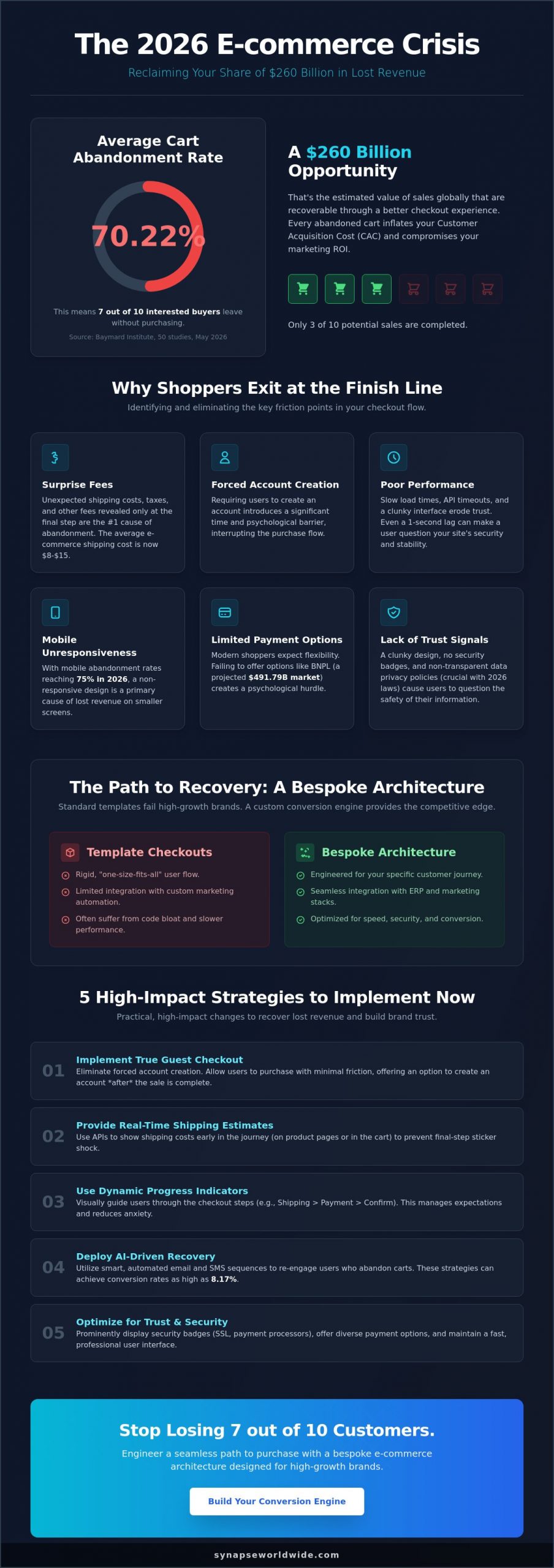
70.22% of your potential revenue is likely evaporating at the final stage of the customer journey, according to the latest data from the Baymard Institute. This means most businesses are losing seven out of every ten interested buyers, making the mandate to reduce cart abandonment the most significant growth lever for 2026. You’ve likely felt the impact of the January 18, 2026, USPS rate increases and rising fuel surcharges, which have turned shipping costs into a major friction point. It’s frustrating to watch high customer acquisition costs go to waste because of a checkout process that lacks the necessary technical performance or trust signals.
We’re here to show you how to reclaim your share of the $260 billion in recoverable global revenue through a streamlined, bespoke e-commerce architecture. You’ll learn how to navigate the complex data privacy laws that took effect in Indiana and Kentucky on January 1, 2026, while implementing AI-driven recovery strategies that deliver an 8.17% conversion rate. This guide provides a strategic roadmap to optimize your digital landscape, integrate robust marketing automation, and secure a higher ROI on your digital marketing spend.
Key Takeaways
- Identify the specific financial and psychological friction points that cause shoppers to exit your funnel before completing a transaction.
- Evaluate why standard, cookie-cutter checkout templates often fail high-growth brands and how bespoke architecture provides a competitive edge.
- Master practical, high-impact strategies to reduce cart abandonment, such as implementing true guest checkout and dynamic progress indicators.
- Shift your focus from minor technical fixes to building a comprehensive conversion engine that integrates seamlessly with your marketing automation.
The Strategic Impact of Cart Abandonment in 2026
Cart abandonment represents the critical disconnect between a consumer’s desire to purchase and the final payment confirmation. As of May 2026, the average shopping cart abandonment rate remains stagnant at 70.22% according to 50 studies by the Baymard Institute. This suggests that despite technological advancements, many e-commerce platforms still suffer from fundamental architectural flaws. To reduce cart abandonment, you must view it as a symptom of digital friction, which includes any technical or psychological barrier that halts the buyer’s journey.
Every lost transaction inflates your customer acquisition cost (CAC). If you’re driving high-quality traffic through SEO or PPC but failing to convert seven out of ten visitors, your marketing ROI is severely compromised. Recent geopolitical events, such as the closure of the Strait of Hormuz in February 2026, have surged global freight rates and fuel surcharges by up to $4,000 per container. These external pressures make every completed sale more valuable. When you reduce cart abandonment, you’re not just fixing a technical glitch; you’re protecting your business’s bottom line against a volatile global economy.
The Hidden Costs Beyond Lost Revenue
The damage isn’t limited to immediate revenue loss. High abandonment rates lead to inventory locking, where items are held in “ghost” carts and remain unavailable to actual buyers. This creates significant friction in your ERP solutions and inventory management systems. Additionally, skewed analytics from incomplete sessions lead to poor strategic decisions, while a clunky checkout process erodes the brand trust you’ve worked hard to build.
Why 2026 Shoppers Have Zero Tolerance for Friction
Shoppers now demand instant gratification and a seamless, one-click experience. In 2026, mobile abandonment rates have reached 75%, driven by a lower patience threshold for non-responsive designs. Users also have heightened sensitivity toward data privacy. With new comprehensive consumer laws taking effect globally this year, transparency regarding data processing is no longer optional. If your checkout doesn’t communicate security and speed instantly, modern consumers will simply move to a competitor who does.
Identifying Friction Points: Why Shoppers Exit at the Finish Line
Pinpointing why users leave your store requires a granular audit of the technical, financial, and psychological drivers behind their behavior. The most common catalyst for an exit is the “Surprise Fee” trap. Industry reports indicate that the average cost to ship an e-commerce order in 2026 is between $8 and $15. When these costs are hidden until the final step, shoppers feel a breach of trust. To reduce cart abandonment, transparency must begin on the product page. Providing real-time shipping estimates early in the journey prevents the sticker shock that often leads to a discarded cart.
Forced account creation remains a significant barrier to conversion. It’s perceived as a time-consuming obstacle that interrupts the flow of a transaction. Technical performance is equally critical; even a one-second lag during the payment processing stage can make a user question the security of your site. If your platform suffers from API timeouts or slow responsiveness, the customer will likely seek a more stable competitor. If you’re seeing high drop-off rates at the final gate, our team can help you build a bespoke e-commerce strategy to eliminate these bottlenecks.
Technical vs. Psychological Barriers
Technical barriers include mobile unresponsiveness and slow load times, which are fatal in a market where shoppers expect immediate results. Psychological barriers are more nuanced, often involving a lack of trust signals or limited payment flexibility. The global Buy Now, Pay Later (BNPL) market is projected to reach $491.79 billion in 2026. Failing to offer these modern, flexible payment options creates an immediate psychological hurdle. Selecting the right ecommerce payment gateways is a critical architectural decision that directly impacts your ability to convert hesitant visitors. Utilizing custom web design for small business ensures your site projects the professional authority needed to convert hesitant visitors.
The “Comparison Shopping” Dilemma
Many shoppers use the cart as a temporary “wish list” or a tool for price comparison. This behavior is a reality of the modern digital landscape. You must distinguish between “intent to buy” and “intent to research” by offering low-friction entry points. Implementing tactics to reduce cart abandonment, such as guest checkout and persistent carts, allows shoppers to return and complete their purchase when they’re ready. By providing a seamless path back to their saved items, you turn window shoppers into committed customers before they exit your ecosystem.
Architectural Solutions: Custom vs. Template Checkout Frameworks
Many businesses rely on off-the-shelf plugins from platforms like Shopify or WooCommerce to manage their transactions. While these templates offer a quick entry point, they often impose rigid structures that cannot accommodate unique B2B logic or complex shipping requirements. To truly reduce cart abandonment, your checkout architecture must feel invisible to the user. High-growth brands frequently outgrow “cookie-cutter” flows because they lack the granular control required to optimize micro-interactions. A template might look professional, but its underlying code is often shared by thousands of other stores, making it difficult to differentiate your brand through a superior user experience.
Headless commerce has emerged as a critical strategic solution in 2026. By decoupling the frontend presentation layer from the backend commerce logic, you achieve ultra-fast load times that templates simply cannot replicate. Data shows that 57% of shoppers will exit if a page takes three seconds to load. A headless approach ensures your checkout isn’t bogged down by legacy code or unnecessary scripts. This level of ecommerce website development prioritizes architectural stability. It ensures your store remains robust during high-traffic events while allowing for the seamless integration of advanced tactics to reduce cart abandonment that templates often struggle to support.
The Power of Bespoke E-commerce Integration
Bespoke solutions allow you to tailor the checkout flow to match specific buyer journeys. Whether you’re handling bulk B2B orders or high-frequency B2C sales, a custom build enables single-page checkouts that eliminate redundant steps. You can implement custom logic for shipping, taxes, and multi-currency transactions that reflect real-time changes, such as the January 2026 USPS rate increases. This level of integration ensures that the financial transparency discussed earlier is technically supported by your site’s architecture.
Scalability and Technical Debt
Template-heavy sites often accumulate technical debt as transaction volumes increase. “Plugin bloat” is a primary cause of slow performance, particularly for mobile users who already face a 73% to 75% abandonment rate. Custom builds eliminate this bloat by including only the necessary features for your specific business model. By investing in a scalable, integrated digital landscape, you ensure that your backend infrastructure can handle the projected growth of modern payment trends like Buy Now, Pay Later, which is expected to reach $491.79 billion this year. Professional execution at the architectural level is the only way to safeguard your long-term ROI.
5 High-Impact Tips to Reduce Cart Abandonment and Recover Revenue
Tactical execution is what ultimately secures the transaction once your architecture is in place. In the 2026 digital landscape, businesses must move beyond basic fixes and implement sophisticated, data-driven interventions. To effectively reduce cart abandonment, you must address the specific friction points where shoppers hesitate. Implementing the following five strategies will help you reclaim revenue and optimize your store’s performance.
- Implement “True” Guest Checkout: Don’t force account creation during the transaction. Use background account creation that captures user data without adding extra steps to the flow.
- Use Dynamic Progress Indicators: Visual cues reduce checkout anxiety by showing the user exactly how close they are to the finish line. Transparency in the process keeps the buyer engaged.
- Deploy AI-Driven Exit Intent: Standard pop-ups are ignored. Use AI-powered triggers that offer personalised value propositions based on the items in the cart. AI recovery tools currently deliver an 8.17% conversion rate.
- Integrate Real-Time Calculators: With global fuel surcharges and freight rates fluctuating, providing instant calculations on the product page prevents “sticker shock” at the final step.
- Optimise for “One-Tap” Mobile Payments: Since mobile users face higher friction, integrating Apple Pay, Google Pay, and modern digital wallets is mandatory for a seamless experience.
Ready to stop the revenue leak? You can audit your checkout performance with our strategic consulting team to identify your specific growth opportunities.
Advanced Recovery through Marketing Automation
Recovery doesn’t end when a user leaves your site. Modern marketing automation allows you to reach customers through SMS and push notifications, which often see higher engagement than traditional email. By leveraging your CRM data, you can offer bespoke incentives to high-value shoppers who abandoned large carts. This integrated approach ensures that your PPC management services are supported by a robust retargeting strategy. Re-engaging lost visitors with specific, relevant messaging is a proven way to reduce cart abandonment over the long term.
Optimising Payment Versatility
Payment flexibility is a requirement for modern commerce. While you’ve already seen the massive growth projections for Buy Now, Pay Later (BNPL), the key is in the implementation. If you don’t offer BNPL or localised payment methods for international shoppers, you’re creating an unnecessary barrier to entry. Maintaining strict PCI compliance is essential for trust, but it shouldn’t come at the cost of a clunky user interface. Understanding how different ecommerce payment gateways handle currency conversion fees, fraud protection, and PCI compliance is essential for building a checkout that balances security and speed. A strategic digital architect ensures that security and speed coexist, providing a stable environment that encourages shoppers to complete their purchase with confidence.
Bespoke E-commerce Development: Engineering a Seamless Path to Purchase
Successful brands in 2026 recognize that a shopping cart is not an isolated feature; it’s the culmination of a complex digital ecosystem. To effectively reduce cart abandonment, you must shift your perspective from simply fixing a broken checkout to engineering a high-performance conversion engine. Synapse Worldwide approaches e-commerce development as a strategic digital architecture, ensuring every technical decision supports long-term business goals. By conducting deep, data-driven audits, we identify the exact micro-moments where your customers exit, allowing for surgical optimizations that off-the-shelf templates cannot provide. A comprehensive approach to ecommerce conversion rate optimization ensures that every element of your store, from product pages to payment confirmation, is engineered to maximize revenue from the traffic you’ve already earned.
Custom development offers a permanent solution to the recurring issues of technical debt and plugin bloat. While a standard store might struggle with the 73% to 75% mobile abandonment rates seen this year, a bespoke build is optimized for the specific hardware and browsing habits of your target audience. This architectural precision ensures that your site remains stable during high-traffic periods, maintaining the trust required to capture your share of the $260 billion in recoverable global revenue. Investing in a tailored solution is the most reliable way to secure a scalable future for your digital presence.
Integrated Systems for Maximum Efficiency
A seamless path to purchase requires more than just a fast frontend. True efficiency comes from connecting your e-commerce platform directly to your CRM and ERP systems. This integration provides a unified view of your inventory, customer history, and shipping logistics, which is vital given that last-mile delivery now accounts for 53% of total shipping costs. Automation reduces the risk of manual errors and ensures that the post-purchase experience is as smooth as the checkout itself. Bespoke integration is the bridge between sales and operations.
Partnering for Strategic Growth
High-stakes e-commerce transformation requires the expertise of a professional agency that understands both high-level strategy and technical execution. At Synapse Worldwide, our commitment to ROI means we don’t just build websites; we build growth engines. We ensure that your digital landscape is robust, secure, and ready to adapt to the evolving demands of the 2026 market. If you’re ready to reduce cart abandonment and reach the next level of business success, it’s time to move beyond cookie-cutter solutions.
Contact Synapse Worldwide to engineer your high-conversion e-commerce platform and reclaim your lost revenue today.
Engineering Your Conversion Engine for 2026
Reclaiming the 70.22% of revenue lost at checkout requires more than surface-level tweaks. It demands a fundamental shift toward bespoke architecture and seamless system integration. By identifying technical bottlenecks and removing psychological barriers, you position your brand to capture a significant portion of the $260 billion in recoverable global revenue. The goal is to move beyond the limitations of cookie-cutter templates and build a robust, scalable digital landscape that prioritizes the user’s journey.
Synapse Worldwide has been a leader in digital strategy since 2005. With 20 years of expertise, we specialize in creating bespoke e-commerce solutions that integrate perfectly with your CRM and ERP systems. Our role as your Digital Architect is to ensure every technical detail serves your long-term ROI. To reduce cart abandonment and reach the next level of business success, you need a partner who understands the intricate details of high-stakes commerce.
Partner with Synapse Worldwide to transform your e-commerce conversion rates
Your growth potential is waiting; let’s build the engine to unlock it.
Frequently Asked Questions
What is the average cart abandonment rate in 2026?
The average e-commerce cart abandonment rate for 2026 stands at 70.22%, according to ongoing research by the Baymard Institute. This figure reflects a broader trend where desktop users abandon at 65% to 68%, while mobile users see higher rates of 73% to 75%. These benchmarks highlight the consistent gap between consumer intent and final transaction completion across the global digital landscape.
How can I identify why my customers are abandoning their carts?
You can identify specific friction points by performing a comprehensive data audit of your checkout funnel. Tools like heatmaps and session recordings reveal where users hesitate, while Google Analytics 4 provides precise drop-off percentages at each step. This evidence-based approach allows you to distinguish between technical failures, such as slow API responses, and psychological barriers like unexpected shipping fees or a lack of trust.
Does a slow website really cause cart abandonment?
Speed is a critical conversion factor; 57% of shoppers will abandon their session if a page takes longer than three seconds to load. Even a one-second delay can reduce customer satisfaction and trust, particularly during the payment processing phase. High-performance architecture is required to maintain the momentum of the buyer’s journey and effectively reduce cart abandonment across all devices.
Should I offer guest checkout to reduce abandonment?
Offering a guest checkout option is one of the most effective ways to lower the barrier to entry for new customers. Research consistently shows that forced account creation is a primary driver for exit, as users prioritize speed over long-term relationship building. You can still capture essential data for your CRM through background account creation once the transaction is finalized, ensuring a seamless user experience.
Can marketing automation help recover abandoned carts?
Marketing automation is a powerful tool for reclaiming revenue that would otherwise be lost. AI-powered recovery sequences currently achieve an 8.17% conversion rate, which is double the performance of standard template emails. By integrating your store with a robust CRM, you can send personalized SMS or email reminders that address the specific items left behind, encouraging the user to return and complete their purchase.
Is custom web design better than templates for reducing abandonment?
Bespoke web design is superior to templates because it eliminates the technical debt and “plugin bloat” that often slow down standard sites. Custom builds allow you to engineer a frictionless, single-page checkout tailored to your specific business logic and buyer personas. This architectural precision is essential for high-growth brands that need to scale without sacrificing performance or the stability of their digital landscape.
What payment methods should I offer to improve conversion rates?
You should offer a mix of traditional credit card processing and modern digital wallets like Apple Pay and Google Pay to cater to mobile shoppers. Including Buy Now, Pay Later (BNPL) options is also crucial, as this market is projected to reach $491.79 billion in 2026. Providing diverse, localized payment methods ensures that customers don’t exit due to a lack of their preferred financial tools.
How does mobile optimization affect cart abandonment?
Mobile optimization is no longer optional; mobile users face a significantly higher abandonment rate of 73% to 75% compared to desktop. Small screens and touch interfaces require a streamlined UI that minimizes typing and simplifies navigation. If your mobile checkout isn’t perfectly responsive, you’re likely losing a majority of your potential revenue to competitors with better reduce cart abandonment strategies and faster load times.

