

Category Archives: Web design


What is Software? Categories, Examples, and Strategic Business Applications

What is Software? Categories, Examples, and Strategic Business Applications

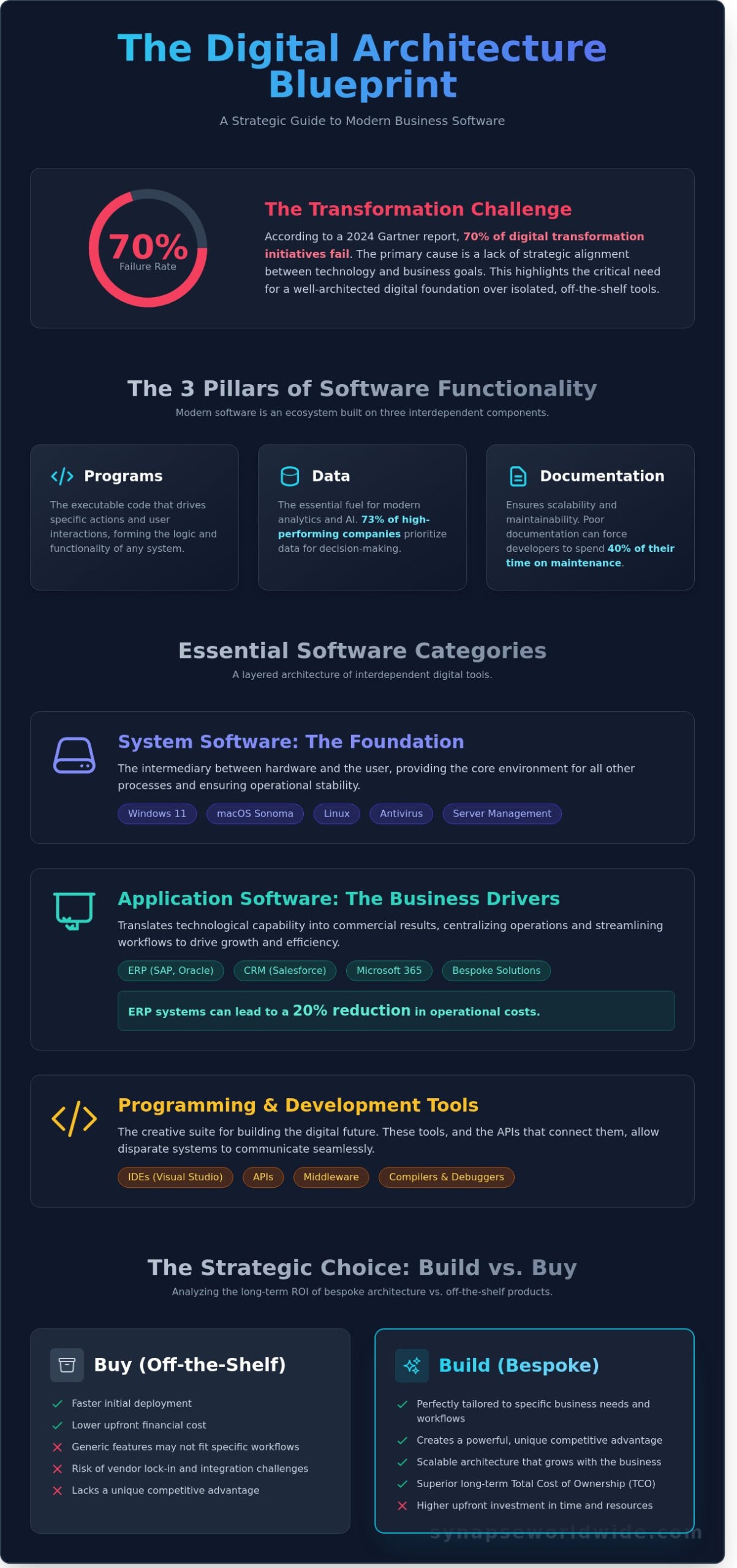
Most business leaders view their digital tools as a necessary expense, yet a 2024 Gartner report indicates that 70% of digital transformation initiatives fail because the underlying strategy lacks alignment. You’ve likely felt the weight of this friction when trying to choose the right software for your operations. It’s exhausting to sift through technical jargon while fearing that a new investment won’t integrate with your existing systems. You deserve a clear distinction between essential infrastructure and optional tools that actually move the needle for your bottom line.

We understand that a robust digital presence requires more than just off-the-shelf fixes; it requires a visionary approach to architecture. This article provides a clear mental map of the technology landscape and explains how bespoke solutions drive measurable growth. We’ll explore the fundamental categories of modern tools, compare the long-term ROI of custom versus pre-packaged options, and give you the confidence to lead your next transformation project. By the end, you’ll see exactly how strategic digital choices turn complex problems into seamless, scalable results for your enterprise.

Key Takeaways

  • Understand how modern software has evolved from simple scripts into intelligent, cloud-native ecosystems that define the current digital landscape.
  • Navigate the essential categories of digital tools to identify which systems and applications are most critical for your specific operational goals.
  • Analyze the strategic “Build vs. Buy” dilemma to determine if a bespoke architecture or an off-the-shelf product delivers a superior long-term total cost of ownership.
  • Uncover how integrated digital workflows eliminate departmental silos and convert manual bottlenecks into streamlined, automated growth engines.
  • Gain a clear roadmap for your digital transformation journey, emphasizing the vital roles of discovery and user-centric design in achieving scalable success.

Defining Software in the 2026 Digital Landscape

Software serves as the essential set of instructions that direct physical hardware to execute precise tasks. While early computing relied on rigid, linear scripts, the 2026 environment demands highly adaptive, AI-driven, and cloud-native ecosystems. Understanding what is software requires moving beyond simple definitions; it’s the digital nervous system that powers every strategic move a business makes. By 2025, Gartner predicted that 95% of new digital workloads would be deployed on cloud-native platforms. This shift confirms that software isn’t just a tool, it’s the very infrastructure of growth.

We approach software from the perspective of a Digital Architect. This means viewing every line of code as strategic infrastructure rather than a mere utility. When software is bespoke and integrated correctly, it transforms from a back-office expense into a front-line competitive advantage. This evolution has moved us from siloed applications to interconnected environments where software manages everything from global supply chains to personalized customer experiences in real time.

The Core Components: Programs, Data, and Documentation

Modern software functionality relies on three distinct pillars. Programs act as the executable code that drives specific actions and user interactions. Data serves as the essential fuel, powering the predictive analytics and machine learning models that 73% of high-performing companies now prioritize for decision-making. Documentation ensures these systems remain scalable and maintainable. Without robust documentation, technical debt accumulates quickly; research suggests this often forces developers to spend 40% of their time on maintenance instead of innovation.

How Software Interacts with Hardware

Software acts as a sophisticated abstraction layer, hiding the complex binary operations of hardware behind intuitive interfaces. This interaction depends on drivers and firmware to translate digital intent into physical action. Our focus remains on seamless integration. When physical assets and digital logic align perfectly, organizations see a measurable lift in operational efficiency. This synergy allows for “zero-friction” deployments where hardware limitations no longer bottleneck strategic expansion. By 2026, the boundary between physical devices and digital control has largely vanished, replaced by a unified, software-defined ecosystem.

Essential Categories and Real-World Software Examples

Modern business relies on a layered architecture of digital tools. We categorize these assets into three distinct yet interdependent pillars: System, Application, and Programming tools. Each serves a specific strategic purpose, ensuring that a company’s digital landscape remains robust and scalable.

System Software: The Foundation

System tools act as the intermediary between hardware and the user. Operating Systems like Windows 11, macOS Sonoma, and various Linux distributions provide the core environment for all other processes. Beyond the OS, utility programs ensure operational stability. Antivirus tools, file management systems, and diagnostic suites maintain the health of your infrastructure. For global enterprises, server management tools are non-negotiable. They secure the 99.9% uptime required for modern digital commerce and prevent costly service interruptions.

Application Software: The Business Drivers

This category translates technological capability into commercial results. Enterprise Resource Planning (ERP) systems like SAP or Oracle centralize operations, often leading to a 20% reduction in operational costs. Customer Relationship Management (CRM) platforms, such as Salesforce, function as growth engines by streamlining sales pipelines. While generic productivity suites like Microsoft 365 offer broad utility, many firms invest in tailored digital solutions to gain a competitive edge. These bespoke tools address specific workflow bottlenecks that off-the-shelf products often ignore.

Programming and Development Tools

Developers use Integrated Development Environments (IDEs) like Visual Studio or IntelliJ IDEA to build the digital future. These tools facilitate the creation of complex Real-World Software Examples that power modern industry. APIs (Application Programming Interfaces) serve as the vital connective tissue here. They allow disparate systems to communicate, enabling the rise of Middleware. This layer bridges the gap between legacy systems and modern cloud applications. By 2025, analysts expect the middleware market to exceed $50 billion as businesses prioritize seamless data integration. Integration doesn’t happen by accident; it requires a strategic approach to how these tools overlap within your organization.
What is Software? Categories, Examples, and Strategic Business Applications

Custom vs. Off-the-Shelf: Choosing the Right Architecture

The decision to build proprietary systems or purchase existing licenses represents a critical strategic fork in the road. Organizations must evaluate whether their core processes are standard enough for a generic solution or unique enough to demand a tailored engine. While a 2023 Gartner report indicates that global enterprise software spending reached $913 billion, much of that investment is lost to inefficient, cookie-cutter tools that fail to map to specific operational workflows. To fully grasp the strategic implications, one must first define What is Software? in the context of modern infrastructure versus specific business applications.

The Case for Off-the-Shelf Software

Software as a Service (SaaS) provides an immediate answer for non-core functions like accounting or basic HR. These platforms offer rapid deployment, often allowing teams to begin work within 24 hours of purchase. However, the convenience of standardized features carries hidden costs. Research from 2023 suggests that 38% of SaaS licenses in mid-market firms go unused, a phenomenon known as feature bloat. Paying for a massive suite when your team only requires five specific tools creates a drag on the total cost of ownership (TCO) that often offsets the lower initial price point.

The Power of Bespoke Development

For enterprises aiming to disrupt their industry, bespoke development offers a level of optimization that generic tools can’t match. Custom software architectures align perfectly with your internal logic, removing the friction of manual workarounds. This strategic alignment directly impacts the bottom line; a 2022 McKinsey study found that companies with high developer velocity see revenue growth four to five times faster than their peers. Bespoke solutions provide three primary advantages:

  • Full IP Ownership: You own the code, eliminating recurring licensing fees and third-party dependency.
  • Scalability: The system expands based on your specific growth trajectory, not a vendor’s rigid roadmap.
  • Competitive Moats: Unique digital tools create barriers to entry that competitors using off-the-shelf products can’t replicate.

Strategic architecture isn’t just about code; it’s about building a robust digital asset that scales with your ambition. By choosing an integrated approach that mirrors your business model, you ensure that your technology acts as an accelerator rather than a constraint. It’s the difference between renting a generic space and owning a facility designed for peak performance.

How Bespoke Software Solves Complex Business Challenges

Manual processes are the silent killers of scalability. When a business relies on disconnected spreadsheets, they aren’t just losing time; they’re losing 20% to 30% of their operational efficiency through redundant data entry. Transitioning to automated digital workflows ensures that every action triggers a logical next step without human intervention. This shift transforms software from a mere tool into a strategic asset that powers growth.

Custom architecture provides three primary advantages over generic alternatives:

  • Elimination of Data Silos: Information moves freely between departments, ensuring marketing, sales, and operations share one source of truth.
  • Optimized User Experience: Interfaces are designed around your specific team’s habits, reducing training time by 40% compared to complex legacy systems.
  • Financial Scalability: The system grows with your transaction volume without requiring expensive per-user license upgrades that often drain 10% of annual IT budgets.

The primary objection to custom development is usually the initial cost. However, the ROI is realized by eliminating the “technical debt” and inefficiency costs that drain revenue in misaligned businesses. By building exactly what you need, you avoid paying for bloated features that 80% of your staff will never use. A disciplined focus on a simple project approach to custom development ensures your investment targets only the features that deliver tangible returns.

Streamlining Operations with ERP and CRM Integration

Disjointed data silos prevent a unified view of the customer journey. By integrating ERP and CRM systems, organizations achieve a 15% reduction in administrative overhead. Data flows seamlessly from the initial lead capture to final fulfillment. This level of integration provides executives with real-time visibility; you can track a project’s profitability the moment a task is completed, rather than waiting for end-of-month reconciliations.

Enhancing Security and Compliance

Generic applications are frequent targets for mass-scale cyberattacks. The 2023 Progress MOVEit breach demonstrated how one vulnerability in a widely used tool can compromise thousands of organizations simultaneously. Bespoke software allows for the implementation of specific security protocols that align with your unique risk profile. We build solutions with robust data encryption and granular access controls that meet strict regulatory standards like GDPR or SOC2 from the ground up.

Ready to transform your operations? Learn more about our bespoke software development services to scale your business with confidence.

Designing Your Future: Implementing Scalable Software Solutions

Success in digital transformation requires a roadmap rather than a reaction. Businesses that prioritize a structured implementation see 25% higher profit margins than peers who rush the process. This transition begins with a shift in perspective; viewing technology as a profit center rather than a cost. We help you build a foundation that supports immediate needs while anticipating future expansion. By focusing on scalability from day one, you avoid the technical debt that hampers 70% of growing enterprises.

The Discovery Phase: Aligning Technology with Strategy

A deep audit of business processes must precede the first line of code. We identify the specific growth bottlenecks, like manual data entry errors that cost mid-sized firms $4.3 million annually according to recent industry benchmarks. By mapping these workflows, we ensure the software solves real-world operational friction. Synapse Worldwide utilizes a fixed-price project model to provide total budget certainty, effectively eliminating the 45% cost overruns common in traditional development cycles. This phase also prioritizes UI/UX design, as intuitive interfaces increase employee productivity by 35% and reduce training costs by half. Teams that follow a streamlined custom development process focused on simplicity consistently achieve faster time-to-market and stronger returns on their initial investment.

Maintenance and Evolution in the Digital Landscape

Software is a living asset. It requires constant refinement to remain secure and efficient. We provide proactive technical support and secure hosting that guarantees 99.99% uptime for enterprise clients. This long-term partnership approach ensures your digital infrastructure scales alongside your revenue. Regular updates prevent the 60% performance degradation typically seen in unmaintained legacy systems after 24 months. Our team focuses on seamless optimization to keep your operations running at peak capacity through every market cycle. We treat your infrastructure as a strategic priority, not a background task.

Partnering with Synapse Worldwide means choosing a Digital Architect dedicated to your ROI. We combine global perspective with hands-on execution to build robust, bespoke solutions. Our commitment to excellence ensures your software remains a competitive advantage for years to come. Reach out today to begin your transformation with a team that values precision as much as you do. Let’s build the digital future your business deserves.

Mastering Your Digital Evolution

Navigating the 2026 digital landscape requires more than just basic tools; it demands a strategic alignment of technology and business objectives. You’ve explored how the right architecture separates market leaders from those struggling with technical debt. Choosing between off-the-shelf products and bespoke systems is a foundational decision that impacts your operational efficiency for years. High-performing organizations prioritize scalability and seamless integration to ensure their software remains a driver of growth rather than a bottleneck.

Since 2005, Synapse Worldwide has delivered over 20 years of technical expertise to high-value corporate and government sectors. We eliminate financial uncertainty through our fixed-price project models; this ensures your budget remains transparent while your infrastructure becomes world-class. Our team acts as your digital architect, building robust solutions tailored to your unique challenges. It’s time to move beyond standard applications and embrace a system designed specifically for your success.

Transform your business with bespoke software solutions from Synapse Worldwide and secure your competitive advantage in an ever-changing market.

Frequently Asked Questions

What is the difference between system software and application software?

System software serves as the foundational layer that manages hardware components, while application software allows users to perform specific business or personal tasks. Windows 11 and macOS are primary examples of system layers that coordinate your computer’s resources. In contrast, 95% of tools used in a professional environment, such as accounting platforms or CRM systems, are applications. These programs rely on the system layer to function but focus entirely on user-facing outcomes.

How much does custom software development typically cost in 2026?

Custom software development in 2026 typically requires an investment ranging from $60,000 for mid-range applications to over $350,000 for complex enterprise systems. These figures reflect a 12% increase in global development rates compared to 2024 benchmarks. Investing in a bespoke solution ensures your architecture scales with your growth. This strategic allocation of capital eliminates the recurring per-seat licensing fees that often drain 15% of annual IT budgets in larger organizations.

Is custom software more secure than off-the-shelf SaaS solutions?

Custom software provides a higher security ceiling because its unique code isn’t a known target for mass-market exploits. Off-the-shelf SaaS solutions are targeted by 85% of automated bot attacks because a single vulnerability can compromise thousands of different companies at once. A bespoke build allows for specific encryption protocols tailored to your industry’s compliance needs. You control the security roadmap, which significantly reduces the risk of third-party data breaches.

How long does it take to develop a bespoke business application?

Developing a bespoke business application generally takes between 4 and 10 months from the initial discovery phase to final deployment. Our data shows that 70% of high-performing digital projects achieve a functional Minimum Viable Product within 18 weeks. This timeline includes rigorous testing and quality assurance to ensure the final product is robust. A structured development sprint ensures your team sees a tangible return on investment within the first year of operation.

What are the most common examples of enterprise-level software?

Enterprise-level software includes robust platforms like SAP for resource planning and Salesforce for relationship management. Other critical examples include Microsoft Dynamics 365 and Oracle NetSuite, which handle high-volume data processing for organizations with over 500 employees. Integrating these tools into your digital landscape creates a unified source of truth. This coordination improves cross-departmental efficiency by 25% compared to fragmented legacy systems that don’t communicate effectively.

Can custom software integrate with my existing tools like Xero or Salesforce?

Your custom solution can integrate seamlessly with existing tools like Xero or Salesforce through secure API connections. Approximately 82% of modern business applications utilize RESTful APIs to facilitate real-time data exchange between different platforms. This connectivity prevents the creation of data silos and eliminates manual entry errors. By bridging these platforms, you create a cohesive ecosystem where financial and customer data flow automatically between your proprietary and third-party systems.

Why is UI/UX design important for internal business software?

UI/UX design is critical for internal software because it directly influences employee adoption rates and daily operational speed. Research indicates that intuitive interfaces can increase internal task completion rates by 35% across most departments. When your team doesn’t struggle with complex navigation, they focus on high-value strategic work instead of troubleshooting. A well-designed digital environment reduces training costs and minimizes the human error that often plagues poorly optimized legacy applications.

What happens to my software if the development agency closes?

Your business remains protected if a development agency closes because our professional contracts grant you 100% ownership of the source code. We provide comprehensive technical documentation and host the code in independent repositories like GitHub or GitLab. This ensures any qualified engineering team can step in and maintain the software without interruption. Securing your intellectual property is a non-negotiable step in building a resilient, long-term digital asset for your company.

 

Mobile App Development in 2026: A Strategic Guide for Businesses

Mobile App Development in 2026: A Strategic Guide for Businesses

Your business doesn’t need another mobile app; it needs a high-performance asset that pays for itself. By 2026, the Australian digital economy is projected to contribute A$250 billion to the national GDP, yet 45% of enterprise mobile app development projects still face significant hurdles during the scaling phase. You’re right to feel concerned about the potential for high development costs without immediate returns. The choice between native and cross-platform options often feels like a gamble when you’re focused on long-term maintenance and scalability.

This guide provides the clarity you need to master these complexities and discover how a bespoke digital strategy transforms user engagement into measurable business growth. We’ll provide a clear roadmap from your initial idea to a successful launch. You’ll learn to evaluate the cost-to-value ratio of your investment and identify the precise technology stack required to meet your specific business objectives in the evolving Australian landscape. Our goal is to ensure your digital presence is robust, scalable, and built for a superior return on investment.

Key Takeaways

  • Learn why modern mobile app development has evolved from simple utility into a comprehensive business ecosystem designed for long-term scalability.
  • Navigate the technical trade-offs between native and cross-platform frameworks to select a bespoke tech stack that aligns with your specific performance requirements.
  • Discover why the discovery and strategy phases are the most critical investments in ensuring your application’s architectural integrity and market success.
  • Shift your perspective from development costs to sustainable ROI by implementing monetisation models tailored for the Australian and global markets.
  • Understand the “Digital Architect” philosophy and how a disciplined technical approach transforms user engagement into measurable A$ business growth.

What is Mobile App Development and Why Does It Matter in 2026?

Mobile app development is the strategic engineering of bespoke software designed specifically for handheld devices. It has evolved far beyond the basic utility tools of the previous decade. By 2026, apps have become integrated business ecosystems that bridge the gap between physical services and digital precision. While responsive web design serves a purpose for discovery, it lacks the deep integration of a native application. Research from eMarketer shows that 88% of mobile time is now spent within apps rather than browsers, highlighting a clear shift in consumer behavior. Successful businesses use these platforms to deliver hyper-personalised experiences driven by on-device AI, ensuring every user interaction feels intentional and relevant.

The Business Value of a Custom Mobile Presence

Building a custom app transforms how you interact with your audience. It establishes a direct-to-consumer channel where push notifications achieve engagement rates 300% higher than traditional email marketing. This proximity allows for sophisticated data collection, providing your team with real-time business intelligence to refine your strategy. High-performance user interfaces foster loyalty; a 0.1-second improvement in mobile speed can increase conversion rates by 8.4%, according to Deloitte’s retail benchmarks. Investing in mobile app development ensures your brand remains a permanent fixture on the most valuable real estate your customer owns: their home screen.

Key Mobile Trends Reshaping the Landscape

  • 5G and Edge Computing: The rollout of 5G-enabled edge computing allows apps to support complex processing locally, reducing latency to under 10 milliseconds for near-instant responsiveness.
  • Augmented Reality (AR): Innovative retailers are integrating AR to let customers “place” products in their homes before purchasing, a move that reduces return rates by up to 27% based on recent industry data.
  • Privacy-First Architecture: Under evolving data privacy frameworks, privacy-first mobile app development has become a core competitive advantage.

Brands that prioritise transparent data handling build deeper trust, securing a larger share of the global digital economy. We don’t just build apps; we architect scalable digital assets that grow alongside your enterprise. This strategic approach ensures your software isn’t just a tool, but a robust driver of measurable ROI. By 2026, the distinction between a market leader and a laggard is often defined by the quality of their mobile ecosystem.

Choosing Your Technology Stack: Native vs. Cross-Platform

Selecting the right technology stack is a pivotal decision that dictates your project’s lifecycle costs and performance ceiling. It’s not about which framework is “better” in a vacuum; it’s about aligning technical architecture with specific commercial objectives. By 2026, the mobile hardware landscape will be dominated by advanced AI-processing chips with a 45% increase in NPU performance compared to 2023 models. Your choice must accommodate these shifts to avoid premature technical debt.

A bespoke technology strategy ensures your mobile app development investment yields a high return. We analyse your specific requirements to determine if your goals demand the raw power of native code or the agility of cross-platform frameworks. This decision impacts everything from your initial A$85,000 MVP budget to your long-term scaling costs across the Australian market.

Native Development: Maximum Performance and Security

Swift for iOS and Kotlin for Android remain the gold standard for high-performance applications. If your Canberra-based enterprise requires deep integration with hardware, such as complex AR features or high-frequency data processing, native is the logical path. Native builds offer a 25% faster runtime efficiency compared to layered frameworks. This approach ensures long-term stability because you remain directly aligned with Apple and Google’s official release cycles. Security-sensitive industries, particularly those complying with Australian Privacy Principles, often favour native environments for their robust, low-level encryption capabilities. Staying within the official ecosystem simplifies maintenance and ensures your app remains functional immediately after major OS updates.

Cross-Platform Frameworks: Speed and Reach

For startups aiming for a rapid nationwide launch, frameworks like Flutter and React Native provide a strategic advantage. These tools allow developers to maintain a single codebase, which can reduce initial development timelines by approximately 35%. This efficiency allows you to allocate more budget toward user acquisition and market testing. While cross-platform solutions have closed the gap in UI fluidity, they require a nuanced architectural approach to ensure the user experience remains premium. Enterprise-grade scalability often benefits from a bespoke digital strategy that integrates hybrid modules for flexible updates. Modern cross-platform apps now achieve 98% code parity across platforms, making them a formidable choice for 85% of standard business use cases. This balance of cost-efficiency and reach is essential for mobile app development projects targeting a broad demographic quickly.

  • Native: Best for high-computation tasks, biometric security, and complex animations.
  • Cross-Platform: Ideal for content-driven apps, rapid prototyping, and unified brand experiences.
  • Hybrid: Suitable for enterprise systems requiring frequent over-the-air updates without store resubmission.

Mobile App Development in 2026: A Strategic Guide for Businesses

The Mobile App Development Lifecycle: From Vision to Launch

Successful software doesn’t happen by accident. It requires a disciplined, architectural approach that treats code as a structural asset rather than a series of scripts. Industry data from the Standish Group indicates that 68% of enterprise projects fail to meet their original objectives because they bypass the structural planning phase. A robust framework ensures your investment scales as your Canberra business grows, transforming a simple concept into a high-performing digital tool.

Quality Assurance (QA) isn’t a final hurdle; it’s a continuous thread. Professional builds integrate automated testing and manual regressions at every milestone. This proactive stance eliminates friction, ensuring the final product maintains 99.9% uptime and delivers the reliability your users expect from a premium brand. It’s about building a legacy, not just a temporary utility.

Phase 1: Discovery, Strategy, and UI/UX Design

Discovery is the most critical investment you’ll make. We map precise user journeys to ensure the app solves a specific business problem rather than just adding noise to the market. Our team creates high-fidelity prototypes for stakeholder validation before a single line of code is written. This process reduces development rework by 45% on average. By defining a lean Minimum Viable Product (MVP), we accelerate your initial launch, allowing you to capture market share in the Australian landscape while gathering real-world data for future iterations.

Phase 2: Agile Development and Integration

Modern mobile app development relies on a seamless marriage between front-end aesthetics and back-end stability. We focus on building integrated systems that don’t operate in isolation. Your app should talk to your existing infrastructure, whether that involves A$50,000 custom ERP systems or standard CRM platforms. We use an iterative deployment model to ensure progress is visible and measurable throughout the build.

  • Front-end Precision: Crafting responsive interfaces that perform across all modern devices.
  • System Integration: Linking API endpoints to CRM and ERP systems for real-time data flow.
  • Continuous Testing: Running over 100 automated test cases during every sprint to catch bugs early.

This methodology turns technical complexity into a strategic advantage. It ensures your digital transformation is measurable, scalable, and ultimately, profitable. By prioritizing mobile app development that focuses on business outcomes, we help you reach the next level of success in an increasingly competitive market.

Strategic Monetisation and ROI: Turning Apps into Revenue

Successful mobile app development isn’t an expense; it’s a capital investment. Business leaders in Canberra often focus on the initial build cost, yet the real value lies in the lifecycle revenue and the long-term equity of the digital asset. By 2026, the Australian mobile app market is projected to reach a volume of A$5.3 billion. To capture this, your strategy must evolve from a “launch and leave” mindset to one of continuous, data-driven refinement. We shift the focus from the price of the code to the scalability of the business model.

Sustainable growth requires a deep understanding of the Australian consumer’s willingness to pay. We analyse market trends to ensure your revenue model aligns with user expectations. Whether you’re targeting a local ACT audience or a global user base, your monetisation strategy must feel like a natural extension of the user experience rather than an intrusion. Understanding the full spectrum of apps and mobile apps available for business in 2026 is essential to selecting the architecture that best supports your chosen revenue model.

Proven App Monetisation Models

Choosing the right model dictates your long-term scalability. In the current Australian tech landscape, three strategies dominate:

  • Subscription-based models: These generate predictable recurring revenue. Recent 2024 industry data shows that 68% of top-grossing non-gaming apps use this structure to maintain high engagement levels and steady cash flow.
  • Freemium strategies: You provide core value for free while locking premium features behind a paywall. This lowers the entry barrier for the 82% of users who prefer to “test drive” an app before committing financially.
  • In-app transactions and e-commerce: Essential for retail growth. Integrating seamless payment gateways can boost conversion rates by 18% compared to standard mobile web checkouts. For businesses looking to build a complete digital sales engine, pairing your mobile app with a scalable ecommerce architecture designed for Australian enterprises in 2026 ensures your revenue infrastructure operates as a unified, high-performance system.

Measuring Success: Key Performance Indicators (KPIs)

ROI isn’t just about direct sales; it also includes operational efficiencies gained through digital automation. If your app saves 15 hours of manual administration per week, that’s a tangible return. We focus on the metrics that actually move the needle for your bottom line.

Retention rates and Daily Active Users (DAU) serve as the pulse of your app’s health. A 5% increase in user retention can lead to a profit boost of 25% to 95% according to research from Bain & Company. We also scrutinise conversion funnels to identify exactly where users drop off. By 2026, acquisition costs are expected to rise by 20%, making the Lifetime Value (LTV) of a customer the most critical metric. Success depends on ensuring your LTV exceeds your Cost Per Acquisition (CPA) by a ratio of at least 3:1.

Don’t leave your returns to chance. Partner with Synapse Worldwide to engineer a high-ROI mobile app development strategy tailored for the Australian market.

Synapse Worldwide: Your Bespoke Digital Architects

Choosing a partner for mobile app development determines whether your software is a depreciating cost or a high-yield asset. Synapse Worldwide operates as more than a development house; we function as strategic growth partners for Canberra businesses. Our Digital Architect philosophy blends visionary user experience design with the technical discipline required for enterprise-grade stability. We focus on long-term value. Every project begins with a deep understanding of your commercial goals, ensuring the final product isn’t just functional but transformative. We’ve seen that generic solutions fail to scale, which is why we prioritise custom code that evolves alongside your business.

Why a Bespoke Approach Outperforms Off-the-Shelf

Generic app builders and templates carry inherent security risks that can devastate a growing company. Industry data shows that nearly 76% of apps built on shared, open-source templates contain at least one critical security vulnerability. Bespoke digital infrastructure mitigates these risks by building security into the foundation of the code. Tailored solutions also support unique business workflows that off-the-shelf products simply can’t handle. While a template might save A$5,000 upfront, the lack of integration often leads to productivity losses costing upwards of A$15,000 annually. For Australian SMEs evaluating their broader digital footprint, exploring custom web design for small business as a strategic growth engine in 2026 reveals how the same bespoke principles that protect your app investment also eliminate technical debt across your entire online presence. Custom builds ensure your mobile assets are ready for future technological shifts, such as AI integration or new OS requirements, without needing a total rebuild.

Starting Your Mobile Transformation

A professional consultation is the first step to defining a precise project scope and avoiding “feature creep” that inflates budgets. Synapse manages end-to-end delivery for national and global clients, maintaining a rigorous standard of execution from the first wireframe to the final deployment. Our process ensures that mobile app development remains a controlled, predictable investment. We bridge the gap between complex technical requirements and clear business outcomes. This disciplined approach allows us to deliver high-impact mobile technology that drives real engagement and revenue growth. Our team handles the intricate technical details so you can focus on the big picture of your business expansion. If you’re ready to develop mobile apps that meet the AI-integrated expectations of Australian consumers in 2026, our strategic blueprint provides the architectural clarity and cost transparency you need.

Future-Proof Your Australian Business Strategy for 2026

Navigating the Australian digital landscape in 2026 requires more than a functional interface; it demands a high-performance asset that drives measurable revenue. Success hinges on selecting the optimal technology stack and ensuring your application integrates seamlessly with existing enterprise systems. Whether you’re targeting an A$500,000 revenue milestone or aiming for national scale, your mobile app development strategy must prioritize long-term stability over short-term trends.

Synapse Worldwide has functioned as a premier digital architect since 2005. With over 20 years of technical leadership, we specialize in complex ERP and CRM integrations that turn standard apps into robust business engines. We’ve spent two decades refining a process that delivers scalable, high-ROI solutions for local enterprises. Your vision deserves a partner who understands the intricate technical details and the broader strategic goals of your business.

Partner with Synapse Worldwide for Bespoke Mobile Excellence

Let’s build a digital future that exceeds your most ambitious growth targets.

Frequently Asked Questions

How much does mobile app development typically cost in 2026?

In 2026, a high-quality bespoke mobile application in Australia typically costs between A$60,000 for a Minimum Viable Product (MVP) and A$250,000 for a complex enterprise solution. These figures reflect the rising costs of specialized engineering talent in the Canberra and Sydney markets. Your investment covers strategic architecture, UI/UX design, and rigorous security testing. Larger projects with AI integration often exceed A$350,000 depending on the backend complexity and data processing requirements.

How long does it take to develop a custom mobile application?

Developing a custom mobile application generally takes between 16 and 36 weeks from the initial discovery phase to the final deployment. A standard business tool requires approximately 20 weeks; however, complex platforms with custom integrations can extend to 40 weeks. We break this timeline into specific sprints, ensuring you see tangible progress every 14 days. This structured approach minimizes delays and keeps the project aligned with your commercial objectives.

Should I build for iOS or Android first?

You should base your decision on your target audience’s device usage, though 92% of our clients now choose cross-platform development to launch on both stores simultaneously. If you must choose one, consider that iOS users in Australia typically show 15% higher in-app spending. Conversely, Android holds a 53% market share in the broader Australian digital landscape. We analyze your specific user demographics to determine the most profitable entry point for your brand.

What is the difference between a mobile app and a web app?

A mobile app is downloaded from an app store and lives on the device, while a web app is accessed via a browser like Safari or Chrome. Mobile apps offer superior performance and 100% access to hardware features like biometric security, GPS, and offline functionality. Web apps are often cheaper to build but lack the deep engagement levels of a dedicated mobile app development project. Choosing the right format depends on your user requirements.

How do I protect my app idea during the development process?

We protect your intellectual property through a comprehensive Mutual Non-Disclosure Agreement (NDA) signed before any strategic discussions begin. Your final contract includes a clear “Work Made for Hire” clause, ensuring you retain 100% ownership of the source code and assets upon final payment. This legal framework is standard for mobile app development in Australia. We also recommend filing for a provisional patent through IP Australia if your app features a unique technical innovation.

What kind of ongoing maintenance does a mobile app require?

A mobile app requires annual maintenance costing roughly 20% of the initial development price to ensure compatibility with new iOS and Android versions. This includes security patches, API updates, and server monitoring to maintain 99.9% uptime. Apple and Google release major OS updates every 12 months, which can break older code. Regular optimization ensures your digital asset remains performant and secure against evolving cyber threats in the Australian market.

Can a mobile app integrate with my existing CRM or ERP system?

Yes, we can integrate your mobile app with existing systems like Salesforce, SAP, or Microsoft Dynamics using secure RESTful APIs. This connectivity allows for real-time data synchronization between your field staff and your central office. We’ve successfully implemented integrations that reduced manual data entry by 40% for Canberra-based enterprises. Robust integration ensures your app isn’t a siloed tool but a core component of your scalable business infrastructure.

Do I need a separate developer for the Apple App Store and Google Play Store?

You don’t need separate developers if you utilize a cross-platform framework like Flutter, which allows one team to write a single codebase for both platforms. This approach reduces development time by 30% compared to building two separate native apps. While native development was once the standard, modern frameworks now deliver 98% of the performance with significantly lower overhead. Our team handles the specific submission requirements for both stores.


Web design rules

9 Rules I follow when creating successful websites


If you are developing a new website, use these points to ensure you have a great website:

  1. Take the time to understand the business. Every business really is different. I feel it’s really important for me to decode the culture and the persona of a business before working out how we are going to represent it online.
  2. What are the short term and long term goals you want to achieve through the website and in general? Website needs to be aligned to the big picture as it is an integral part of any business.
  3. Next is products or service offerings. How they are offered online can significantly improve the chances of getting conversions.
  4. Understanding your customer is the key. Your website must be customer focused and should be able to connect itself with its audience. It doesn’t matter how good it looks to you or me. It must look good to the target audience. For this, you must take the time to dig deep into the behavioural profile of your customers.
  5. Branding comes at #5 for me. Some agencies put Branding as #1, but I need to have all above points checked-off first. Make sure the brand is represented well on the website. The website should help enhance the values and message of the brand.
  6. Now comes the design and layout. It’s not just the design that matters, it’s the User Interface & Experience that makes all the difference. The better you do at #4, the better you will do in this area. The idea is simple; even the most complex task should feel like a piece of cake to the user. Make your website super user-friendly.
  7. Once the design is done, the next focus should be on development. The small details during development can make a huge difference in the effectiveness and interactivity of the website. Good development also goes a long way in helping the website get higher Search Engine rankings as well longer shelf life.
  8. Next is content. Once all the efforts have gone into making the site, it’s the content that will prompt users to take any action on your website. From the main heading on the home page to the descriptions on the products/services or about page, good copy/content will help you jump through the hoops.
  9. Next is Call to action. Now that you have designed a user-friendly interface, you want users to interact with your website using Enquiry or Quote form or Call now or Add to Cart. Make it easy for customers to do business with you.

After 12 years and hundreds of websites later, I believe these golden rules help our clients attract, retain and convert more quality customers.


Speed Optimisation

Speed kills the bottom line

Yes, speed kills – the difference is that it’s the other way around for the websites. A slow loading website is most likely reducing your conversion rate, hampering your search engine ranking and in essence affecting your business revenue and bottom line. In this article, let’s talk about the need for speed in the digital world.

1. Why is speed important? In today’s fast paced world, people just don’t like waiting for the website to load. This is specially applicable on the mobile devices. When it comes to user experience (UX), speed becomes one of the most important factors. When was the last time you waited patiently for someone else’s website to load? Page load time is one of the major factors in page abandonment. The longer the page time, the higher the bounce rate is likely to be. This will also turn into less average time spent on the website. So with lower speed, comes less customers, less average time spent on site and less conversions. Need I say more?

2. What affect does it have on SEO? Although, speed optimisation is only one of the factors affecting your ranking, I believe it’s an important one. Google, towards the end of last year, started using it’s mobile search engine as the primary index. For mobile devices, speed is very important due to the limitation of mobile network and device processing power. Now, Google’s primary index will most likely dictate the secondary/ desktop search results. This means, speed will become one of the most important ranking factors in the near future (if it’s not already the case).

3. How to optimise your website for speed? This is a topic by itself. I don’t want to get too technical on this. I will give you three tips that you can take to your web developers to help you optimise your website for speed.

  • Use Gzip compression to reduce the size of your webpage elements.
  • Make sure your website images are optimised for web to reduce the size of your webpage.
  • Where possible, use browser cache to carry the load of your webpage. (Please note, this may not suit every website. Discuss the pros and cons with your web developer first.)

In essence, what I am trying to say is; in short term speed may not be the most important factor in search engine ranking, but in long run, it could potentially become one of the most factors. Regardless of this, it can still affect your conversion rate and eventually affect the overall bottom line. The solution is simple. Keep your website light and fast.


simplicity is complex

Is what you see what you get?

Steve Jobs once said; design is not just what it looks like or feels like, it is how it works. Every user is different and so is every website or app. In many cases, the engagement and interactivity boils down to one thing; how user-friendly it looks and feels to your users. User experience (abbreviated as UX) is exactly that; how users feel while using with your digital product. It is why Apple became Apple. Even though they sell devices, the primary reason why people buy their phones, tablets and computers is because of the user experience. I have seen as young as a 1-year-old using an Apple device with ease; it’s amazing.

So, needless to say, user interface (UI) plays an important role in our daily lives. It is not just about making it user friendly, but taking it to the next level. It is about understanding who the users are, what are they looking for, how are they behaving and being able to design your website or applications accordingly. UX is more about intuition and emotional connection with the user. I believe simplicity is the most complex thing to do and clarity is the key to it. Below is a three step process you can follow to better user experience:

1. Identify

Two things you need to identify; who the user is and what device are they on. You may have different groups of users also. What is their demographics. What are their perceptions. Take the time to clearly identify the traits of your users.

2. Understand

Understand what are they looking for, what are their expectations, what are they use to. They will have different expectations on mobile devices and different on a personal computer. A 20-year-old user is likely to behave differently to a 40-year-old user. Take the time to understand their behaviour and what drives them.

3. Empower

Users feel comfortable when they feel they are in control. Empower them with functionalities. Keep the user interface simple and user-friendly. Don’t restrict users for the sake of it. Let the back-end programming do its bit. Guide them towards next actions by providing them visual feedbacks for each interaction. Anticipate their actions and try to make their life easy.

There is a reason, even after so many years, Google’s front page has just one simple search option in the centre of the page. Perception is reality and experience is everything. Keep your interface consistent throughout the website or app. Try to design to serve one primary purpose that the interface will help users achieve.

If you are looking to improve the user experience of your website or application, opt for our free 1-hour consultation to see how you ¬can¬ improve it.


i-clicked-a-page-and-i-bounced-it

I clicked a page and I bounced it…

Alright, don’t let that song get stuck in your head. Let’s talk about bounce rate this month. Bounce rate is one of the biggest thieves of your online dollars and you may not even know the amount of damage it might be doing to your business. I recently came across a website where the owner is spending thousands of dollars in advertisements and the bounce rate is nearly 80%. Imagine 80% of your hard earn money going in the drain! Can you imagine the cost they must be paying out of their pockets for each online lead? What if you were to half that rate? Wouldn’t that be great? I always say, a dollar saved is TEN dollars earned!
Continue reading I clicked a page and I bounced it…


Attention economy

Forget clicks – attention is the new currency

Yup, if you are still measuring your digital success with the number of clicks, you are doing it wrong. Our (human beings) average attention span is about 8 seconds, which is shorter than that of a goldfish. An average page visit lasts less than a minute. On a mobile device, it’s even less. We are being continuously overloaded with information and attention is now a scarce commodity. Welcome to the age of Attention Economy!

In this age of information overload, Attention economics is an approach that treats human attention as a scarce commodity.

Simply put, if you can’t keep someone’s attention on your website for more than 8 seconds, you have lost them, possibly to a competitor.

The digital and social media wave has changed the traditional marketing landscape significantly. There is a lot of noise out there. Many businesses are competing for the same audience. Our job is to cut through the noise and grab the audience’s attention.

Just getting attention is not enough though. The problem with Attention is that it’s not a very measurable activity. If someone says they are paying attention, doesn’t actually mean that they are paying a full attention. So, attention can only be measured by the next action taken by a user; which could be as simple as a decision to stay on a webpage and read what it has to offer. This is why attention is only the first step; the second piece of the puzzle is Engagement.

Attention and engagement go hand in hand. After successfully getting someone’s attention, you then need to keep them engaged to really make it worthwhile. Out of the millions of hours of free videos available online, the average length watched is only around 2.7 minutes. How long can you keep your users engaged?

After doing all that work, the battle is not yet won. The third piece in the puzzle is Retention. Once you have grabbed the attention and engaged them with your message, you must repeat this a few times before they buy from you. Traditionally, it use to take a minimum of 7 contacts for someone to buy your product or service. This number is more like 12 or 15 now a days depending upon the market you are in. The problem is most businesses give up after the 2nd or 3rd contact with their prospective audience and then they are back to square one.

If you would like to know about how you can use various digital strategies to grow your business, give me a call and we can discuss it over a¬ coffee.

Prepare your business to stand out from the crowd. Learn to catch attention of your audience. The more attention you get, the richer your business will get. Good thing is, not many people are doing it. So this is the time. Don’t wait. Be awesome!


mobilegeddon

Save your website from Mobilegeddon

Yes, it sounds a bit dramatic, but if your website is not mobile friendly, the latest Google algorithm could significantly affect your ranking on Google’s search engine. In Australia, over 90% of searches are done on Google. It’s never been more critical for websites to be mobile friendly. If you don’t do something about this now, it is likely to affect your website traffic and eventually your business.

Is my website mobile friendly?
To find out, open Google on your smartphone and search for your website name. Scroll down to organic search list – hopefully your website will be on the top of the list. Don’t click on the link. Just check the listing. You should have your business name in the first line, then your web-address and then a small description. In front of the description, if you don’t have ‘Mobile-friendly’ in front of your description, your website is not labelled as mobile friendly and that could affect your ranking.

What makes a website mobile friendly?

  • The text should be readable without zooming in on mobile devices
  • There should not be any horizontal scroll on the screen. (Vertical scroll is not a problem.)
  • It should address the typical mobile user experience. Links should be easily clickable using fingers.
  • You should not use any technologies such as Adobe Flash that are not readable on all types of mobile devices.
  • Also, check with your website developers to ensure that various JavaScripts on your website are mobile friendly. Otherwise, some features such as forms or image zoom will not work on mobile.

How much does it cost to make a website mobile friendly?
It really depends on your website, its functionalities and what path you take. A cheaper way to do it is to create a very small, mobile friendly version of your main website rather than the whole site. However, I would recommend creating a fully responsive website so that it serves your business better. Through Synapse, you can get a basic responsive 5 page website for just under $2500.

I can help you do the mobile-friendly test without charge. Please email your website link to support@synapseworldwide.com.