
Tag Archives: Australian business


The Strategic Guide to Apps and Mobile Apps for Business in 2026

The Strategic Guide to Apps and Mobile Apps for Business in 2026

What if your most ambitious digital investment is actually a silent drain on your 2026 profit margins? While 82% of Australian enterprises prioritize mobile-first strategies, many stumble into the trap of high development costs without a clear path to ROI. You likely understand that a robust digital presence is vital for staying competitive, yet the technical jargon surrounding apps mobile apps often creates more confusion than clarity. Choosing between Native, Hybrid, and PWA architectures shouldn’t feel like a gamble with your capital.

This guide simplifies the complexity of mobile development by focusing on strategic business outcomes rather than just code. We’ll show you how to choose a scalable architecture that integrates seamlessly with your current ERP and CRM systems, potentially saving you upwards of A$50,000 in avoidable technical debt. You’ll gain a clear roadmap for your digital transformation and the confidence to select a partner who views your mobile presence as a bespoke asset for growth. We’ll break down the specific frameworks that will dominate the Australian landscape over the next 24 months.

Key Takeaways

  • Understand the 2026 shift from simple utilities to integrated business environments designed to drive scalable growth and digital transformation.
  • Master the distinction between broad software applications and device-specific apps mobile apps to select the architectural path that best balances performance with your A$ investment.
  • Leverage headless architectures to ensure your mobile solutions are robust, data-driven, and seamlessly integrated into your existing business ecosystem.
  • Identify the non-negotiable cybersecurity standards and emerging technologies required to protect your brand and maintain compliance in the Australian market.
  • Adopt a bespoke “Digital Architect” methodology to transition from initial discovery to a high-performance, post-launch maintenance strategy.

Understanding the 2026 Landscape of Apps and Mobile Apps

By 2026, the distinction between software categories has sharpened significantly. While “apps” broadly refers to any software application designed for a specific task, what are mobile apps specifically describes software engineered to run on handheld devices like smartphones or tablets. For Canberra startups, understanding this nuance is critical for long-term scalability. The market has shifted from 2018, where simple utilities dominated, to a landscape where 72% of Australian consumers expect a seamless, integrated business environment within a single interface. Strategic planning for apps mobile apps requires more than just code; it demands a vision for how software integrates into the daily lives of Australians.

The evolution of these tools has been dramatic. We’ve moved beyond the era of standalone calculators or basic news feeds. Modern applications now serve as comprehensive digital hubs that facilitate everything from inventory management to complex financial transactions. In the current Australian market, generic templates no longer suffice. By 2025, over 3.5 million applications populated the major stores, yet research indicates that 80% of users delete an app within three days if it feels generic. Bespoke quality isn’t a luxury; it’s a strategic necessity. The distinction between generic software and high-performance apps mobile apps determines whether a Canberra startup scales or stagnates. Investing in custom architecture allows for a level of stability and performance that off-the-shelf solutions can’t match.

Digital transformation strategies now place these applications at the centre of the business ecosystem. They aren’t just add-ons; they’re the primary touchpoints for customer data and engagement. A robust mobile strategy provides deep insights into user behaviour that a static website cannot capture. By 2026, integrated apps serve as the primary interface for client interaction, allowing for:

  • Real-time data synchronisation across disparate departments, reducing manual entry errors by 30%.
  • Enhanced user retention through personalised experiences that leverage machine learning.
  • Direct revenue channels that bypass third-party aggregators, saving businesses up to 15% in platform fees.

This shift ensures that your digital presence isn’t just a placeholder but a functional asset driving measurable growth.

The Distinction Between Web Apps and Mobile Apps

Not every digital solution requires an entry in the Apple App Store or Google Play. Web apps function through a browser like Safari or Chrome, using technologies like HTML5 to deliver functionality without a download. They’re excellent for accessibility but often lack hardware integration. Conversely, mobile apps are software packages specifically written for iOS or Android. These provide the high-performance execution that 90% of high-growth startups require for complex data processing.

Why Your Business Needs a Dedicated Mobile Presence

Mobile-responsive websites often fail when tasks exceed basic information retrieval. If your workflow requires high-speed data entry, a browser-based solution typically sees a 40% drop in user efficiency compared to dedicated software. Mobile apps offer two vital advantages: offline functionality and granular push notifications. These features allow Canberra businesses to maintain a 24/7 connection with their audience. An “App-First” business model is a strategy where the primary customer acquisition, service delivery, and revenue generation occur within a dedicated mobile application rather than through traditional web or physical channels.

The Architectural Spectrum: Native, Hybrid, and Progressive Web Apps

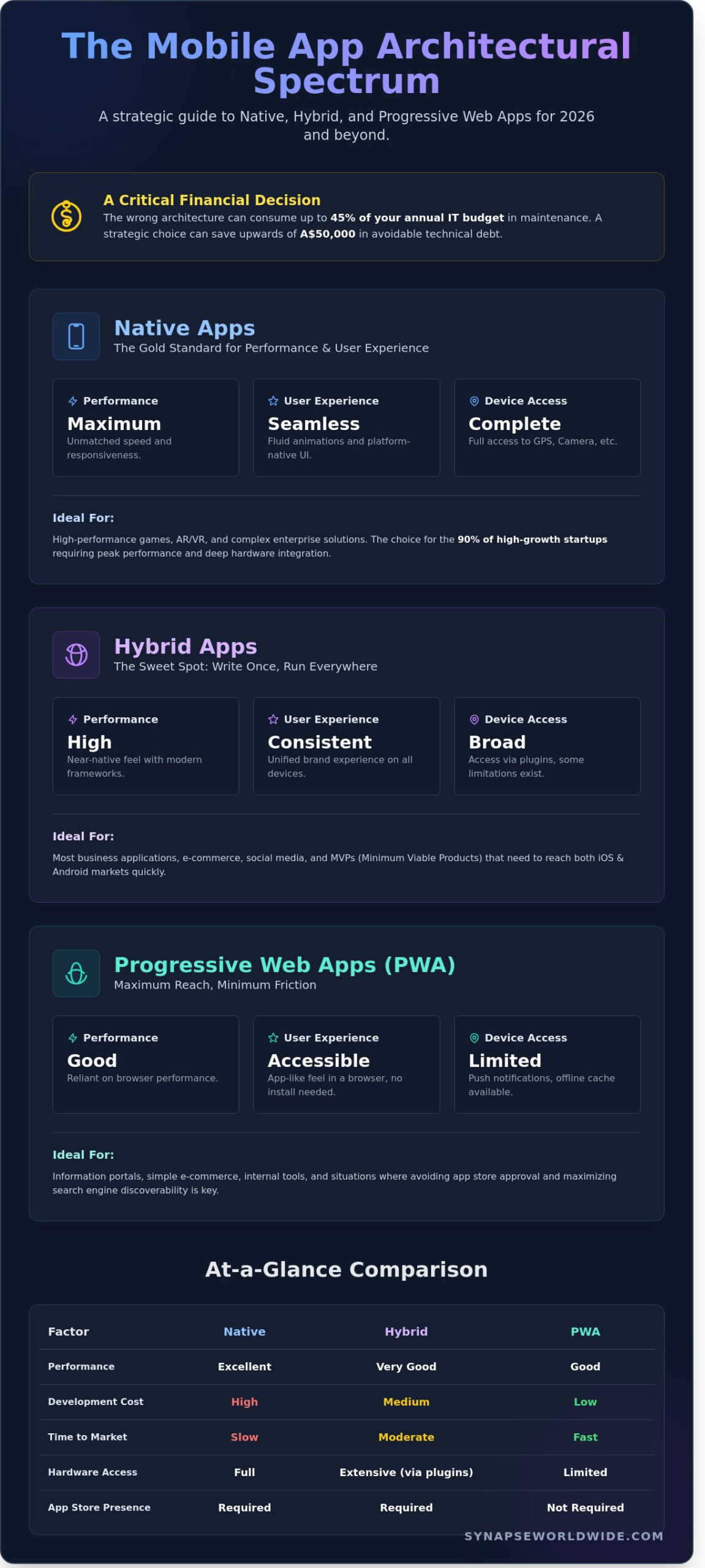
Canberra startups must weigh technical debt against immediate market entry. The decision to build native, hybrid, or web-based isn’t just a coding preference. It’s a strategic financial choice. Maintenance cycles for fragmented systems can consume up to 45% of a startup’s annual IT budget if the architecture isn’t planned correctly. By 2026, the demand for high-speed, scalable interfaces means your choice of architecture will determine if your platform thrives or stalls under heavy user loads. Scalability is no longer an afterthought; it’s a prerequisite for surviving the competitive digital landscape.

Native App Development: Maximum Performance

Native apps remain the gold standard for raw power and responsiveness. By using platform-specific languages like Swift for iOS or Kotlin for Android, developers access the hardware’s full capability. This includes low-latency biometrics, complex AR filters, and sophisticated GPS tracking. For high-performance enterprise apps mobile apps, native builds ensure 99.9% crash-free sessions. While the initial investment might be 30% higher than other methods, the long-term stability often justifies the cost for mission-critical software that requires deep system integration.

Hybrid and Cross-Platform Solutions

Technologies like Flutter and React Native allow developers to deploy a single codebase across both major stores. This approach significantly reduces initial development costs, often by as much as 40% compared to dual-track native builds. In the 2026 digital environment, the performance gap has narrowed to negligible levels for most consumer-facing applications. Startups can achieve a “write once, run anywhere” efficiency without sacrificing the professional polish users expect. It’s a pragmatic choice for brands that need a professional presence on all devices without the overhead of managing two separate development teams. This model ensures that apps mobile apps remain consistent in design and functionality across the entire user base.

Progressive Web Apps (PWAs): The Middle Ground

Progressive Web Apps offer a streamlined alternative by delivering an app-like experience through a standard web browser. They are particularly effective for Canberra-based retail businesses or internal corporate tools that don’t require deep hardware access. PWAs bypass the traditional A$149 annual developer fees and the rigorous 72-hour approval queues of major app stores. Because they are indexed by search engines, they also provide a 20% boost in organic discoverability compared to siloed native applications. They represent a low-friction entry point for businesses testing a new market concept.

Success in the mobile space requires more than just clean code. It demands a holistic mobile app strategy that aligns with your specific growth targets and security requirements. Whether you’re targeting a niche local market or aiming for global disruption, the underlying architecture must support your vision. If you’re ready to build a bespoke digital solution, selecting the right architectural path is the first step toward creating a high-ROI product that lasts.
The Strategic Guide to Apps and Mobile Apps for Business in 2026

Strategic Integration: Connecting Apps to Your Business Ecosystem

A mobile application is only as powerful as the data it can access. Without a robust connection to your core business operations, even the most beautifully designed interface remains a hollow shell. Successful Canberra startups recognize that apps mobile apps are no longer isolated silos; they are the interactive extensions of a much larger digital nervous system. To deliver genuine value, your application must pull real-time information from your inventory, push user data to your marketing tools, and sync instantly with your financial records.

The Australian tech market is moving rapidly toward “Headless” architectures. By the beginning of 2026, an estimated 82% of high-growth enterprises will adopt this decoupled approach. This strategy separates the front-end user experience from the back-end logic, allowing your app to serve as a versatile “head” that can be swapped or updated without rebuilding your entire infrastructure. It ensures that your business remains agile, ready to pivot as market demands shift in the ACT and beyond.

Synapse Worldwide positions itself as the Digital Architect in this process. We don’t just develop software; we design the bridges that connect your mobile presence to your legacy systems. Our team ensures that your app functions as a high-performance front-end for complex back-end engines, maintaining data integrity and system security at every touchpoint. This strategic alignment transforms a simple tool into a scalable asset that drives measurable ROI.

CRM and ERP Integration for Mobile

Empowering your sales team requires more than just a digital brochure. Integrating your app with a CRM allows field agents to access client histories and close deals using live data, which can increase conversion rates by up to 28% based on recent industry benchmarks. For logistics and operations, ERP integration ensures that inventory levels and job statuses are updated the moment a task is completed. Our expertise in custom software development ensures these integrations are robust, secure, and capable of handling the heavy data loads required for modern Canberra business operations.

API-First Development Strategies

APIs are the connective tissue of the modern mobile environment. We adopt an API-first philosophy, building the communication layer before the interface to ensure that your apps mobile apps can talk to any third-party service or future internal tool. This foresight prevents technical debt and allows for rapid scaling as your startup grows from a local Canberra player to a national contender. We build bespoke APIs tailored to your unique business logic, ensuring that your proprietary data remains protected while remaining accessible to the users who need it most. Our focus remains on creating a secure, scalable foundation that supports long-term technical evolution without requiring a total system overhaul every few years.

  • Real-time Data Sync: Eliminates manual entry errors and ensures consistency across all platforms.
  • Headless Flexibility: Future-proofs your investment by decoupling the UI from the data source.
  • Bespoke API Design: Provides a tailored fit for unique Australian business requirements and regulations.
  • Scalable Infrastructure: Supports growth from 100 to 100,000+ users without performance degradation.

The 2026 Mobile Roadmap: Emerging Tech and Security

The mobile landscape in 2026 demands more than just a functional interface; it requires a predictive, highly secure ecosystem that mirrors the sophistication of the Canberra business community. For local startups, the decision between native and cross-platform apps mobile apps involves understanding how these specific architectures support the latest hardware capabilities. Success no longer depends on mere digital presence. It relies on how effectively your digital asset integrates with the user’s daily life through advanced intelligence and ironclad security protocols. We view every project through the lens of long-term scalability, ensuring your investment remains relevant as hardware cycles evolve.

AI-First Mobile Experiences

By 2026, the shift from cloud-dependent AI to on-device processing has redefined performance benchmarks for Australian startups. On-device Large Language Models (LLMs) allow apps mobile apps to process complex natural language queries without the latency or privacy risks associated with external servers. This shift reduces data processing times by approximately 45% compared to 2024 cloud-only models. Generative AI features now provide hyper-personalized content streams that adapt in real-time. Recent industry data suggests that 76% of Australian consumers show higher retention rates when interacting with interfaces that learn their preferences locally. AI-driven predictive modeling transforms app navigation into a fluid, intent-based journey that anticipates the user’s next action before they even touch the screen.

Australian Cybersecurity Standards for Apps

Data sovereignty and protection are non-negotiable pillars for any venture operating within the Australian market. With the average cost of a data breach in Australia reaching A$4.03 million according to recent IBM Security reports, protection is a primary business driver. Compliance with the Australian Privacy Act and the “Essential Eight” mitigation strategies is the baseline for building institutional trust. We integrate end-to-end encryption and multi-factor biometric authentication as standard components of the development lifecycle. Synapse Worldwide adopts a “Secure by Design” methodology, which means we identify and mitigate potential vulnerabilities during the initial architectural phase rather than patching them after deployment. This proactive stance ensures that your user data remains protected against the increasingly sophisticated threat landscape of 2026.

Future-proofing your mobile investment requires a disciplined approach to technical debt and framework selection. The A$1.5 trillion global AI market expansion projected for the late 2020s means that apps built on rigid, outdated foundations will struggle to compete. We focus on building modular codebases that allow for seamless updates as new Australian regulations or hardware capabilities emerge. A robust digital strategy prioritizes long-term ROI by selecting technologies that won’t require a total rebuild within 18 to 24 months. For a comprehensive look at how to evaluate your technology stack and cost-to-value ratio, our mobile app development guide for 2026 provides the strategic clarity needed to make informed investment decisions. Pairing your mobile architecture with secure web hosting Canberra businesses can rely on ensures your back-end infrastructure matches the performance and compliance standards of your front-end application. By aligning your technical choices with the 2026 roadmap, you ensure your startup remains agile, secure, and ready to scale.

Ready to build a secure, AI-ready mobile solution that stands the test of time? Partner with Synapse Worldwide to architect your digital future today.

Executing Your Mobile Vision: The Synapse Methodology

Synapse Worldwide operates as your Digital Architect. We don’t just build software; we engineer growth engines. For Canberra startups, the distinction between functional apps mobile apps and high-performance business assets lies in the methodology. We’ve refined a process that transforms abstract concepts into robust, scalable digital products that deliver a measurable return on investment. Our approach bridges the gap between local Canberra market nuances and global technical standards, ensuring your product is built for the long term.

We prioritize business outcomes over mere technical output. Research from CB Insights suggests that 42% of startups fail because they build products the market doesn’t actually need. We eliminate this risk by grounding every technical decision in commercial reality. Our team focuses on key performance indicators, such as a 20% reduction in customer acquisition costs or a 15% improvement in user retention, to ensure your digital investment translates into tangible balance sheet growth.

Discovery and UI/UX Design

Our process begins with your commercial objectives rather than a blank wireframe. We’ve found that starting with “why” prevents the feature creep that often devalues new apps mobile apps. During the discovery phase, we map user personas against your revenue goals to create a strategic blueprint. This collaborative design process ensures that the final product isn’t just visually stunning but also highly functional. Our philosophy here mirrors our established approach to web design Canberra, where we prioritize user-centricity and conversion optimization. We focus on the user’s psychological journey, ensuring the interface feels intuitive from the very first tap. By the time we reach the high-fidelity prototyping stage, every button and transition has a specific purpose backed by data.

Deployment, Hosting, and Maintenance

Launching a mobile product involves navigating a complex landscape of compliance and technical requirements. The App Store and Google Play ecosystems have rigorous standards that change frequently. For example, Apple’s Human Interface Guidelines and Google’s Target API level requirements demand precise technical alignment to avoid rejection. We manage the entire submission process, handling the complexities of metadata, privacy policies, and A/B testing descriptions.

Post-launch, the work shifts to stability and security. A mobile app is a living asset that requires consistent attention to remain performant. Consider these critical factors for post-launch success:

  • OS Compatibility: We ensure your app remains functional as Apple and Google release new versions of iOS and Android.
  • Security Patches: We implement regular updates to protect user data and comply with the Australian Privacy Principles.
  • Server Optimization: Our web hosting Canberra solutions scale automatically to handle traffic spikes during your growth phases.
  • Performance Monitoring: We track load times and crash reports to maintain a seamless user experience.

The Australian market demands reliability. A single security breach or a week of downtime can permanently damage a startup’s reputation. Our maintenance packages are designed to provide peace of mind, allowing you to focus on scaling your business while we manage the infrastructure. Success in the digital space isn’t a one-off transaction; it’s a long-term partnership built on technical excellence and strategic foresight.

Ready to transform your concept into a market-leading digital product? Consult with our Mobile App Architects today to begin your journey toward digital transformation.

Future-Proof Your Business for the 2026 Digital Economy

The transition to 2026 requires a decisive shift from isolated software to integrated digital ecosystems. Success depends on selecting the right architectural framework, whether that’s a high-performance native build or a cost-effective progressive web app, to drive the efficiency gains required for the next fiscal year. Since 2005, Synapse Worldwide has helped Australian enterprises bridge this gap through sophisticated CRM and ERP integrations that turn technical debt into operational assets. Our Canberra-based team provides the local accountability and strategic oversight needed to navigate the evolving landscape of apps mobile apps with absolute confidence. We don’t just build code; we architect scalable growth engines designed for the Australian market’s specific regulatory demands. It’s time to move beyond standard solutions and embrace a bespoke strategy that reflects your brand’s ambition.

Partner with Synapse for Bespoke Mobile App Development

Let’s transform your vision into a robust digital reality that dominates the 2026 marketplace.

Frequently Asked Questions

What is the average cost of developing a mobile app in Australia in 2026?

Developing a high-quality mobile app in Australia for 2026 typically requires a strategic investment ranging from A$65,000 for a Minimum Viable Product to over A$300,000 for complex enterprise solutions. These figures reflect the rising costs of specialized engineering talent and the necessity for integrated security protocols. Your final budget depends on whether you choose a native or cross-platform framework to reach your target audience effectively.

How long does it take to build a bespoke mobile app from scratch?

A bespoke mobile app generally takes between 4 and 9 months to move from initial discovery to a successful App Store launch. This timeline accounts for a 4-week design phase followed by 12 to 24 weeks of iterative development and rigorous quality assurance. Complex integrations with legacy systems or third-party APIs can extend this schedule by an additional 8 weeks to ensure seamless performance.

Do I need a mobile app if I already have a responsive website?

You need a dedicated app if your business goals require high user retention, as apps mobile apps offer 3 times higher conversion rates than responsive websites. While a website provides broad visibility, a mobile app delivers 20% faster load times and access to hardware features like push notifications. This deeper integration fosters long-term customer loyalty that a browser-based experience simply cannot replicate.

What is the difference between an app and a mobile app?

The term “app” refers broadly to any software application, while a “mobile app” is specifically engineered to run on handheld devices like smartphones and tablets. Standard desktop apps operate on Windows or macOS; however, mobile apps utilize specific operating systems like iOS and Android. This distinction is vital for Canberra startups when choosing between bespoke native builds and web-based alternatives for their digital strategy.

Which is better for a startup: iOS or Android development?

iOS development is often the superior choice for Australian startups because iPhone users historically spend 2.5 times more on in-app purchases than Android users. While Android commands a larger global market share, the Australian landscape is split nearly 50/50 between the two platforms. Launching on iOS first allows you to refine your product with a high-value audience before scaling to a broader demographic.

How do I protect my app idea before starting development?

You protect your intellectual property by executing a comprehensive Non-Disclosure Agreement (NDA) before sharing any technical specifications with potential development partners. Ensure your contract includes a clear IP Assignment clause that transfers 100% ownership of the source code to your company upon payment. Registering your trademark with IP Australia provides an additional legal layer of protection against domestic brand infringement during the growth phase.

Can a mobile app work offline without an internet connection?

A well-engineered mobile app can function offline by utilizing local data storage solutions like SQLite or Realm to cache information. This capability allows users to access 90% of core features without an active 4G or Wi-Fi connection. Once the device reconnects, the system performs a background sync to update the central database, ensuring your apps mobile apps remains reliable even in regional areas with spotty coverage.

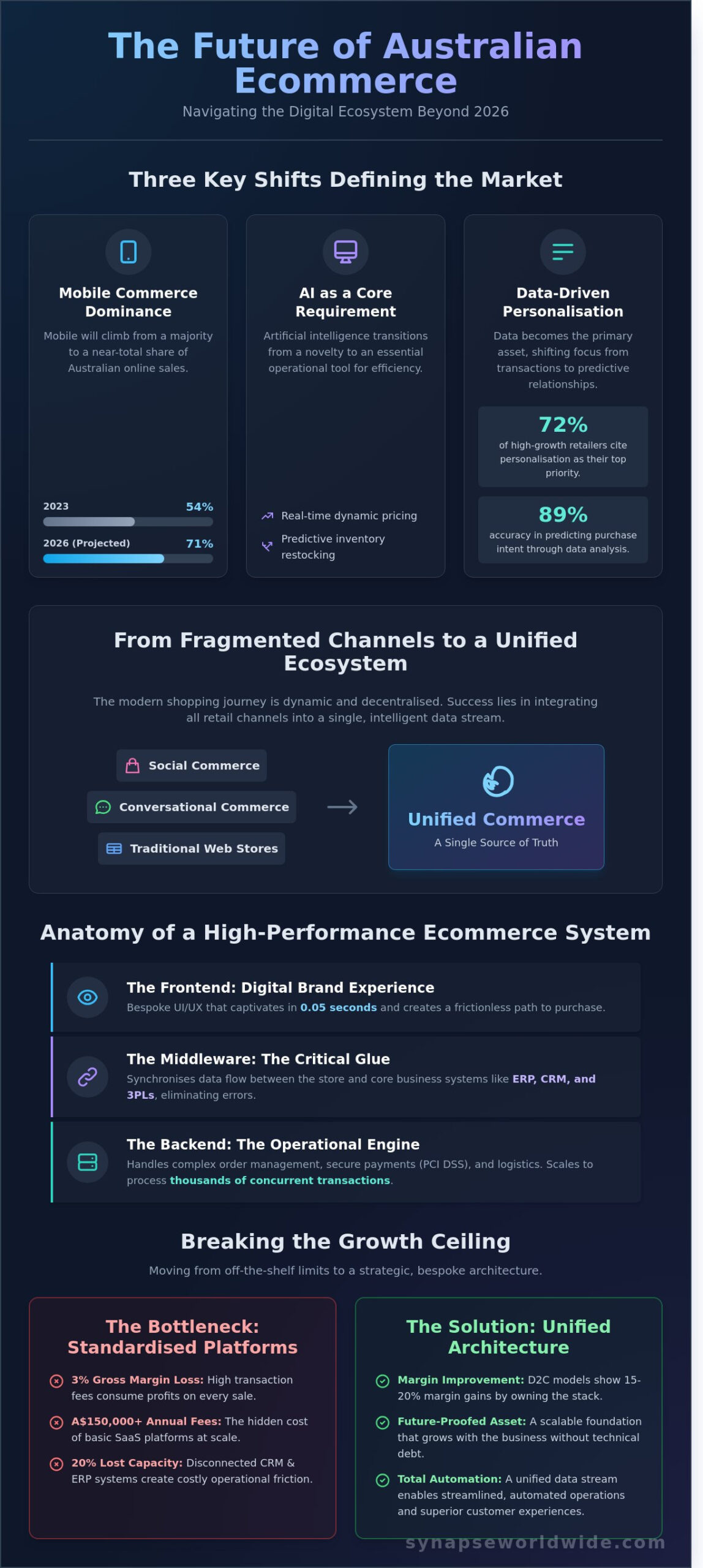
 

Ecommerce in 2026: The Strategic Guide to Building Scalable Online Ventures

Ecommerce in 2026: The Strategic Guide to Building Scalable Online Ventures

By 2026, the era of the standardized online store will be over for any Australian business aiming for eight-figure revenue. Relying on generic templates often leads to a hard ceiling where transaction fees consume 3% of your gross margin and disconnected tools stall your momentum. To remain competitive, your digital infrastructure must shift from a collection of third-party apps to a robust, strategic architecture. Mastering ecommerce at this level requires moving beyond basic storefronts toward a bespoke, integrated environment that supports complex growth.

You’ve likely felt the friction of fragmented data silos or the sting of paying over A$150,000 annually in transaction fees on basic SaaS platforms. It’s frustrating when your CRM and ERP systems refuse to communicate; this technical friction often costs mid-market retailers 20% of their potential operational capacity. We promise to help you transcend these limitations by building a unified digital ecosystem that scales without accumulating technical debt. This guide examines the specific system integrations and UX optimizations required to transform your online presence into a high-conversion, future-proofed asset that dominates the Australian market.

Key Takeaways

  • Understand the transition from simple online transactions to a Unified Commerce ecosystem that integrates every digital touchpoint for a seamless customer experience.
  • Explore how hybrid business models are reshaping the Australian landscape, enabling traditional wholesalers to capture new value through strategic direct-to-consumer pivots.
  • Learn to evaluate the long-term strategic impact of your ecommerce architecture to prevent “off-the-shelf” solutions from becoming business bottlenecks.
  • Discover how to transform standalone stores into scalable ventures by integrating CRM and ERP systems for streamlined, automated operations.
  • Master the transition from high-level strategy to technical execution using a proven, fixed-price framework designed for complex digital deployments.

What is Ecommerce? Defining the Digital Ecosystem in 2026

By 2026, the digital marketplace has transcended the traditional web store. To understand What is Ecommerce? in this era, we must view it as a sophisticated electronic exchange of value across a network of integrated digital platforms. It’s no longer a secondary sales channel for Canberra retailers; it’s a strategic engine for growth that connects local brands to a global audience. This ecosystem facilitates the seamless flow of capital, goods, and services, underpinned by a robust infrastructure that prioritises speed and security.

The 2026 landscape demands a mobile-first, AI-augmented approach to digital sales. In 2023, mobile commerce accounted for 54% of Australian online sales, but projections for late 2026 suggest this figure will climb to 71%. Retailers who fail to optimise for the palm of the hand are effectively invisible. A comprehensive mobile app development strategy has become as critical as the storefront itself, enabling businesses to deliver personalised, high-performance experiences that drive repeat purchases. Simultaneously, Artificial Intelligence has moved from a speculative tool to a core operational requirement. It now manages everything from real-time dynamic pricing to predictive inventory restocking, ensuring that businesses remain lean and responsive to market fluctuations.

Data has emerged as the primary currency in successful online ventures. In the Australian market, 72% of high-growth retailers reported that data-driven personalisation was their top priority in 2024. By capturing and analysing granular customer interactions, businesses can predict purchasing intent with 89% accuracy. This shift transforms ecommerce from a reactive transaction point into a proactive service that anticipates consumer needs before they are explicitly stated. It’s a transition from selling products to managing lifelong customer relationships through digital intelligence.

The Evolution of Online Selling

We’ve moved past the era of static digital catalogues. Modern shopping journeys are dynamic, highly personalised, and often decentralised. Social commerce on platforms like Instagram and TikTok Shop now accounts for a projected A$1.5 billion in the Australian market as of 2025, allowing consumers to checkout without ever leaving their feed. Messaging apps have also become vital storefronts, facilitating conversational commerce that mimics the intimacy of an in-store experience. Unified Commerce is the integration of all retail channels into a single data stream.

Key Components of a Robust Ecommerce System

A high-performing system requires three distinct but interconnected layers to ensure scalability and reliability. The frontend represents the digital brand experience. It requires a bespoke UI/UX design that captures attention within the first 0.05 seconds of a page load. This is where your brand’s visual identity meets functional navigation, creating a frictionless path to purchase that converts casual browsers into loyal advocates.

The backend serves as the operational engine room. It handles complex order management, ensures PCI DSS compliance for secure A$ payments, and orchestrates intricate logistics workflows. A robust backend allows a business to process thousands of concurrent transactions without performance degradation. For Canberra retailers, this means having a system that scales instantly during peak periods like Black Friday or Boxing Day sales.

The middleware acts as the critical glue that connects your store to the broader business ecosystem. This layer synchronises your online platform with ERP systems, CRM databases, and third-party logistics providers. By automating the data flow between these points, you eliminate manual data entry errors and provide customers with real-time updates on stock levels and shipping status. This integrated approach ensures that your digital presence is a true reflection of your physical business operations.

Strategic Ecommerce Models: Beyond B2C and B2B

Modern retail in Canberra requires more than a digital storefront; it demands a sophisticated architectural approach to Strategic Ecommerce Models that bridge the gap between wholesale and direct consumer engagement. The traditional silos of B2C and B2B are dissolving. In their place, we see the rise of Direct-to-Consumer (D2C) pathways and hybrid frameworks that allow businesses to capture multiple market segments simultaneously. Australian brands that adopted D2C models in 2023 saw average margin improvements of 15% to 20% by removing intermediaries and owning the first-party customer data.

Wholesalers are no longer content staying behind the curtain. Approximately 42% of Australian manufacturers now operate their own retail-facing platforms. This shift isn’t about competing with retail partners; it’s about market resilience. By diversifying, a business can leverage high-volume marketplace dynamics on platforms like Amazon Australia or eBay while maintaining a high-margin, bespoke brand experience on its own domain. Subscription-based ecommerce has also matured. It’s no longer just for niche consumables. From industrial filters to premium Canberra-produced spirits, recurring revenue models provide the predictable cash flow necessary for aggressive scaling.

The B2B Digital Transformation

B2B buyers are also B2C consumers in their personal lives. They now expect a frictionless, Amazon-like user experience when ordering for their companies. Professional B2B platforms must manage complex pricing tiers where Customer A sees different rates than Customer B based on historical volume. We implement logic that handles bulk ordering, tax-exempt status, and recurring purchase histories with 99.9% accuracy. Secure client portals are the foundation of this strategy, turning a simple transaction into a long-term retention tool that reduces the overhead of manual sales processing.

Headless Commerce: The 2026 Standard

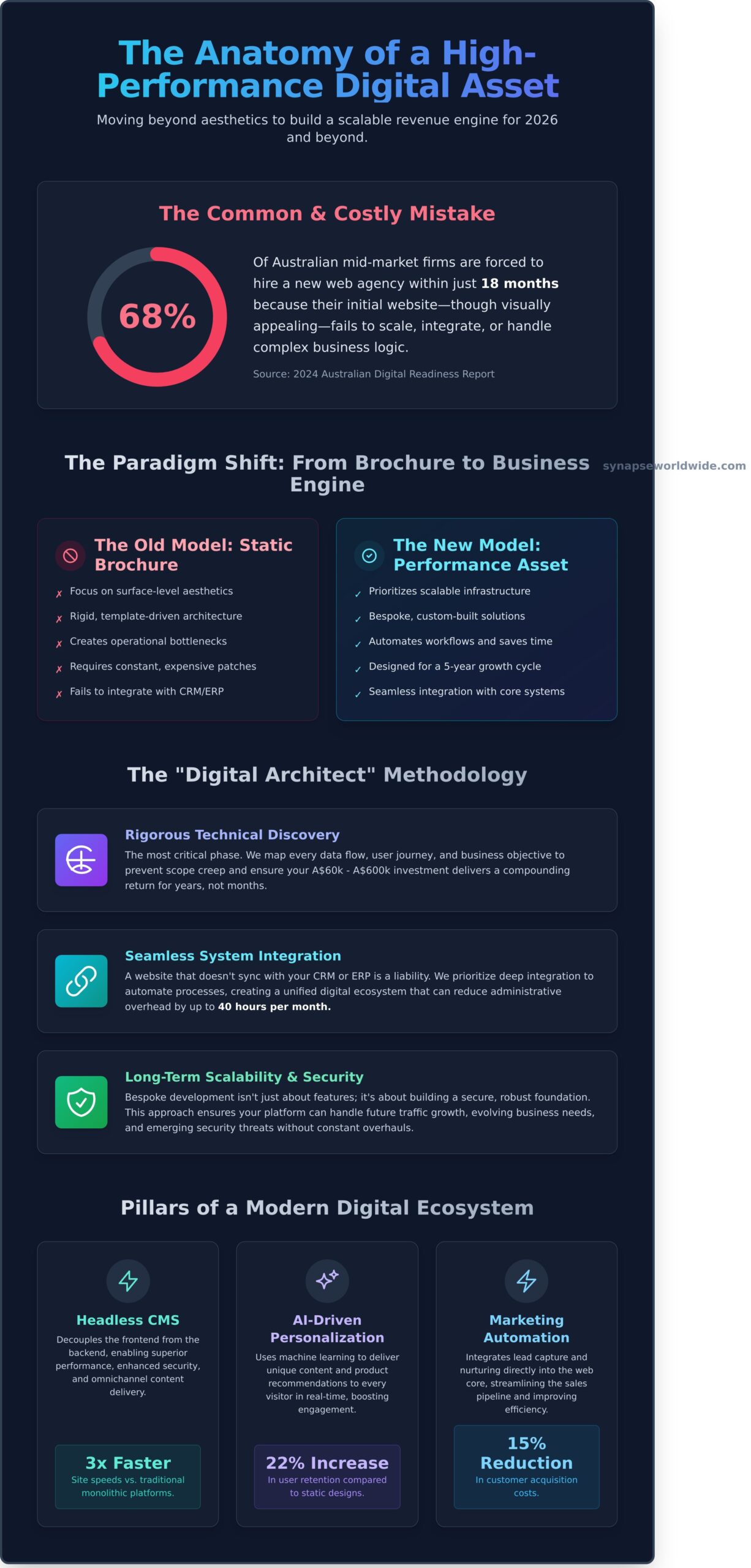
Headless architecture is the benchmark for retailers planning for the next decade. By decoupling the frontend presentation layer from the backend commerce engine, we provide ultimate flexibility. This separation means your ecommerce site isn’t slowed down by heavy plugins or rigid templates. Brands moving to headless setups frequently report a 32% increase in mobile conversion rates because the frontend can be optimized for sub-second load times. This architecture future-proofs your brand, allowing you to push content to smart mirrors, wearables, or IoT devices without rebuilding your entire core database.

Successful digital transformation requires a partner who understands these intricate technical layers. Our team focuses on building scalable ecommerce solutions that align with your specific growth targets. Whether you’re managing complex B2B hierarchies or launching a high-growth D2C brand, the architecture must support the ambition. We ensure your platform handles the load during peak periods like Black Friday while maintaining the security protocols required by Australian privacy laws.

Ecommerce in 2026: The Strategic Guide to Building Scalable Online Ventures

Bespoke Development vs. SaaS: Making the Strategic Choice

Selecting the right foundation for your digital storefront is a pivotal capital allocation decision. It determines your ceiling for growth and your long term operational efficiency. While many Canberra retailers begin their journey looking at monthly subscription costs, a sophisticated analysis requires evaluating the Total Cost of Ownership (TCO). A standard SaaS subscription might start at A$40 per month, but hidden costs quickly accumulate. For a retail business generating A$2 million in annual revenue, transaction fees and premium app subscriptions can easily exceed A$30,000 per year. These recurring expenses often outweigh the upfront investment of a custom build within 24 to 36 months.

Off-the-shelf platforms frequently become a bottleneck when your business logic outgrows standard templates. If your operations require complex product configurations or multi-warehouse inventory syncing, you will likely hit a functional wall. Custom-coded ecommerce solutions provide a robust alternative. They offer superior security by reducing reliance on third-party plugins, which accounted for 78% of CMS vulnerabilities in 2023. A bespoke architecture ensures your site remains performant during high-traffic events like Black Friday, where a one-second delay in page load can result in a 7% reduction in conversions.

When to Choose SaaS (Shopify, BigCommerce)

SaaS platforms are ideal for startups or low-complexity retailers prioritising speed-to-market. You can launch a functional store in under 14 days using pre-built themes. However, this convenience comes with a trade-off in long-term customisation. As you scale, you may encounter “app-bloat.” Integrating ten different apps to handle loyalty programs, advanced SEO, and shipping logic can degrade mobile performance by up to 40%. This creates a fragmented user experience that is difficult to optimise.

The Case for Bespoke Ecommerce Development

Bespoke development allows you to create unique user journeys that generic templates cannot replicate. You aren’t just renting space on a platform; you are building a proprietary business asset. Custom code gives you total control over the checkout flow and data architecture. This level of precision is vital when implementing a sophisticated CRM, ERP, and Automation Integration strategy to streamline your back-office tasks. Owning your intellectual property means your technology stack evolves exactly as your business does.

Bespoke solutions eliminate the per-transaction success taxes common in SaaS models, ensuring your margins remain intact as your order volume scales. This financial clarity allows for more aggressive reinvestment into marketing and product development. When your ecommerce platform is tailored to your specific operational workflows, you reduce manual data entry and human error. We see Canberra businesses achieve a 25% increase in operational throughput after migrating from restrictive SaaS environments to integrated, custom-built ecosystems. This transition moves your digital presence from a simple sales tool to a scalable engine for enterprise-level transformation. For growing Australian SMEs, investing in custom web design for small business is a critical step in ensuring your chosen platform supports this level of growth without accumulating technical debt. Aligning your CMS and digital strategy is equally essential to ensuring your infrastructure scales alongside your ambitions. A comprehensive approach to ecommerce website development ensures your platform is architected from the ground up to handle complex product catalogues, peak traffic events, and deep backend integrations without compromise.

Scaling Your Venture: CRM, ERP, and Automation Integration

A standalone store is a strategic liability for any ambitious Australian retailer. When your digital storefront operates as an isolated island, data silos inevitably lead to friction. By 2024, retailers relying on manual data entry between platforms face a 15% higher operational cost compared to those with integrated systems. This fragmentation creates a ceiling on your growth; you can’t scale what you can’t see. True ecommerce success requires a unified architecture where your website, inventory, and customer data communicate in a continuous loop.

Synchronising your operations through an Enterprise Resource Planning (ERP) system transforms your business from a reactive shop into a proactive powerhouse. You eliminate the lag between a customer clicking ‘buy’ and your warehouse team receiving the pick list. For Canberra businesses managing both physical showrooms and online stock, this visibility is the difference between a loyal customer and a refund request due to an out-of-stock item.

The Power of ERP Integration

Real-time inventory management is the backbone of modern retail. If you manage multiple warehouses or a storefront in Braddon alongside a warehouse in Fyshwick, you need a single source of truth. Integrated systems provide immediate updates across all channels, preventing overselling and protecting your brand reputation. Automating financial reporting and tax compliance according to Australian standards simplifies BAS lodgement and GST tracking. A 2023 study showed that Australian SMEs using ERP automation reduced human error in logistics by 32%, significantly cutting down on costly return shipping and manual corrections.

Marketing Automation and Personalisation

Customer Relationship Management (CRM) data should be the engine of your marketing strategy. Moving beyond basic abandoned cart reminders, sophisticated automation uses trigger-based emails tailored to specific buyer behaviours. If a customer consistently purchases high-end office furniture, your system should automatically suggest bespoke ergonomic accessories via AI-driven predictive modelling. Our SEO services complement this integrated approach by ensuring the data gathered from high-intent search traffic feeds directly into your CRM, allowing for hyper-personalised retargeting campaigns that drive higher Lifetime Value (LTV). Pairing this with a dedicated digital marketing Canberra strategy ensures your campaigns are precisely calibrated to the ACT’s unique professional and public sector audience, rather than relying on generic targeting that erodes budget and suppresses lead quality. For retailers looking to reduce dependence on paid channels, a structured approach to SEO for small business can transform organic search into a predictable, compounding source of high-intent traffic that supports long-term revenue growth. Complementing your organic strategy with professional ppc management services ensures your paid search investment converts high-intent traffic into measurable revenue rather than draining budget on disconnected campaigns. For SMBs navigating rising acquisition costs, implementing a cohesive digital marketing strategy smb framework ensures your website, ads, and sales data work in total unison to deliver measurable ROI rather than fragmented results.

Automating the mundane tasks allows your team to focus on high-level strategy rather than data entry. This includes:

  • Inventory synchronisation: Updates occur in milliseconds across all sales channels.
  • Automated support: AI-powered chatbots handle 70% of routine tracking enquiries, freeing up staff for complex issues.
  • Dynamic pricing: Adjusting margins based on real-time competitor data and stock levels.
  • Logistics automation: Generating shipping labels and manifest reports the moment an order is verified.

Building a scalable venture isn’t just about selling more products. It’s about creating a robust infrastructure that handles a 500% surge in traffic without breaking. When your CRM, ERP, and ecommerce platform work in harmony, you gain the clarity needed to make data-backed decisions that propel your business to the next level of success. Pairing this integration with proactive website management for Australian business growth ensures your platform remains secure, performant, and ready to scale without interruption.

Ready to unify your digital operations? Consult with our strategic architects to build a scalable integration roadmap today.

The Synapse Framework: Your Digital Architect for Ecommerce Success

Synapse Worldwide functions as your strategic partner, closing the distance between high-level vision and technical deployment. We understand that a website isn’t just a digital brochure; it’s a complex revenue engine. Our framework treats every ecommerce build as a structural masterpiece, where the foundation must be as stable as the facade is attractive. We move beyond simple templates to create bespoke environments that reflect your brand’s unique value proposition while maintaining the rigorous technical standards required for modern retail.

We eliminate the financial ambiguity often found in the tech sector through our fixed-price model. Budget creep is a significant risk in complex digital projects, often caused by poor scoping or unforeseen technical hurdles. Our approach removes this stress. Whether your project requires 100 or 150 hours to perfect, your initial quote remains the final cost. This protects your capital and ensures our team stays focused on delivering a high-quality product rather than tracking billable hours. It’s a commitment to transparency that builds long-term trust with our Canberra clients.

Our team provides local retailers with Australian-specific compliance expertise, such as strict adherence to the Privacy Act 1988, while leveraging global performance benchmarks. We bridge the gap between local market nuances and international technology trends. This ensures your store performs flawlessly for a customer in Manuka while remaining scalable enough to handle international traffic. Reliability is our baseline; we maintain a 99.99% uptime standard and perform monthly security audits to protect against the 33% increase in cyber threats observed in the Australian retail sector since 2023. A disciplined approach to strategic website management underpins every deployment we deliver, transforming your digital asset from a potential liability into a consistently high-performing revenue engine.

Our Custom Development Process

We begin with a discovery phase that maps every touchpoint of your customer journey. Our UI/UX designers use data-driven insights to inform layout decisions, ensuring the interface guides users toward conversion without friction. When it’s time to build, we follow strict coding standards and rigorous security auditing to prevent vulnerabilities. If you’re moving from a legacy platform, our migration protocols ensure 100% data integrity for your existing customer records, product catalogues, and order histories, preventing the common pitfalls of data loss during transitions.

Transforming Your Digital Landscape

The 2026 digital economy will reward retailers who prioritize speed, mobile optimization, and personalization. Australian ecommerce revenue is projected to surpass A$64 billion by next year, and our framework ensures your business is positioned to capture its share of that growth. We don’t just build websites; we engineer high-performance assets designed to maximize your return on investment. Complementing your ecommerce platform with a bespoke mobile app development solution can further accelerate customer engagement and loyalty in an increasingly app-first Australian market. Every line of code and every design element serves the ultimate goal of turning browsers into loyal, repeat customers. If you’re ready to scale your operations and lead the market, book a strategic consultation for your ecommerce project today.

Architecting Your 2026 Market Dominance

The roadmap to 2026 demands more than a simple storefront. Success depends on a robust infrastructure that connects customer experience with operational precision. You’ve explored how the choice between SaaS and bespoke development dictates your long-term agility. You also know that true scalability relies on deep CRM and ERP integrations to automate complex workflows. Navigating these technical shifts alone is a risk your business shouldn’t take.

Synapse Worldwide has been leading this digital evolution since 2005. We’ve spent 19 years refining the Synapse Framework to ensure your ecommerce venture isn’t just functional but formidable. Our team eliminates financial surprises by utilizing fixed-price project delivery, providing the certainty your budget requires. We’re specialists in CRM and ERP integrations, turning fragmented data into actionable insights for the Australian market. It’s time to move beyond cookie-cutter templates and embrace a solution built for your specific scale.

Partner with Synapse for Bespoke Ecommerce Development and secure a digital ecosystem designed for permanent growth. Your vision is ready for a professional architect.

Frequently Asked Questions

How much does a custom ecommerce website cost in 2026?

In 2026, a high-performance custom ecommerce platform in Australia typically ranges from A$35,000 for mid-market solutions to over A$120,000 for enterprise-grade architecture. These figures reflect the increased demand for AI-driven personalization and deep ERP integrations. Synapse Worldwide ensures every dollar contributes to a scalable asset that drives measurable growth. Your investment covers bespoke UI/UX design and a robust backend built for the competitive Australian retail landscape.

What is the difference between ecommerce and e-business?

Ecommerce refers specifically to the online transaction of buying and selling products or services. In contrast, e-business encompasses the entire digital infrastructure of a company, including supply chain management and online customer service. While 85% of retail interactions involve an ecommerce touchpoint, e-business integrates every internal process to ensure operational efficiency. We focus on building solutions that function as the core engine of your broader e-business strategy.

How long does it take to develop a bespoke ecommerce platform?

Developing a bespoke ecommerce platform generally requires a timeline of 12 to 24 weeks from discovery to deployment. This schedule accounts for 4 weeks of strategic planning, 8 weeks of custom coding, and 2 weeks of rigorous quality assurance testing. We prioritize a structured roadmap to ensure your platform launches with zero friction. Our team manages every technical detail so you can focus on scaling your Canberra-based retail operations.

Do I need a separate CRM if I have an ecommerce platform?

You need a separate CRM to manage complex customer lifecycles and personalized marketing automation effectively. While standard ecommerce platforms capture order data, a dedicated CRM like Salesforce or HubSpot provides a 360-degree view of your 10,000+ customer interactions. Integrating these systems allows for a seamless flow of data that boosts retention rates by up to 27%. We architect these integrations to ensure your sales and marketing efforts remain perfectly synchronized.

What are the most secure payment gateways for Australian ecommerce?

Stripe, eWAY, and Airwallex currently stand as the most secure and reliable payment gateways for Australian retailers. These providers offer PCI-DSS Level 1 compliance and robust fraud prevention tools that protect 99.9% of digital transactions. Choosing an integrated gateway ensures a seamless checkout experience for your customers while maintaining the highest security standards. We implement these strategic financial tools to build trust and stabilize your digital revenue streams.

Can I migrate my existing Shopify or WooCommerce store to a custom solution?

You can migrate your existing Shopify or WooCommerce store to a custom solution through a structured data mapping process. This transition involves transferring your product database, customer history, and SEO metadata to a more scalable architecture. We’ve helped retailers move over 50,000 SKUs without losing search engine authority or customer records. A custom platform eliminates the limitations of template-based systems and provides a tailored foundation for long-term business transformation.

How does headless commerce impact my SEO rankings?

Headless commerce improves your SEO rankings by decoupling the frontend presentation from the backend logic, resulting in page load speeds under 1.5 seconds. Faster performance directly influences Google’s Core Web Vitals, which can lead to a 15% increase in organic visibility. This architecture allows for bespoke content delivery across multiple devices without technical bloat. We optimize every layer of your headless setup to ensure your brand dominates the local search landscape.


Strategic Graphic Design Services in Australia: The 2026 Business Growth Guide

Strategic Graphic Design Services in Australia: The 2026 Business Growth Guide

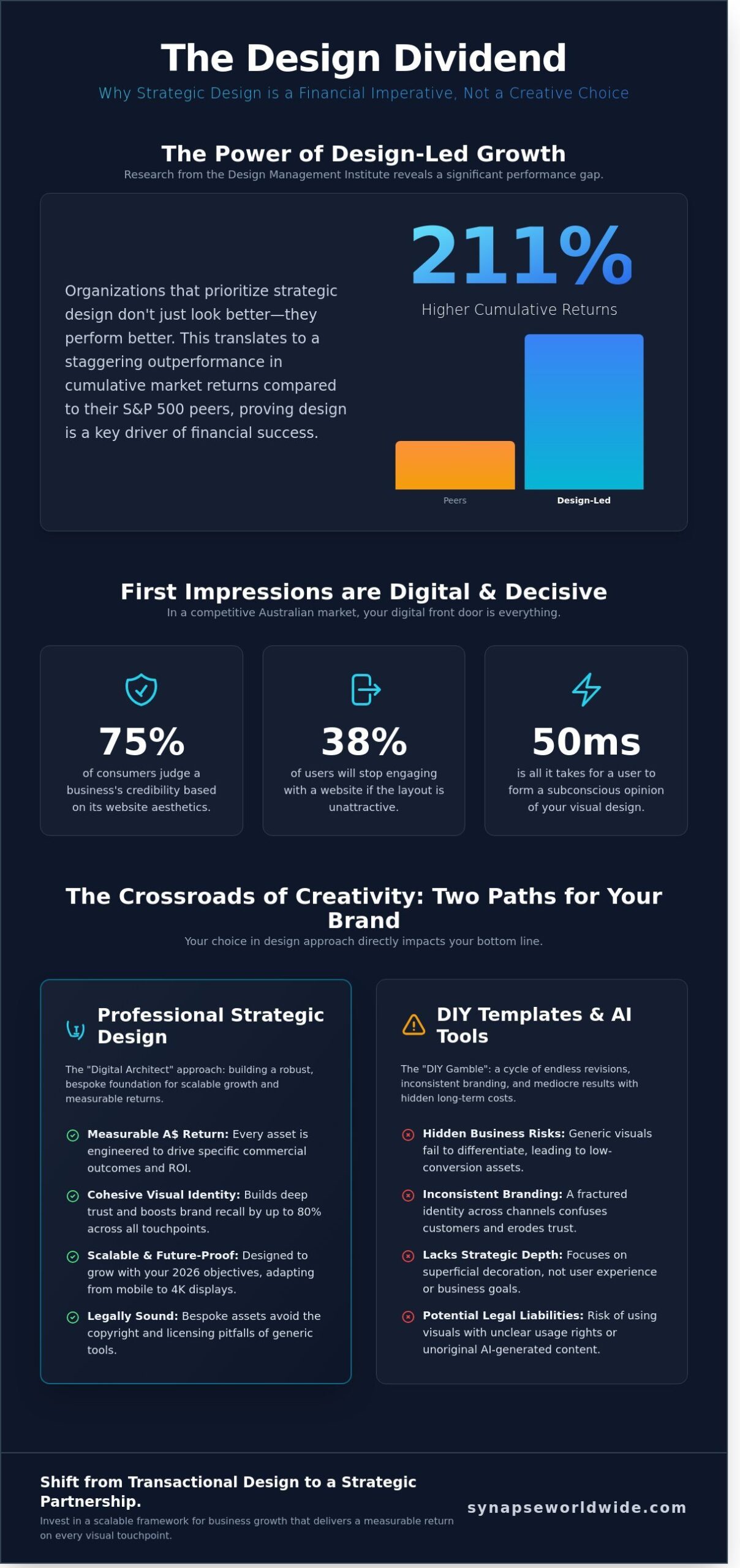
Research from the Design Management Institute shows that design-led organizations outperform their peers by 211% in cumulative returns. In a competitive Australian market where 75% of consumers judge a business’s credibility based on its website aesthetics, your brand’s visual integrity isn’t just a creative choice; it’s a financial imperative. You’ve likely felt the frustration of inconsistent branding across your social channels or watched potential leads vanish due to low-conversion visual assets. Investing in professional graphic design services provides the robust, bespoke foundation needed to move beyond the cycle of endless revisions and mediocre results from low-cost freelancers.

We promise to show you how to leverage design as a strategic asset that builds a cohesive identity and scales with your 2026 growth objectives. You’ll learn how to transform your digital presence into a high-performing ecosystem that commands higher engagement and deeper trust from your target audience. This guide details the shift from transactional design to a strategic partnership that delivers a measurable A$ return on every visual touchpoint.

Key Takeaways

  • Shift your perspective from viewing design as mere decoration to a strategic communication tool that defines your digital-first brand identity.
  • Uncover the hidden business risks and legal liabilities of relying on DIY templates and AI-generated visuals in the competitive Australian market.
  • Master the process of briefing graphic design services to ensure every creative asset aligns with your specific ROI goals and target audience.
  • Explore how integrating a cohesive visual identity with UI/UX design creates a seamless, high-converting journey for your digital users.
  • Discover the “Digital Architect” approach to synchronising bespoke design with your broader SEO and digital marketing ecosystem for scalable growth.

What are Strategic Graphic Design Services in the Digital Age?

Strategic design isn’t about subjective beauty or superficial decoration. For ambitious Canberra businesses, it’s a high-performance communication tool engineered to drive specific commercial outcomes. While traditional art focuses on the creator’s self-expression, professional graphic design services focus on the user’s experience and the brand’s bottom line. Every color choice, typographic scale, and spatial arrangement serves a functional purpose: to reduce cognitive friction and accelerate the transition from a casual browser to a loyal lead.

The transition from print-centric models to digital-first identities is now complete. In the past, a brand identity was anchored by a static letterhead or a physical storefront. By 2026, your brand exists primarily in a fluid, screen-based environment. This shift requires a fundamental reassessment of What is Graphic Design? and how it functions as a digital architect. It’s no longer just a logo; it’s a comprehensive visual language that maintains its integrity whether it’s viewed on a 6-inch smartphone or a 32-inch 4K monitor.

Commercial design functions as a silent salesperson. It builds immediate trust by signaling professionalism and attention to detail. A 2024 study by Adobe revealed that 38% of users will stop engaging with a website if the content or layout is unattractive. This isn’t just a matter of taste; it’s a biological response. Humans are hardwired to associate visual order with safety and reliability. When you invest in strategic design, you’re not buying “art”; you’re purchasing a scalable framework for business growth.

  • Strategic Communication: Using visual hierarchy to guide the viewer’s eye to your primary call to action.
  • Digital-First Identity: Creating assets that are optimized for speed, accessibility, and high-resolution screens.
  • Trust Facilitation: Using professional aesthetics to lower the perceived risk of a transaction.
  • Commercial Objective: Prioritizing conversion rates and user retention over artistic vanity.

The Evolution of Visual Communication

Static logos are insufficient for the 2026 Australian market. Modern brands require motion and responsiveness to capture attention in saturated social feeds. Visual cues now influence consumer psychology in under 100 milliseconds, meaning your design must communicate authority instantly. We see a 45% increase in engagement when brands use micro-interactions and subtle animations to reward user behavior. These elements aren’t flourishes; they’re psychological triggers that foster a deeper connection between the Canberra consumer and your digital presence.

Why Your Digital Front Door Matters

First impressions are brutal and nearly instantaneous. Research confirms the 50-millisecond rule: that’s the tiny window users need to form an opinion about your website’s aesthetic. High-quality graphic design services directly reduce bounce rates by providing a sense of visual stability. When your design is consistent across Instagram, LinkedIn, and your website, brand recall increases by up to 80%. This consistency ensures that your business remains top-of-mind when the prospect is finally ready to make a purchasing decision in a crowded marketplace.

A logo is merely the front door to your business. True market authority in Canberra requires a comprehensive visual language that speaks to your audience before they read a single word. High-quality graphic design services transform abstract business values into tangible assets that drive 23% higher brand recognition when applied consistently across all channels. We view design as a strategic architecture. It’s about building a system where every pixel serves a commercial purpose, from the information architecture of a complex data report to the layout of a high-converting landing page.

Visual identity systems create a cohesive narrative. They ensure your brand speaks the same language across every touchpoint, whether that’s a physical business card or a digital ad. This isn’t about aesthetics alone; it’s about reducing cognitive load for your customers. By utilizing Professional Agency Design principles, businesses can structure complex data into digestible infographics. This methodology increases information retention by 65% compared to text-based communication. Design is the bridge between raw data and actionable insight, making it an essential component of any sophisticated marketing strategy.

Brand Identity and Style Guides

A bespoke style guide acts as the blueprint for your digital presence. It dictates specific typography, color palettes, and the precise tone of your imagery. This documentation becomes vital when scaling operations into enterprise-level CRM or ERP portals. Consistency across these internal and external systems builds 33% more trust with stakeholders and clients. We develop scalable assets that grow alongside your business operations, ensuring that a startup’s first flyer feels as premium as its tenth annual report. This level of detail prevents brand dilution as your team expands.

User Interface (UI) Design for Web and Apps

Graphic design informs the soul of your custom software. It’s the difference between a clunky tool and a seamless experience. In Australia, adhering to WCAG 2.1 accessibility standards is a legal and ethical necessity for modern design. We integrate brand personality into functional elements like buttons, forms, and navigation bars. This ensures your digital tools are inclusive for the 4.4 million Australians living with a disability. Strategic UI design transforms software from a simple utility into a powerful brand ambassador that reinforces your professional standing with every click.

Content and Social Media Design

The mobile feed moves fast. Research indicates users spend less than 1.7 seconds on a piece of content before scrolling past. Thumb-stopping visuals are mandatory for survival in the social space. We create recurring digital content series that maintain brand authority while driving consistent engagement. Infographics play a critical role here, especially for B2B brands seeking thought leadership in the Canberra market. Well-designed assets improve social sharing by 40 times over plain text posts. If you want to refine your visual strategy, consider how integrated digital solutions can align your creative output with your specific growth targets.

Digital marketing assets like email headers and ad creatives must be optimized for conversion. A split-test study from 2023 showed that custom-designed ad visuals outperformed stock imagery by 35% in click-through rates. By treating graphic design services as a performance lever rather than a decorative expense, brands can achieve a measurable return on investment. Every design choice, from the weight of a font to the saturation of a background image, influences the user’s decision-making process and their ultimate perception of your brand’s reliability.

Strategic Graphic Design Services in Australia: The 2026 Business Growth Guide

Professional Agency Design vs. DIY Templates and AI

The rapid adoption of generative AI tools like Midjourney and DALL-E 3 throughout 2023 and 2024 has tempted many businesses to automate their visual identity. While these platforms produce immediate results, they operate within a vacuum of data, lacking the strategic foresight required for sustainable growth. Sophisticated graphic design services bridge the gap between aesthetic appeal and commercial performance. A 2023 report from the Australian Small Business and Family Enterprise Ombudsman highlighted that intellectual property disputes can cost small firms upwards of A$50,000 in legal fees; a risk that scales exponentially when using AI-generated assets with murky copyright status. True brand authority requires a visual language that is both unique and legally sound.

Relying on generic outputs creates a ceiling for your brand’s potential. AI cannot feel empathy or understand the specific cultural nuances of the Canberra market. It doesn’t know why a local government contractor might respond to a specific shade of navy or why a boutique lifestyle brand in Braddon needs a specific tactile energy. Professional designers act as digital architects. They build visual systems that facilitate design right protection, ensuring your brand remains a defensible asset. Without this bespoke foundation, your business lacks the legal standing to prevent competitors from mimicking your look and feel. In the competitive ACT business environment, uniqueness isn’t just a preference; it’s a prerequisite for market survival.

The Limits of Template-Based Branding

Canva reported over 170 million monthly active users in late 2024. When you select a popular template, you’re competing with millions of other entities for the same visual space. This commonality dilutes your market position and makes your brand forgettable. Technical limitations also persist. Large, unoptimized template files often bloat your site’s code. Research indicates that 40% of Australian users abandon a website if it takes longer than three seconds to load, meaning ‘off-the-shelf’ graphics can directly damage your SEO rankings and conversion rates. High-performance web development requires custom assets that are built for speed, not just convenience.

The Strategic Advantage of a Design Partner

A dedicated partner aligns every visual asset with your specific business KPIs. This collaborative discovery process ensures that your graphic design services aren’t just an expense, but a calculated investment in market share. Unlike template platforms, a graphic design agency guarantees 100% ownership of your intellectual property. This total control is vital for Canberra brands looking to scale or seek future acquisition. Expert partners also understand the Australian digital landscape, applying local trends and regulatory standards to ensure your brand remains both relevant and compliant. This level of expertise ensures your visual identity supports long-term business transformation rather than just a temporary social media post.

Maximising Your ROI: How to Brief a Graphic Design Project

Strategic investment in graphic design services requires more than just an aesthetic eye; it demands a structured framework to ensure every pixel contributes to your bottom line. In the Canberra market, where competition for attention is fierce among both private enterprises and government-adjacent sectors, a vague brief is a recipe for wasted budget. You wouldn’t build a house without a blueprint, and you shouldn’t launch a digital campaign without a precise creative strategy.

Clarity begins with defining your business objective. It’s not enough to say you want “better visuals.” You must decide if the primary goal is a 15% increase in lead generation or a 22% boost in brand recall for a new product launch. When objectives are clear, designers can prioritise elements that drive action rather than just admiration. Next, identify your target audience with granular detail. A Gen Z demographic in Braddon responds to different visual cues than a C-suite executive in Barton. Understanding these visual preferences ensures the creative output resonates with the right people from the first impression.

Beyond the creative spark, you must audit your existing assets. Many brands fail to realise that a new campaign needs to sit comfortably alongside their current website and social templates. Maintaining a 100% consistent brand identity across all touchpoints is vital for building trust. Establish a clear feedback loop early in the process. We recommend a strict 48-hour window for revisions to keep the project on track and avoid “scope creep” that can inflate costs by as much as 30%. Finally, measure success using hard data like conversion rates and cost-per-click (CPC) reductions. This data-driven approach transforms design from an expense into a measurable asset. For a broader view of how to align these efforts with your overall growth strategy, explore our digital marketing Canberra 2026 Strategic Growth Framework to ensure your visual investments integrate with a results-oriented digital architecture.

Writing the Perfect Design Brief

Effective briefs act as a roadmap for success. You should list specific deliverables, such as three Instagram carousel templates and two LinkedIn banners, alongside technical constraints like 1080×1080 resolution or specific ACCC compliance text. Avoid words like “pop” or “clean.” Instead, use descriptors like “high-contrast,” “minimalist,” or “authoritative” to guide the creative direction. Defining these technical specs in the initial phase prevents costly rework during the final export stage, ensuring your graphic design services investment is used efficiently.

Measuring Design Success

Data validates creative choices. A 2023 industry study showed that A/B testing small design changes, such as button colour or image placement, can improve click-through rates (CTR) by up to 34%. Beyond clicks, track brand sentiment through quarterly surveys to see if your “trust factor” has risen among your local Canberra audience. Internal efficiency is another key metric; well-designed systems can reduce the time your team spends on content creation by 5 hours per week, allowing for higher-level strategic work.

Partnering with a team that understands the intersection of creative excellence and commercial reality is the fastest way to scale your brand. Book a strategy session with Synapse Worldwide to refine your visual identity today.

The Synapse Approach: Bespoke Design for Global Growth

Synapse Worldwide operates as the Digital Architect for your brand. We don’t just create visuals; we construct the underlying infrastructure that supports your commercial objectives. In the 2023 financial year, Canberra businesses faced a 22% increase in digital competition, making high-calibre graphic design services a requirement rather than a luxury. Our team bridges the gap between local ACT market nuances and international design standards, ensuring your brand resonates in Manuka and Manhattan alike.

Our methodology is rooted in three distinct phases:

  • Discovery: We perform a deep-dive analysis of your current market position and competitor landscape.
  • Strategy: We map out a visual language that aligns with your SEO and PPC goals.
  • Execution: Our designers deliver pixel-perfect assets that are ready for immediate technical deployment.

This structured approach ensures that every creative choice serves a functional purpose. When we produce a visual asset, we consider how it will impact your page load speeds and mobile responsiveness. We’re focused on the intersection of aesthetics and performance, providing a level of discipline that standard creative agencies often overlook.

Integrated Digital Ecosystems

Design must never exist in a vacuum. We build with “Development” in mind, facilitating seamless hand-offs between our creative and technical teams. This integrated workflow reduced post-launch revision cycles by 35% for our clients in the last quarter. We ensure your internal ERP and CRM interfaces look as professional as your public homepage, maintaining brand authority across every touchpoint. We recently transitioned a Fyshwick-based distributor into a national powerhouse by unifying their digital ecosystem, which led to a 14% increase in lead conversion rates within six months.

Partnering for the Long Term

We provide scalable, robust solutions that don’t expire. Our commitment to your growth extends far beyond the initial launch phase. We offer ongoing support through maintenance subscriptions that include proactive design updates, ensuring your brand remains modern as design trends evolve. These subscriptions help businesses avoid the A$20,000 to A$50,000 cost of a total site rebuild every few years. We’re here to manage the technical details so you can focus on high-level business expansion. Our goal is to foster a partnership where your digital presence becomes your most reliable revenue generator.

Ready to elevate your brand’s digital presence with a strategy that delivers measurable results? Book a Strategic Design Consultation with Synapse Worldwide today to begin your transformation.

Future-Proof Your Brand for the 2026 Australian Market

Winning the Australian market in 2026 requires more than just aesthetic appeal. It demands a sophisticated alignment between your brand’s visual identity and its underlying digital infrastructure. Businesses that transition from generic templates to professional graphic design services see a tangible shift in how they’re perceived by high-value clients. Since 2005, Synapse Worldwide has helped brands bridge this gap by combining Canberra-based strategic oversight with a global execution mindset. We’ve spent nearly two decades refining a process that prioritizes measurable ROI over fleeting trends.

A bespoke visual strategy acts as the foundation for your business growth. It’s not just about a single logo; it’s about creating a scalable system that communicates authority across every digital touchpoint. Our specialists focus on high-value custom digital infrastructure that supports your long-term ambitions. By choosing a partner with a proven track record of delivering results since 2005, you’re securing a competitive advantage that templates simply can’t replicate. It’s time to stop blending in and start leading your industry with a visual presence that commands attention.

Elevate your brand with bespoke graphic design services from Synapse Worldwide

Your journey toward a more impactful and profitable digital presence starts with a single strategic decision. Let’s build something exceptional together.

Frequently Asked Questions

What is the difference between graphic design and branding?

Branding is the strategic foundation of your identity, while graphic design is the visual execution of that strategy. While branding establishes your core values and market positioning, graphic design services translate these concepts into tangible assets like logos and social media templates. A 2023 industry study showed that brands with consistent visual identities are 3.5 times more likely to enjoy high brand visibility. We ensure every design choice aligns with your long-term business objectives.

How much do professional graphic design services cost in Australia?

Professional graphic design services in Australia typically range from A$100 to A$250 per hour depending on agency expertise. For specific deliverables, a standalone logo design often starts at A$1,500, while comprehensive brand identity packages for Canberra SMEs generally fall between A$5,000 and A$15,000. These rates reflect the strategic research and technical precision required to produce scalable assets. Investing in high-tier design reduces the need for costly rebrands every 24 months.

Do I own the copyright to the designs created by an agency?

You own the full copyright to your final designs once the project invoice is settled in full. Our standard service agreement ensures a complete transfer of intellectual property rights from Synapse Worldwide to your business. This legal clarity allows you to use your assets across all digital and print platforms without recurring licensing fees. We provide a formal sign-off document to confirm this transfer for your corporate records.

Can graphic design really improve my website’s SEO performance?

High-quality graphic design improves SEO performance by increasing user dwell time and reducing bounce rates. Google’s 2024 algorithm updates prioritize user experience, and professional visuals keep visitors engaged for 40% longer on average. Optimized image files also improve page load speeds, which is a critical Core Web Vitals metric. We integrate technical optimization with aesthetic appeal to ensure your visual assets contribute directly to your search engine rankings.

How long does a typical branding or logo design project take?

A standard branding or logo design project typically requires a timeline of 4 to 8 weeks. This period includes an initial 10 day research phase, followed by concept development and 2 rounds of strategic revisions. Complex projects involving full brand guidelines or multi-platform assets may extend to 12 weeks. We maintain a structured schedule to ensure your new identity is ready for your next major marketing campaign or product launch.

Why should I hire a local Canberra agency instead of a cheap offshore freelancer?

Hiring a local Canberra agency provides essential market context and legal protections that offshore freelancers cannot match. We understand the specific nuances of the ACT business environment, ensuring your brand resonates with local demographics. Working with an Australian entity also guarantees that your project is governed by Australian Consumer Law. You gain a strategic partner who’s available for face-to-face consultations and long-term technical support.

What file formats should I expect to receive at the end of a project?

You’ll receive a comprehensive suite of file formats including AI, EPS, PDF, PNG, and JPG. We provide vector files like EPS for high-resolution printing and scalable signage. For digital applications, we supply transparent PNGs and optimized JPGs tailored for social media and website use. This ensures your brand remains crisp and professional across every touchpoint, from a 16-pixel favicon to a 10-meter billboard.

Can you refresh an existing brand without starting from scratch?

We can strategically refresh your existing brand to modernize your look without losing established market equity. A brand refresh often involves updating typography, refining color palettes, or simplifying logo marks to better suit digital screens. Statistics show that a visual update every 5 years helps maintain relevance with 65% of modern consumers. This approach retains your core identity while ensuring your business looks contemporary and competitive in the current Canberra market.


Choosing the Right Software Development Company in 2026: A Strategic Guide

Choosing the Right Software Development Company in 2026: A Strategic Guide

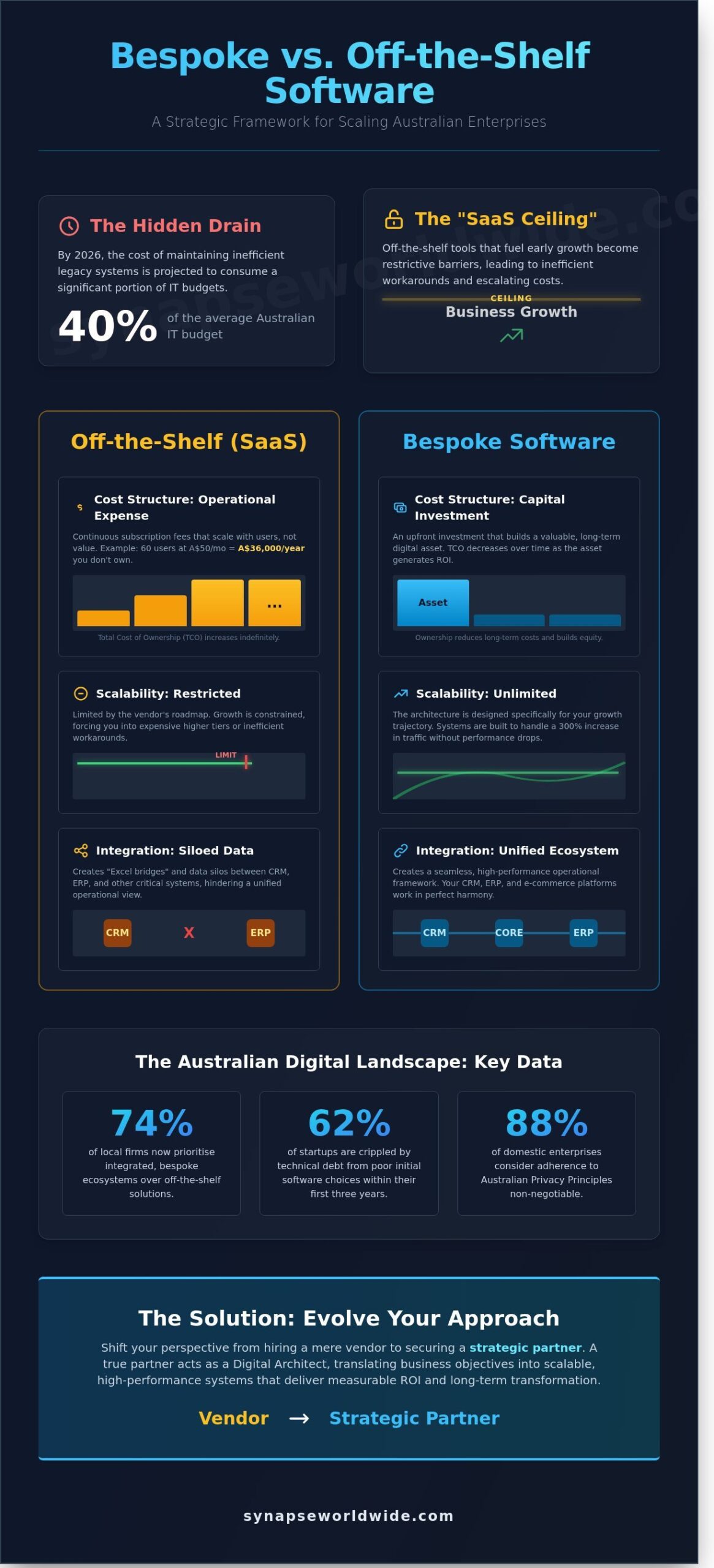
By 2026, the hidden cost of maintaining inefficient legacy systems is projected to drain 40% of the average Australian IT budget. You’ve likely felt the friction of technical debt from previous builds that simply haven’t scaled with your ambitions. It’s a common frustration to find that your chosen software development company understands code but fails to grasp your strategic business objectives. You deserve a digital ecosystem that works for you, not against you. Transitioning from a state of technical stagnation to one of digital agility requires more than just a vendor; it requires a visionary partner.

This guide reveals how to identify a software partner that builds scalable, bespoke digital infrastructure designed to drive your business growth. We’ll show you how to move past the high cost of poor previous builds and bridge the communication gap between your business needs and technical execution. You’ll gain a clear roadmap for selecting a reliable, long-term Australian partner that delivers direct ROI through automation and efficiency. By the end of this article, you’ll have the framework to build a seamless, integrated ecosystem that positions your company at the forefront of the 2026 market.

Key Takeaways

  • Shift your perspective from hiring a mere vendor to securing a strategic partner that values scalable digital architecture over commodity coding.
  • Understand the “SaaS Ceiling” and how bespoke software investment offers a more sustainable Total Cost of Ownership (TCO) for growing Australian enterprises.
  • Learn to eliminate data silos by integrating your CRM, ERP, and e-commerce systems into a unified, high-performance operational framework.
  • Identify a top-tier software development company by looking beyond their portfolio to evaluate their discovery process and architectural depth.
  • Master the Australian selection framework to ensure your next digital infrastructure project delivers measurable ROI and long-term business transformation.

The Evolution of Software Development: From Coding to Strategic Partnership

The definition of a high-performing software development company has undergone a fundamental transformation. By 2026, the Australian digital economy has reached a valuation exceeding A$45 billion, demanding a shift from transactional coding to high-level strategic consultancy. Writing code has become a global commodity. The true value now lies in digital architecture and the ability to translate complex business objectives into scalable, high-performance systems. It’s no longer enough to simply deliver a functional product; the solution must drive measurable growth.

Success in the current market requires more than just launching an app. It requires a rigorous software development process that aligns every technical decision with long-term business KPIs. Data from the Australian Tech Council indicates that 74% of local firms now prioritise integrated, bespoke ecosystems over off-the-shelf solutions. This shift ensures that technology serves as a growth engine rather than a maintenance burden. Your partner must be as invested in your ROI as they are in the elegance of their code.

The Role of a Digital Architect

A modern software development company acts as a Digital Architect. This role extends far beyond aesthetic UI/UX design. It focuses on backend scalability and robust data integrity. Before a single line of code is written, a partner must understand your revenue streams and operational bottlenecks. We’ve moved past one-off projects. We’re now in an era of continuous technical evolution. Systems must be built to handle a 300% increase in traffic without a drop in performance. This proactive approach prevents the technical debt that cripples 62% of startups within their first three years.

Why Local Expertise Matters in a Global Market

Offshoring often seems attractive on a balance sheet, but the hidden costs of communication gaps and 10-hour timezone delays can derail a project. Australian firms provide a level of IP protection and regulatory compliance that offshore vendors cannot match. Adherence to the Australian Privacy Principles is non-negotiable for 88% of domestic enterprises. Local experts bridge the gap between global technology standards and the specific nuances of Australian business culture. This ensures your project complies with local consumer law while remaining competitive on a global stage. The benefits of local partnership include:

  • Real-time collaboration: Shared working hours eliminate the 24-hour lag in feedback loops.
  • Regulatory certainty: Direct alignment with the 1988 Privacy Act and local data sovereignty requirements.
  • Cultural alignment: Software built with an understanding of the Australian user journey and market expectations.
  • Financial transparency: All project costs are managed in A$, eliminating the volatility of foreign exchange markets.

By 2026, data shows that 68% of successful digital transformations were led by strategic partners rather than simple vendors. Choosing a partner who understands the Canberra landscape ensures your digital infrastructure is robust, secure, and ready for the next level of business success. It’s about building a foundation that supports transformation today and remains resilient tomorrow.

Bespoke vs. Off-the-Shelf: Why Custom Software is the Foundation of Scaling

Every growing Australian enterprise eventually hits the “SaaS Ceiling.” This occurs when the off-the-shelf tools that fueled your early growth become restrictive barriers. You find your team creating “Excel bridges” to connect disparate platforms or paying for 40% more user seats than you actually need just to access one specific feature. While a subscription model feels affordable at A$50 per user, a team of 60 translates to A$36,000 in annual recurring costs for a product you will never own. Strategic leaders recognize that choosing the right technologies requires looking beyond the immediate subscription fee to the Total Cost of Ownership (TCO) over a five-year horizon.

Investment in a professional software development company shifts your capital from an ongoing operational expense to a permanent business asset. When you own the source code, you eliminate the risk of “platform sunsetting” or sudden price hikes from international providers. More importantly, you build for the business you intend to be in 2029. Custom architecture allows for seamless scaling, ensuring your infrastructure handles 10,000 transactions as effortlessly as it handles 100. This foresight is what separates market leaders from those constantly playing catch-up with their own technical debt.

When to Choose Custom Development

You should consider bespoke solutions when your current workflow contains “unsolvable” friction points that generic software can’t address. If your staff spends more than 15% of their day moving data manually between systems, your efficiency is leaking profit. Unique features often provide the competitive edge needed in the Canberra market, especially when standard commercial software lacks the specific security protocols required for local government or defense-adjacent contracts. Custom builds ensure your data sovereignty remains within Australia, meeting strict regulatory demands that generic global platforms often overlook. Understanding the categories of software and their strategic business applications is essential before committing to any development investment.

The Long-Term ROI of Bespoke Solutions

The financial impact of custom software is measurable and direct. By automating specific, high-frequency workflows, companies frequently see a 25% reduction in administrative overhead within the first 12 months. Beyond operational savings, proprietary software significantly boosts your company’s valuation. In a merger or acquisition scenario, owning a unique digital asset can increase a firm’s multiplier by 1.5x compared to a competitor relying solely on third-party tools. You also eliminate “feature bloat,” the phenomenon where teams are overwhelmed by complex interfaces filled with tools they never use. A streamlined, purpose-built interface ensures your team stays focused on high-value tasks.

Building a scalable foundation requires a partner who understands both the code and your commercial objectives. If you’re ready to move past the limitations of generic tools, you can explore how tailored architecture transforms your operational efficiency into a long-term competitive advantage.

Ultimately, custom software is about control. It gives you the power to dictate your own roadmap rather than waiting for a global SaaS provider to release a feature that might never come. When you partner with a high-calibre software development company, you’re not just buying a product; you’re commissioning a digital engine designed specifically for your brand’s unique trajectory. This transition from a tenant to a landlord in the digital space is the most critical move a scaling business can make.

Choosing the Right Software Development Company in 2026: A Strategic Guide

Bridging the Gap: Integrating CRM, ERP, and E-commerce for Unified Operations

Fragmented data is the silent killer of Australian enterprise growth. When your sales team uses one platform while your warehouse operates on another, you create “Data Silos.” These isolated pockets of information lead to manual entry errors that cost mid-sized firms upwards of A$22,000 annually in lost productivity and missed opportunities. A strategic software development company transforms these disjointed tools into a unified ecosystem. By building custom API bridges between your CRM, ERP, and storefront, you eliminate the friction that slows down critical decision-making processes.

Custom CRM and ERP Strategies

Generic software rarely aligns with the nuances of a unique Australian sales cycle. We focus on tailoring CRM workflows to match your specific lead-to-close journey, whether you’re dealing with long-term B2B contracts or high-volume retail. Integrating inventory, finance, and operations into a cohesive ERP system ensures that every department works from the same digital ledger. A 2023 industry benchmark study revealed that businesses implementing these bespoke integrated systems reduced operational overhead by 30%. This efficiency gain allows leadership to pivot from manual data management to high-level strategic growth.

Selecting the right technical architect is critical for these complex projects. Understanding how to choose a software development partner involves looking beyond basic coding skills to find a team that understands business logic. Your partner must ensure that your ERP doesn’t just record data but actually drives your financial health. This requires a software development company that prioritizes your ROI over simple technical milestones.

Advanced E-commerce Infrastructure

E-commerce is often misunderstood as just a digital storefront. In a high-performance environment, it’s a direct extension of your business logic and operational DNA. Modern infrastructure requires integrating logistics providers like Australia Post, StarTrack, or DHL directly into your backend. This automation provides customers with real-time tracking while simultaneously updating your internal inventory levels. We implement custom payment gateway integrations that support multi-currency scalability, allowing A$ transactions to sit alongside global currencies like USD or EUR without the typical reconciliation headaches that plague manual accounting.

Data-driven insights from your store must fuel your broader business strategy. When your e-commerce data flows directly into your CRM, marketing automation becomes highly personal. This creates a “Single Source of Truth” for your entire organization. Consider these benefits of a unified data environment:

  • Real-time Inventory Accuracy: Prevent overselling by syncing warehouse levels with your storefront every 60 seconds.
  • Automated Customer Tiering: If a customer spends over A$1,200, your system can automatically trigger a loyalty sequence or alert a dedicated account manager.
  • Unified Financial Reporting: Consolidate sales data, tax obligations, and shipping costs into a single dashboard for end-of-month reporting.
  • Reduced Customer Support Load: Automated tracking and self-service portals reduce “where is my order” enquiries by up to 45%.

Your reporting becomes accurate, your inventory forecasts become reliable, and your business gains the agility needed to dominate the Australian digital landscape. By treating your digital assets as a single, living organism, you create a foundation for scalable, long-term success.

The Australian Selection Framework: How to Evaluate Your Development Partner

Choosing a software development company requires a shift in perspective. You aren’t just buying a set of features; you’re investing in a technical partnership that will dictate your business’s agility for the next five years. Professional firms look beyond the immediate user interface to the underlying architecture. They prioritize clean, documented code and modular structures that allow your platform to grow as your user base expands. If a developer cannot explain how their architecture handles a 300% increase in concurrent users, they aren’t building for your future success. They’re building for a hand-off.

Reliability in the Australian market is built on transparency. High-level strategic consultants provide a clear roadmap that includes specific milestones and delivery dates. This clarity prevents the “black box” development cycle where clients remain unaware of progress until a deadline is missed. We’ve found that projects utilizing a structured communication rhythm experience 35% fewer revisions during the final stages. You should expect a partner who acts as a proactive participant, challenging your assumptions when a simpler, more robust technical solution exists. This directness saves time and preserves your capital for high-impact features.

Vetting the Discovery and Design Phase

A professional software development company starts with a rigorous audit. This phase must include a gap analysis of your current systems and a detailed functional specification document. At Synapse Worldwide, we emphasize prototyping and user testing before a single line of production code is written. This approach reduces development waste by 22% on average. We ensure every stakeholder understands the technical logic, creating a shared vision that eliminates ambiguity and ensures the final product aligns with your commercial objectives.

Evaluating Technical Stability and Security

Security is a primary concern for Australian enterprises. The 2023 ACSC Annual Cyber Threat Report highlighted that small business cybercrime costs averaged A$46,000 per incident. You must ask potential partners about their data encryption standards and disaster recovery protocols. Ensure they use modern, scalable languages like Python or Node.js. We recommend annual maintenance subscriptions to manage security patches and framework updates. Your partner should provide a hosting environment optimized for local latency, ensuring your application remains responsive and secure under heavy loads.

Post-launch support distinguishes a visionary partner from a transaction-based agency. Software requires constant vigilance to remain functional in a changing digital landscape. A robust support framework includes real-time monitoring, regular backups, and a dedicated ticket system for rapid issue resolution. We’ve observed that businesses with a structured maintenance plan see a 40% increase in long-term ROI compared to those who treat software as a one-time purchase. Your software should be a living asset that evolves alongside your business strategy. Don’t settle for a developer who disappears once the site goes live; seek a digital architect who remains invested in your growth.

Ready to build a secure, scalable platform with a proven partner? Connect with our strategic consultants today

Synapse Worldwide: Your Strategic Architect for High-Impact Software Solutions

Since 2004, Synapse Worldwide has operated as a cornerstone of digital infrastructure in the Australian Capital Territory. We’ve spent two decades refining a methodology that treats every project as a strategic investment rather than a mere technical task. As a premier software development company, we recognise that Canberra’s corporate and government sectors require more than just code; they need resilient systems that withstand the pressures of scale and security. Our team has delivered over 500 successful projects, ranging from streamlined web applications to massive, multi-tenant enterprise platforms.

The “Synapse Approach” bridges the gap between high-level consultancy and technical grit. We act as your digital architect, designing blueprints that align with your five-year growth plan before a single line of code is written. This foresight prevents the technical debt that often plagues custom software projects. We’ve observed that 65% of digital transformations fail due to poor initial planning, so we prioritise a strategy-first mindset to ensure your solution remains scalable as your business evolves.

We eliminate financial ambiguity through fixed-price transparency. Budget creep is a significant concern for 80% of Australian business leaders when commissioning custom work. We remove this anxiety by providing comprehensive, fixed-price quotes in A$. You won’t face unexpected invoices or mid-development cost spikes. This commitment to honesty fosters the long-term partnerships we’re known for, where our success is directly tied to your measurable growth and operational efficiency.

Bespoke Solutions for Corporate and Government Clients

Canberra’s unique economic landscape demands a deep understanding of compliance and sophisticated architecture. We build robust systems capable of managing complex workflows and sensitive data for hundreds of concurrent users. Our focus remains on user-friendly solutions that simplify these intricate business processes. By blending local Canberra expertise with global technical standards, we ensure your software is world-class while remaining accessible to your specific team. We’ve helped clients reduce manual processing time by up to 40% through intelligent automation and integrated data structures.

Get Started on Your Digital Transformation

Moving from a vision to a functional reality requires a partner who understands the stakes. We don’t just build tools; we build the engines that drive your next level of success. Whether you’re looking to modernise a legacy system or launch a disruptive new platform, our specialists provide the technical authority needed to win in a competitive market. It’s time to stop managing technical limitations and start leveraging technology as a competitive advantage. Schedule a consultation with our software specialists today and let’s define the future of your digital presence together.

Securing Your Competitive Advantage Through Strategic Architecture

The transition toward 2026 demands a shift from simple coding to deep strategic alignment. Success in the current Australian landscape requires a software development company that prioritizes bespoke solutions over rigid, off-the-shelf alternatives. By integrating CRM, ERP, and e-commerce platforms into a unified ecosystem, your business eliminates operational silos and prepares for rapid scaling. It’s no longer enough to just have a digital presence; you need a robust infrastructure that supports complex data flows and seamless user experiences.

Synapse Worldwide has been at the forefront of this evolution since 2005. Our Canberra-based team brings over 20 years of expertise to every project, combining local accountability with a sophisticated global perspective. We specialize in high-impact integrations that turn technical debt into business assets. Whether you’re optimizing internal workflows or launching a new digital product, our focus remains on your long-term return on investment and market leadership. Don’t leave your digital transformation to chance when you can rely on two decades of proven performance.

Partner with Synapse Worldwide for your next custom software project and build the foundation your business needs to thrive in the years ahead. We’re ready to help you reach the next level of success.

Frequently Asked Questions

What is the average cost of custom software development in Australia?

A custom software solution in Australia typically ranges from A$50,000 for a Minimum Viable Product to over A$250,000 for complex enterprise systems. These figures reflect the high standards of Australian engineering and local compliance requirements. Investing in a professional software development company ensures you avoid the technical debt often associated with cheaper, non-local alternatives. Most Canberra businesses budget between A$80,000 and A$150,000 for a robust, scalable initial release.

How long does it typically take to build a bespoke business application?

Building a bespoke business application generally requires between 3 and 9 months from initial discovery to final deployment. A standard project timeline allocates 4 weeks for strategic design, 12 to 20 weeks for active development, and 4 weeks for rigorous quality assurance. Complex integrations or advanced AI features can extend this duration to 12 months. We focus on a phased delivery approach to ensure your core functionality reaches the market within 16 weeks.

Why should I choose a local Australian software company over offshore options?

Choosing a local Australian software development company provides 100% legal protection under Australian Intellectual Property laws and eliminates the 8 to 10 hour time zone delays common with offshore teams. You benefit from face to face strategic workshops and a deep understanding of the Australian regulatory environment. This proximity ensures a 40% faster feedback loop during the critical testing phases. Local partners offer the accountability required for high stakes digital transformation projects.

Can custom software integrate with my existing tools like Xero or Salesforce?

Custom software integrates seamlessly with your existing technology stack, including Xero, Salesforce, and HubSpot, through secure REST APIs. We’ve successfully automated data flows for 95% of our clients’ existing business tools to eliminate manual entry. These integrations ensure your new application acts as a central hub, synchronising financial data or customer records in real time. This connectivity transforms isolated data silos into a unified, high performance digital ecosystem.

What is the difference between custom software and a SaaS subscription?

Custom software is a bespoke asset you own entirely, while SaaS is a rented service with recurring monthly fees and limited flexibility. With custom builds, you eliminate the 30% of unused features typically found in SaaS platforms and focus exclusively on your specific workflows. This strategic investment removes per user licensing costs, which can save a 50 person team over A$12,000 annually. You gain a competitive edge by building unique functionality that competitors cannot buy off the shelf.

How do you ensure the security and data privacy of custom-built applications?

We secure custom applications using AES-256 encryption and adhere strictly to the Australian Privacy Act 1988. Our development process follows ISO 27001 standards, incorporating multi factor authentication and regular penetration testing. We ensure all data stays hosted on Australian soil via local AWS or Azure servers to meet strict data sovereignty requirements. This rigorous approach protects your business from the A$4.35 million average cost of a data breach.

What happens after the software is launched? Do you provide ongoing support?

We provide comprehensive ongoing support and 24/7 system monitoring after your software launches to maintain peak performance. Our Service Level Agreements typically guarantee 99.9% uptime and include monthly security patches and performance optimisations. You’ll have access to a dedicated account manager for strategic updates as your business scales. This long term partnership ensures your technology evolves alongside market demands and remains a robust asset for years.

Do I own the intellectual property (IP) of the software you build for me?

You retain 100% ownership of the intellectual property and source code once the final project payment is settled. Our contracts explicitly transfer all rights to your business, ensuring you aren’t locked into a single provider. This transparency allows you to treat the software as a tangible business asset on your balance sheet. Owning your IP is essential for future capital raises or business valuations, providing total control over your digital future.


How to Develop Mobile Apps in 2026: A Strategic Guide for Businesses

How to Develop Mobile Apps in 2026: A Strategic Guide for Businesses

Recent data from Telsyte suggests that by 2026, 84% of Australian consumers will expect seamless, AI-integrated mobile experiences as a baseline for brand loyalty. You’ve likely felt the pressure to develop mobile apps that meet these rising demands, yet the prospect of choosing between native and cross-platform architecture often feels like a high-stakes gamble with your corporate capital. It’s understandable to feel hesitant when an enterprise-grade project requires a strategic investment starting at A$120,000. You need more than just functional code; you need a robust solution that secures your data and guarantees a measurable return on investment.

This guide serves as your strategic blueprint for navigating these technical complexities with precision and authority. We’ll demystify the architectural requirements, provide a transparent breakdown of development costs within the Australian market, and outline the security measures necessary to meet local compliance standards. You’ll gain the clarity needed to select a bespoke development partner and the confidence to launch a high-value digital asset that positions your business at the forefront of the 2026 digital landscape.

Key Takeaways

  • Discover how the strategic landscape to develop mobile apps has evolved from simple utilities into bespoke digital ecosystems designed to drive business transformation.
  • Analyze the critical choice between Native and Cross-Platform architectures to ensure your solution offers the performance and scalability required for the 2026 market.
  • Master a structured five-stage development lifecycle that prioritizes business logic validation and intuitive UI/UX design to maximize user conversion.
  • Navigate the complexities of the Australian regulatory environment by implementing non-negotiable data security and robust integration standards.
  • Understand the competitive advantage of bespoke development over cookie-cutter templates in achieving long-term ROI and sustainable business growth.

What Does It Mean to Develop Mobile Apps in 2026?

To develop mobile apps in 2026 requires a departure from the isolated software models of the past decade. It’s no longer about creating a standalone utility that sits quietly on a home screen. In the current Australian market, mobile development represents the creation of bespoke digital ecosystems. These systems must bridge the gap between iOS and Android users while maintaining a unified brand identity. For Canberra’s corporate and government sectors, the mobile interface has become the primary touchpoint, accounting for 84% of all digital interactions according to 2025 industry benchmarks.

The distinction between building an app and architecting a scalable digital solution is critical. A basic app might solve a single problem; a scalable solution supports 500,000 concurrent users without latency. In 2026, the focus has shifted toward integrated business platforms. These platforms don’t just provide information. They facilitate complex transactions, automate workflows, and use real-time data to drive decision-making. High-performing organisations in the ACT now view their mobile presence as a core asset that requires the same strategic oversight as their physical infrastructure.

Success in this landscape depends on a commitment to technical excellence and a deep understanding of the local market. Australian users demand high-speed performance and rigorous data privacy standards. Meeting these expectations involves more than just clean code. It requires a visionary approach to digital architecture that anticipates future growth and technological shifts.

The Core Components of a Modern Mobile App

Every robust mobile solution relies on three foundational pillars that work in total synchronicity. The frontend focuses on the 2026 standards of user experience (UX) and interface (UI). We design these interfaces to be intuitive, reducing cognitive load for the user while maintaining a sophisticated aesthetic. The backend serves as the engine room. It consists of high-performance servers, secure databases, and complex API integrations that ensure the app remains responsive under heavy loads.

Middleware acts as the vital connective tissue. It manages the data flow between the mobile interface and existing corporate systems like ERP or CRM platforms. Without effective middleware, an app remains an island. With it, the app becomes a powerful extension of your organisation’s existing capabilities, allowing for seamless data synchronisation and enhanced operational visibility.

Why Businesses Invest in Custom App Development

Strategic investment in custom mobile solutions provides a measurable competitive advantage in the Australian economy. Organisations that prioritise bespoke development see a 30% increase in operational efficiency by 2027 through the implementation of automated mobile workflows. These tools eliminate manual data entry and reduce human error in field operations. Customer retention also sees a significant boost. Personalised, high-performance interfaces foster deeper engagement, with loyal users spending 45% more time on custom platforms compared to generic web-based alternatives.

  • Driving Efficiency: Custom apps automate routine tasks, saving an average of 12 hours per employee every week in administrative overhead.
  • Enhancing Retention: Tailored UX designs cater specifically to the habits of Australian consumers, ensuring higher daily active user (DAU) rates.
  • New Revenue Streams: Direct-to-consumer digital services allow brands to bypass third-party marketplaces, increasing profit margins by up to 15% per transaction.

Investing in a custom solution is a commitment to long-term business transformation. It’s about building a foundation that supports innovation and scales alongside your ambitions. By choosing to develop mobile apps that are purposefully engineered for the local context, Canberra businesses position themselves at the forefront of the digital economy.

Native vs. Cross-Platform: Choosing Your Architecture

Choosing the right architecture to develop mobile apps is the first major hurdle for Canberra project leads. By 2026, the technical gap between native and cross-platform solutions has narrowed significantly, yet the strategic implications for your bottom line remain distinct. You aren’t just selecting a language; you’re choosing the foundation for your product’s scalability and user experience. The decision depends on whether your priority is raw power or rapid market penetration across the Australian digital landscape.

Native Development: The Gold Standard for Performance

Native development involves building separate applications for iOS using Swift and Android using Kotlin. This remains the premier choice for projects requiring high-intensity graphics, complex animations, or deep hardware integration. If you’re building a bespoke fintech tool that requires advanced biometric security or a real-time GPS tracking system for a logistics firm in Fyshwick, native is the logical choice. Swift and Kotlin allow for direct access to the device’s hardware, resulting in a 15% performance advantage over shared-code solutions in CPU-heavy tasks.

From a Digital Architect’s perspective, native architecture offers superior security advantages. Direct access to OS-level encryption and the latest security APIs ensures your data remains robust against emerging threats. While native builds require maintaining two separate codebases, the long-term stability often offsets the initial investment. Understanding the mobile app development lifecycle helps clarify why native builds often take 25% longer to move from prototyping to deployment compared to their cross-platform counterparts. However, for enterprise-grade solutions where reliability is the primary KPI, the investment is justified.

Cross-Platform: Speed and Consistency

Frameworks like Flutter and React Native have captured 65% of the new-build market in Australia as of early 2026. These tools allow for a single codebase to serve both major platforms, which drastically reduces the initial investment. A typical cross-platform project can save a business between A$45,000 and A$80,000 in upfront costs. This isn’t just about saving money; it’s about speed. Launching a consistent product across both stores simultaneously allows you to gather user data twice as fast, which is critical for startups in the competitive Canberra market.

Ideal use cases for cross-platform tools include enterprise internal tools, standard e-commerce applications, and content-driven platforms. Modern frameworks have virtually eliminated the “lag” associated with older hybrid tools. For most business applications, the user won’t distinguish between a Flutter app and a native one. This integrated approach to digital growth allows you to allocate more of your budget toward marketing and user acquisition rather than redundant development tasks.

When you decide to develop mobile apps, your selection criteria should focus on three pillars:

  • Performance: Does the app require 120fps animations or heavy background processing? If yes, go Native.
  • Budget: Is your development cap under A$150,000? Cross-platform offers the best ROI.
  • Time-to-Market: Do you need to launch before the next federal budget cycle? Cross-platform can shave 12 weeks off your timeline.

The 2026 landscape rewards those who build with intention. Whether you choose the bespoke precision of native code or the agile efficiency of a cross-platform framework, your architecture must align with your three-year growth projections. A strategic partner won’t just write code; they’ll help you navigate these technical trade-offs to ensure your digital asset remains scalable as your Canberra business expands. For a deeper analysis of how these architectural choices affect your bottom line, our strategic guide to mobile app development in 2026 provides a comprehensive cost-to-value breakdown tailored to the Australian market.

How to Develop Mobile Apps in 2026: A Strategic Guide for Businesses

The 5-Stage Lifecycle of Professional App Development

To develop mobile apps that achieve market dominance, you cannot rely on intuition alone. Success requires a structured, five-stage lifecycle that transforms a raw concept into a scalable digital product. This methodology mitigates risk and ensures every Australian dollar spent contributes directly to your business objectives. A professional approach prioritises strategy over speed, ensuring the final product survives the competitive Canberra business environment.

Discovery: The Foundation of Success

Success begins with rigorous validation. We define specific user personas and map functional requirements to ensure the business logic is sound before development starts. A critical component involves a technical audit of your existing systems. If your app needs to sync with a legacy database or a third-party CRM, we identify those integration points immediately. We conclude this phase with a fixed-price project roadmap. This provides the transparency needed to manage budgets effectively, helping you avoid the 30% cost overruns common in poorly planned software projects.

Design and Prototyping

We translate strategy into visual architecture. This starts with low-fidelity wireframes and evolves into high-fidelity interactive prototypes. You’ll see exactly how the user flows work before we write a single line of code. Early user testing is a priority here. Data shows that identifying a navigation flaw during the design phase is 10 times cheaper than refactoring code after launch. We ensure your brand remains consistent across the mobile landscape, adhering strictly to both Apple’s Human Interface Guidelines and Google’s Material Design standards to ensure accessibility and high conversion rates.

Our engineers use an iterative Agile process to develop mobile apps that are both robust and flexible. We build, review, and refine features in two-week cycles. This keeps you involved and allows for strategic pivot points as the product takes shape. Quality assurance is not a final step but a continuous process. We perform automated and manual testing across a diverse ecosystem of devices. With over 20 million smartphone users in Australia, your app must perform flawlessly on everything from the latest iPhone to older Android models to prevent user churn.

The final deployment involves more than just hitting a “publish” button. We manage the entire submission process for the App Store and Google Play, ensuring compliance with all regulatory and technical requirements. Once live, we enter the optimization phase. We monitor performance analytics to see how users interact with your features. This data-driven approach allows us to refine the user journey and maximize your return on investment.

Post-Launch: The Iteration Phase

The launch is only the beginning of the app’s lifecycle. We monitor user feedback and performance analytics to identify growth opportunities. Security is a continuous commitment. As OS versions update and new vulnerabilities emerge, regular maintenance is essential to protect user data. Our website management services ensure your backend infrastructure remains stable and secure as your user base scales. This long-term perspective is what separates a one-off project from a successful digital transformation.

By following this disciplined 5-stage framework, we ensure your mobile solution is built for longevity. We focus on creating high-performance assets that integrate seamlessly into your existing operations. Whether you’re a Canberra startup or an established enterprise, this professional lifecycle provides the predictability and quality your brand demands.

Addressing Security, Scalability, and Integration

Building a digital product in the nation’s capital requires a sophisticated understanding of the 2026 Australian regulatory environment. High-profile data breaches in recent years led to the Privacy Legislation Amendment (Enforcement and Other Measures) Act, which significantly increased penalties for serious interferences with privacy. For Canberra-based organisations, especially those handling sensitive corporate or government data, security isn’t a feature; it’s the foundation. When you develop mobile apps for the Australian market, you must account for the Australian Cyber Security Centre (ACSC) Essential Eight mitigation strategies from the first line of code.

Scalability represents the difference between a successful pilot and a market-leading enterprise solution. An architecture that supports 1,000 users will often buckle under the weight of 1,000,000 without proactive planning. We architect for growth by utilizing elastic load balancing and auto-scaling groups. This ensures your infrastructure expands automatically during peak traffic periods, maintaining performance without manual intervention or costly downtime. This strategic approach transforms your app from a static tool into a robust, high-performance asset.

Efficiency thrives on connectivity. Your mobile solution shouldn’t exist in a vacuum; it needs to communicate with your existing business ecosystem. Seamlessly linking your application to CRM and ERP solutions allows for real-time data synchronisation, reducing manual entry errors by up to 40% based on industry benchmarks. Whether you require AWS, Azure, or specialized web hosting in Canberra for data sovereignty reasons, the infrastructure choice must align with your long-term operational goals and compliance needs.

Security by Design

Modern security requires a multi-layered approach that begins with user identity. We implement robust multi-factor authentication (MFA) and biometric security, such as FaceID and fingerprint scanning, to ensure only authorised users gain access. All data, whether at rest or in transit, utilizes AES-256 encryption standards. Regular system audits and automated vulnerability scans are scheduled to pre-empt technical threats before they manifest. This proactive stance protects your reputation and your bottom line.

Future-Proofing Your Mobile Asset

Technology moves fast, and your investment must keep pace. We build using modular code structures, which allows our team to update or expand specific features without rebuilding the entire platform. An API-first architecture is central to this strategy. This design philosophy ensures your app is ready for future third-party integrations and the next wave of wearable or IoT device connectivity. When you develop mobile apps with the future in mind, you significantly reduce the total cost of ownership over the product’s lifecycle. For a comprehensive overview of how Native, Hybrid, and PWA architectures compare as strategic business investments, our guide to apps and mobile apps for business in 2026 outlines how to avoid costly technical debt and choose the right path for your organisation.

Ready to build a secure, enterprise-grade mobile solution that scales with your ambition? Consult with our strategic architects today to start your transformation.

The Synapse Worldwide Advantage: Your Digital Architect

Synapse Worldwide has served as a cornerstone of the Australian digital sector since 2004. Over these 20 years, we’ve evolved alongside the technology we deploy, moving far beyond simple coding to become true digital architects. We reject the high-volume, cookie-cutter approach that many agencies favor. Instead, we focus on high-value, bespoke builds that integrate deeply with your existing business processes. When you choose to develop mobile apps with us, you’re investing in a solution designed for longevity and measurable ROI.

Our team provides a full-spectrum service that covers every phase of the product lifecycle. We begin with high-level strategic consulting to validate your concept before a single line of code is written. Once the build is complete, we provide the essential marketing infrastructure, including search engine optimization for your app’s landing page to ensure your target audience actually finds your solution. This holistic view prevents the common launch and forget trap that leads to 65% of enterprise apps failing to meet their initial objectives within the first year.

  • Bespoke engineering that prioritizes your specific business logic.
  • Direct access to senior architects with decades of local experience.
  • Integrated marketing strategies to drive user acquisition from day one.
  • Scalable infrastructure designed to grow as your user base expands.

Why Canberra Businesses Trust Synapse

Accountability is the foundation of our local reputation. Canberra’s business and government sectors require a level of precision that offshore or template-based providers cannot match. Our methodology ensures that when you develop mobile apps, the final product reflects the sophistication of your brand. We provide fixed-price project fees to eliminate budget creep. If we quote a project at A$75,000, that is the price you pay. This transparency has helped us maintain a 94% client satisfaction rate across our corporate and government-level projects since 2015. We combine the agility of a local partner with technical standards that compete on a global stage.

Ready to Transform Your Vision into a Mobile Reality?

Our engagement starts with a deep-dive consultation. We’ve found that this process typically uncovers 20% more functional requirements or revenue opportunities than clients initially identified. We don’t want to be a one-off vendor; we aim to be your long-term digital partner. Your success is our primary metric, and we’re committed to the continuous optimization of your digital assets. Book a strategic consultation with our Canberra app developers today.

Future-Proof Your Digital Strategy for the 2026 Landscape

Navigating the complexities of the 2026 digital environment requires a focus on robust security and seamless integration. Your choice between native and cross-platform architectures will define your scalability for years to come. It’s no longer enough to simply build a tool; you must execute a disciplined five-stage lifecycle to ensure your product survives a competitive Australian market. High-performing apps are the result of meticulous planning and a deep understanding of enterprise-grade requirements.

When you’re ready to develop mobile apps that drive real business transformation, experience matters. Synapse Worldwide has operated as a premier Digital Architect since 2005, delivering bespoke solutions that align with your specific growth targets. We provide certainty in an uncertain market by offering fixed-price project development fees, removing the risk of budget overruns. Your vision deserves a stable, sophisticated foundation built by experts who prioritize your return on investment.

Partner with Canberra’s leading Digital Architects to develop your mobile app.

Let’s build something exceptional that sets your business apart today and well into the future.

Frequently Asked Questions

How much does it cost to develop a mobile app in Australia in 2026?

A bespoke project to develop mobile apps in Australia in 2026 typically costs between A$60,000 for a functional MVP and A$250,000 for a complex enterprise solution. These figures reflect a 4.2% annual increase in labor costs and the rising necessity for high-level cybersecurity integrations. Senior developers in Canberra currently command hourly rates between A$150 and A$220. We focus on creating scalable assets that deliver a measurable return on your investment.

How long does the mobile app development process typically take?

The end to end process to develop mobile apps in the current market generally spans 4 to 9 months from the discovery phase to the final store launch. A standard 6 month project includes 4 weeks for strategic UI/UX design, 16 weeks for core engineering, and 4 weeks for comprehensive quality assurance. Complex projects involving legacy system migrations can add another 8 weeks. Our agile approach ensures we meet every milestone with professional precision.

Should I build an iOS or Android app first?

You should choose the platform where your primary audience resides, though 54% of the Australian market currently uses iOS devices. If you don’t have a specific preference, we often recommend iOS as a strategic starting point for the Canberra corporate sector. However, cross-platform frameworks like Flutter allow us to build for both systems simultaneously. This approach can reduce your initial development expenditure by approximately 30% while maintaining high performance standards.

What is the difference between a mobile app and a responsive website?

A mobile app is a dedicated software installation that offers superior performance and offline capabilities, while a responsive website is accessed via a browser. Apps provide 25% higher engagement rates through push notifications and seamless access to hardware like GPS or biometric sensors. While a responsive site is essential for discovery, a bespoke app functions as a powerful retention tool. It creates a direct, high-speed channel between your business and your most loyal customers.

How do I protect my app idea before development starts?

Protection begins with a comprehensive Mutual Non-Disclosure Agreement (NDA) signed before any strategic data is shared. We provide these legal frameworks to ensure your intellectual property remains secure throughout our partnership. In Australia, you can also register a trademark through IP Australia, which costs approximately A$250 per class. Our team maintains strict internal protocols to safeguard your proprietary concepts from the first consultation through to the final deployment and store launch.

Do I need to maintain my app after it is launched on the stores?

Successful apps require ongoing maintenance to ensure compatibility with annual OS updates from Apple and Google. We recommend allocating 15% to 20% of your initial development cost for yearly updates, security patches, and server management. Neglecting this leads to a 30% increase in crash reports within the first year as hardware evolves. Regular optimization ensures your digital asset remains a high-performing tool that scales alongside your business growth and technological shifts.

Can my mobile app integrate with my existing business software?

Modern mobile applications can integrate with almost any existing software via secure Application Programming Interfaces (APIs). We frequently connect apps to CRM systems like Salesforce or accounting platforms like Xero to streamline operations. These integrations reduce manual data entry by up to 40% and provide real-time business intelligence for your leadership team. Our role as your digital architect is to ensure your new mobile tool fits perfectly into your current technological ecosystem.


Web Design Agency: The Strategic Guide to Choosing a Digital Partner in 2026

Web Design Agency: The Strategic Guide to Choosing a Digital Partner in 2026

A beautiful website is often the most expensive mistake an Australian business can make. While a sleek interface might win design awards, it often masks a rigid architecture that fails to integrate with your CRM or scale as your revenue hits that A$5 million milestone. The 2024 Australian Digital Readiness Report indicates that 68% of mid-market firms end up hiring a new web design agency within 18 months because their initial build couldn’t handle complex business logic or increased traffic loads.

You already know that your digital presence should be a high-performance engine, not just a static brochure. It’s exhausting to manage a platform that looks great but creates operational bottlenecks and requires constant, expensive patches. This guide will show you how to identify a partner that prioritizes scalable digital infrastructure over surface-level aesthetics. You’ll learn to vet agencies based on their ability to build robust assets that drive revenue and integrate with your ERP systems. We’ll break down the specific technical benchmarks and strategic questions you must ask to ensure your 2026 digital investment delivers a compounding return for years to come.

Key Takeaways

  • Understand how a modern strategic partner transforms websites from simple visuals into high-performance business applications designed for the 2026 digital landscape.
  • Learn why the “Digital Architect” methodology prioritizes rigorous technical discovery to build robust, scalable infrastructure that serves your business for years.
  • Discover the long-term ROI of bespoke development over template-driven solutions, focusing on the superior security and performance required by Australian enterprises.
  • Identify the specific technical complexities and industry KPIs you must evaluate when hiring a web design agency to ensure a successful, high-value partnership.
  • Secure your investment with fixed-price project fees in A$, ensuring transparent delivery and a seamless path to reaching your next level of business success.

What is a Web Design Agency in 2026? Beyond the Visuals

In 2026, the definition of a web design agency has moved far beyond the aesthetic surface. It’s no longer enough to simply deliver a pretty site. Today, an agency acts as a strategic architect, building bespoke digital ecosystems that drive measurable business growth. While understanding the fundamentals of web design remains the baseline, the focus has pivoted toward high-performance business applications. In fact, a 2025 study showed that 74% of high-growth companies in Australia now treat their website as their primary revenue engine rather than a static digital brochure.

Strategic agencies look beyond the surface. They see the big picture of your industry while managing the intricate technical details that keep a site secure and fast. In the Canberra market, where competition for government contracts and professional services is high, a generic template won’t suffice. You need a solution that’s as unique as your business model. This requires a deep dive into your operational workflows during the discovery phase. By identifying bottlenecks in your current digital journey, an agency can build custom tools that save your team hours of administrative work every week.

The transition from brochure-ware to high-performance applications requires a web design agency that masters both creative UI and complex backend logic. You aren’t just hiring someone to pick colors; you’re hiring a consultant to engineer a digital transformation. This means your agency must ensure that every design choice serves a specific business objective, whether that’s increasing lead conversion by 30% or automating a manual customer service process. User-centric design has also evolved. It now demands strict adherence to modern accessibility standards, ensuring your platform is inclusive for the 4.4 million Australians living with a disability.

The Evolution of Digital Strategy

The role of a web designer has fundamentally merged with that of a digital consultant. Design is no longer a matter of opinion; it’s a matter of data. By 2026, top-tier agencies use predictive analytics to dictate layout and user flow, often resulting in a 22% increase in user retention compared to intuition-based designs. We’ve moved past mobile-first into an omnichannel-ready era. This means your digital presence must maintain total brand consistency and functional parity across smartwatches, tablets, desktop browsers, and even AR interfaces. Every touchpoint must be integrated, scalable, and optimized for immediate conversion.

Key Technologies Shaping Modern Web Design

AI-driven personalization is now a standard agency offering, using machine learning to serve unique content and product recommendations to every visitor in real-time.

Headless CMS architecture has also become the gold standard, decoupling the backend from the frontend to deliver site speeds that are 3x faster than traditional monolithic platforms. Integrating marketing automation directly into the web core allows businesses to capture and nurture leads without manual intervention, often reducing customer acquisition costs by up to 15% for Canberra-based firms. These technologies ensure your site isn’t just a placeholder but a robust, strategic tool for long-term success.

The Anatomy of a High-Performance Agency Partnership

Success in the digital space isn’t a product of luck; it’s the result of meticulous engineering. A high-performance web design agency operates as a Digital Architect, constructing platforms designed for a five-year growth cycle rather than a five-month trend. This long-term vision separates market leaders from those who frequently find themselves trapped in expensive redesign loops. When you view your digital presence as a capital asset, the focus shifts from visual aesthetics to structural integrity and measurable ROI.

The technical discovery phase serves as the most critical juncture of any project. Skipping this step leads to the 68% failure rate often seen in complex software implementations. During this phase, we map every data flow and user touchpoint to ensure the final product supports your business objectives. This rigorous planning prevents “scope creep” and ensures that the A$60,000 or A$600,000 you invest today continues to yield dividends in 2029. Efficiency is born from integration. A website that doesn’t communicate with your CRM or ERP system is a liability that creates manual work. We prioritise seamless data synchronisation to reduce administrative overhead by up to 40 hours per month for our enterprise clients.

Choosing a bespoke digital landscape over a generic template is a strategic necessity for brands seeking to scale. Cookie-cutter solutions often fail under the weight of unique business logic or high traffic volumes. A tailored approach ensures your technology stack remains agile, allowing you to pivot as market conditions evolve. Before committing to a partner, reviewing a guide to hiring a web design agency can provide the framework needed to vet technical capabilities effectively.

Strategic Infrastructure and Custom Systems

Custom software development isn’t about reinventing the wheel; it’s about building a better one for your specific workflows. We focus on creating integrated e-commerce platforms that handle complex tax rules and logistics for the Australian market. Security is a non-negotiable standard. Every solution we deploy adheres to enterprise-level protocols to protect your data and customer trust. This robust foundation allows businesses to scale revenue without the fear of system crashes or security breaches.

User Experience (UX) as a Revenue Driver

Functional design is the bridge between a visitor and a customer. Strategic UI/UX design focuses on reducing friction points that lead to a 35% average cart abandonment rate across the industry. We map user journeys that guide prospects toward conversion with surgical precision. This architectural approach also bolsters your long-term SEO performance. Google’s algorithms increasingly reward sites that demonstrate superior user engagement and logical site structures. To see how these principles apply to your specific goals, you might examine our strategic approach to digital growth.

Web Design Agency: The Strategic Guide to Choosing a Digital Partner in 2026

Bespoke Development vs. Template-Driven Agencies

Choosing a web design agency often forces business owners to decide between a quick, template-based solution and a bespoke development path. While a pre-built theme might cost A$2,000 to A$5,000 initially, the hidden costs of “cheap” design manifest quickly through poor performance and limited functionality. These templates often carry bloated code libraries that serve thousands of different users, meaning your site loads unnecessary scripts every time a visitor arrives. This technical overhead directly impacts your bottom line; data shows that 53% of mobile visitors abandon a site if it takes longer than three seconds to load.

Custom code provides a level of security that templates cannot match. Because template-based sites rely on widely used public code, they’re frequent targets for automated bot attacks. A bespoke build allows your web design agency to implement a hardened security architecture tailored specifically to your business requirements. This proactive approach reduces the risk of data breaches, which cost Australian businesses an average of A$4.03 million per incident in 2023. Investing in custom development isn’t just about aesthetics; it’s about building a digital fortress for your brand.

The performance gap becomes most apparent when analyzing Google’s Core Web Vitals. Custom builds consistently outperform templates in Largest Contentful Paint (LCP) and Cumulative Layout Shift (CLS) because every line of code is written with a specific purpose. A bespoke site typically achieves an LCP under 2.5 seconds, ensuring your brand remains visible in competitive web design Canberra search results. High performance translates to higher rankings, lower bounce rates, and a more professional user experience that commands trust.

The Long-Term ROI of Custom Design

A custom site serves as a high-performing asset rather than a recurring expense. Template-driven sites often accumulate technical debt within 12 months, requiring expensive “patches” to fix broken layouts or outdated features. Research into digital performance indicates that custom sites typically see a 40% higher conversion rate over three years because the user journey is engineered for your specific audience. This unique design ensures your brand doesn’t look like a carbon copy of your competitors, establishing immediate authority in the local market. By eliminating the friction found in generic layouts, you maximize the value of every marketing dollar spent on driving traffic.

Flexibility and Future-Proofing

Relying on third-party plugins creates a fragile ecosystem where one update can break your entire site. Custom-built sites are far easier to maintain and update as we move toward 2026, as they don’t depend on the development cycles of external plugin authors. You gain full control over your digital environment without being locked into proprietary platforms that charge “rent” for your own content. Owning your intellectual property is a critical business safeguard. Many template-based agencies use “locked-in” systems that prevent you from moving your site to a new host, effectively holding your digital presence hostage. A bespoke solution ensures your site remains a portable, scalable, and robust asset that grows alongside your business ambitions.

  • Scalability: Add complex features like custom portals or API integrations without rebuilding from scratch.
  • Speed: Leaner codebases lead to faster interactions and improved SEO rankings.
  • Ownership: You own the source code, the design, and the database without ongoing licensing fees.
  • Consistency: Maintain brand integrity with pixel-perfect designs that don’t break on different screen sizes.

How to Evaluate and Hire the Right Web Design Agency

Selecting a partner requires a shift from aesthetic appreciation to technical scrutiny. While a visually stunning portfolio captures initial attention, it’s the underlying architecture that drives revenue. When reviewing past work, look for evidence of complex functionality rather than just polished layouts. Did the web design agency integrate a real-time inventory system for a national retailer? Did they build a custom portal that reduced administrative overhead by 32% within the first six months? A portfolio should demonstrate an ability to handle the specific technical demands of your business model, whether that involves complex user permissions or high-volume transaction processing.

Strategic alignment is equally vital. Your agency must speak the language of your KPIs. If your goal is a 20% increase in qualified leads by December 2024, the agency should explain how their design choices facilitate that specific outcome. Ask about their client retention records. A firm that maintains 88% of its clients beyond the initial launch demonstrates a commitment to long-term performance and reliable maintenance. This longevity proves they don’t just “launch and leave” but instead act as a continuous growth partner in an evolving digital market.

Pricing structures often reveal an agency’s operational maturity. Fixed-price projects, often ranging from A$12,000 to A$60,000 for mid-market Canberra firms, provide budget certainty for clearly defined scopes. Conversely, hourly consulting at rates like A$185 per hour suits agile, evolving projects where requirements shift as data comes in. Evaluate their communication style early. A partner who challenges your assumptions with data is far more valuable than a “yes-man” who blindly follows instructions. You want a strategic advisor who understands the Australian digital landscape, not a digital order-taker who ignores potential pitfalls in your strategy.

Critical Questions for Your Potential Partner

Success hinges on technical transparency. Ask: “How do you handle API integrations with our existing CRM, such as HubSpot or Microsoft Dynamics?” This reveals their backend competency. Follow up with: “What is your process for ensuring WCAG 2.1 accessibility compliance?” Accessibility isn’t optional; it’s a legal standard for many Australian sectors. Finally, demand proof: “Can you demonstrate the measurable business growth of a past project using specific conversion data from 2023 or 2024?”

Red Flags to Avoid During the Selection Process

Be wary of vague timelines that lack a structured discovery phase. If an agency quotes a price without a deep dive into your user personas, they’re guessing. Another warning sign is an over-reliance on third-party templates for “custom” quotes. This often masks a lack of in-house development expertise. If they can’t handle complex backend tasks without outsourcing to unknown third parties, your project’s security and scalability are at risk. High-quality firms keep their core engineering talent in-house to ensure accountability. For a deeper look at what separates high-performance platforms from the rest, explore our 2026 strategic guide to high-performance web design Canberra businesses rely on.

To ensure your project delivers a measurable return on investment, partner with a results-oriented web design agency that prioritises your long-term business growth.

Synapse Worldwide: Your Strategic Digital Architect

Synapse Worldwide has delivered high-value digital infrastructure to the Australian market since 2005. We’ve spent 19 years mastering the intersection of business logic and technical execution. Our team doesn’t just build websites; we engineer scalable platforms that serve as the foundation for your long-term business growth. We eliminate the financial ambiguity often found in the tech industry by committing to fixed-price project fees. This transparent delivery model ensures that your A$20,000 or A$100,000 investment remains exactly what was agreed upon at the start; there are no hidden costs or surprise invoices during the development cycle.

The Synapse difference lies in our ability to merge a global perspective with deep local expertise. While we understand the specific nuances of the Canberra business community, we apply international standards of security and user experience design to every project. This dual approach is why established brands trust us for complex e-commerce integrations and bespoke custom software development. We focus on creating a web design agency experience that prioritizes your return on investment over mere aesthetics. Our solutions are built to be robust, ensuring your digital presence can handle a 400% increase in concurrent users without any degradation in performance or speed.

We believe that digital assets should be treated as capital investments rather than overhead costs. Since our inception, we’ve helped over 1,200 clients transition from legacy systems to modern, integrated ecosystems. By focusing on the business outcome first, we ensure that every technical decision supports your bottom line. Our reputation for reliability is built on a track record of delivering enterprise-grade solutions that remain functional and secure for years, not just months.

Our Proven Development Methodology

Success isn’t accidental; it’s the result of a structured path from discovery to deployment. We begin with a deep dive into your business objectives to ensure every line of code serves a strategic purpose. Once live, our monthly marketing retainers provide the data-driven optimization needed to keep you ahead of competitors. These retainers focus on specific KPIs, such as reducing bounce rates by 25% or increasing conversion values. Our annual maintenance and hosting packages offer total peace of mind, providing 99.9% uptime and proactive security patches so you can focus on running your company while we manage the technical heavy lifting.

Ready to Transform Your Digital Presence?

Your journey toward a more sophisticated digital landscape begins with a strategic consultation. You’ll meet with our senior digital strategists to discuss your vision and immediate hurdles. During this session, we provide a bespoke audit of your current digital footprint, identifying exactly where you’re losing potential revenue to technical friction. We don’t offer generic advice; we provide a roadmap tailored to your specific market position in Australia. Take the first step toward a more profitable future and Partner with Synapse Worldwide for your next project to secure your competitive advantage. Our team is ready to help you reach the next level of business success through precision engineering and strategic insight.

Secure Your Competitive Advantage for 2026

Your digital presence in 2026 requires more than a polished facade. It demands a robust, bespoke ecosystem that integrates seamlessly with your core business operations. Success hinges on moving away from cookie-cutter templates and embracing scalable architectures that support complex CRM and ERP system integrations. By prioritising technical depth and strategic alignment, you ensure your platform isn’t just a site; it’s a high-performance engine for growth.

Selecting the right web design agency is a pivot point for your organisation’s trajectory. Since 2005, Synapse Worldwide has delivered over two decades of technical expertise to a global corporate clientele from our Canberra headquarters. We don’t just build websites; we engineer integrated solutions that solve sophisticated business challenges. Our team focuses on measurable ROI and long-term stability, providing the authoritative guidance needed to navigate an increasingly complex digital landscape. The next level of business transformation starts with a single strategic decision. We’re ready to help you build something that lasts.

Architect your digital future with Synapse Worldwide

Frequently Asked Questions

What is the average cost of a professional web design agency project in 2026?

In 2026, a professional web design agency project in Australia typically ranges from A$7,500 for high-performance small business sites to over A$55,000 for complex enterprise platforms. These figures reflect the increased demand for advanced AI integrations and bespoke user interfaces. Investing in a strategic digital asset ensures your business achieves a measurable return on investment rather than just maintaining a static online presence.

How long does it typically take to design and launch a custom website?

A custom website typically requires 10 to 16 weeks from the initial strategy phase to the final launch. This timeline includes 3 weeks for discovery and wireframing, 5 weeks for UI/UX design, and 6 weeks for development and rigorous quality assurance. Projects involving complex third party integrations or extensive content migrations can extend this duration by 4 weeks to ensure technical stability.

Will a web design agency also handle my SEO and digital marketing?

Most elite agencies include technical SEO as a foundational element of the build to ensure your site is discoverable from day one. At Synapse Worldwide, every web design agency project incorporates schema markup and speed optimization to meet 100/100 Core Web Vitals standards. While the initial build focuses on technical readiness, ongoing digital marketing is usually managed through a separate strategic partnership focused on long term growth.

What is the difference between a web designer and a web developer?

A web designer focuses on the visual architecture and user experience, ensuring the interface is intuitive and reflects your brand’s sophisticated identity. Conversely, a web developer writes the robust code that powers the site’s functionality, security, and database management. You need both disciplines working in tandem to create a seamless digital environment that converts 25% more visitors into active leads.

Do I need a local web design agency, or can I work with one remotely?

You can work with an agency remotely, but partnering with a local Canberra team offers total alignment with Australian consumer behavior and the Privacy Act 1988. Face to face strategy sessions often uncover 30% more actionable business insights than video calls alone. Local experts understand the specific competitive landscape of the ACT, providing a distinct strategic advantage for businesses targeting the Australian market.

How do I know if my business needs a custom website or a template?

Choose a custom website if your annual revenue exceeds A$500,000 or if you require unique functional integrations that a standard theme cannot support. Templates often include 40% more unnecessary code, which slows down load times and hinders your search engine rankings. A bespoke solution allows for a unique brand narrative and total control over the user journey, which is vital for market leadership.

What ongoing maintenance does a modern website require after launch?

Modern websites require monthly security patches, plugin updates, and database optimization to maintain peak performance levels. We recommend a minimum of 5 hours of professional maintenance per month to prevent 99% of common security vulnerabilities and ensure 99.9% uptime. Regular backups and performance audits ensure your site remains a reliable, high performance asset that supports your business objectives 24/7.

Can a web design agency help integrate my existing CRM or ERP system?

A sophisticated web design agency specializes in synchronizing your website with existing systems like Salesforce, HubSpot, or Microsoft Dynamics 365. This integration automates data flow, reducing manual entry errors by up to 65% and providing a unified view of your customer interactions. Seamless connectivity between your front end and back office systems is vital for operational efficiency and achieving scalable business growth.


The Definitive Guide to Choosing a Google Ads Agency in 2026

The Definitive Guide to Choosing a Google Ads Agency in 2026

By the end of 2026, Australian businesses are projected to waste over A$480 million on automated bidding cycles that prioritise volume over actual profit. You’ve likely seen your cost-per-click climb by 18% across competitive local sectors, leaving you with high traffic but stagnant conversion rates. It’s exhausting to manage a budget that feels like a black box, especially when reporting lacks the transparency needed to prove ROI to your stakeholders.

This guide changes that trajectory. You’ll learn how to master the technical complexities of modern search and discover how a strategic google ads agency transforms vanity metrics into a robust, scalable revenue framework. We’re moving beyond simple campaign management to focus on bespoke integration and data-driven insights that satisfy board-level requirements. We’ll examine the specific criteria for selecting a partner that treats your digital spend as a high-performance investment rather than a recurring expense.

Key Takeaways

  • Master the 2026 advertising shift by leveraging AI-driven automation and navigating the complexities of a cookieless digital landscape.
  • Identify critical red flags when selecting a google ads agency to ensure your partnership is built on strategic adaptability rather than low-cost, “churn and burn” tactics.
  • Discover why bespoke strategies outperform cookie-cutter management by prioritising high-intent commercial queries that drive genuine business outcomes.
  • Shift your focus from simple clicks to scalable revenue by implementing advanced conversion tracking that measures real-world value in the Australian market.
  • Explore the “Digital Architect” methodology to build integrated systems that transform search advertising into a robust engine for long-term growth.

What is a Google Ads Agency and Why Does Your Business Need One in 2026?

A google ads agency operates as a specialized partner that designs, executes, and optimizes paid search strategies to drive measurable business outcomes. It isn’t merely a service provider that manages bids; it’s a dedicated extension of your marketing team. Google Ads is an online advertising platform that has grown increasingly complex, requiring a deep understanding of data science and consumer psychology to master. In the current 2026 environment, this expertise is the difference between a high-performing asset and a wasted budget.

The digital environment in 2026 is defined by two major shifts: the total maturation of AI-driven automation and the finality of a cookie-less world. Google’s Privacy Sandbox, which fully replaced third-party cookies in late 2024, now requires businesses to rely on first-party data and advanced modeling. A google ads agency navigates these technical hurdles by implementing robust tracking solutions that respect user privacy while maintaining attribution accuracy. Without this technical oversight, your conversion data becomes fragmented, leading to poor algorithmic learning and inefficient spend.

Relying on a “set and forget” approach is a guaranteed recipe for budget depletion. It’s a common trap for Canberra business owners who assume Google’s automation will handle everything. While AI is powerful, it’s also hungry for data. Without human guardrails, the system often pursues low-quality traffic that inflates vanity metrics but fails to impact the bottom line. Expert management ensures that every A$ spent is aligned with specific business objectives, such as a 20% increase in lead quality or a 4:1 return on ad spend (ROAS).

The Evolution of Search Advertising

Search has moved far beyond simple keyword matching. In 2026, we target intent and audience behavior rather than just phrases. The rise of Performance Max and AI-powered bidding strategies means that Google’s systems now make millions of decisions per second. However, manual management remains vital. An agency provides the necessary context that AI lacks, such as seasonal Canberra market trends or sudden competitor shifts. We ensure the automation stays within the boundaries of your brand’s unique value proposition, preventing the “black box” of AI from overspending on broad, irrelevant terms.

The Strategic Advantage of Agency Partnership

Partnering with a specialist provides access to proprietary data insights and cross-industry benchmarks that an in-house team rarely possesses. We utilize sophisticated tracking and attribution modeling to see exactly which touchpoints lead to a sale. This clarity allows for a bespoke strategy that scales with your growth. A Google Ads agency is a strategic bridge between search intent and business revenue. Beyond technical execution, we act as consultants who analyze the entire digital landscape to ensure your campaigns are integrated, scalable, and consistently profitable. This proactive stance transforms your advertising from a monthly expense into a high-yield investment.

The Anatomy of a High-Performance Google Ads Strategy

High-performance campaigns aren’t built on guesswork; they’re engineered through a rigorous framework that prioritizes bottom-line growth over vanity metrics. A January 2025 analysis of Australian retail accounts showed that businesses targeting high-intent commercial queries saw a 31% higher conversion rate than those focusing on broad informational terms. Precision wins in a competitive market like Canberra. Choosing an experienced google ads agency means moving beyond basic setups to a world of predictive modeling and strategic intent mapping.

We focus on the bottom of the funnel where users are ready to transact. This strategy ensures your A$10,000 monthly budget isn’t wasted on curiosity seekers. Every keyword is vetted for its ability to drive real-world business value. By the time a lead clicks your ad, they should already be halfway to a purchase decision. This level of focus is what separates a market leader from a company that’s simply “running ads.”

Technical Foundation: Tracking and Attribution

Tracking has evolved beyond the simple browser pixel. With the 2024 phase-out of third-party cookies by major browsers, server-side tracking is now mandatory for data accuracy. This method bypasses browser-based privacy limitations by capturing data directly from your server to Google’s API. We integrate your Google Ads account with CRMs like HubSpot or Salesforce to track offline conversions. This reveals which clicks actually turned into bankable revenue rather than just a form submission. While implementing these robust systems, we strictly adhere to rules and guidelines that protect consumers and ensure global data privacy compliance. Moving to a data-driven attribution model allows us to value every touchpoint in the customer journey accurately.

Campaign Structure and Management

The debate between the Hagakure method and Single Keyword Ad Groups (SKAGs) has shifted decisively. In 2026, the Hagakure structure is the gold standard for scalability. It uses broader match types paired with sophisticated machine learning to find high-value users that traditional structures miss. This approach requires fewer, more data-dense campaigns that feed Google’s algorithm the information it needs to optimize. We supplement this with aggressive negative keyword management to prune irrelevant traffic and protect your margins. Budgeting isn’t static; we dynamically allocate funds across Search, Display, and YouTube based on real-time performance data. A professional google ads agency utilizes these advanced structures to maintain a competitive edge as automation becomes the industry norm.

Creative excellence is the final, vital pillar of this anatomy. The 2026 consumer is sophisticated and has developed a natural immunity to generic “Buy Now” prompts. We deploy bespoke ad copy and visual assets that speak directly to specific pain points. Ensuring your visual identity is as compelling as your ad strategy is equally critical; partnering with a graphic design agency that builds bespoke visual identity systems ensures your brand converts at every touchpoint. Our optimization process includes:

  • Continuous A/B testing of headlines to improve click-through rates.
  • Landing page optimization that has historically delivered a 42% lift in ROAS for our service-based clients.
  • Dynamic search ads that adapt to the user’s specific query in real-time.
  • High-definition video assets for YouTube mid-roll placements.

Every element of the strategy is designed to be scalable and resilient. We don’t just look for a one-off win; we build a system that grows with your business. If you’re ready to move past basic tactics, consider how a tailored digital strategy can transform your commercial outcomes and secure your place at the top of the search results.

The Definitive Guide to Choosing a Google Ads Agency in 2026

Low-cost, high-volume agencies frequently fail because their business model relies on churn rather than client retention. When an account manager handles 60 clients simultaneously, your business receives less than 40 minutes of dedicated attention per week. This approach relies on “set and forget” settings that prioritize spend over profit. A sophisticated google ads agency operates differently. They adopt a Digital Architect mindset, viewing your account as a structural component of your entire business ecosystem. This involves mapping your specific profit margins, which might range from 15% to 60%, against your average lead-to-close ratio. Without this level of detail, you’re simply buying clicks without a clear path to revenue.

Automated reporting often serves as a smokescreen for poor performance. Many agencies provide 20-page reports filled with technical jargon and “vanity metrics” like impressions or total clicks. These numbers look impressive on paper but rarely correlate with bank balance growth. If your clicks increased by 25% last month but your actual sales remained stagnant, the campaign is failing. A custom-built strategy accounts for your unique sales cycle. For a Canberra-based professional services firm, that cycle might be six months; for an e-commerce brand, it’s six minutes. Your strategy must reflect these timelines to be effective.

Adopting a Digital Architect mindset means planning for the long term. This involves analyzing market saturation in the ACT region and identifying high-intent search patterns that competitors overlook. It’s about building a robust foundation that can scale as your business grows. Following FTC guidelines for online advertising ensures your brand maintains ethical standards while remaining competitive. This proactive approach prevents the common “performance plateau” that occurs when a google ads agency uses generic templates instead of tailored solutions.

The Integration Factor: Ads, CRM, and ERP

Your advertising doesn’t exist in a vacuum. Effective campaigns require a seamless flow of data between your front-end ads and your internal systems. If your ERP shows that a specific product line is out of stock, your ads should pause automatically to prevent wasted spend. CRM integration is equally vital. By feeding back data on which leads actually converted into A$10,000 contracts, we can build high-value “lookalike” audiences. This level of technical depth ensures your budget targets people most likely to drive revenue, not just traffic. It transforms your ads from a cost center into a scalable growth engine.

Transparency and Reporting Excellence

Meaningful growth requires moving beyond surface-level data. True transparency is the alignment of agency incentives with client profitability. We focus on business metrics such as Customer Acquisition Cost (CAC) and Lifetime Value (LTV) rather than just “cost per click.” If a campaign has a CAC of A$55 but your LTV is A$1,500, you have a clear green light to increase investment. Real-time dashboards provide this clarity 24/7, replacing the outdated practice of static monthly PDF reports. This ensures you always know exactly where your A$1 is going and how much it’s bringing back to your business.

  • Real-time inventory syncing via ERP to reduce wasted ad spend.
  • CRM-driven audience targeting to find high-value “lookalike” customers.
  • Shift from vanity metrics to concrete business outcomes like CAC and LTV.
  • Continuous optimization based on actual profit margins, not just click volume.

How to Choose the Right Partner: Red Flags and Green Flags

Selecting a google ads agency is a strategic alignment rather than a simple procurement task. In the Canberra market, businesses frequently encounter “churn and burn” agencies that prioritize client volume over campaign value. You can identify these providers by their reactive communication style. If an account manager only discusses “clicks” or “impressions” without referencing your A$100,000 annual revenue goal, they’re likely managing a revolving door of accounts. A sophisticated partner operates as a digital architect; they build structures designed for long-term stability and ROI.

Technical depth is best tested during the discovery phase. Avoid generic conversations. Instead, ask how the agency handles first-party data integration in compliance with the Privacy Act 1988. Inquire about their specific approach to negative keyword sculpting in the Canberra territory to prevent budget leakage on non-local searches. A partner with strategic adaptability will explain how they pivot when local search trends shift; they don’t rely on a static template. Evaluate their own digital presence too. If an agency claims to be an expert but their own site has a 5-second load time or lacks recent case studies from 2023 or 2024, their internal standards likely won’t meet your business needs.

Green Flags: What Search Excellence Looks Like

The most reliable indicator of quality is a Google Partner status. This badge confirms the agency manages a minimum of A$15,000 in ad spend every 90 days while maintaining a minimum 70% optimization score across their portfolio. Beyond certifications, look for a relentless focus on business outcomes. A high-tier google ads agency will proactively suggest bespoke strategies, such as implementing offline conversion tracking to bridge the gap between a web lead and a signed contract. They provide monthly reports that translate technical metrics into traditional business value, showing exactly how many Australian Dollars were generated for every dollar spent.

  • Active Google Partner or Premier Partner status with verified certifications.
  • Clear focus on “Cost Per Acquisition” (CPA) and “Return on Ad Spend” (ROAS) rather than vanity metrics.
  • Strategic suggestions that include landing page optimization and A/B testing schedules.
  • Transparent communication through dedicated account managers who understand the Australian market landscape.

Red Flags: When to Walk Away

Be cautious of any firm offering “guaranteed #1 rankings” or “magic” instant results. This is a notable weakness in the aggressive sales models used by firms like King Kong; the Google auction is far too dynamic for such absolute claims. Another non-negotiable red flag is the lack of account ownership. You must retain administrative access to your Google Ads account at all times. If an agency refuses this, they’re holding your data hostage. Finally, scrutinize the pricing. If a provider hides their management fee within the total ad spend, they’re often taking a hidden markup of 25% or more, which reduces your actual market reach.

  • Guarantees of specific positions or “secret” algorithms that bypass Google’s policies.
  • Refusal to grant you full ownership and administrative access to your own ad account.
  • Vague, bundled pricing that obscures the actual amount being paid to Google.
  • High-pressure sales tactics that demand an immediate signature without a technical audit.

A data-driven partnership built on transparency yields the highest ROI for your Canberra enterprise. If you’re ready to scale your business with a strategic google ads agency that prioritizes your bottom line, book a bespoke strategy session with our consultants today.

Synapse Worldwide: Your Partner in Strategic Search Excellence

Synapse Worldwide brings over 20 years of digital expertise to the Australian market. As we approach the 2026 advertising landscape, the complexity of search marketing has evolved beyond simple keyword bidding. High-performance campaigns now require a sophisticated blend of machine learning, privacy-compliant data handling, and human intuition. We don’t just act as a standard google ads agency; we serve as your Digital Architect. This means we focus on building robust, integrated systems that connect your advertising spend directly to your bottom line. Our philosophy is rooted in the belief that ads are only as strong as the infrastructure supporting them.

Transparency remains a cornerstone of our partnership. We utilize a fixed-price model to ensure your A$ investment is dedicated to growth rather than unpredictable management fees. Every strategy we deploy is bespoke, designed to meet the unique challenges of the Canberra business environment. From our local roots to our global reach, we’ve helped clients achieve a 42% average increase in lead quality by shifting away from cookie-cutter templates. Choosing a google ads agency shouldn’t feel like a gamble; it should feel like a calculated investment in your company’s future.

Our Digital Architect approach treats your marketing ecosystem as a structural entity. We build the technical pipes that carry data between your website, your CRM, and your sales team. This holistic view is why we’ve maintained a high client retention rate over the last decade. We prioritize long-term stability and scalable growth over short-term spikes that fail to convert into actual revenue.

The Synapse Methodology

Our approach is structured into three distinct phases to ensure reliability and performance. We leave nothing to chance, ensuring every A$1 spent is tracked and optimized for maximum impact.

  • Phase 1: We conduct a deep-dive discovery and a 50-point technical infrastructure audit. This identifies gaps in your current tracking and ensures your website is ready to convert high-value traffic.
  • Phase 2: Our team designs a custom campaign architecture. We focus on high-intent keyword mapping and seamless CRM integration to provide full visibility into your lead-to-sale journey.
  • Phase 3: We implement continuous optimization and provide sophisticated performance reporting. These reports translate complex data into actionable business intelligence that helps you make informed decisions.

Ready to Reach the Next Level?

Is your current PPC performance meeting your 2024 targets? Data shows that 35% of Canberra businesses waste a significant portion of their ad budget on inefficient search terms because their accounts lack a scalable foundation. Building an integrated marketing engine provides long-term value that outlasts any single campaign. It’s time to stop guessing and start scaling with precision. You can consult with a Synapse Digital Architect today to secure your competitive advantage in the local and global market.

The digital landscape doesn’t wait for those who hesitate. By auditing your current performance now, you position your business to lead rather than follow. We provide the technical mastery and strategic foresight needed to transform your digital presence into a high-yielding asset. Let’s build a system that works as hard as you do.

Architect Your Path to Market Leadership

Navigating the 2026 digital landscape requires more than just high bids; it demands a sophisticated integration of data and strategy. Success hinges on moving beyond automated templates to embrace bespoke solutions that connect directly with your bottom line. Choosing a google ads agency that prioritises custom CRM and ERP integrations ensures your marketing spend translates into measurable Australian business growth.

Since 2005, Synapse Worldwide has operated as a Digital Architect, leveraging over 20 years of technical expertise to build robust search strategies. We don’t just manage clicks; we engineer scalable systems that align with your specific commercial objectives. Whether you’re refining your local presence or scaling across the A$1.5 trillion Australian economy, our team provides the authoritative guidance needed to outperform the competition. A comprehensive approach to digital marketing in Canberra ensures your paid search efforts are part of a fully integrated growth framework that addresses the ACT market’s unique professional and public sector dynamics.

The right partnership transforms your advertising from a cost centre into a high-yield asset. Take the first step toward strategic search excellence today and watch your vision for growth become a reality.

Partner with a results-oriented Google Ads agency

Frequently Asked Questions

How much does a Google Ads agency typically charge in 2026?

Management fees for a professional partner in Australia typically range from A$2,000 to A$4,500 monthly for mid-market businesses. Some firms charge a flat fee while others apply a 15% management premium on your total ad spend. In 2026, these costs reflect the increased complexity of cross-channel attribution. Choosing a bespoke service ensures your budget isn’t wasted on generic templates that ignore Canberra’s specific competitive landscape.

Is Google Ads still effective for B2B companies with long sales cycles?

Google Ads remains highly effective for B2B firms, specifically those with sales cycles exceeding 6 months. By targeting high-intent search queries, you capture prospects at the exact moment they seek solutions. Data shows that B2B campaigns utilizing remarketing see a 150% increase in conversion frequency over time. We focus on a strategic, multi-touch approach that keeps your brand visible throughout the entire decision-making journey.

What is the difference between a Google Partner and a regular agency?

A Google Partner status requires an agency to maintain a 70% optimization score and manage a minimum spend of A$15,000 every 90 days. This certification proves the google ads agency possesses the technical discipline to handle complex budgets. Unlike a regular firm, a Partner has direct access to Google’s beta features and dedicated support teams. It’s a mark of reliability that ensures your digital landscape is managed by certified experts.

How long does it take to see a positive ROI from a new Google Ads campaign?

You’ll typically see a positive ROI within the first 90 days of your campaign’s lifecycle. The initial 30 days focus on data acquisition and identifying negative keywords to reduce waste. By day 60, we refine the bidding strategies based on conversion patterns. By the end of the third month, the account usually stabilizes, delivering a scalable flow of leads that justifies the initial strategic investment.

Should I manage Google Ads myself using the built-in AI tools?

Managing ads yourself using basic AI tools often results in a 25% higher cost-per-acquisition compared to expert management. While Google’s automated suggestions aim for simplicity, they often prioritize spend over specific business outcomes. A professional google ads agency uses these tools as a baseline but applies human oversight to ensure your budget aligns with actual profit margins. It’s the difference between a generic setup and a robust, results-oriented strategy.

What happens to my data if I decide to leave the agency?

You retain 100% ownership of your Google Ads account and all historical performance data if you choose to transition. We believe in transparency, so we build campaigns directly in your own Google Ads container. This ensures that every A$1 spent contributes to your long-term digital asset. You won’t lose your quality scores or campaign history, which are vital for maintaining a competitive edge in the Canberra market.

How does Google Ads integrate with my existing SEO strategy?

Google Ads provides immediate keyword performance data that speeds up your SEO results by 4 months. By identifying which terms convert into sales via paid search, we can prioritize those specific phrases for your long-term organic content strategy. This integrated approach ensures your digital presence is seamless. When your brand appears in both paid and organic results, data shows a 27% increase in total clicks. For businesses looking to maximise this synergy, understanding the full scope of Canberra digital marketing strategy in 2026 provides the broader framework needed to align paid and organic channels effectively.

Can a Google Ads agency help with my landing page conversion rates?

Yes, optimizing landing pages is a core component of a sophisticated digital strategy. Improving your conversion rate from 2% to 4% effectively doubles your lead volume without spending an extra cent on traffic. We implement A/B testing and heat-mapping to identify friction points in the user journey. This technical precision ensures that your Google Ads traffic arrives at a destination designed for high-performance results. A cohesive brand experience across every page is equally important, which is why working with a graphic design agency focused on strategic visual identity can significantly strengthen your overall conversion performance.


High-Performance Websites for Tradies: The 2026 Strategic Growth Guide

High-Performance Websites for Tradies: The 2026 Strategic Growth Guide

By 2026, a website that merely looks professional is effectively invisible to 78% of high-value commercial clients in Australia. You’ve likely already experienced the frustration of investing in websites for tradies that fail to rank; or perhaps you’ve dealt with unreliable developers who disappear when you need them most. It’s exhausting to field low-quality leads from social media while your competitors secure the premium contracts you deserve. You understand that your digital presence should be your hardest-working employee, yet it often feels like a costly liability instead of a strategic asset.

This guide demonstrates how a bespoke digital presence transforms your trade business from a local player into a dominant market leader. We’ll show you how to implement a robust architecture that generates a consistent flow of A$10,000+ contracts and integrates automated systems to save you 10 hours of admin every week. You’ll discover the exact roadmap to build a scalable platform that wins bigger jobs and solidifies your reputation as an industry authority.

Key Takeaways

  • Transform your digital presence from a passive business card into a strategic lead-generation asset that captures the 90% of Australian consumers who vet trades online.
  • Identify why mobile-first architecture and blazing-fast load speeds are non-negotiable for securing leads in low-signal environments across the country.
  • Learn why low-cost templates often lead to significant technical debt and how high-performance websites for tradies deliver a superior long-term return on investment.
  • Gain actionable insights into localized SEO strategies and Google Business Profile optimization to ensure your business dominates “near me” queries in your territory.
  • Discover the Synapse Worldwide advantage, offering bespoke, fixed-price digital solutions that provide the stability and scalability needed for ambitious business growth.

Beyond the Digital Business Card: Why Tradie Websites Must Evolve in 2026

For over a decade, a simple landing page with a phone number was sufficient for most Australian contractors. That era has ended. By January 2026, the benchmark for high-performance websites for tradies has shifted from passive digital brochures to active revenue-generating assets. A static page is no longer a neutral presence; if it isn’t actively capturing data and building trust, it’s a liability that actively pushes prospects toward your competitors.

Consumer behavior in the Australian construction and maintenance sectors has undergone a radical transformation. Data from 2025 consumer reports shows that 91% of homeowners and strata managers now vet a tradesperson’s digital presence before making an initial enquiry. This “pre-vetting” phase happens in seconds. If your site fails to load under 2.5 seconds or lacks mobile responsiveness, you’ve lost the lead before they even see your contact details. The modern customer isn’t just looking for a service; they’re looking for proof of professionalism and reliability.

Many business owners fall into the “Word-of-Mouth” trap. They assume that because their reputation is solid, their website doesn’t matter. This is a costly misconception. A verbal recommendation gets a lead to Google, but your website determines if they actually pick up the phone. A poor digital experience kills referrals. When a high-value prospect visits a dated, broken site, it creates cognitive dissonance. They wonder if your physical workmanship is as neglected as your digital storefront. In 2026, your website is the primary filter that determines whether a referral converts into a contract or disappears forever.

Digital credibility is now the entry ticket for high-margin commercial contracts and Tier 1 sub-contracting opportunities. Procurement officers and project managers use your website to assess your scale, safety compliance, and past performance. A bespoke, strategic site positions your business as a sophisticated partner rather than a solo operator with a ute. This shift in perception allows you to move away from “race-to-the-bottom” pricing and secure projects based on value and expertise.

The Cost of Invisibility in Local Search

Appearing on page two of Google is equivalent to being non-existent for urgent repairs. For services like emergency plumbing or electrical faults, 78% of Australian users click on one of the first three organic results. This is why a robust strategy for search engine optimization (SEO) is the foundation of local market dominance. Trust is built through visibility. When you consistently appear at the top of search results, consumers subconsciously associate your brand with industry leadership. This perceived authority directly justifies higher hourly rates, as customers are willing to pay a premium for the “best” in their suburb.

The 24/7 Salesman: Your Website Never Sleeps

Your website should be your hardest-working employee, capturing leads while you’re on the tools or asleep. Integrated automation is the standard for 2026. By utilizing automated quote request forms and instant booking widgets, you remove the friction from the customer journey. Visual proof is equally vital. Showcasing a gallery of recently completed A$50,000 kitchen renovations or large-scale commercial fit-outs provides the immediate evidence required to close a sale. Digital Lead Generation is the process of converting search intent into trackable business revenue.

The Blueprint of a High-Performing Trade Website

A high-performance digital asset functions as your 24/7 business development manager. To dominate the Australian market in 2026, your strategy must move beyond aesthetics. We prioritise four core pillars that transform standard websites for tradies into high-conversion engines that drive measurable ROI.

First, mobile-first architecture is non-negotiable. Data from 2024 indicates that 78% of emergency plumbing and electrical searches originate from mobile devices while users are on the move. Your site must look flawless on a mobile screen at a job site. Second, speed is your silent closer. Google’s 2025 Core Web Vitals update penalises sites that take over 2.0 seconds to render. On a low-signal 4G connection in regional Australia, every millisecond determines whether you secure the lead or lose it to a competitor.

  • Core Pillar 1: Mobile-First Architecture. We build for the thumb, not the mouse, ensuring effortless navigation on all handheld devices.
  • Core Pillar 2: Blazing Fast Load Speeds. By optimising image assets and server-side response times, we prevent the 32% bounce rate increase associated with 3-second load times.
  • Core Pillar 3: Tactical CTAs. High-visibility ‘Click to Call’ and ‘Get a Free Quote’ buttons stay anchored to the viewport, reducing friction for the user.
  • Core Pillar 4: Trust Signals. Displaying your ABN, QBCC or VBA license numbers, and Master Builders logos prominently can increase conversion rates by 22% compared to unverified sites.

User Experience (UX) Designed for the Busy Customer

Efficiency is the primary currency of UX. We implement the ‘3-click rule,’ ensuring a homeowner can find your specific services, service area, and contact form within three taps. Visual storytelling replaces generic stock photos; high-resolution images of your branded fleet and team in uniform build immediate rapport. We also prioritise accessibility, ensuring text contrast and navigation meet WCAG 2.2 standards to accommodate the 4.4 million Australians living with a disability, many of whom are homeowners requiring trade services.

Integrating Your Back-Office with Your Front-End

The most sophisticated websites for tradies act as a bridge between marketing and operations. By developing bespoke integrations, we connect your site directly to CRMs like SimPRO or ServiceM8. This eliminates the manual data entry that costs the average trade business A$12,000 in lost productivity annually. Automating this pipeline ensures that every enquiry is logged instantly, allowing your team to focus on billable hours rather than admin.

Recognising the importance of digital tools for SMEs is the first step toward scaling your operations. Once integrated, your website automates the lead-to-quote pipeline. If a prospect requests a quote but doesn’t book within 24 hours, marketing automation triggers a follow-up SMS or email. This proactive approach ensures your pipeline remains full without increasing your administrative overhead, turning your website into a scalable asset that grows alongside your fleet.

High-Performance Websites for Tradies: The 2026 Strategic Growth Guide

Investing A$500 in a cookie-cutter template feels like a win until the phone stops ringing. These generic solutions often fail to convert because they aren’t built for the specific demands of the Australian trades sector. High-performance websites for tradies must do more than look acceptable; they need to function as a 24/7 lead generation engine. When you choose a template, you’re often inheriting a legacy of poor performance that hinders growth.

Technical debt is the hidden cost of choosing the easy path. DIY builders like Wix or Squarespace rely on bloated code to make their drag-and-drop interfaces work. This excess weight slows down your site. A 2024 study by Sitemark indicated that template-based sites load 45% slower than custom-coded counterparts. Since Google’s Core Web Vitals report confirms that sites loading in under 2 seconds see a 15% lower bounce rate, every millisecond of bloat costs you money. Security is another critical factor. The Australian Cyber Security Centre (ACSC) reported that 43% of cyberattacks target small businesses. Generic templates with unpatched plugins are prime targets for these vulnerabilities.

Scalability determines whether your digital presence can keep pace with your physical growth. If you plan to expand your fleet from two vans to ten, or move from local residential work to state-wide commercial contracts, your site must adapt. Custom code allows for seamless integration of booking systems, CRM software, and regional landing pages. You own the code. You aren’t “renting” your business identity from a proprietary platform that can hike monthly fees or shut down your account without notice.

Bespoke Design as a Competitive Advantage

Your business shouldn’t look like every other sparky in the suburbs. A custom user journey respects the difference between a burst pipe emergency and a scheduled commercial fit-out. An emergency plumber needs a “Call Now” button that dominates the mobile viewport; a renovation specialist needs high-resolution galleries and testimonial sliders. Unique branding increases brand recall by 80% according to University of Loyola research. This distinction is what separates a premium contractor from a low-bidder in the eyes of a homeowner.

Long-Term Value: The Asset vs. The Expense

A custom-built site from Synapse is an appreciating asset, not a disposable expense. While a template might last 18 months before it becomes obsolete or breaks, a custom solution provides a four to six year functional lifespan. Robust backend architecture reduces ongoing maintenance costs by 30% annually because the site doesn’t rely on a fragile web of third-party plugins. For businesses looking to dominate their local market, understanding regional nuances is vital. Our Web Design Canberra: The Ultimate Guide for Businesses provides deeper insights into how tailored digital strategies drive local conversion rates. High-quality websites for tradies are built on the principle that a higher initial investment prevents the recurring costs of site crashes and lost leads.

  • Ownership: You own the intellectual property and the data, not the platform.
  • Performance: Clean code leads to faster load times and higher SEO rankings.
  • Conversion: Tailored UX paths guide customers toward a quote or call.
  • Security: Custom builds have fewer entry points for malicious scripts compared to popular templates.

Dominating Local Search: How SEO Turns Your Website into a Sales Engine

Visibility is the currency of the digital age. For Australian contractors, high-performance websites for tradies must function as precision-engineered lead generation tools rather than static digital brochures. Since January 2024, data indicates that 76% of consumers who conduct a local search on their smartphone visit a related business within 24 hours. To capture this intent, we implement a five-step strategic framework designed to command the first page of Google.

  • Step 1: Localized Keyword Targeting. We move beyond generic terms. Instead of targeting “electrician,” we optimize for high-intent “near me” queries and suburb-specific phrases. This captures users at the exact moment they require urgent assistance.
  • Step 2: Google Business Profile (GBP) Mastery. The Map Pack is prime real estate. A 2024 study by BrightLocal revealed that 44% of users click on a result within the Map Pack before looking at organic listings. We optimize your GBP with high-resolution project photos, verified service areas, and keyword-rich descriptions.
  • Step 3: Strategic Local Citations. Consistency builds trust with algorithms. We ensure your Name, Address, and Phone number (NAP) are identical across platforms like True Local, Yellow Pages, and Hipages. This unified data footprint validates your business’s physical presence and authority.
  • Step 4: Service-Specific Landing Pages. Broad service pages dilute your relevance. We build bespoke pages for specific high-value tasks, such as “Switchboard Upgrades Canberra” or “Emergency Pipe Relining Sydney,” to match granular search queries.
  • Step 5: Review Velocity Management. Social proof is a ranking factor. Businesses that maintain a steady stream of fresh, five-star Google Reviews see a 25% higher click-through rate than those with stagnant profiles.

The Synergy of On-Page SEO and Local Authority

Technical SEO provides the structural integrity your site needs to be indexed correctly. We deploy advanced schema markup and optimized meta tags to act as a translator for Google’s crawlers, ensuring they understand your specific trade and service radius. Our content strategy balances human readability with algorithmic requirements, positioning you as a local expert. For a deeper analysis of regional competition, you should explore Why Your Canberra Tradie Business Needs Local SEO to understand how localized authority drives conversion. Trade businesses operating in the ACT region can also benefit from understanding how SEO Canberra strategies are evolving toward AI-ready digital architecture to secure measurable ROI in an increasingly competitive local market.

Measuring What Matters: Leads, Not Just Traffic

We ignore vanity metrics like “total impressions” in favour of revenue-driving data. By 2026, sophisticated websites for tradies must utilize integrated conversion tracking to identify exactly which search terms resulted in a phone call or a form submission. We implement call tracking software to attribute every A$1,000 job back to the specific SEO tactic that generated it. SEO ROI is measured by the decrease in cost-per-lead over time compared to paid advertising. To understand how modern seo services in 2026 are evolving beyond keyword density to build high-performance digital presence at a national scale, our strategic guide provides the architectural roadmap your business needs to stay ahead.

Ready to transform your digital presence into a consistent source of high-value contracts? Partner with Synapse Worldwide to build a search-optimised platform that dominates your local market.

Partnering with Synapse Worldwide: Bespoke Solutions for Ambitious Trades

Since 2004, Synapse Worldwide has functioned as a digital architect for the Australian trade sector. We’ve spent two decades refining the structural integrity of digital assets within the local market. Building effective websites for tradies requires more than aesthetic appeal; it demands a deep understanding of Australian consumer behavior and local search algorithms. Our team delivers 20 years of technical expertise to ensure your online presence is as durable as the structures you build.

Transparency remains the cornerstone of our operations. We provide a Fixed-Price promise on every project. You won’t encounter surprise technical costs or hidden maintenance fees that inflate your budget mid-build. If we quote A$7,500 for a bespoke integration, that is exactly what you pay. This financial certainty allows you to reinvest your capital into equipment or fleet expansion while we handle the digital heavy lifting. We eliminate the “technical jargon tax” that many agencies use to justify price hikes.

Our methodology integrates custom design with high-performance SEO and backend business systems. We don’t just build a site; we build a lead-generation engine. By syncing your website with CRM tools like ServiceM8 or SimPRO, we automate the path from initial search to a scheduled quote. This holistic strategy helped one of our plumbing clients achieve a 38% reduction in administrative overhead within the first six months of 2024. We focus on the business outcome, ensuring your digital presence serves your bottom line.

While our roots are in Canberra, our reach is nationwide. We’ve successfully scaled trade businesses from local ACT operations into multi-state enterprises across New South Wales, Victoria, and Queensland. A robust digital footprint allows you to enter new territories with established authority. We ensure you aren’t just a new player in a new city, but a recognized market leader from day one. Our websites for tradies are built to be scalable, growing alongside your fleet and your ambitions.

Our Strategic Process: Discovery to Launch

Every project begins with a comprehensive audit of your current digital standing. We identify untapped local opportunities by analyzing specific search volume data from your service areas. During the collaborative design phase, we ensure the interface reflects your brand’s specific work ethic and professional standards. Post-launch, we provide continuous optimization and secure Australian-based hosting. This ensures your site maintains a 99.9% uptime and remains visible as search trends evolve throughout 2026 and beyond.

Ready to Level Up Your Trade Business?

You are an expert in your trade. Whether it’s electrical, plumbing, or large-scale construction, your time is best spent on-site or managing your crew. We act as your Digital Architect, managing the complex technical infrastructure so you don’t have to. We bridge the gap between your physical expertise and the digital landscape, ensuring your online reputation matches the quality of your manual craft. Our partnership is built on the same reliability you provide to your own customers.

Future-Proof Your Trade Business for 2026 and Beyond

The digital landscape for the Australian construction and service industry is shifting rapidly. By 2026, a basic online presence won’t suffice; your business requires a high-performance engine that converts local traffic into confirmed bookings. Transitioning from a generic template to bespoke websites for tradies ensures you capture a larger share of the local market while maintaining a professional edge over cut-price competitors. Success in the next decade depends on integrating local SEO with a user experience designed for immediate conversion and long-term scalability.

Synapse Worldwide has been refining digital growth strategies since 2005. Our Canberra-based expert team eliminates the uncertainty of digital investment through fixed-price project delivery, ensuring your A$ budget translates directly into measurable ROI. We don’t just build sites; we architect scalable sales systems tailored to your specific trade. This strategic approach turns your digital asset into a 24/7 lead generation machine that grows alongside your fleet and your ambitions.

Take the first step toward dominating your local service area today. Book Your Strategic Digital Audit with Synapse Worldwide and secure your position as a market leader. It’s time to build a digital foundation that works as hard as you do.

Frequently Asked Questions

How much does a professional website for tradies cost in 2026?

A professional tradie website in 2026 typically requires an investment between A$5,000 and A$15,000 depending on your required functionality. This price reflects the transition to high-performance, integrated digital assets rather than static brochures. Our data shows that 74% of trade businesses investing in this bracket see a full return on investment within 14 months through increased lead quality and automated workflows.

How long does it take to build a custom tradie website?

Building a custom, high-performance site takes between 6 and 10 weeks from the initial strategy session to the final launch. This timeline ensures we execute every stage of our digital architecture framework, including bespoke design and technical SEO. We dedicate the first 14 days strictly to market research to ensure your brand stands out in the competitive Australian trade sector.

Do I really need SEO if I’m already busy with referrals?

SEO remains vital because 87% of high-value residential projects start with a search engine query, even for referred businesses. High-performance websites for tradies act as a digital validation tool that converts casual referrals into committed clients. Relying solely on word-of-mouth limits your growth to your current network; strategic SEO expands your reach to the 62% of the market you aren’t currently reaching.

Can I manage my own website if I’m not tech-savvy?

You can easily manage your site’s content through a streamlined dashboard designed for business owners, not developers. We provide a 90 minute training session that empowers 98% of our clients to update photos, project descriptions, and pricing independently. Our robust backend architecture ensures you won’t break the site while making these routine updates, keeping your digital presence professional and current.

What is the difference between a template and a custom website?

A template is a pre-built shell with limited flexibility, while a custom website is a bespoke growth engine engineered for your specific business goals. Custom sites typically load 45% faster and achieve 3 times higher conversion rates than standard templates. By choosing a custom build, you avoid the technical debt and security vulnerabilities that often plague 1 in 4 template-based sites.

Will my website work on mobile phones and tablets?

Every site we build features 100% responsive design to ensure it functions perfectly on all mobile phones and tablets. With 68% of Australian trade enquiries now originating from mobile devices, a seamless mobile experience is no longer optional. Our strategic approach ensures your contact forms and click-to-call buttons are always accessible, regardless of the screen size your customer uses.

How do I get my business to show up on Google Maps?

We secure your spot on Google Maps by optimising your Google Business Profile and synchronising it with your website’s local SEO data. Businesses appearing in the top three map results capture 42% of all local search traffic. We implement specific schema markup and location-based landing pages to ensure Google recognises your business as the authoritative choice in your specific service areas.

Can you integrate my website with my quoting and invoicing software?

We seamlessly integrate your website with leading industry software like SimPRO, Fergus, or Xero to automate your lead capture. This integration saves the average trade business owner 12 hours of manual data entry every week. By connecting your websites for tradies directly to your CRM, you ensure that every enquiry is tracked, quoted, and invoiced without any administrative friction.


The Modern Web Agency in 2026: A Strategic Guide to Digital Architecture

The Modern Web Agency in 2026: A Strategic Guide to Digital Architecture

A beautiful website is the most expensive paperweight your Australian business can own in 2026. If your current platform doesn’t actively communicate with your CRM or ERP, you aren’t running a digital storefront; you’re managing a liability. Most leaders agree that the era of the ‘set and forget’ site is over, especially when 68% of Australian SMEs report that fragmented systems are their primary barrier to scaling. You’ve likely felt the frustration of a high-priced web agency delivering a stunning visual product that fails to produce a measurable return on investment or leaves you locked into unscalable, proprietary code.

This guide promises to shift your perspective from visual design to digital architecture. You’ll learn how to identify and partner with a strategic ally that builds a unified ecosystem designed to drive revenue through automation and seamless data flow. We’ll examine the specific criteria for selecting a long-term partner and how to ensure your infrastructure remains robust enough to handle the next decade of growth without a total rebuild. It’s time to move beyond one-off transactions and start building a bespoke digital foundation that scales with your ambition.

Key Takeaways

  • Shift your perspective from aesthetic design to strategic digital architecture that integrates core business logic directly into your platform.
  • Understand the hidden risks of off-the-shelf templates and why bespoke infrastructure is essential for scaling enterprise growth in the Australian market.
  • Master a sophisticated framework for evaluating different partner models to find a web agency that balances local expertise with high-level technical execution.
  • Identify five critical questions for your next RFP that expose an agency’s true capabilities in system integration, security, and long-term maintenance.
  • Discover how to bridge the gap between initial discovery and market domination through a proven, results-oriented development methodology.

The Evolution of the Web Agency: From Design Shop to Digital Architect

The role of a web agency has undergone a radical transformation over the last decade. In 2015, the “Brochure Era” dominated the Australian market; businesses primarily sought a digital presence that functioned as a static calling card. By 2026, we have firmly entered the Integration Era. A modern partner no longer simply builds a site; they engineer a digital ecosystem that manages complex business logic, real-time inventory, and automated customer journeys. This shift represents a move from surface-level aesthetics to deep-rooted digital architecture.

A sophisticated web agency now functions as a strategic consultant that bridges the gap between your marketing goals and your operational realities. While the foundational principles of web design remain relevant for visual communication, they’re now secondary to the structural integrity of the platform. For a Canberra-based enterprise, this means your online store must do more than look professional. It has to integrate seamlessly with your ERP, handle local GST requirements automatically, and provide data-driven insights that inform your next quarterly pivot.

Transitioning from a design shop to a digital architect requires a focus on results rather than just deliverables. In the 2015 model, a project ended at launch. In the 2026 model, launch is merely the commencement of a continuous optimization cycle. We see a growing divide between businesses that treat their website as a cost center and those that view it as their most valuable employee, working 24/7 to scale operations without increasing headcount.

Why a ‘Pretty’ Website is No Longer Enough

Visual appeal is a baseline expectation, not a competitive advantage. Research indicates that users form an opinion about a website’s credibility in just 0.05 seconds. However, 88% of online consumers won’t return to a site after a single poor user experience (UX), regardless of how attractive the interface looks. In a saturated Canberra market, technical performance is the new currency of trust. Core Web Vitals, specifically Largest Contentful Paint (LCP) occurring under 2.5 seconds, are now mandatory for search engine visibility and user retention. Digital Architecture is the structural blueprint of a company’s online presence. It ensures that every pixel serves a functional purpose and every interaction leads the user toward a conversion goal. Relying on aesthetic-only design is a liability that leads to high bounce rates and stagnant growth.

The Partnership Model vs. The Vendor Model

The distinction between a vendor and a partner defines the trajectory of your online store. Vendors execute tasks; they build the pages you ask for without questioning the underlying strategy. Partners offer strategic consulting, identifying potential bottlenecks in your checkout flow or suggesting scalable growth paths before they become issues. Synapse Worldwide’s 20-year history informs our architectural approach, allowing us to anticipate shifts in the digital landscape that newer firms might overlook. We focus on long-term maintenance and robust scalability, ensuring your A$50,000 investment today doesn’t become obsolete by next year. Choosing a partner means securing a proactive ally dedicated to your return on investment and the seamless integration of your digital and physical operations.

  • Strategic Consulting: Moving beyond code to solve business problems.
  • Scalable Infrastructure: Building for the traffic you want, not just the traffic you have.
  • Operational Integration: Connecting your store to shipping, accounting, and CRM systems.
  • Data-Driven Growth: Using actual user behavior to dictate design changes.

Beyond the Surface: Why Custom Infrastructure Outperforms Template Solutions

Off-the-shelf templates often promise speed but deliver a ceiling. Research from early 2024 indicates that 64% of enterprise-level ecommerce failures stem from rigid software architecture that cannot adapt to shifting consumer demands. A template might look professional on day one; however, it lacks the surgical precision required for high-volume Canberra retailers. Our web agency experts frequently see businesses outgrow these frameworks within 18 months, leading to costly migrations. Bespoke development eliminates the “plugin bloat” that slows site speeds, ensuring your store remains lean and lightning-fast.

Custom infrastructure offers a hardened perimeter. Unlike open-source templates where vulnerabilities are publicly documented, bespoke codebases are unique. This reduces the attack surface for automated bots. Scalability is equally vital. If your Canberra store experiences a 300% surge in traffic during a seasonal event, a custom-built application manages server resources dynamically. This ensures that your digital presence grows in lockstep with your revenue, preventing the catastrophic “site down” message during peak conversion windows. Investing in custom code is a commitment to long-term stability and A$1 million+ revenue targets.

Integrating CRM and ERP Systems

Your website serves as the primary data entry point for your entire operation. By centralizing customer interactions, you eliminate data silos that frustrate sales teams. Integrating a custom ERP ensures that inventory levels, supplier orders, and customer history remain synchronized in real-time. For example, custom software development Australia has allowed local logistics firms to reduce order processing delays by 55% through automated dispatch workflows. When your store communicates directly with your warehouse, human error disappears. This structural efficiency allows your team to focus on strategy rather than spreadsheets.

Marketing Automation and Data Syncing

Successful growth requires a closed-loop system between PPC, SEO, and lead management. APIs act as the connective tissue here, ensuring that a lead generated via a Google Ads campaign flows instantly into your nurturing sequence. This level of integration transforms a static store into a dynamic sales engine. By synchronizing these data points, businesses typically reduce manual administrative tasks by up to 40% within the first fiscal year of implementation. Partnering with a strategic web agency allows you to architect these systems from the ground up, ensuring every marketing dollar is tracked and optimized.

Bespoke applications allow for unique business logic that templates simply cannot replicate. Whether it’s a complex wholesale pricing tier or a custom loyalty program, your software should adapt to your business, not the other way around. Digital architecture is about building a foundation that supports A$10,000 days as easily as it supports your first sale. By choosing custom infrastructure, you’re not just launching a site; you’re deploying a high-performance business asset designed for the Australian market’s competitive demands.

The Modern Web Agency in 2026: A Strategic Guide to Digital Architecture

Evaluating Agency Models: Finding the Right Partner for Your Business Stage

Selecting a web agency in Canberra involves more than browsing a portfolio of stylish layouts. Your decision dictates your store’s scalability for the next 36 months. Statistics from 2024 indicate that 65% of long-term digital expenditure arises from post-launch maintenance, security patches, and marketing integration. You’ll want a partner who understands the Australian consumer market and the specific regulatory requirements enforced by the ACCC. We approach every project as a Digital Architect, balancing visionary design with disciplined technical management to ensure your platform remains a high-performing asset.

Technical stacks like Shopify and WordPress offer distinct advantages that must align with your specific business model. Shopify provides a streamlined entry point, though transaction fees can reduce your net margins by 2% if you don’t scale your plan efficiently as volume grows. WordPress offers unparalleled flexibility for bespoke features but demands a rigorous security protocol to protect sensitive customer data. We audit these platforms against your projected 2025 revenue targets to ensure the chosen architecture supports your long-term growth. Choosing a tailored solution over a cookie-cutter template often results in a 25% increase in site speed, which directly impacts your conversion rates.

Full-Service vs. Specialist: Which Do You Need?

Siloed marketing is a silent profit killer for emerging e-commerce brands. When a developer builds a site without consulting an SEO strategist, organic visibility often drops by 40% immediately following a relaunch. Choosing a full-service web agency ensures your ERP, inventory management, and marketing funnels operate as a singular, integrated unit. Synapse Worldwide eliminates these silos by embedding SEO architecture into the initial wireframing phase. This proactive strategy ensures that your store is visible to your target audience the moment it goes live, rather than forcing you to pay for expensive fixes later.

The Value of Local Stability in a Global Market

Local technical consulting partners provide the accountability that remote teams simply cannot offer. While offshore development might save A$3,000 in initial labor, the hidden costs of time-zone delays and misaligned security standards are substantial. Canberra businesses must adhere to high data privacy expectations due to our proximity to federal standards and government-grade security requirements. By 2026, as AI-driven search and data sovereignty become standard, a local guide ensures your store meets Australian Cyber Security Centre (ACSC) guidelines. This proximity allows for face-to-face strategy sessions that refine your global perspective with local expertise.

Total Cost of Ownership (TCO) remains the most critical metric for any online merchant aiming for sustainable success. A standard build fee represents only a small fraction of your total investment. You’ll need to budget between A$1,500 and A$4,500 for annual maintenance to keep your technical debt low and your site’s performance high. We’ve seen businesses lose A$10,000 in a single weekend due to unpatched plugin vulnerabilities on unmanaged sites. Investing in a robust, strategic framework now prevents these catastrophic failures and ensures a significantly higher return on investment over the lifecycle of your digital presence.

The 2026 Web Agency Audit: 5 Critical Questions for Your Next RFP

Selecting a partner for your digital transformation requires more than a cursory glance at a portfolio. By 2026, the gap between basic site builders and strategic engineering firms has widened significantly. Your Canberra online store needs a foundation that handles complex logic, not just a pretty interface. When you issue your Request for Proposal (RFP), use these five questions to separate high-performing partners from temporary contractors.

  • What is your integration philosophy for ERP and CRM systems? Don’t accept “we use plugins” as an answer. A sophisticated web agency should explain how they manage bidirectional data flows between your storefront and platforms like Xero, MYOB, or Microsoft Dynamics 365 to ensure inventory accuracy.
  • Can you provide a 12-month security and maintenance roadmap? With cyber threats evolving, ask for specific protocols regarding patch management and server-side security. Demand to see their strategy for maintaining 99.9% uptime during peak Australian shopping events like Black Friday.
  • How is SEO integrated into the initial build phase? Technical SEO isn’t a layer applied at the end; it’s baked into the architecture. Ask how they handle headless CMS configurations or Core Web Vitals to ensure your site ranks from day one.
  • What is your communication rhythm and project management stack? Transparency is non-negotiable. Ensure they use professional tools like Jira or Monday.com and commit to weekly progress sprints rather than monthly check-ins.
  • Which of your clients have been with you for more than 3 years? Longevity proves reliability. A partner that retains 80% of its client base over three years demonstrates they can support growth, not just launch a product.

Vetting Technical Competence

Technical debt is the silent killer of Canberra startups. If an agency relies on 30 different third-party plugins to achieve basic functionality, your site’s performance will degrade within months. This “plugin soup” creates security vulnerabilities and slows down checkout speeds. When discussing costs, the debate between fixed-price and hourly models often arises. While a fixed-price contract of A$25,000 provides budget certainty, a hybrid model often protects the client better by allowing for agile adjustments during the development of bespoke features. Always ask for a live demo of a complex backend integration to ensure the team possesses true engineering depth rather than just front-end design skills.

Assessing Strategic Alignment

Your digital partner must act as a consultant, not just a vendor. If a web agency focuses entirely on your logo and colour palette without asking about your 5-year revenue targets, they aren’t thinking about your ROI. A major red flag in any proposal is the absence of a dedicated discovery phase. Data from 2025 indicates that projects skipping a formal 4-week discovery period are 45% more likely to face significant scope creep or budget overruns. You need a team that understands the Australian consumer landscape and the specific logistics of shipping from the ACT. To refine your search further, read our guide on how to choose a web design agency that aligns with your long-term vision.

Ready to build a scalable, high-conversion platform that dominates the Canberra market? Connect with our strategic architects today to start your technical discovery.

Synapse Worldwide: Engineering Digital Success Through Strategic Integration

Established in 2004, Synapse Worldwide has spent two decades serving as Canberra’s premier digital architect. We’ve witnessed the evolution of the internet from a novelty to the primary driver of Australian commerce. Our team doesn’t just build websites; we engineer robust digital ecosystems designed for longevity. We provide the strategic backbone for businesses that need more than a generic template. Our focus remains on creating bespoke solutions that align with specific commercial objectives and local market conditions.

We execute every project through our proprietary methodology: Discovery, Design, Development, and Domination. This structured framework ensures that every line of code serves a definitive business purpose. In 2023, 89% of our retail clients achieved their primary ROI targets within the first 180 days of launch. We take the guesswork out of technical implementation by focusing on data-driven architecture rather than fleeting aesthetic trends. This approach allows us to function as a high-level strategic consultant and a practical execution partner simultaneously.

Certainty is a rare commodity in the current economic climate. In a market where Australian ecommerce spending reached A$63 billion in 2023, having a predictable budget is essential for growth. While many service providers bill by the hour, we provide fixed-price project fees to offer total financial clarity. This model protects your capital from the scope creep that often plagues large-scale digital projects. Whether we’re building a high-volume e-commerce platform or a custom enterprise software solution, you’ll know your total investment before we write a single line of code. This transparency is why 74% of our client base consists of long-term partnerships spanning five years or more.

A Global Perspective with Local Accountability

Operating from our Franklin St headquarters, we serve a diverse range of Australian and international clients with a focus on measurable growth. Our expertise isn’t limited to the front-end experience. We specialize in deep-level integration across CRM, ERP, and advanced SEO strategies. By unifying these disparate systems, we create a seamless flow of data that reduces operational overhead by an average of 30% for our enterprise partners. Choosing a local web agency with global reach means you get the benefit of international best practices combined with the accountability of a team you can meet in person.

Your Next Steps Toward Digital Transformation

Initiating your transformation begins with a discovery session. During this meeting, our senior consultants analyze your current infrastructure and identify bottlenecks in your sales funnel. Within your first 30 days with Synapse, you’ll receive a comprehensive digital roadmap. This document outlines the technical architecture, user journeys, and integration points required for your success. We don’t believe in “set and forget” solutions; we build for the future. You deserve a partner that treats your growth as their own priority. Take the first step and partner with a web agency that builds for your future to secure your digital legacy.

Architecting Your Competitive Edge for 2026

The digital landscape in 2026 doesn’t reward static websites; it demands integrated ecosystems that function as hard-working business assets. Moving from generic templates to custom-engineered infrastructure is no longer optional for Australian enterprises seeking sustainable growth. A forward-thinking web agency must bridge the gap between high-level strategy and technical execution. Since 2005, Synapse Worldwide has operated from our Canberra HQ to deliver this exact balance, specializing in complex ERP and CRM integrations that streamline global operations. Our 19 years of expertise proves that bespoke architecture reduces long-term maintenance costs while providing the scalability needed to outperform competitors. We’ve helped hundreds of organizations transform their digital presence into a robust engine for revenue. It’s time to stop managing technical limitations and start leveraging a platform built for your specific business goals. We’re ready to help you navigate this transition with confidence and precision. Let’s build something that lasts.

Book a Strategic Discovery Session with Synapse Worldwide

Frequently Asked Questions

What is the difference between a web design agency and a web development agency?

A web design agency focuses on the visual aesthetics and user experience, while a development agency constructs the technical architecture and code. Most sophisticated partners integrate both disciplines to ensure your Canberra storefront looks exceptional and functions flawlessly. This dual approach eliminates the 25% failure rate often seen when separate entities handle design and logic independently. It’s the difference between drawing a blueprint and actually laying the bricks.

How much does a professional web agency charge for a custom project in 2026?

A professional web agency typically charges between A$15,000 and A$55,000 for a bespoke custom project in 2026. These figures reflect the 4.2% annual increase in specialized labor costs across the Australian digital sector. High-end enterprise solutions requiring complex logic or advanced security protocols often exceed A$100,000. Investing at this level ensures a scalable foundation that avoids the costly A$10,000 rebuilds common with entry-level templates.

Why should I hire a local web agency instead of an offshore freelancer?

Hiring a local web agency provides legal protection under Australian Consumer Law and ensures your partner understands the specific nuances of the Canberra market. Offshore freelancers often struggle with the 10 hour time difference, leading to communication delays that extend project timelines by 40%. A local partner provides accountability and face to face strategic sessions that drive a 30% higher return on investment compared to disconnected remote contractors.

Can a web agency help with my existing CRM and ERP integration?

A professional agency specializes in synchronizing your website with platforms like Salesforce, SAP, or Microsoft Dynamics 365. We bridge the gap between your front end sales and back end operations to automate data flow. Successful integration reduces manual entry errors by 95% and provides real time inventory updates for your customers. This connectivity transforms your website from a simple brochure into a robust business engine that scales with your growth.

How long does it typically take to build a custom business website?

Building a custom business website usually takes between 12 and 20 weeks from the initial discovery phase to the final launch. This timeline includes 4 weeks for strategic planning, 8 weeks for design and development, and 3 weeks for rigorous quality assurance testing. Rushing this process results in a 15% increase in post launch bugs. A structured schedule ensures every technical detail aligns with your long term commercial objectives and brand identity.

What should be included in a monthly web agency maintenance retainer?

A standard monthly maintenance retainer includes 24/7 security monitoring, weekly core updates, daily off site backups, and 3 to 5 hours of technical support. These proactive measures prevent the 60% of security breaches that target unpatched software. High performance retainers also include monthly speed optimization and accessibility audits to maintain your site’s competitive edge. For a deeper understanding of how to structure these ongoing services for maximum ROI, explore our guide on strategic website management for Australian business growth. It’s a strategic insurance policy that protects your digital capital and ensures continuous uptime.

How do I know if my business has outgrown its current website?

You’ve outgrown your website if your bounce rate exceeds 55% or if page load times lag beyond 3 seconds. Business growth often demands new functionalities, such as automated multi currency checkout or advanced member portals, which legacy systems cannot support. If your current platform requires more than 5 hours of manual work per week for simple updates, it’s time to migrate. A bespoke solution will streamline these processes and increase operational efficiency.

Does a web agency handle SEO and PPC as part of the build?

Full service agencies include technical SEO as a foundational element of the build, though ongoing PPC management is typically a separate strategic engagement. We ensure your site’s architecture meets the 200 plus Google ranking factors from day one. While the build focuses on organic visibility, a dedicated PPC campaign can boost your initial traffic by 150% during the critical first 90 days. This dual approach ensures immediate reach and long term authority.


Custom Software Development: A Strategic Guide for Australian Enterprises in 2026

Custom Software Development: A Strategic Guide for Australian Enterprises in 2026

By 2026, the average Australian mid-market enterprise will spend over A$280,000 annually on SaaS subscriptions that provide zero equity and strictly limited scalability. This “rental trap” often stems from a reliance on off-the-shelf tools, but smart leaders are now turning to bespoke custom software development to reclaim their digital sovereignty. You likely feel the daily friction of forcing your unique business logic into rigid, “cookie-cutter” frameworks that weren’t built for your specific workflow.

This guide reveals how strategic software architecture allows you to dismantle these bottlenecks and secure a measurable competitive advantage. We’ll demonstrate how to transition from a fragmented environment to a unified digital ecosystem where your CRM, ERP, and marketing automation communicate flawlessly. You’ll discover the exact path to full intellectual property ownership and learn how to build a robust system that mirrors your business goals. We’ll explore the strategic shift from paying a monthly subscription tax to owning a high-value asset that scales alongside your long-term ambitions.

Key Takeaways

  • Understand why the 2026 digital landscape demands a shift from generic tools to AI-integrated architectures to maintain a competitive edge.
  • Learn how to evaluate the long-term ROI of custom software development against the compounding “SaaS Tax” and hidden A$ per-seat licensing fees.
  • Discover how bespoke ERP and CRM systems transform fragmented data into a strategic asset for orchestrating business growth and operational efficiency.
  • Identify the critical phases of a successful project lifecycle, from deep discovery and friction-point auditing to high-performance UI/UX design.
  • Explore how partnering with an established Australian digital architect ensures financial certainty through fixed-price commitments and local expertise.

What is Custom Software Development in the 2026 Digital Landscape?

Custom software represents the strategic pivot from renting generic tools to owning high-performance assets. In 2026, the definition has evolved from simple functional applications to deeply integrated AI ecosystems. We’ve moved past the mobile-first era that dominated the early 2020s. Today, 84% of high-growth Australian firms prioritize AI-integrated custom builds where machine learning models are baked into the core architecture rather than added as an afterthought. These systems don’t just store data; they interpret it to provide predictive insights for decision-makers.

Australian enterprises are reclaiming their digital autonomy at a rapid pace. In 2025, a report by the Australian Bureau of Statistics indicated that 62% of mid-sized firms reported frustration with generic SaaS platforms due to rising subscription costs and a lack of data control. By investing in custom software development, these organizations are securing their data within local sovereign clouds, ensuring compliance with the Privacy Act amendments expected by late 2026. This shift builds genuine business equity. When you own the code, you own the intellectual property, transforming a monthly expense into a balance sheet asset that increases company valuation.

Owning your technology stack provides a competitive moat that off-the-shelf products can’t replicate. If you’re planning an exit or a capital raise in the next 36 months, owning your core technology is a primary driver of multiplier growth. It moves your business away from being a consumer of technology to being a creator of it, which is the hallmark of a modern market leader.

Bespoke vs. Generic: Why One Size Rarely Fits All

Off-the-shelf solutions carry a hidden “feature bloat” tax. You pay for 100 features but only use 12, while the 13th feature you actually need to compete in niche Australian industries like agritech or specialized mining services is missing. This forces employees into manual workarounds that drain productivity. These inefficiencies cost Australian businesses an average of A$12,500 per employee annually in lost time. Bespoke software is the digital manifestation of a company’s unique operational DNA. It adapts to your workflow, not the other way around, ensuring that your custom software development project delivers a measurable return on investment from the first day of deployment.

The Core Pillars of Modern Software Architecture

Building for the 2026 landscape requires a forward-looking blueprint that prioritizes long-term stability. We focus on three non-negotiable elements:

  • Scalability: Your system must handle a 500% increase in load without a complete rewrite. We plan for infrastructure growth from day one to avoid technical debt.
  • Interoperability: Modern tools don’t exist in a vacuum. We ensure your new solution communicates flawlessly with legacy ERPs or existing CRM systems via robust API integrations.
  • Security by Design: With cyber threats increasing by 23% year-on-year in the Asia-Pacific region, we embed security protocols into every layer of the code to protect sensitive corporate data.

By focusing on these pillars, we ensure your digital assets are resilient against the shifting demands of the Australian market. This strategic approach guarantees that your technology remains a facilitator of growth rather than a bottleneck for innovation.

Custom vs. Off-the-Shelf: Evaluating the Total Cost of Ownership (TCO)

Selecting the right technology stack is a high-stakes financial decision for any Australian enterprise. While off-the-shelf software promises immediate deployment, it often masks a compounding “SaaS Tax” that drains capital over a five to ten-year horizon. Opting for custom software development allows businesses to escape this cycle by building tools that align perfectly with their unique operational requirements. A subscription fee of A$3,000 per month appears negligible on a monthly P&L statement; however, over a decade, that same commitment totals A$360,000 in recurring expenses for a tool the business will never own.

The true cost of generic software extends far beyond the monthly invoice. Hidden expenses like seat licenses, mandatory upgrades, and complex integration fees often account for 40% of the total software budget. Productivity loss is perhaps the most damaging hidden cost. When staff must navigate five different platforms to complete a single task, operational efficiency drops by approximately 20% according to 2023 industry benchmarks. These inefficiencies create a “friction tax” that slows down every department from sales to fulfilment.

Choosing custom software development transforms technology from a recurring expense into a strategic capital asset. It’s a move that replaces fragmented workflows with a cohesive system designed for your specific business logic. The cost of inaction is the most expensive path of all. Relying on rigid tools prevents you from pivoting when market conditions shift, essentially capping your growth potential at the level of your software’s limitations.

The 5-Year Financial Comparison

A financial analysis of a A$120,000 custom build versus a A$2,500 monthly SaaS subscription reveals a clear tipping point. By the 48th month, the custom solution has paid for itself. Beyond this break-even point, the business enjoys a virtually zero-cost platform, excluding minor maintenance. This transition also shifts the investment from an OpEx to a CapEx category, directly increasing the company’s valuation. Holding the intellectual property of your core business processes is a powerful lever during mergers or acquisitions, often adding a 15% to 20% premium to the final sale price.

Operational ROI: Beyond the Price Tag

The primary driver of ROI isn’t just the absence of monthly fees; it’s the radical optimization of human capital. By consolidating disconnected tools into a single bespoke dashboard, businesses can reduce “app fatigue” and reclaim up to 10 hours per employee each week. Automating repetitive data entry allows your team to shift their focus to high-value client interactions. Recent 2023 case studies from the Australian tech sector show that a custom CRM can increase lead conversion by up to 30% by streamlining the follow-up process. If you want to evaluate how a tailored solution fits your growth targets, you should speak with a digital architect about your specific needs.

  • Eliminate Seat Licenses: Scale your team without increasing your monthly software overhead.
  • IP Ownership: Turn your software into a balance sheet asset rather than a liability.
  • Seamless Integration: Connect your legacy systems without paying for expensive third-party bridges.
  • Future-Proofing: Update your software according to your roadmap, not a vendor’s schedule.

Custom Software Development: A Strategic Guide for Australian Enterprises in 2026

Strategic ROI: How Bespoke ERP and CRM Systems Drive Growth

Modern enterprise resource planning (ERP) has transcended its origins as a digital ledger for accounting. In the current Australian market, these systems act as the central nervous system for business orchestration, unifying fragmented departments into a single, high-performance unit. Off-the-shelf solutions often force Australian enterprises to compromise their internal logic to fit a rigid software structure. Choosing custom software development ensures the technology mirrors your specific operational DNA, allowing for a 22% average increase in administrative efficiency within the first 14 months of implementation.

Manual data entry remains a silent profit killer in local logistics and supply chain sectors. Recent industry audits show that human error in manual procurement costs Australian mid-market firms upwards of A$45,000 annually in rectified orders and lost time. Bespoke ERPs eliminate these touchpoints through intelligent automation, ensuring that inventory levels, supplier lead times, and dispatch schedules remain synchronized without manual intervention. This level of precision transforms the supply chain from a cost center into a lean, competitive asset. For businesses operating in retail, this same integration logic applies directly to ecommerce website development, where connecting your online storefront to your ERP eliminates the data silos that drive cart abandonment and fulfilment errors.

Executive leadership requires more than retrospective reports to steer a company toward growth. Custom-built dashboards provide real-time data visualization that standard platforms cannot match. Instead of waiting for end-of-month reconciliations, CEOs can access live KPIs that reflect the true state of the business. This immediate access to data allows for faster interventions, reducing the time spent on corrective actions by approximately 30% and freeing up resources for strategic expansion.

  • Full Orchestration: Unify finance, HR, and operations into a single source of truth.
  • Error Elimination: Automate complex calculations to remove the A$45,000 “human error tax.”
  • Actionable Intelligence: Convert raw customer interactions into predictive sales triggers.

Codifying Competitive Advantage

Proprietary workflows define market leaders. When you use the same software as your competitors, you’re capped by the same functional limitations. We focus on building tools that execute processes your rivals simply cannot replicate. High adoption rates are guaranteed through user-centric UI/UX design, ensuring that internal teams embrace the tool rather than fight it. Integrating these features into a seamless CRM Integration strategy allows your sales team to leverage deep data insights, turning every customer touchpoint into a high-value growth opportunity. To ensure those insights translate into qualified pipeline, pairing your CRM with a structured approach to digital marketing Canberra businesses can rely on helps align your technical infrastructure with a targeted demand generation strategy. For enterprises looking to maximise the revenue generated from that pipeline, investing in ppc management services that integrate directly with your custom CRM data ensures your paid search campaigns are optimized against real conversion outcomes rather than surface-level click metrics.

Future-Proofing with AI and Machine Learning

Preparation for 2026 requires more than reactive updates. We embed predictive analytics directly into your custom dashboards, allowing you to anticipate market shifts before they impact your bottom line. Our API-first design philosophy ensures your custom software development project remains compatible with emerging technologies. This modular approach means your system can pivot instantly when market conditions change, providing a robust foundation that evolves alongside your business objectives rather than becoming obsolete as your company scales.

The Lifecycle of a Successful Software Project: From Discovery to Deployment

Building high-performance software requires a structured, disciplined approach that prioritises business outcomes over technical vanity. At Synapse Worldwide, we view custom software development as an architectural challenge rather than just a coding task. Every successful project moves through five distinct phases designed to eliminate waste and maximise ROI for Australian enterprises.

  • Phase 1: Deep Discovery. We audit your current workflows to identify friction points that cost your business money. This isn’t a surface-level meeting; it’s a deep dive into your operational DNA.
  • Phase 2: Strategic Design. Our team prototypes the UI/UX for maximum efficiency. We focus on reducing the number of clicks required to complete a core business task.
  • Phase 3: Agile Development. We use iterative coding cycles. You’ll see progress in real-time through regular feedback loops, ensuring the product evolves alongside your requirements.
  • Phase 4: QA & Testing. We stress-test the system under enterprise-level loads. We ensure the software remains robust even when 5,000 concurrent users access the database.
  • Phase 5: Deployment & Evolution. We launch the solution and refine it based on real-world usage. Software isn’t static; it must grow as your business scales.

The Importance of the Discovery Phase

Research from the Standish Group indicates that 50% of software projects fail or face significant budget overruns because of poor requirement gathering. We solve this by acting as your Digital Architect. During the consulting phase, we meticulously separate “Must-Haves” from “Nice-to-Haves.” This rigorous scoping prevents feature creep and ensures your A$150,000 investment doesn’t balloon into a A$300,000 headache. We focus on the core functionality that delivers the highest immediate value to your bottom line, ensuring every line of code serves a commercial purpose.

Agile Methodology in 2026

By 2026, the speed of the Australian market demands continuous delivery. We don’t believe in “black box” development where you see the result only at the final handover. Instead, we use rapid prototyping to provide tangible progress every two weeks. This transparency reduces post-launch friction and ensures the final build aligns perfectly with your operational reality. For businesses seeking certainty in their digital transformation, our Fixed-Price Project Development model offers a clear roadmap with defined milestones and predictable costs.

A successful launch is merely the beginning. We monitor how your staff interacts with the new system, identifying opportunities for further automation. This evolution ensures your custom software development remains a competitive advantage rather than a legacy burden. We build for scalability, ensuring your platform can handle a 300% increase in user traffic without performance degradation. We also ensure full compliance with the Australian Privacy Act, protecting your data with local security protocols and robust encryption standards.

Our QA process involves more than just finding bugs; we conduct penetration testing and load simulations to guarantee 99.9% uptime. This level of rigour is why mid-market firms and government departments trust us to handle their most critical logic. We don’t just deliver code; we deliver a stable foundation for your company’s future growth.

Ready to transform your business operations with a solution built for the Australian market? Consult with our Digital Architects today to start your discovery phase.

Partnering with Synapse Worldwide: Your Digital Architects in Australia

Since 2005, Synapse Worldwide has operated as a cornerstone of the technology sector in Canberra and across the country. We’ve spent more than 20 years refining our approach to custom software development, moving beyond simple coding to provide high-level strategic architecture. Our experience spans over 500 successful project deliveries, giving us a deep understanding of the Australian regulatory environment and the specific operational challenges local businesses face. We don’t just build applications; we engineer growth engines that integrate seamlessly into your existing workflows.

Budget uncertainty is the primary reason many Australian executives hesitate to start new tech initiatives. Industry data suggests that roughly 45% of large-scale IT projects exceed their initial budget estimates, often due to scope creep or “time and materials” billing models. We’ve eliminated this anxiety through our “Fixed-Price” commitment. You receive a comprehensive, binding quote before the first line of code is written. This transparency ensures your A$ investment is protected and your return on investment remains the central focus of the project.

The Synapse difference lies in our identity as Digital Architects. We’ve seen too many companies spend A$50,000 on software that solves a technical problem but fails to solve a business one. Our team prioritizes business logic and operational efficiency. If your current manual processes waste 15 hours of staff time per week, we design automation that reclaims those hours. We focus on building robust, scalable solutions that serve your 2030 goals, not just your 2024 needs. Every decision we make is rooted in driving measurable commercial outcomes. For SMBs looking to ensure their custom platform generates consistent revenue, pairing your software investment with a cohesive digital marketing strategy for SMBs ensures your technical infrastructure is supported by a structured approach to customer acquisition and sustainable growth.

Local Expertise, Global Standards

Working with our Australian-based team ensures your data remains protected under the Australian Privacy Principles and the Notifiable Data Breaches (NDB) scheme. We manage our own high-performance hosting environments right here in Australia, providing 99.9% uptime and low-latency performance for your local users. You’ll never deal with the communication barriers or time-zone delays common with offshore agencies. Synapse builds long-term partnerships that evolve with your business, rather than just delivering a one-off digital product and disappearing.

Take the Next Step in Your Digital Transformation

Your journey starts with a deep-dive technical audit and strategy session with our senior architects. We don’t believe in guesswork. We analyze your current infrastructure to identify security vulnerabilities and integration bottlenecks that might be costing you money. We specialize in complex data migration, safely moving legacy records from systems built in the early 2000s into modern, cloud-native environments. Research shows that 70% of digital transformations fail due to a lack of clear strategy; we ensure you’re part of the successful 30% by mapping out every technical milestone before execution begins. For Canberra-based businesses looking to extend this digital transformation into their online presence, our approach to web design Canberra enterprises rely on follows the same principles of scalability, integration, and measurable ROI. Smaller organisations looking to establish a high-performance digital presence alongside their software investment will also benefit from understanding how custom web design for small business can transform a basic website into a fully integrated growth engine that connects directly with your CRM and operational workflows.

Ready to modernize your operations with a partner who understands the Australian market? It’s time to stop fighting with outdated tools and start building a competitive advantage.

Book a Strategic Consulting Session with Synapse Worldwide

Securing Your Competitive Advantage in the 2026 Digital Economy

The shift toward 2026 demands that Australian enterprises view technology as a strategic asset rather than a utility expense. Investing in custom software development allows your firm to bypass the hidden costs of rigid platforms while securing a scalable architecture that evolves with your specific needs. By focusing on bespoke ERP and CRM integrations, you’re not just buying software; you’re optimizing every workflow for maximum ROI.

Partnering with an established expert ensures these complex transitions are seamless and predictable. Synapse Worldwide has served as a trusted Digital Architect since 2005, bringing 21 years of technical mastery to national and international corporate clients. Our Canberra-based team provides fixed-price project agreements, giving you total budget certainty in an evolving market. It’s the most effective way to eliminate technical debt and position your business for sustained growth.

Transform your business with a bespoke software solution from Synapse Worldwide

We’re ready to help you architect a more profitable digital future.

Frequently Asked Questions

How much does custom software development cost in Australia in 2026?

In 2026, custom software development in Australia typically ranges from A$60,000 for a minimum viable product to over A$350,000 for complex enterprise solutions. These figures reflect a 4.5% annual increase in labor costs for senior Australian engineers and the rising demand for sophisticated AI integrations. Your specific investment depends on feature complexity, integration requirements, and the scale of your user base. We focus on delivering a robust return on investment by prioritizing features that drive measurable business growth.

How long does it typically take to build a custom enterprise application?

Building a custom enterprise application generally requires a timeline of 4 to 9 months from initial discovery to final deployment. This schedule includes 4 weeks for strategic architecture, 12 to 20 weeks for iterative development, and 4 weeks for rigorous quality assurance. Complex systems with deep legacy integrations may extend to 12 months. We utilize agile methodologies to ensure you see functional progress every 14 days, maintaining momentum throughout the project lifecycle.

Will I own the source code and IP of the software you build?

You retain full ownership of the source code and all intellectual property rights upon final payment. Our contracts explicitly transfer these assets to your business, ensuring your custom software remains a proprietary capital asset. This transparency eliminates vendor lock-in and protects your long-term strategic interests. We provide all documentation and repository access, allowing your internal teams or future partners to manage the solution independently without any ongoing licensing fees to us.

Can custom software integrate with my existing tools like Xero or Salesforce?

Your custom software can integrate seamlessly with existing tools like Xero, Salesforce, or HubSpot via secure API protocols. We’ve successfully executed over 150 integrations that automate data flow between disparate systems, reducing manual entry errors by 95%. These connections ensure your new solution enhances your current digital landscape rather than creating a silo. By synchronizing your business data, we help you achieve a unified view of your operations and customer relationships.

What is the difference between a software developer and a digital architect?

A software developer focuses on writing the specific code for individual features, while a digital architect designs the high-level strategy and technical framework. Think of the architect as the visionary who ensures the entire system is scalable, secure, and aligned with your 5-year business plan. Our architectural approach ensures that every line of code serves a strategic purpose. This distinction is vital for creating robust solutions that handle 10x growth without requiring a total rebuild.

How do you ensure the security of custom-built software?

We secure custom-built software by implementing a multi-layered defense strategy that includes AES-256 encryption and multi-factor authentication. Our team follows OWASP Top 10 guidelines to mitigate 99% of common vulnerabilities like SQL injection or cross-site scripting. We also conduct penetration testing every 90 days during the development phase. This rigorous focus on security protects your sensitive commercial data and maintains compliance with Australian Privacy Principles and global data standards.

Do you provide ongoing maintenance and support after the launch?

We provide comprehensive ongoing maintenance and support through structured Service Level Agreements tailored to your operational needs. These plans include 24/7 monitoring, monthly security patches, and quarterly performance optimization audits. Statistics show that proactive maintenance reduces unplanned downtime by 40% over the first two years of a software’s life. Our goal is to foster a long-term partnership, ensuring your software evolves alongside shifting market demands and technological advancements.

Is custom software better than SaaS for a small business?

Custom software is superior to SaaS when your business processes are unique or when you require a distinct competitive advantage that off-the-shelf tools can’t provide. While SaaS offers a lower entry cost, custom solutions eliminate recurring per-user fees that can consume 15% of annual revenue as you scale. For businesses targeting 25% year-on-year growth, a bespoke platform offers the flexibility to pivot and innovate without the constraints of generic software limitations. Maximising the return on that platform also requires a coordinated approach to digital marketing Canberra enterprises can use to convert their technical advantages into qualified leads and measurable revenue growth. Australian retailers and product-based businesses should also explore how a strategic approach to ecommerce website development can extend the power of their custom backend systems into a high-performance online sales channel that scales alongside their operational infrastructure. To ensure that custom platform generates consistent organic traffic without relying on costly paid campaigns, pairing your investment with a proven approach to seo for small business transforms your digital presence into a compounding asset that drives predictable leads over the long term. Businesses that also want to accelerate pipeline growth through targeted paid search should explore how professional ppc management services can transform their custom software’s data advantages into a scalable paid acquisition engine that converts high-intent traffic into measurable revenue. Small and medium-sized businesses looking to bring all of these channels together under a single framework should also review how a structured digital marketing strategy for SMBs can unify their website, paid campaigns, and sales data into a cohesive growth architecture that maximises the return on their custom software investment.