
Category Archives: Digital Strategy


Custom web design strategy and digital business growth concept for scalable online solutions in 2026

Custom Web Design Examples: Strategic Blueprints for Business Growth in 2026

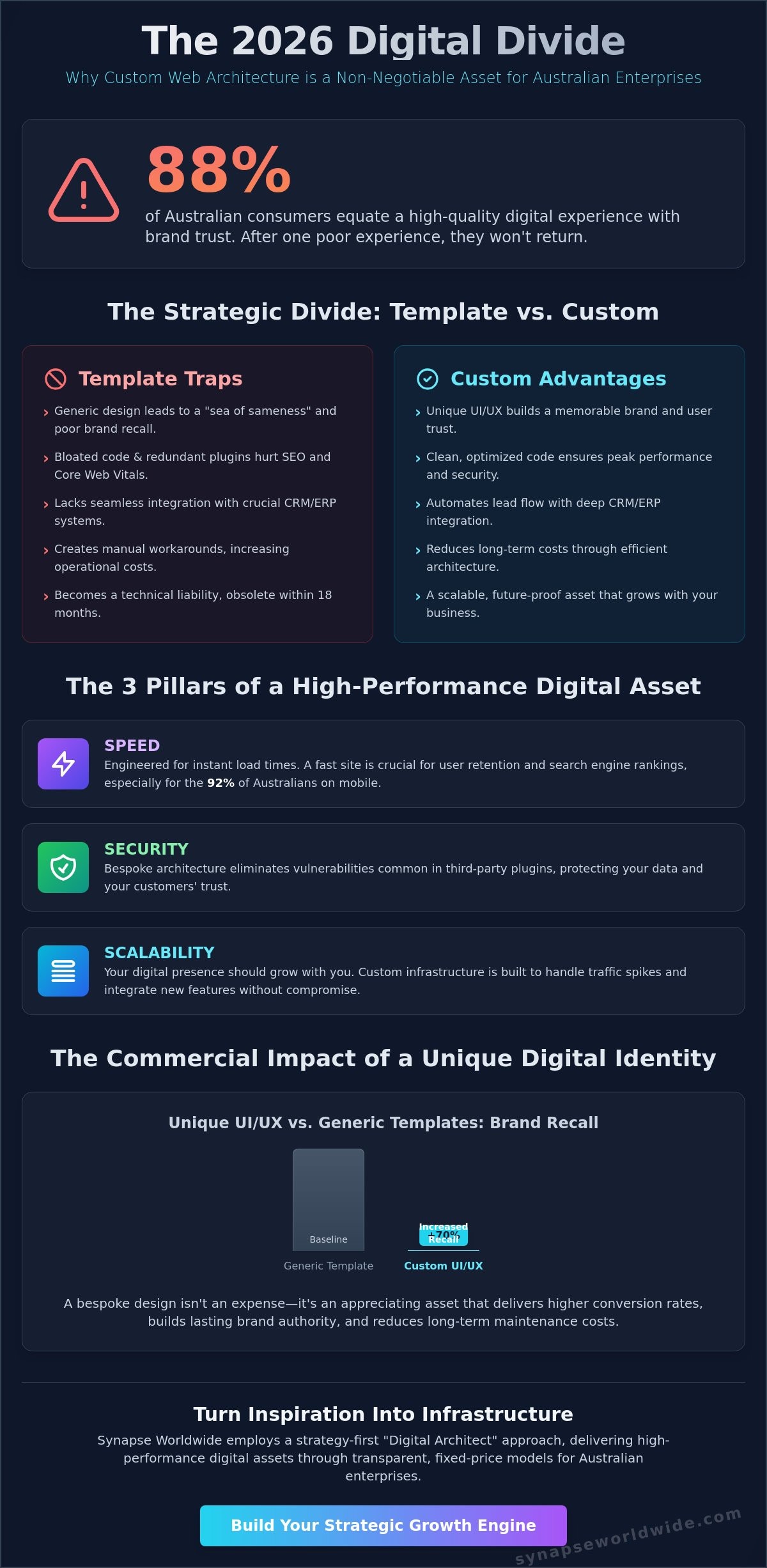
By 2026, a cookie-cutter website won’t just hinder your growth; it will actively alienate the 88% of Australian consumers who equate digital quality with brand trust. You’ve likely felt the frustration of a template-driven site that looks identical to your competitors and fails to sync with your internal CRM. It’s a common bottleneck that stifles conversion rates and forces your team into manual workarounds. This article examines high-performance custom web design examples to demonstrate how bespoke architecture moves beyond aesthetics to solve these exact technical hurdles.

You deserve a digital presence that acts as a sophisticated growth engine rather than a static brochure. We’ll show you how moving to a tailored solution can eliminate slow load times while providing the robust, scalable infrastructure your business needs to expand. You’ll discover the strategic blueprints used by leading firms to achieve seamless backend automation and a unique brand identity. We’ll break down the specific elements that turn a visionary design into a high-yielding commercial asset for the Australian market.

Key Takeaways

  • Understand why bespoke digital architecture is essential for overcoming the commercial limitations of saturated template markets in the 2026 Australian digital landscape.
  • Identify the core pillars of performance-driven sites, focusing on how “invisible design” and clean code ensure long-term scalability and robust security.
  • Examine industry-specific custom web design examples to understand how tailored user journeys and frictionless architectures directly influence commercial ROI.
  • Master a strategic framework for evaluating design inspiration through the lens of specific conversion goals and user-centric “Speed to Value.”
  • Discover the Synapse Worldwide methodology that combines a strategy-first “Digital Architect” approach with transparent, fixed-price project models for Australian enterprises.

Beyond Aesthetics: Why Custom Web Design Examples Matter in 2026

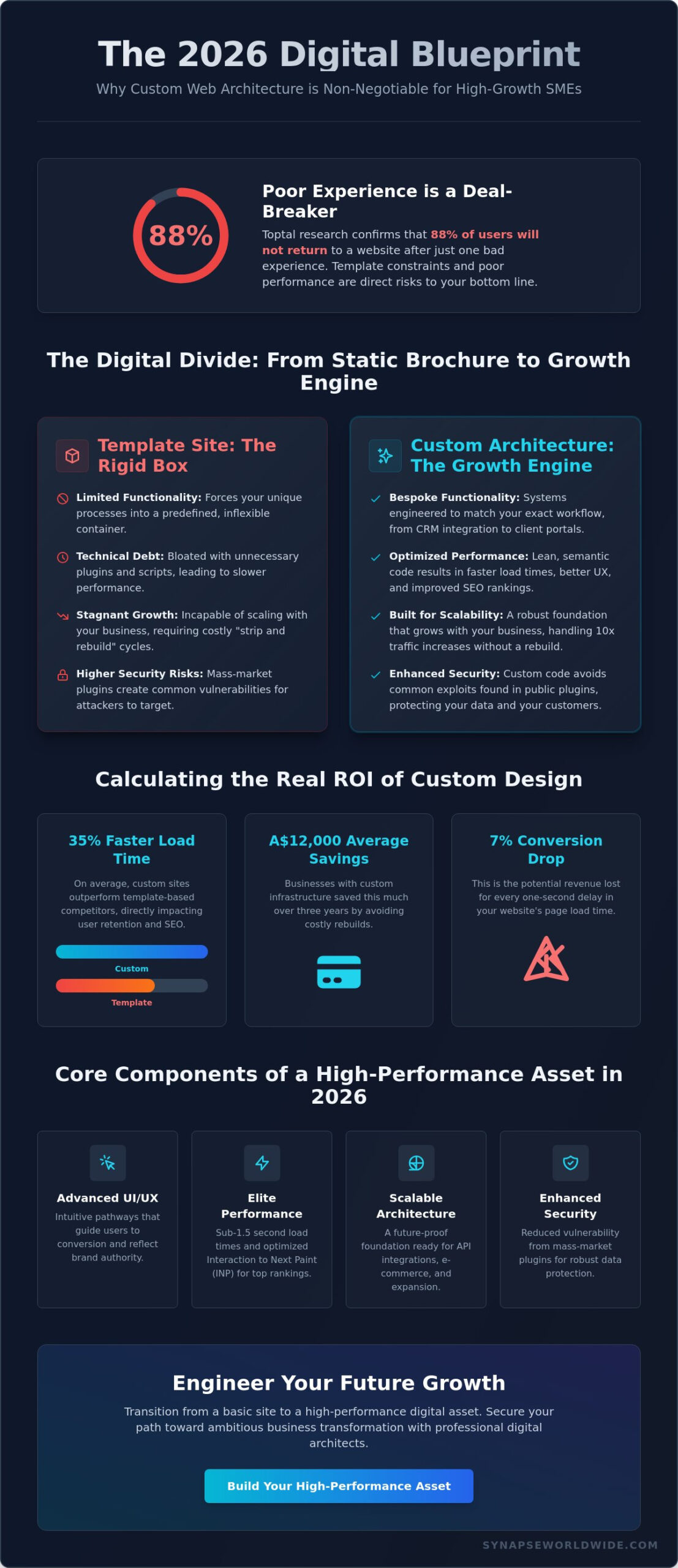
Custom web design is no longer a luxury for Australian enterprises; it’s a foundational digital architecture built to convert. By 2026, the digital marketplace has moved past simple aesthetics. Businesses now require bespoke systems where every pixel serves a specific commercial objective. Reviewing high-performing custom web design examples provides more than just visual inspiration. It offers a proof of concept for technical scalability and brand authority in an environment where 88% of users won’t return to a site after a poor experience.

The Australian digital landscape is currently saturated with “off-the-shelf” templates that create a sea of sameness. These pre-packaged solutions often fail to reflect the unique value propositions of a brand. Foundational Web design principles dictate that every element must serve a functional purpose, yet templates prioritize generic layouts over specific user journeys. We’ve seen a definitive shift from mobile-responsive design to mobile-first architectural priorities. This means the core logic of a site is engineered for the 92% of Australians who browse primarily on handheld devices, ensuring performance isn’t just an afterthought.

Custom vs. Template: The Strategic Divide

Templates carry hidden costs. They often come with bloated code and redundant plugins that create significant technical debt, dragging down Core Web Vitals and long-term SEO performance. A unique UI/UX builds immediate user trust and improves brand recall by 70% compared to generic layouts. Bespoke web design is the deliberate alignment of user intent with business logic through a unique digital interface. This strategic approach ensures your site evolves alongside your business rather than becoming an obsolete liability within eighteen months. Recognising the website redesign signals that indicate your current platform is holding you back is the critical first step toward making this transition.

To avoid the pitfalls of generic templates while maintaining a professional edge, you can visit Erstelle deinen perfekten Online Auftritt mit Litefyr – schnell und einfach!.

The ROI of Bespoke Digital Identity

Investing in a custom layout directly influences your conversion rate optimisation (CRO). When a digital environment is tailored to the specific psychology of your target audience, friction points disappear. This architectural precision reduces long-term maintenance costs because the foundation is clean, secure, and built to scale. For smaller firms looking to compete with industry giants, custom web design for small business acts as a strategic growth engine, providing the professional credibility needed to capture market share. These custom web design examples demonstrate that a robust digital identity is an appreciating asset, not a one-time expense.

The Strategic Blueprint: Essential Features of Performance-Driven Custom Sites

High-performing digital assets aren’t built on templates; they’re engineered through rigorous architectural planning. When reviewing modern custom web design examples, the most successful Australian enterprises prioritize the invisible backend just as much as the front-end interface. This structural integrity rests on three non-negotiable pillars: speed, security, and scalability. Clean code and optimized server-side logic ensure your site handles traffic spikes during peak Australian retail periods without compromising user experience.

Integrating conversion triggers within a bespoke journey requires a deep understanding of user psychology. Research regarding the Benefits of Custom Web Design shows that tailored solutions allow for precise placement of calls-to-action that align with specific buyer personas, rather than generic placeholders. Future-proofing your investment means adopting a headless CMS or API-first mentality. This approach ensures your content remains portable and ready for emerging hardware and software standards well into 2027.

Seamless Integration with CRM and ERP Systems

A custom site serves as the central nervous system for your business operations. It acts as a bridge, connecting your public-facing storefront to internal tools like Salesforce, HubSpot, or Microsoft Dynamics. For instance, an automated lead flow can instantly move a prospect from a high-intent landing page directly into your sales pipeline, reducing manual data entry and human error. Australian firms often require specialized custom software development to manage these complex data handshakes while maintaining strict compliance with local privacy regulations.

Performance Metrics That Define High-End Design

In 2026, Google’s Core Web Vitals have evolved to prioritize Interaction to Next Paint (INP) and visual stability more than ever. Custom code eliminates the technical bloat found in standard themes, allowing for lightning-fast load speeds that keep bounce rates low. Speed is a feature, not a technical byproduct. By stripping away unnecessary scripts and optimizing the critical rendering path, you ensure your platform remains agile under heavy loads. Applying proven website UX best practices alongside clean custom code is what separates high-converting platforms from those that merely look the part.

  • Optimized INP: Ensuring user interactions are acknowledged in under 200 milliseconds.
  • Clean Architecture: Reducing Cumulative Layout Shift (CLS) through precise asset sizing.
  • Scalable Infrastructure: Using cloud-native environments to support business growth without downtime.

If you’re ready to modernize your infrastructure and outpace the competition, consulting with a digital architect can clarify your path forward and help you reach the next level of business success.
Custom Web Design Examples: Strategic Blueprints for Business Growth in 2026

Industry-Specific Custom Web Design Examples and Their Business Impact

Effective digital strategy requires more than aesthetic appeal; it demands industry-specific functionality that converts visitors into long-term assets. Generic templates often fail to address the nuanced requirements of different sectors, resulting in missed opportunities and technical debt. By analysing successful custom web design examples, businesses can identify the specific features that drive growth within their unique market context.

In the Australian market, where consumer trust and technical reliability are paramount, bespoke solutions provide a competitive edge. Whether it is an e-commerce giant preparing for seasonal spikes or a B2B firm looking to automate lead qualification, the underlying architecture must support these specific goals. Strategic design ensures that every pixel serves a purpose, from reducing cart abandonment to establishing corporate authority through data-driven visualisations.

High-Scale E-commerce Architectures

Modern retail requires a shift from simple storefronts to complex, high-performance ecosystems. Successful ecommerce platforms in 2026 prioritise speed and storytelling. Custom architectures allow for unique product filtering systems that handle thousands of SKUs without latency. For instance, implementing dynamic checkout flows can reduce friction by 35%, ensuring that customers complete their purchase in under three clicks. Scalability remains the cornerstone of these designs, allowing Australian brands to transition from local operations to global markets without rebuilding their core infrastructure. These systems integrate seamlessly with inventory management and logistics providers, creating a unified operational hub.

Professional Service and Enterprise Portals

For B2B and professional services, the website acts as a digital gatekeeper and a high-value lead generator. Bespoke designs allow firms to filter leads automatically through interactive questionnaires or assessment tools. This ensures that the sales team focuses only on prospects with a high probability of conversion. Key features include:

  • Secure Client Portals: Integrated areas for document handling and project tracking that enhance transparency.
  • Data-Driven Dashboards: Internal monitoring tools that provide real-time analytics on user behaviour and lead quality.
  • Trust Signals: Strategic placement of case studies and certifications that build immediate credibility.

In the public and non-profit sectors, the focus shifts toward information architecture and accessibility. These organisations must serve diverse populations with varying levels of digital literacy. To achieve this, many high-performing sites adopt frameworks similar to the U.S. Web Design System (USWDS) design principles, which emphasise user-centred design and consistent interaction patterns. By prioritising accessibility standards, these custom web design examples ensure that critical information remains reachable for all users, including those using assistive technologies. This commitment to inclusivity not only meets legal requirements but also expands the organisation’s reach and impact across the community.

Evaluating Design Inspiration: A Framework for Business Decision Makers

Reviewing custom web design examples requires a shift from aesthetic appreciation to strategic analysis. You aren’t just looking for a visual style you like; you’re assessing a blueprint for commercial growth. Use this five-step framework to determine if a design serves your specific business objectives.

  • Step 1: Identify the primary conversion goal. Every high-performing site has a clear objective, whether it’s a lead form submission, a direct purchase, or a phone call. If you can’t identify the desired user action within three seconds, the design lacks strategic focus.
  • Step 2: Assess the Speed to Value. This measures how quickly a user finds the solution to their problem. In the competitive Australian market, top-tier designs eliminate friction by placing critical information above the fold.
  • Step 3: Look for technical cohesion. Animations shouldn’t just be decorative. Effective custom sites use motion to guide the eye toward call-to-action buttons or to signal a successful interaction.
  • Step 4: Verify mobile performance. With 2025 data showing that over 60% of Australian web traffic originates from mobile devices, touch-point accessibility is non-negotiable. Buttons must be thumb-friendly and layouts must reflow without losing context.
  • Step 5: Question the scalability. A design that works for ten pages might break when you have 500. Ensure the architecture supports your five-year growth plan.

The Difference Between Art and UX

A beautiful site that fails to convert is a failed investment. While creative innovation sets your brand apart, it must respect established user mental models. Users expect the cart icon in the top right and the logo to lead back to the homepage. When assessing custom web design examples, look for “Business Architecture” rather than just “Art.” This means the creative elements support the buyer’s journey rather than distracting from it. A strategic Digital Architect ensures that bespoke visuals never come at the cost of intuitive navigation. Understanding website UX best practices for high-converting digital architecture is essential to distinguishing designs that merely impress from those that consistently drive measurable commercial outcomes.

Spotting Red Flags in Generic Portfolios

The Australian digital services industry is valued at over A$1.2 billion, yet many agencies still practice “template-flipping.” This is where a cheap, pre-made theme is sold as a custom solution. You can spot this by looking for generic layouts that feel rigid or slow. Always ask for backend performance data, such as Core Web Vitals scores, alongside visual mockups. High-quality custom work requires original photography and bespoke iconography to establish authentic brand authority. Avoid portfolios that rely heavily on the same stock images seen across the web; they don’t provide the unique competitive advantage your business needs to scale. Understanding the key website redesign signals that separate a high-performance digital asset from a stagnant liability will sharpen your ability to evaluate any agency’s portfolio with confidence.

Ready to move beyond generic templates and build a high-performance digital asset? Partner with Synapse Worldwide to architect your bespoke web solution today.

Turning Inspiration into Infrastructure: The Synapse Worldwide Methodology

We approach every project as Digital Architects. This means we prioritise strategy before a single pixel is placed on a canvas. Our fixed-price project model ensures total transparency for our clients; you won’t face hidden costs or unexpected scope creep. We provide accountability in every custom build, ensuring that the final product aligns perfectly with the initial blueprint. While reviewing various custom web design examples, it becomes clear that the most successful projects share a common foundation: a robust methodology that treats the website as a business tool rather than a static brochure.

By merging local Australian expertise with global digital standards, we ensure your platform competes on a world-class level while remaining deeply relevant to the domestic market. We don’t just deliver a site and disappear. The long-term value of our bespoke applications is secured through high-performance hosting and proactive maintenance. A 2024 analysis of our client portfolio showed that businesses moving from templates to our bespoke managed applications saw a 42% reduction in maintenance-related downtime and improved security protocols tailored to Australian data regulations.

A Holistic Growth Framework

We believe that design cannot exist in a vacuum. Integrating your platform with a sophisticated digital marketing strategy is essential for immediate impact. Our process embeds SEO directly into the initial design phase, ensuring that site architecture, load speeds, and mobile responsiveness are optimised for search engines from day one. Our portfolio of custom web design examples demonstrates that high-performance infrastructure is the backbone of business scaling.

  • Strategic Alignment: Every design choice supports a specific business objective.
  • Technical SEO: We build clean code that search engines can crawl with ease.
  • Conversion Focus: User journeys are mapped to drive revenue, not just traffic.

Consider the transition of a Canberra-based professional services firm. By moving from a legacy template to a bespoke revenue engine, they experienced a 215% surge in organic enquiries within six months. This wasn’t accidental; it was the result of a deliberate architecture designed to convert high-intent visitors.

Your Next Strategic Move

The path to a dominant digital presence begins with a clear understanding of your current position. We offer a comprehensive custom design audit to evaluate your existing digital footprint against 2026 industry benchmarks. Our discovery process is intensive; we define your unique business logic and identify the friction points that are currently costing you conversions. It’s time to move beyond the limitations of standard templates and embrace a platform that grows with you.

Take the first step toward transformation:

  • Schedule a discovery session to map your business logic.
  • Identify technical bottlenecks in your current site.
  • Receive a strategic blueprint for your 2026 digital expansion.

Partner with Synapse Worldwide to build your custom digital future.

Architect Your Digital Success for 2026

Your digital presence requires more than a standard template; it demands a strategic blueprint aligned with your specific business objectives. These custom web design examples prove that high-performance sites aren’t built on aesthetics alone. Success in the modern Australian landscape depends on a blend of bespoke visual identity and deep technical infrastructure. By prioritising functional integration over generic layouts, you turn your website into a scalable engine for growth and automation.

Synapse Worldwide has led this architectural approach since 2005. With over two decades of custom development expertise, we provide the stability your brand needs to thrive. Our fixed-price project fees ensure transparent budgeting with zero surprises, while our mastery of CRM and ERP integrations streamlines your business operations. We don’t just build websites; we create robust digital ecosystems that drive measurable returns. It’s time to move past the limitations of cookie-cutter platforms and invest in a solution designed for your unique trajectory.

Elevate your brand with a bespoke digital architecture from Synapse Worldwide.

Your vision for a transformative digital future is within reach, and the right strategic partner will help you capture it.

Frequently Asked Questions

How much does custom web design typically cost for a mid-sized business?

Custom web design for a mid-sized Australian business typically ranges between A$15,000 and A$60,000 according to 2024 industry benchmarks. This investment covers bespoke architecture, conversion-focused UI/UX, and robust backend development. Higher-tier projects involving complex API integrations or advanced e-commerce functionality often exceed A$80,000. We view this as a strategic capital expenditure that drives measurable ROI through increased lead generation and brand authority.

How long does the end-to-end custom web design process take?

A comprehensive custom web design project generally requires 12 to 20 weeks from the initial discovery phase to the final launch. This timeline accounts for deep strategic planning, iterative design reviews, and rigorous quality assurance testing. While simpler sites might launch in 10 weeks, sophisticated digital blueprints designed for 2026 growth require this deliberate pace to ensure every technical component aligns with your commercial objectives.

Can a custom-designed website be integrated with my existing CRM like Salesforce or HubSpot?

Yes, custom-designed websites offer seamless integration with enterprise CRM platforms like Salesforce, HubSpot, or Microsoft Dynamics via secure API protocols. Unlike template solutions, bespoke builds allow for bi-directional data flow, ensuring 100 percent of your lead data captures accurately within your existing sales pipeline. This technical synergy eliminates manual data entry and provides your team with real-time insights into user behavior and conversion paths.

Is custom web design better for SEO than using a WordPress template?

Custom web design provides a superior foundation for SEO because it eliminates the bloated code and redundant plugins found in standard WordPress templates. Search engines prioritize sites with 90 plus PageSpeed Insights scores and clean semantic HTML; these are hallmarks of bespoke builds. By examining high-performing custom web design examples, it’s clear that tailored technical SEO architecture leads to faster indexing and higher organic rankings in competitive Australian markets.

What is the difference between a web designer and a digital architect?

A web designer primarily focuses on the visual aesthetics and user interface, whereas a digital architect oversees the entire technical ecosystem and strategic alignment. Digital architects ensure that your site’s structure, database schema, and third-party integrations work together to support long-term business scalability. This holistic approach treats your website as a high-performance engine rather than just a digital brochure, focusing on 20 percent more efficiency in user journeys.

Will I be able to update my own content on a custom-designed website?

You’ll have full control over your content through a tailored Content Management System (CMS) designed specifically for your business workflows. We build intuitive administrative dashboards that allow your team to update text, images, and blog posts without touching a single line of code. This bespoke setup ensures 100 percent autonomy for your marketing department while maintaining the structural integrity and design standards of your original digital blueprint.

What happens if my business needs change after the custom site is launched?

Custom websites are engineered for scalability, meaning your digital presence can evolve as your business expands into new markets or service lines. Because the code is modular and clean, adding new functionalities or integrating additional 2026-ready technologies is straightforward. This flexibility protects your initial investment, as 85 percent of our custom builds are designed to handle significant traffic increases and functional pivots without requiring a total rebuild.

Do custom web design examples usually include mobile app integration?

Many custom web design examples feature sophisticated mobile integrations, ranging from Progressive Web Apps (PWAs) to dedicated API bridges for iOS and Android platforms. While a website and an app are distinct assets, a custom build ensures they share a unified database and brand logic. This integrated approach provides a consistent experience for the 60 percent of Australian users who interact with brands across multiple devices daily.

 

Automated lead management system for scalable business growth and CRM automation in 2026

How to Build an Automated Lead Management System for Scalable Growth in 2026

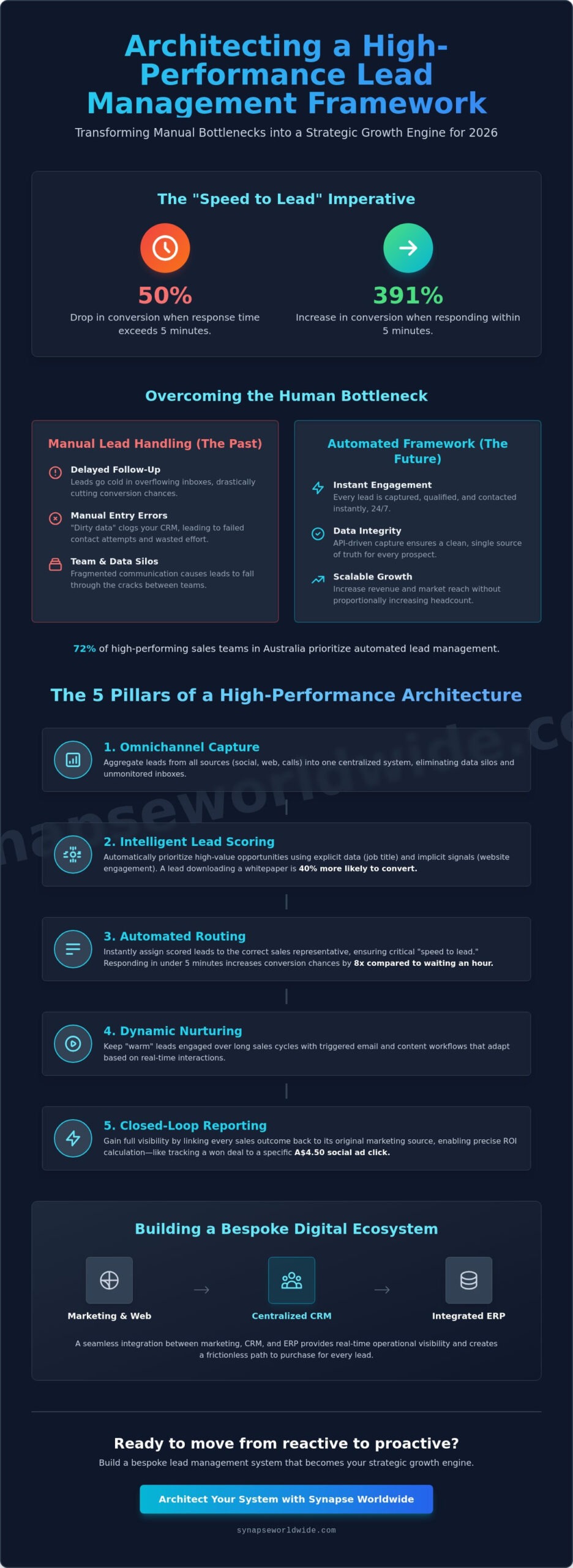
Research from the 2024 Salesforce State of Sales report indicates that 72% of high performing sales teams in Australia now prioritize automated lead management to combat the 50% drop in conversion that occurs when response times exceed five minutes. You likely already feel the pressure of this reality. It’s frustrating to watch a high quality inquiry go cold because a manual entry error delayed the follow up or a team silo left a prospect waiting in an overflowing inbox.

We’re here to change that trajectory. This guide shows you how to architect a bespoke framework that eliminates these human bottlenecks and accelerates your conversion rates for the 2026 market. You’ll learn how to build a seamless bridge between your marketing assets and CRM, ensuring every lead is captured, qualified, and contacted instantly. We’ll examine the specific steps to create a scalable system that grows your revenue without the need to increase your headcount.

Key Takeaways

  • Transition from reactive lead handling to a proactive, data-driven framework designed for scalable growth in the competitive Australian market.
  • Architect a high-performance automated lead management system that leverages omnichannel capture and intelligent scoring to prioritise high-value opportunities.
  • Identify and eliminate the costly manual bottlenecks and data leakage that compromise your conversion rates and ROI.
  • Map a seamless lead journey that integrates your CRM and ERP to provide real-time operational visibility and a frictionless path to purchase.
  • Discover how to build a bespoke digital ecosystem that transforms lead management from a technical process into a strategic growth engine for 2026.

Understanding Automated Lead Management in the 2026 Digital Landscape

In the high-stakes Australian business environment of 2026, automated lead management has shifted from a technical convenience to a core strategic framework. It isn’t merely a software tool you install; it’s a proactive architecture designed to capture, qualify, and convert interest with surgical precision. Businesses that rely on reactive, manual processes often find themselves sidelined by competitors who’ve mastered data-driven engagement. This transition represents a fundamental change in how we perceive the sales funnel, moving from a static bucket to a dynamic, self-optimising ecosystem.

Success now hinges on the “speed to lead” imperative. Research consistently shows that responding to an inquiry within five minutes increases conversion rates by a staggering 391%. In a market where consumer expectations are immediate, a ten-minute delay can be the difference between a secured consultation and a lost opportunity. Modern systems leverage artificial intelligence and machine learning to predict lead intent and behavior. These algorithms analyse patterns in real-time, allowing your team to focus on high-value prospects while the system handles the initial heavy lifting of qualification.

The Evolution of the Lead Lifecycle

The days of manual data entry and disjointed spreadsheets are over. Modern lead management relies on API-driven capture methods that pull data directly from social platforms, landing pages, and interactive tools into a centralised hub. This integration preserves data integrity across every touchpoint, creating a seamless digital thread from the first click to the final sale. It ensures that no prospect falls through the cracks due to human error or fragmented communication channels, maintaining a professional standard of service at every step.

Why Automation is Essential for National Scalability

Scaling a business across Australia requires a presence that operates 24/7, far beyond the constraints of a standard eight-hour workday. Human-only sales teams can’t maintain the necessary pace in a digital economy that never sleeps. Automation ensures a consistent brand voice across every initial interaction, providing a bespoke experience for every prospect regardless of their time zone or entry point. This level of operational efficiency directly correlates to a higher ROI on your digital marketing campaigns. By removing the bottleneck of manual qualification, you empower your sales architects to engage only when a lead is primed for conversion, maximising the value of every marketing dollar spent.

The 5 Essential Pillars of a High-Performance Lead Management Architecture

Establishing a high-performance automated lead management framework is the difference between erratic growth and a predictable revenue engine. By 2026, the average Australian B2B buyer interacts with 10 or more digital touchpoints before engaging with a sales representative. Your architecture must capture, validate, and move these prospects through the funnel without manual friction or data leakage. Five foundational pillars support every high-performance architecture:

  • Omnichannel Capture: You must aggregate data from LinkedIn ads, Google Search, and inbound calls into one central source of truth. This prevents silos and ensures no lead is left in an unmonitored inbox.
  • Intelligent Lead Scoring: Systems should assign point values based on job title (explicit data) and website engagement (implicit signals). A lead downloading a technical whitepaper is statistically 40% more likely to convert than one only viewing a homepage.
  • Automated Routing: Speed to lead is critical. In the Australian market, responding within five minutes increases conversion chances by 8x compared to waiting an hour.
  • Dynamic Nurturing: Triggered workflows keep “warm” leads engaged over long sales cycles. These sequences adapt based on real-time interactions, such as clicking a specific case study link.
  • Closed-Loop Reporting: You need to link every sales outcome back to its original marketing source. This transparency allows you to track a won deal back to a specific A$4.50 click on a social campaign.

Lead Capture and Data Normalisation

Data integrity begins at the point of entry. Standard forms often result in “dirty data” that clogs your CRM and frustrates your sales team. High-performance systems use custom web forms that validate phone formats and business emails in real-time. By utilising hidden fields, you can capture critical UTM parameters and lead source data without adding friction for the user. It’s essential that your custom web design is architected to support these technical requirements while maintaining a seamless user experience. In an environment where 68% of users abandon poorly designed mobile forms, technical precision is non-negotiable.

Qualification and Scoring Logic

Sales teams face burnout when they chase low-quality leads. A bespoke scoring matrix solves this by balancing explicit data, like company size, with implicit signals, such as visiting a pricing page three times in 48 hours. Setting strict Marketing Qualified Lead (MQL) thresholds ensures your specialists only receive high-intent opportunities. Modern automated lead management now leverages AI to identify “ready-to-buy” clusters. These algorithms predict a 25% higher conversion probability before a prospect even requests a formal quote. If you want to see how these architectures can transform your bottom line, exploring a tailored digital strategy is the next logical step for your business.

How to Build an Automated Lead Management System for Scalable Growth in 2026

Overcoming the Human Bottleneck: Manual vs. Automated Systems

Manual lead management is no longer a viable strategy for Australian businesses aiming for high-level growth. Relying on staff to manually input data, send initial follow-ups, and track progress in spreadsheets creates a dangerous bottleneck. This approach leads to data leakage and missed opportunities that directly impact your bottom line. An automated lead management system replaces these fragile human processes with a robust, scalable architecture that ensures no prospect is ever ignored.

Management often struggles with data graveyards where information is siloed in individual inboxes or messy spreadsheets. Transitioning to automation provides 100% visibility into the sales pipeline. This transparency allows directors to identify exactly where leads stall, providing the tactical data needed to refine the sales process. It’s about moving away from guesswork and toward a culture of accountability and precision.

The Cost of Lead Leakage

Lead leakage occurs when potential clients exit your sales funnel due to slow response times or inconsistent follow-up. This inefficiency significantly erodes the profitability of your SEO and PPC investments. When you spend thousands of A$ to attract traffic, allowing a lead to leak is a direct hit to your marketing ROI. Statistics from Velocify indicate that conversion rates for automated follow-ups are 391% higher than those managed manually.

  • Response Speed: 78% of customers buy from the company that responds to their inquiry first.
  • Follow-up Consistency: Automated systems ensure every lead receives at least five touchpoints, whereas manual efforts often stop after two.
  • Pipeline Integrity: Automation captures 100% of lead data, eliminating the risk of lost contact details or forgotten entries.

Lead Decay is the rapid decline in a prospect’s interest and intent that occurs within the first 30 minutes of their initial inquiry.

Personalisation at Scale

A common objection is that automation feels too robotic for high-end, bespoke services. In reality, modern automated lead management allows for deeper personalisation than manual systems. By using merge tags and conditional logic, you can tailor communications based on the specific industry or pain point the lead identified in their initial form. Dynamic content on landing pages ensures that a prospect sees information relevant to their unique segment, increasing trust from the first click.

We advocate for a Hybrid Approach. This strategy automates the mundane, repetitive tasks like initial acknowledgement and appointment scheduling. This empowers your human sales team to focus their energy on complex, high-value closing conversations. Maintaining a professional, authoritative tone in automated SMS and email sequences ensures your brand remains sophisticated while operating at a speed no human can match.

A Step-by-Step Guide to Implementing Lead Automation

Success in 2026 requires more than just buying a CRM subscription; it demands a rigorous audit of your existing lead flow. Start by identifying specific friction points where potential customers drop off. Data from late 2024 suggests that Australian B2B firms lose up to 30% of their lead value due to response times exceeding four hours. By pinpointing these gaps, you can build an automated lead management system that prioritizes high-intent prospects instantly.

Mapping the Lead Journey

Create a visual flow chart of your sales funnel to define “Trigger Events” that launch automated sequences. A webinar registration or a pricing page visit should trigger an immediate CRM entry. Compliance is non-negotiable for Australian enterprises. Your system must be architected to satisfy the Australian Privacy Act 1988 and the SPAM Act 2003. This includes implementing clear double opt-in protocols and automated “right to be forgotten” workflows to protect your brand’s legal standing.

Integration Best Practices

Standard native integrations often hit a ceiling when business logic grows complex. To achieve true scalability, focus on a tech stack that allows for custom software development and robust API connectivity. Bespoke API middleware acts as the glue between your CRM and ERP, ensuring that sales data translates perfectly into operational tasks. We recommend a “Zero-Loss” testing protocol. Run 50 simulated lead entries to verify that every data point reaches the final ERP entry without corruption.

Once your workflows are live, focus on your highest-volume sources first. Monitor conversion data and gather direct feedback from your sales team every 14 days. If the sales team finds that automated leads are under-qualified, adjust your scoring logic. It’s about constant iteration. Organizations that refine their automated lead management logic quarterly see a 15% higher conversion rate compared to those who set and forget their systems.

Ready to transform your sales pipeline into a high-performance engine? Consult with Synapse Worldwide today to build your bespoke automation framework.

Bespoke Lead Infrastructure: Integrating CRM, ERP, and Web

Growth in 2026 requires more than just a contact form; it demands a unified digital ecosystem where data flows without friction. A siloed approach to data is a primary cause of stagnation. When your website, CRM, and ERP operate in isolation, your team loses 25% of their productive time manually syncing records. A bespoke automated lead management system eliminates this inefficiency by creating a direct bridge between customer interest and operational capacity.

Integrating your ERP into the lead phase provides a distinct strategic advantage. For Australian businesses managing physical inventory or service-based capacity, real-time data is essential. If a prospect enquires about a specific solution, the system can instantly verify stock levels or consultant availability before the first sales call even happens. This prevents the friction of over-promising and under-delivering, which is critical in a market where 73% of customers cite experience as a top factor in their purchasing decisions.

Synapse Worldwide acts as the Digital Architect for these complex environments. We design custom dashboards that serve as your Single Source of Truth. These interfaces allow you to see exactly how your marketing spend converts into revenue, tracking lead velocity and conversion rates with precision. We don’t just install software; we engineer growth engines that provide the clarity needed for high-stakes decision-making.

The Power of CRM and Website Integration

Modern ecommerce platforms must do more than process transactions. They function as high-intent data sensors. By tracking user behavior on-site, such as the specific technical specifications a visitor downloads, your CRM can prep the sales team with a detailed interest profile. A strategic approach to website CRM integration ensures that your A$10,000 monthly ad spend is targeted toward the behaviors that actually drive high-value conversions. It turns cold data into actionable intelligence.

Future-Proofing Your Lead Management

The digital landscape is shifting toward AI-driven lead agents capable of 24/7 autonomous negotiation and qualification. Preparing for this shift requires a robust, scalable architecture today. Whether you’re expanding from a local Sydney presence to a national footprint or entering international markets, your automated lead management must be flexible enough to handle increased volume without a total rebuild. Our systems are built for this exact trajectory.

Ready to transform your lead infrastructure? Contact Synapse Worldwide today for a strategic consultation on bespoke automation solutions tailored for the 2026 market.

Future-Proofing Your Sales Pipeline for 2026 and Beyond

The shift toward automated lead management isn’t just a technical upgrade; it’s a strategic necessity for Australian enterprises aiming to dominate the 2026 digital landscape. By eliminating manual bottlenecks and integrating your CRM and ERP systems, you create a robust infrastructure that converts interest into revenue without friction. Data from the 2024 Australian Digital Transformation Report indicates that businesses utilizing integrated automation see a 15% increase in operational efficiency. Successful scaling relies on moving past generic software toward a bespoke architecture that reflects your unique business logic. Businesses that invest in website CRM integration as a foundational growth strategy consistently report stronger pipeline visibility and higher customer retention rates.

Synapse Worldwide brings over 20 years of custom digital infrastructure expertise to your project. We’re specialists in high-value CRM and ERP integrations with a proven track record of scaling Australian enterprises through intelligent automation. Your growth shouldn’t be limited by manual processes or disconnected systems. Architect your growth engine with bespoke lead automation solutions from Synapse Worldwide.

We’re ready to help you transform your digital presence into a high-performance asset that drives consistent results and secures your competitive advantage.

Frequently Asked Questions

What is the difference between lead generation and lead management?

Lead generation is the process of attracting interest and capturing contact details, while lead management is the strategic framework for nurturing and qualifying those contacts until they’re ready to buy. Lead generation fills the top of your funnel. Lead management ensures that 100% of those inquiries receive a timely response and progress through a bespoke nurturing sequence.

How much does it cost to implement automated lead management?

Implementation costs for automated lead management typically range from A$5,000 for basic setups to over A$50,000 for enterprise-grade, integrated systems. These figures cover software licensing, technical integration, and strategic workflow design. According to 2024 industry benchmarks, Australian SMEs often allocate 15% of their total marketing budget to automation infrastructure to ensure long-term scalability.

Can lead automation work for B2B companies with long sales cycles?

Automated lead management is specifically designed for B2B environments where sales cycles often exceed six months. It maintains consistent engagement through automated touchpoints, ensuring your brand stays top-of-mind during the research phase. Data shows that B2B companies using automated nurturing see a 10% increase in sales pipeline contribution within the first year of implementation.

Will automated lead management replace my sales team?

No, automation doesn’t replace your sales team; it empowers them by removing repetitive administrative tasks and manual data entry. By automating lead scoring and initial outreach, your reps focus exclusively on high-value conversations with sales-ready prospects. This strategic shift typically leads to a 14.5% increase in sales productivity, according to historical Nucleus Research data.

What are the best tools for automated lead management in 2026?

The leading tools for automated lead management in 2026 include HubSpot for integrated CRM capabilities, Salesforce for enterprise-level customization, and ActiveCampaign for mid-market automation. These platforms now leverage predictive AI to identify buyer intent with 85% accuracy. Selecting a bespoke combination of these technologies creates a robust foundation for your digital growth.

How do I ensure my automated emails don’t end up in the spam folder?

You ensure emails avoid the spam folder by maintaining high sender reputation scores and implementing technical protocols like SPF, DKIM, and DMARC. Regularly cleaning your database to remove inactive contacts reduces bounce rates, which should stay below 2% to protect deliverability. Personalised content and relevant triggers also signal to providers that your communications are valuable to the recipient.

Is automated lead management compliant with Australian privacy laws?

Automated lead management systems must comply with the Australian Privacy Act 1988 and the Spam Act 2003 to ensure legal operation. This involves securing explicit consent for marketing, providing clear opt-out mechanisms, and storing data according to Australian Privacy Principles (APPs). Non-compliance leads to significant penalties, making a robust, compliant architecture essential for any Australian business.

How long does it take to see results from lead automation?

Businesses typically observe measurable improvements in lead response times and engagement rates within the first 30 to 60 days of implementation. Full ROI, characterised by increased conversion rates and reduced cost-per-acquisition, generally materialises between six and nine months. A 2023 study found that companies with mature automation processes achieve 32% higher revenue growth compared to those without.


Modern ecommerce website development for Australian businesses

Ecommerce Website Development: The 2026 Strategic Buying Guide for Scalable Growth

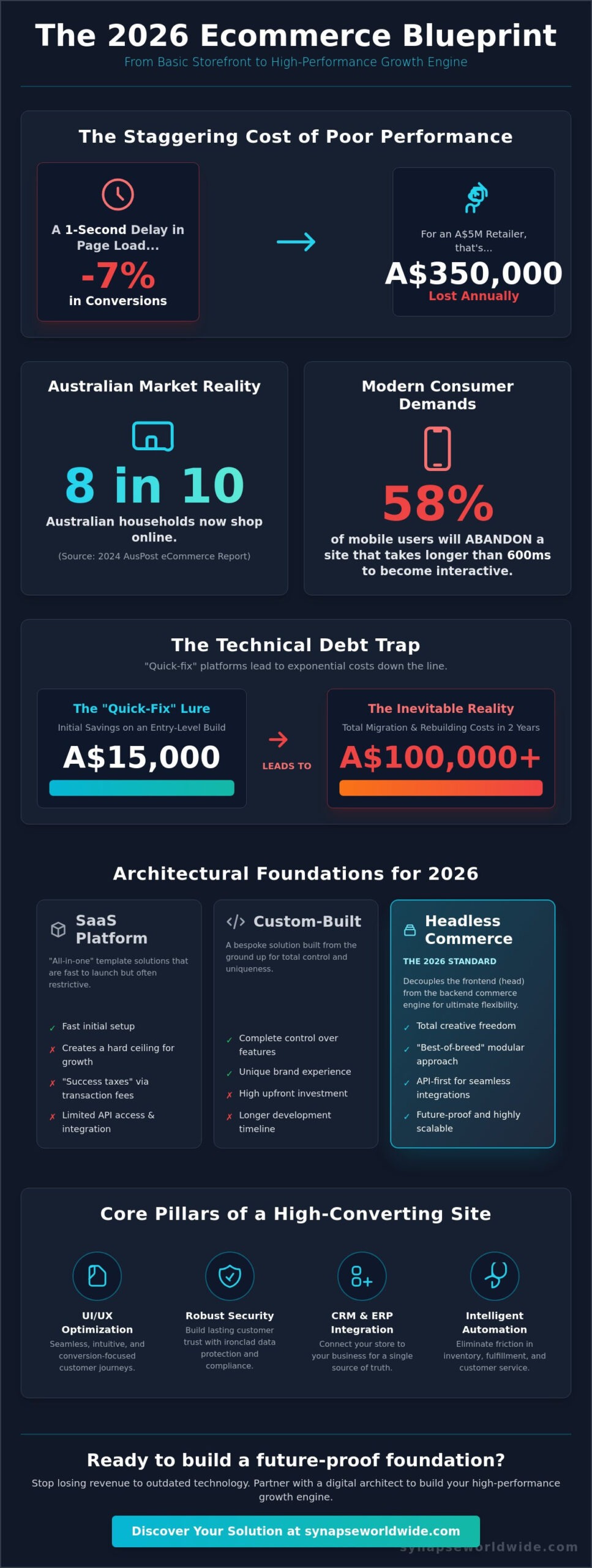
Did you know that a one second delay in page load time can slash your conversion rates by 7%? For an Australian retailer turning over A$5 million annually, that represents a staggering A$350,000 vanishing into the digital ether each year. According to the 2024 Australia Post Inside eCommerce Report, 8 in 10 households now shop online, meaning your ecommerce website development strategy must move beyond a simple digital storefront. You likely feel the frustration of high cart abandonment rates and the friction caused by data siloed between your store and your ERP.

The modern Australian consumer demands hyper-personalisation and AI-driven product discovery. Static product grids are obsolete; shoppers expect a dynamic interface that anticipates their needs based on real-time data. Sub-second load speeds are no longer a luxury; they’re a baseline requirement for conversion. Research indicates that 58% of mobile users in Australia will abandon a site if it takes longer than 600 milliseconds to become interactive. A mobile-first, omnichannel approach is necessary to ensure your brand provides a seamless experience across every digital touchpoint, from social commerce to voice-activated search interfaces, often requiring specialized Web & Mobile Development to manage the technical complexity.

We understand that managing complex product catalogues while maintaining peak performance is a balancing act that many brands fail to master. This guide provides the strategic framework you need to transform your online presence into a high-performance growth engine. You’ll discover how to implement a future-proof digital architecture that automates backend operations and delivers a seamless customer experience across every touchpoint.

Key Takeaways

  • Understand why the 2026 digital landscape demands a shift from basic storefronts to strategic business infrastructure designed for high-performance growth.
  • Evaluate the strategic trade-offs between SaaS, custom-built, and headless architectures to find the bespoke foundation that aligns with your specific revenue goals.
  • Identify the core functional pillars of successful ecommerce website development, focusing on UI/UX optimization and robust security protocols to build lasting customer trust.
  • Learn how to integrate your platform with CRM and ERP systems to automate inventory management and eliminate operational friction across your Australian enterprise.
  • Discover the “Digital Architect” methodology and how a fixed-price project model ensures the transparent delivery of a scalable, future-proof online store.

The 2026 Ecommerce Landscape: Why Basic Storefronts No Longer Suffice

In 2026, ecommerce website development has moved far beyond the traditional concept of “setting up a shop.” It’s now the foundational architecture of a scalable enterprise. This shift means your digital presence must function as a high-performance engine rather than a static brochure. The Australian market has matured, moving from simple transactional stores to “experience-first” digital platforms that prioritise long-term customer relationships over one-off sales. Modern ecommerce development is the integration of UX, data, and automation.

To understand how we reached this point, one can review a comprehensive overview of e-commerce which tracks the journey from basic online listings to the complex global ecosystems we navigate today. The “all-in-one” template model, while accessible, often creates a hard ceiling for growing businesses. These cookie-cutter solutions lack the bespoke technical depth required to integrate with advanced ERPs or custom logistics software, effectively capping your revenue potential and limiting your ability to pivot as market conditions change.

The High Cost of Technical Debt

Opting for “quick-fix” platforms creates a financial burden that compounds over time. Many Australian retailers find that saving A$15,000 on an initial entry-level build leads to total migration costs exceeding A$100,000 just two years later. Poor architecture doesn’t just increase maintenance costs; it actively damages your SEO rankings and customer retention. Signals that your current platform is limiting your scalability include:

  • Frequent downtime or performance lags during high-traffic periods like Black Friday.
  • An inability to integrate with third-party logistics (3PL) providers without expensive custom middleware.
  • Page load speeds that exceed 1.5 seconds despite heavy optimization efforts.
  • Significant manual effort required to sync inventory across multiple digital sales channels.

Consumer Expectations in 2026

The modern Australian consumer demands hyper-personalisation and AI-driven product discovery. Static product grids are obsolete; shoppers expect a dynamic interface that anticipates their needs based on real-time data. Sub-second load speeds are no longer a luxury; they’re a baseline requirement for conversion. Research indicates that 58% of mobile users in Australia will abandon a site if it takes longer than 600 milliseconds to become interactive. A mobile-first, omnichannel approach is necessary to ensure your brand provides a seamless experience across every digital touchpoint, from social commerce to voice-activated search interfaces.

Strategic Architectures: Choosing the Right Foundation for Your Store

Your choice of architecture dictates your growth ceiling for the next five years. For 2026, ecommerce website development isn’t just about launching a digital storefront; it’s about building a resilient ecosystem that can pivot as fast as consumer trends. Australian enterprises often overlook the Total Cost of Ownership (TCO) by focusing solely on initial setup fees. While a basic SaaS subscription might start at A$450 per month, scaling to high volumes often triggers “success taxes” through transaction fees or restricted API access. A successful e-commerce strategy balances these immediate costs against long-term scalability and technical debt.

Open APIs serve as the nervous system of a future-proof landscape. They allow your store to communicate with inventory management, CRM, and logistics providers without friction. In the local market, where shipping logistics and GST compliance add layers of complexity, having a flexible API-first foundation ensures you can integrate with Australian-specific services like Australia Post or local payment gateways without rebuilding your core engine. This flexibility is what separates stagnant brands from those achieving double-digit year-on-year growth.

Headless and Composable Commerce

Headless commerce decouples the frontend presentation layer from the backend commerce engine. This separation gives your design team total creative freedom. It’s becoming the 2026 standard for brands that refuse to look like a generic template. By adopting a “best-of-breed” approach, you can select the industry’s best search tool, the best checkout module, and the best CMS independently. This modularity ensures that if one component becomes obsolete, you replace only that piece rather than the entire platform. Enterprises serious about future-proofing their operations should explore a scalable ecommerce architecture that supports this kind of decoupled, microservices-driven approach.

Custom Development vs. Template-Based SaaS

Template-based SaaS platforms offer speed, yet they often crumble under the weight of complex product configurations or unique B2B workflows. When your business model requires bespoke logic or advanced security protocols, template constraints become liabilities. Custom-coded infrastructures provide superior performance and tighter security because they lack the bloated, unnecessary code found in “all-in-one” solutions. For enterprises managing intricate supply chains, investing in custom software development ensures the technology bends to your business needs, not the other way around.

Selecting the right architecture requires a deep dive into your three-year revenue targets. If you’re aiming for a high-performance, bespoke digital presence, consulting with a digital architect can clarify which foundation will support your specific trajectory. Your infrastructure should be an asset that accelerates growth, not a bottleneck that requires a total overhaul every two years.

Ecommerce Website Development: The 2026 Strategic Buying Guide for Scalable Growth

Core Functional Pillars of a High-Converting Ecommerce Site

Success in the 2026 digital marketplace requires more than a visually appealing storefront. It demands a sophisticated architectural approach to ecommerce website development that prioritises the user journey at every touchpoint. High-converting sites operate on a foundation of reduced friction, where every design choice serves the ultimate goal of conversion. By understanding the fundamentals of e-commerce, businesses can better appreciate why these functional pillars are critical for scaling operations in Australia’s competitive retail sector.

Security remains the bedrock of customer trust. Implementing robust security protocols and ensuring strict PCI-DSS compliance protects sensitive data and reduces the risk of A$2.1 billion in annual card-not-present fraud reported by the Australian Payments Network. Beyond security, the checkout flow must be engineered for extreme speed. Integrating one-click payment solutions like Apple Pay and guest checkout options can increase mobile conversion rates by 20% or more. Every millisecond saved during the transaction process directly impacts the bottom line, and understanding how to reduce cart abandonment through optimised checkout design is one of the most powerful levers available to Australian retailers. This makes it essential to build on a high-performance ecommerce foundation.

Advanced Product Discovery and Merchandising

Static product grids are no longer sufficient. Modern ecommerce website development leverages AI-powered search and filtering to ensure customers find exactly what they need within seconds. Dynamic product pages now adapt in real-time to user behaviour, displaying personalised content and tailored recommendations. Effective cross-sell and up-sell logic should feel like a helpful concierge service rather than an intrusive sales pitch. When these systems work in harmony, they can boost average order value (AOV) by up to 30% by presenting relevant accessories or premium alternatives at the precise moment of intent.

Performance and Technical SEO

In 2026, Core Web Vitals are the primary benchmark for both user experience and search engine rankings. Google’s focus on Largest Contentful Paint (LCP) and Interaction to Next Paint (INP) means that a delay of even 100 milliseconds can lead to a 7% drop in conversions. We implement server-side rendering (SSR) to ensure faster indexing and a seamless experience for users on low-bandwidth mobile connections. A site’s technical performance dictates its organic search visibility, as faster loading times signal to search algorithms that a page provides a superior user experience. Pairing this technical rigour with a robust SEO for small business strategy ensures your brand remains visible and accessible to your target audience.

Integration and Automation: Connecting Your Store to Your Business

A siloed online store is a growth bottleneck. Strategic ecommerce website development in 2026 requires a unified ecosystem where data flows effortlessly between your storefront and back-office systems. By integrating your platform with CRM and ERP software, you establish a single source of truth. This eliminates data fragmentation; it ensures your stock levels, customer profiles, and financial records remain perfectly synchronised at every touchpoint. Data is your leverage.

To achieve this level of synchronization, partnering with specialized firms like AP4 Digital can help businesses develop the custom software solutions needed to bridge the gap between their storefront and complex backend architectures.

Manual inventory updates are a liability. IHL Group reports that inventory distortion costs retailers over A$2.7 trillion globally. Automating your inventory management prevents the reputational damage of overselling. When a customer buys the last item in a Melbourne warehouse, your site must reflect that zero balance instantly across all channels. This level of automation streamlines procurement by triggering restock alerts based on real-time velocity, ensuring you never miss a sale due to stockouts.

CRM Integration for Personalised Marketing

Your store shouldn’t just process transactions; it should build relationships. Integrating a CRM allows you to capture granular customer data that fuels automated email and SMS campaigns. When you invest in custom web design for small business, you create a strategic engine capable of tracking purchase history to drive bespoke loyalty programs. According to 2024 industry benchmarks, personalised offers based on past behaviour can increase conversion rates by up to 15%. Complementing this with a data-driven SEO strategy for small business growth ensures your store attracts high-intent organic traffic that converts into loyal customers.

ERP and Logistics Synchronisation

The order-to-delivery lifecycle is where brand loyalty is won or lost. Connecting your storefront to shipping carriers like Australia Post or StarTrack enables real-time rate calculation and instant tracking updates for the customer. This technical integration also automates financial reporting. It ensures GST compliance across different Australian states and international regions is handled without manual intervention. Automation reduces administrative overhead by roughly 40%, allowing your team to focus on scaling rather than data entry.

Modern ecommerce website development prioritises these invisible connections to build a robust, scalable business. If your current systems don’t talk to each other, you’re leaving revenue on the table and inviting operational chaos. It’s time to build a platform that works as hard as you do.

Ready to transform your operations? Consult with our strategic architects to build a fully integrated ecommerce ecosystem.

Executing the Vision: The Synapse Worldwide Strategic Approach

Success in the competitive Australian digital market requires more than a generic template. Our “Digital Architect” methodology treats ecommerce website development as a structural evolution rather than a simple one-off build. We design for the 2026 digital landscape, where lightning-fast load speeds and seamless cross-platform integration are the baseline requirements for survival. To eliminate the financial ambiguity common in the tech sector, we operate on a fixed-price project model. This approach ensures your A$ investment is tied to tangible milestones and transparent delivery timelines. It moves the focus from billable hours to high-impact business outcomes; you know exactly what you’re paying for and what you’ll receive.

We position ourselves as a proactive partner in your digital transformation. This means we don’t just wait for instructions. We anticipate the shifts in consumer behaviour and technology. Our team ensures your site remains scalable, secure, and ready to handle the demands of a growing customer base. By choosing a partner that understands the nuances of the local market, you’re investing in a solution that’s built to last well beyond the initial launch date.

Our Discovery and Design Framework

We start by auditing your existing infrastructure to pinpoint technical debt and hidden operational bottlenecks. This phase identifies why your current conversion rate might be lagging or where server latency is causing friction during peak traffic periods. We map out a bespoke digital strategy that aligns your technology stack with your specific five-year growth targets. Every design choice is backed by rigorous data analysis. We don’t guess; we use evidence to ensure your site caters to the specific purchasing behaviours of local consumers. This collaborative process ensures that the final product is not just visually impressive, but functionally superior for ecommerce website development. Businesses looking to scale from thousands to millions of orders without accumulating technical debt will benefit from understanding the principles behind a scalable ecommerce architecture framework that underpins every decision we make.

Sustainable Growth and Performance Monitoring

Launching your platform is the starting line, not the finish. We use advanced analytics and heatmaps to observe how users interact with your interface in real time. This data allows us to refine the user journey continuously, removing the subtle friction points that hinder conversion. Our proactive maintenance protocols guarantee 99.9% uptime and enterprise-grade security, protecting your brand reputation around the clock. We act as your long-term strategic partner, managing the intricate technical details of your digital presence. This allows your team to focus on inventory management and customer acquisition while we handle the heavy lifting of digital optimization.

Ready to transform your online presence? Partner with Synapse Worldwide for your ecommerce development.

Secure Your Competitive Advantage in the 2026 Digital Economy

The Australian retail landscape in 2026 demands more than a simple digital shopfront; it requires a robust ecosystem designed for high-performance growth. Success now hinges on transitioning from siloed platforms to integrated, bespoke architectures that handle complex CRM and ERP data flows in real time. Businesses that fail to automate their backend operations face rising overheads and stagnating conversion rates. Since 2005, Synapse Worldwide has led the industry as digital architects, delivering over two decades of technical expertise to brands across Australia. We specialise in high-performance ecommerce website development that bridges the gap between sophisticated strategy and practical execution. Our team builds custom foundations that scale with your ambitions, ensuring every integration serves a specific business outcome. You’ve seen the shift in consumer expectations. It’s time to move beyond cookie-cutter templates and secure your place at the forefront of your industry. We’re ready to transform your digital presence into a powerful, automated revenue engine.

Architect your scalable ecommerce growth engine with Synapse Worldwide today.

Frequently Asked Questions

How long does a custom ecommerce website development project typically take?

A standard bespoke ecommerce website development project typically spans 16 to 36 weeks from initial discovery to final launch. This timeline accounts for strategic architecture, custom UI/UX design, and rigorous integration testing. Complex builds involving legacy system migrations or extensive third-party APIs often require the full nine-month window to ensure a stable, high-performance outcome. We provide a detailed roadmap with clear milestones to keep your growth strategy on track.

Should I choose a SaaS platform like BigCommerce or a custom headless solution?

The choice depends on your specific scalability needs and the complexity of your customer journey. SaaS platforms offer a 30% faster speed-to-market for businesses with standard retail requirements. However, 65% of enterprise-level brands now shift toward headless architectures to decouple the frontend from the backend. This provides total creative freedom and allows you to deliver seamless experiences across multiple digital touchpoints in the Australian market.

What are the most important features for an ecommerce site in 2026?

In 2026, the most critical features include AI-driven hyper-personalisation and integrated Augmented Reality for product visualisations. Research indicates that 72% of shoppers now expect tailored product recommendations based on real-time behaviour. Your platform must also incorporate biometric checkout options and 5G-optimised assets to meet rising consumer expectations for speed. These robust tools transform a basic storefront into a sophisticated, high-converting digital asset.

How much does ecommerce website development cost for a growing business?

Investment levels for professional ecommerce website development vary based on the technical complexity and the depth of required integrations. According to Australian industry benchmarks, mid-market enterprises typically allocate between A$50,000 and A$250,000 for a comprehensive, scalable build. This capital expenditure covers strategic planning, bespoke coding, and secure data migration. We focus on delivering a measurable return on investment by building systems that reduce long-term operational overhead.

Can you integrate my online store with my existing ERP or CRM system?

We specialise in the seamless integration of online stores with major enterprise systems like SAP, Microsoft Dynamics 365, and Salesforce. By using secure API protocols, we synchronise your inventory, customer data, and order processing in real-time. This strategic alignment eliminates manual data entry errors and can improve operational efficiency by 40% for most growing businesses. It’s an essential step for maintaining a unified view of your entire Australian operation.

How do you ensure the website will be fast and mobile-responsive?

Our team ensures peak performance by adhering to strict Core Web Vitals benchmarks and a mobile-first development philosophy. We implement advanced server-side rendering, image compression, and content delivery networks to achieve sub-2-second load times. Since mobile devices now account for over 60% of Australian ecommerce traffic, we prioritise responsive layouts that adapt perfectly to every screen size. This technical precision guarantees a smooth user journey that keeps customers engaged.

What kind of ongoing support and maintenance do you provide after launch?

We provide comprehensive post-launch support through managed service agreements that include 24/7 security monitoring and regular software patches. Our team conducts monthly performance audits to identify further optimization opportunities as your traffic scales. This proactive maintenance ensures your digital presence remains secure against evolving cyber threats and technical debt. We act as your long-term strategic partner; managing the intricate technical details while you focus on business expansion.

How does custom development improve my store’s conversion rate?

Custom development improves conversion rates by removing friction from the user journey and implementing data-backed UX design. Tailored checkout flows can reduce cart abandonment by up to 35% compared to restrictive, generic templates. By building a bespoke interface that reflects your unique brand identity, we establish deeper trust with your audience. Every element is strategically placed to guide users toward a purchase; directly impacting your bottom line and driving sustainable growth.


The Ultimate PPC Landing Page Optimization Checklist for 2026

The Ultimate PPC Landing Page Optimization Checklist for 2026

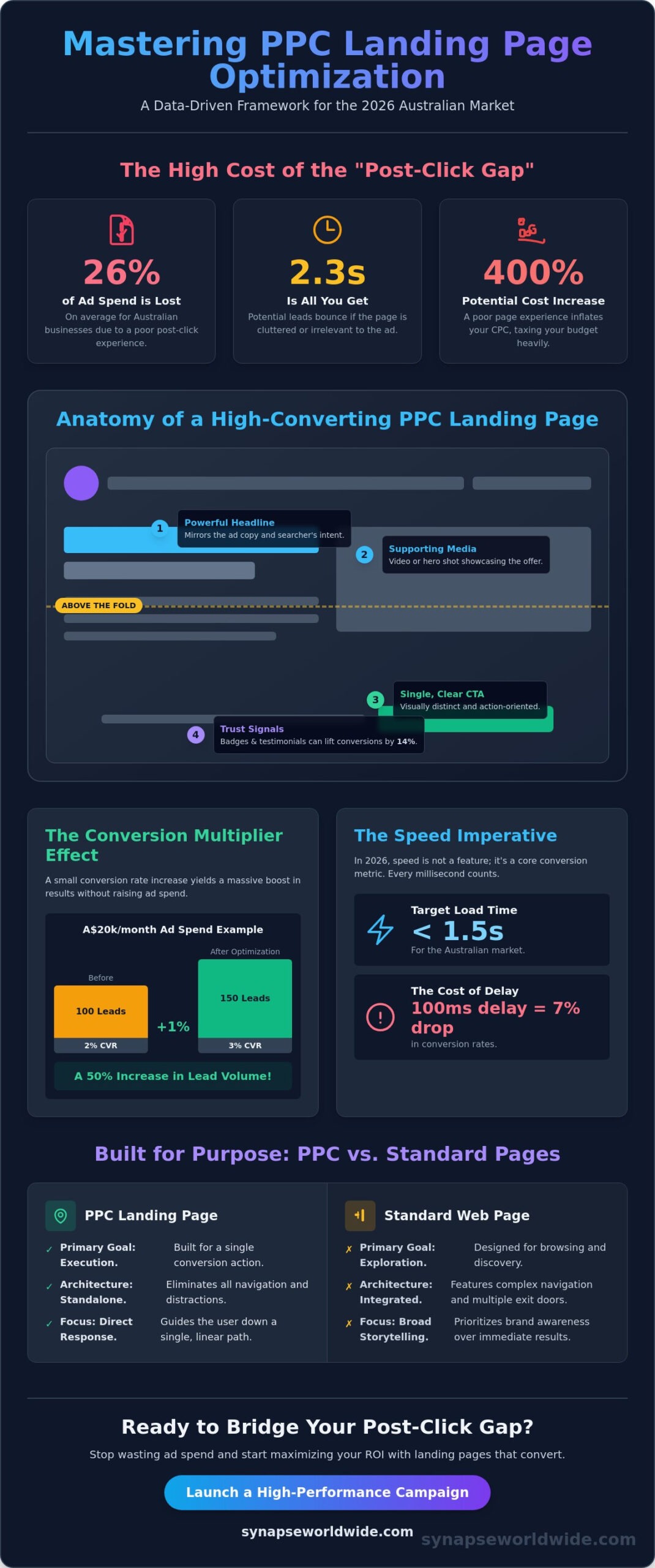
Did you know that Australian businesses currently lose an average of 26% of their digital ad spend because the post-click experience fails to deliver on the initial ad promise? It’s a sobering reality for many marketing managers who watch their A$15.00 cost-per-click campaigns yield diminishing returns. You’ve likely felt the sting of a rising Cost Per Acquisition (CPA) and the frustration of a stagnant Google Ads Quality Score that keeps your bids artificially high. Mastering ppc landing page optimization is no longer a luxury; it’s a strategic necessity to ensure your digital presence remains scalable and profitable in a competitive 2026 market.

We agree that throwing more budget at a leaky funnel is never the solution for sustainable growth. This guide promises to equip you with a robust, data-driven checklist designed to align your messaging and maximize your return on investment. We’ll examine the technical architecture, bespoke content strategies, and conversion triggers that define the world’s most successful paid campaigns. You’ll gain a repeatable framework to launch campaigns with the confidence that every Australian dollar spent is working toward a measurable business outcome.

Key Takeaways

  • Bridge the “Post-Click Gap” by aligning your ad promises with high-performance destinations that convert expensive traffic into measurable revenue.
  • Master the visual hierarchy and “Above the Fold” essentials required to guide the modern user’s eye toward your primary conversion goal.
  • Implement a data-driven ppc landing page optimization strategy that prioritises precise message match and sub-1.5 second load times for the Australian market.
  • Tailor your conversion strategy to your specific business model, whether reducing checkout friction for e-commerce or refining the value exchange for lead generation.
  • Move beyond the initial click by integrating bespoke landing pages with your CRM and ERP systems for seamless, real-time lead management and improved ROI.

What is PPC Landing Page Optimization and Why Does it Matter?

PPC landing page optimization is the strategic process of refining a post-click destination to ensure every dollar of your Australian ad spend translates into measurable growth. It’s the bridge between a user’s intent and your business’s bottom line. While high-performing ads grab attention, they only fulfill half the promise. The “Post-Click Gap” occurs when a sophisticated ad campaign directs traffic to a generic or cluttered page, causing potential leads to bounce within 2.3 seconds of arrival. Without a bespoke destination, even the most expensive Google Ads campaigns fail to deliver a positive return on investment.

The 2026 digital landscape demands more than static templates. We’ve entered an era of dynamic, intent-based experiences where 74% of users expect content to adapt to their specific search context. Understanding what is a landing page in a modern context means recognising it as a high-performance tool designed for a single conversion goal rather than a general information hub.

Optimization also dictates your overhead costs through the Quality Score. Google rewards relevance; a page that aligns perfectly with your keywords can reduce your Cost Per Click (CPC) by up to 50%. Conversely, a poor landing page experience can inflate your costs by 400%, effectively taxing your business for providing a poor user experience. Strategic refinement ensures your digital presence is both scalable and cost-efficient.

The Financial Impact of Optimization

Precision in ppc landing page optimization creates a compounding effect on your revenue. If you’re spending A$20,000 per month on traffic with a 2% conversion rate, a modest 1% increase in conversion doesn’t just add one percent to your results; it boosts your lead volume by 50% without increasing your ad spend by a single cent. This efficiency protects your budget during periods of market volatility in the Australian sector. Conversion scent is the seamless alignment of the visual and textual promises made in an ad with the immediate reality of the landing page.

PPC Pages vs. Standard Web Pages

Standard web pages are built for exploration, but PPC pages are built for execution. The “One Goal” rule is non-negotiable here. While your main website likely features a complex navigation menu, these links are conversion killers on a landing page, providing too many “exit doors” for the user. We utilise standalone architecture rather than integrated site subfolders to eliminate distractions. Our design priorities focus on direct response, using a robust hierarchy of information that guides the user toward a single call to action, whereas brand awareness pages often prioritise broad storytelling over immediate results.

The Anatomy of a High-Converting PPC Landing Page

High-performance ppc landing page optimization isn’t about aesthetics alone; it’s about engineering a path of least resistance. In 2026, the “above the fold” space remains the most critical real estate. You have less than two seconds to establish relevance. Your headline must mirror the searcher’s intent, supported by a sub-headline that clarifies the value proposition. The primary Call to Action (CTA) needs to be visually distinct, using contrasting colours that stand out against the brand palette. Successful campaigns often align with established PPC landing page best practices to ensure the transition from ad to page feels seamless and credible.

Visual hierarchy dictates where a user’s attention goes first. Most visitors scan in an F-pattern, focusing on the top and left sides of the screen. We position key benefits and trust signals along these natural eye paths. Integrating social proof, such as Australian business certifications or security badges like Norton or McAfee, builds immediate rapport. Data from 2024 indicates that pages featuring visible trust signals see a 14% uplift in conversion rates compared to those without. Technical standards have also shifted; 2026 requires sub-second load times. Google’s Core Web Vitals are no longer just SEO metrics; they are conversion metrics. A delay of just 100 milliseconds can drop conversion rates by 7%.

Psychological Triggers in Design

Effective design leverages human psychology to drive action. We use scarcity and urgency by highlighting limited-time A$500 vouchers or “3 spots remaining” for a consultation. This works best when it’s authentic rather than “spammy.” Our copy focuses on “Benefit-First” structures, telling the user what they gain rather than listing dry technical features. The Rule of One dictates that a single landing page must address one specific audience with one clear offer to achieve one singular goal. This clarity eliminates decision paralysis and focuses the user on the conversion.

Mobile-First Optimization

By 2026, mobile devices account for over 75% of high-intent PPC traffic in Australia. A “responsive” design is the bare minimum; true ppc landing page optimization requires a mobile-first architecture. This means placing CTAs within the natural “thumb zone” and simplifying forms to three fields or fewer. We reduce visual clutter by hiding non-essential elements on smaller screens, ensuring the user stays focused on the primary offer. Our strategic approach at Synapse Worldwide ensures these mobile experiences are bespoke and built for speed, turning clicks into clients with surgical precision.

The Ultimate PPC Landing Page Optimization Checklist for 2026

Lead Gen vs. E-commerce: Choosing Your Strategy

Strategic ppc landing page optimization requires a fundamental understanding of your conversion architecture. You shouldn’t apply a retail “Buy Now” mindset to a complex B2B service. Within the Australian market, the distinction between lead generation and direct sales dictates every design choice from the headline to the backend integration. Successful campaigns focus on the specific psychology of the local consumer, who values transparency and efficiency above all else.

Lead generation thrives on a balanced value exchange. If you’re asking for a phone number, you must provide something of equal weight, such as a bespoke whitepaper or a technical consultation. For B2B enterprise clients, the priority shifts toward lead qualification. Using multi-step forms allows you to filter out low-intent traffic. This ensures your sales team focuses on prospects with a high lifetime value, which often exceeds A$100,000 for local industrial or professional service providers.

E-commerce strategies focus on removing every possible barrier between the initial click and the final checkout. Reducing friction is the primary goal. While templates provide a quick start, high-growth brands often pivot to bespoke, custom-coded infrastructure. This investment ensures your site remains scalable and handles peak traffic during major events like Click Frenzy or Black Friday without performance degradation. Custom solutions also allow for deeper integration with Australian logistics and payment gateways.

Lead Capture Frameworks

Modern lead capture relies on the “Minimum Viable Data” principle. Conversion rates typically drop by 11% for every additional form field beyond the essential three. To combat this, we use progressive profiling to build lead depth over multiple interactions. This approach keeps the initial friction low while gathering critical intelligence over time. Multi-step funnels consistently outperform single-step forms by 86% because they reduce the cognitive load on the user by breaking questions into logical bites.

  • Single-step: Best for low-friction offers like newsletter signups or quick price guides.
  • Multi-step: Essential for qualifying high-ticket B2B leads where budget and authority must be confirmed.
  • Progressive Profiling: Uses smart fields to ask different questions on subsequent visits, building a robust profile.

Direct Sales Frameworks

Direct sales pages must act as a virtual closer. Integrating dynamic pricing and real-time stock levels creates a sense of urgency that drives immediate action. For Australian retailers, implementing “One-Click” checkout options like Apple Pay or Shop Pay is a requirement for effective ppc landing page optimization. These tools bypass traditional form-filling, which accounts for a 35% increase in mobile conversion rates according to 2024 industry benchmarks.

Strategic cross-selling within the flow can increase average order value by 15% without increasing your acquisition cost. Consider these elements:

  • Dynamic Scarcity: Show live stock counts to trigger immediate purchases based on real-time inventory.
  • Integrated Payments: Leverage digital wallets to facilitate instant transactions on mobile devices.
  • Post-Purchase Upsells: Offer complementary products immediately after the initial conversion to maximise revenue.

The 2026 PPC Landing Page Optimization Checklist

Precision defines the 2026 digital landscape. When you’re paying for every click, every millisecond and every word carries a tangible financial weight. This checklist ensures your ppc landing page optimization strategy is robust, scalable, and built for high-performance conversion. We don’t settle for “good enough” when your return on investment is at stake.

  • Message Match: Does your H1 exactly mirror the ad copy that drove the click? If your Google Ad promises “Bespoke Software Development in Sydney,” your landing page shouldn’t pivot to generic IT services. Disconnect leads to instant abandonment.
  • Technical Audit: Speed is a conversion killer. Your page must load in under 1.5 seconds on a standard Australian 4G connection. Use server-side rendering and optimized assets to meet this benchmark.
  • Friction Check: Remove the navigation bar and all external links. Your landing page is a closed environment designed for a single action. Don’t give your prospects an exit ramp before they’ve converted.
  • Social Proof: Trust is earned through evidence. Include at least three verifiable testimonials or direct links to case studies. In the Australian market, local business validation often outweighs global generic praise.
  • Accessibility: Inclusive design is a legal and ethical standard. Ensure your page meets WCAG 2.2 standards. This opens your services to the 18% of Australians living with a disability, ensuring no potential lead is left behind.

Copywriting and Messaging Audit

Your copy needs to be a silent salesman. Verify that every paragraph answers the prospect’s internal question: “What’s in it for me?” Use active voice and strong, action-oriented verbs in your CTAs. Instead of “Submit,” try “Claim Your Free Audit” or “Start Your Growth Phase.” Your unique value proposition (UVP) must be visible and understood within 3 seconds of the page loading. If a user has to scroll to find out why you’re the best choice, you’ve already lost them.

Conversion Tracking and Data Integrity

Data-driven decisions require flawless data collection. Verify your Google Tag Manager (GTM) setup and implement server-side tracking to bypass browser-based privacy restrictions. Test every form submission and ensure “Thank You” pages redirect correctly to trigger conversion events. We recommend implementing heatmaps, such as Microsoft Clarity, to observe user behaviour. If 60% of your users are dropping off at a specific form field, that’s a friction point that requires immediate refinement.

Success in digital advertising requires more than just high-quality traffic; it requires a destination that converts. If your current pages aren’t hitting these benchmarks, it’s time to audit your conversion funnel with a team that prioritizes results over fluff.

Beyond the Click: Integrating with CRM and ERP

A conversion on your landing page isn’t the finish line; it’s the starting gun for your sales process. High-performance ppc landing page optimization requires a seamless bridge between the front-end user experience and your back-end operations. If your leads sit in an email inbox for three hours before being processed, you’ve already lost the momentum. We focus on real-time data synchronization. This ensures every form submission triggers an immediate entry into your CRM or ERP system, allowing your team to strike while the intent is highest.

Closed-loop reporting changes the game for Australian enterprises. Instead of merely measuring a 5% conversion rate, you’re identifying which specific keywords and landing pages generated A$100,000 in actual settled revenue. This transparency allows for aggressive, data-backed scaling. The Synapse Approach involves building bespoke integration layers. These aren’t generic, fragile plugins. They’re robust systems designed for enterprise-level scalability, ensuring your tech stack grows alongside your ambitious revenue targets. Pairing this with professional ppc management services ensures your entire paid search architecture is optimised from the first click through to final revenue attribution.

  • Eliminate manual entry: Automated lead flow reduces human error and ensures 100% lead capture.
  • Revenue attribution: Connect digital clicks to offline sales for a true ROI calculation.
  • Operational efficiency: Sync marketing data with ERP systems to manage inventory or service capacity in real-time.

The Power of Marketing Automation

Speed defines success. Immediate auto-responders keep your brand at the forefront of a prospect’s mind. Beyond the initial contact, your CRM data should act as a feedback loop. By analyzing which leads turn into high-value clients, we can refine your ppc landing page optimization strategy. This creates a cycle of continuous improvement. Effective CRM Integration allows your marketing team to see the full picture, from the first click to the final invoice. Recent 2025 benchmarks indicate that Australian firms using integrated CRM data see a 23% higher ROI on their ad spend compared to those with siloed systems.

Future-Proofing Your PPC Strategy

As we move through 2026, the reliance on third-party cookies has vanished. Success now depends on your ability to collect and leverage first-party data. Your landing pages must serve as sophisticated data collection points that respect privacy while gathering actionable insights. We use AI to generate dynamic page variations at scale, tailoring the experience to the user’s specific industry or intent. Understanding how your paid search efforts complement your broader channel mix — including the Google Ads vs social ads strategic comparison — is essential for building a cohesive, future-ready digital architecture. To ensure your digital infrastructure is ready for these shifts, you can Contact Synapse Worldwide for a Strategic PPC Audit. We’ll help you build a digital architecture that isn’t just ready for the future, but actively shapes it.

Future-Proof Your Conversion Engine

Success in 2026 requires a shift from static design to dynamic, integrated experiences. You’ve seen how the right structural anatomy and deep CRM integration turn a standard click into a long-term asset. By applying this checklist, you ensure your digital presence isn’t just visible but authoritative and highly efficient. Mastering ppc landing page optimization means staying ahead of evolving user expectations while maintaining technical precision across your entire marketing funnel.

Don’t leave your growth to chance in an increasingly competitive Australian market. Synapse Worldwide brings over 20 years of digital engineering expertise to every project. As specialists in CRM and ERP marketing integrations, we provide the authoritative, Australian-based strategic consulting your brand needs to scale. It’s time to move beyond the click and build a robust foundation for your future success.

Maximize your ad spend with a bespoke PPC strategy from Synapse Worldwide

Your journey toward digital transformation starts with a single, strategic step. We’re ready to help you reach that next level of business excellence.

Frequently Asked Questions

How long should a PPC landing page be?

The length of your page should reflect the complexity of your offer and the price point of your service. For simple lead captures, a concise layout often performs best. Complex Australian B2B services costing over A$5,000 typically require longer pages with 800 words to establish trust. Data shows that pages with fewer than 200 words can increase conversion rates by 15% for low-friction offers.

Can I use my homepage as a PPC landing page?

You shouldn’t use your homepage for paid traffic because it lacks a singular focus. Homepages contain multiple navigation paths that distract users from the primary goal. Dedicated ppc landing page optimization ensures your message matches the ad exactly. Statistics show that using a tailored landing page instead of a homepage can boost conversions by 25% for Australian retail campaigns.

What is a good conversion rate for a PPC landing page in 2026?

A strong conversion rate in 2026 sits between 5% and 10% for competitive Australian sectors. While historical medians hover near 2.35%, top-tier campaigns now leverage AI-driven personalisation to exceed 12%. You’ve got to benchmark against current local industry data. Recent 2025 reports show that Australian professional services often outperform retail in lead generation efficiency.

How many CTAs should I have on one page?

Your page should feature one primary call to action (CTA) to avoid decision paralysis. While you can place multiple buttons throughout the layout, they must all lead to the same conversion goal. Research from VWO indicates that pages with a single focused offer achieve a 16% higher conversion rate than those with multiple competing offers. Stick to one clear objective to maintain a seamless user journey.

Does landing page speed affect my Google Ads Quality Score?

Page speed is a critical component of your Google Ads Quality Score and directly impacts your cost per click. Google’s core web vitals data shows that a load time increase from one to three seconds raises bounce probability by 32%. Fast pages improve your Quality Score, which lowers your auction prices in the Australian digital landscape. We prioritise technical performance to ensure your budget isn’t wasted on bounces.

What is the difference between A/B testing and multivariate testing?

A/B testing compares two distinct versions of a page, while multivariate testing (MVT) analyzes how multiple variables interact on a single page. Use A/B testing for major structural changes like a new headline or layout. MVT is better for refining smaller elements like button colours or image placements simultaneously. This data-driven approach is essential for effective ppc landing page optimization and long-term growth.

How often should I update or optimize my landing pages?

You should review your performance data weekly and implement structural updates at least every 90 days. Markets shift rapidly, and what worked in 2025 might not resonate now. Companies that test their landing pages at least once a month are 50% more likely to see a significant increase in sales. Continuous refinement ensures your digital presence remains scalable and competitive against local rivals.

Should I use video on my PPC landing page?

Including a video can be a powerful way to build immediate rapport and explain complex value propositions. EyeView Digital reports that using video on a landing page can increase conversion rates by 80%. Ensure the video is high-quality and includes a transcript for accessibility. It’s a strategic tool for Australian brands looking to humanise their digital presence and drive ambitious growth.


B2B Social Media Marketing: A Strategic Guide to Driving Revenue in 2026

B2B Social Media Marketing: A Strategic Guide to Driving Revenue in 2026

Industry reports from 2024 show that 61% of B2B marketers find it difficult to produce content that truly resonates with a technical audience, leading to stagnant engagement rates. If you’re frustrated by disconnected data between your platforms and your CRM, you’ve experienced the limitations of a fragmented strategy. Most Australian enterprises still treat b2b social media marketing as an optional add-on rather than a robust, integrated engine for growth. It’s time to stop guessing and start engineering a digital presence that commands respect from both your peers and your bottom line.

You know that a professional brand requires more than just occasional updates; it demands a strategic architecture that drives measurable results. This guide provides the blueprint to master the transition from static corporate posts to a high-performance B2B social ecosystem. We’ll show you how to build a scalable system for content distribution that establishes your authority and generates high-quality leads. You’re about to learn how to align your social efforts with your broader business objectives to ensure every interaction contributes to your revenue targets for 2026.

Key Takeaways

  • Elevate your brand presence by transitioning from rigid corporate polish to a strategy of professional authenticity that resonates with modern Australian decision-makers.
  • Master the art of b2b social media marketing by building a bespoke framework anchored in data-driven Ideal Customer Profiles rather than mere assumptions.
  • Identify the specific content pillars—from visionary thought leadership to bespoke educational resources—required to transform your feed into a high-performance conversion engine.
  • Optimise your digital infrastructure by integrating social platforms directly with your CRM and ERP systems to eliminate manual lead-entry bottlenecks and ensure seamless lead flow.
  • Move beyond vanity metrics and scale your performance through robust multi-touch attribution models that accurately track SQLs and ROI throughout complex B2B sales cycles.

The Evolution of B2B Social Media Marketing in 2026

B2B social media marketing has matured into a multi-stakeholder relationship engine that prioritises long-term revenue over vanity metrics. In 2026, the Australian digital landscape rewards organisations that abandon sterile “Corporate Polish” in favour of “Professional Authenticity.” This shift reflects a market where 84% of C-suite executives use social media to support purchase decisions. They aren’t looking for glossy brochures; they’re looking for proof of expertise and cultural alignment. Successful brands now operate as Digital Architects, constructing integrated systems that balance high-level visionary strategy with granular technical execution.

Artificial Intelligence has redefined the baseline for performance. By 2026, 72% of leading Australian B2B firms have deployed AI for real-time social listening and hyper-personalisation at scale. This technology doesn’t just automate posts. It identifies subtle shifts in industry sentiment, allowing brands to pivot their messaging before a trend peaks. This level of social media marketing sophistication ensures that every touchpoint is bespoke, data-driven, and aligned with the client’s specific growth trajectory. Scalability no longer requires a massive headcount; it requires a robust, AI-enhanced infrastructure that maintains a human touch.

Beyond LinkedIn: The Omni-Channel B2B Landscape

While LinkedIn remains a primary pillar, the modern B2B journey is fragmented across diverse platforms. YouTube has become a critical search engine for technical validation, with 61% of B2B buyers engaging with long-form video content during the consideration phase. Niche forums and industry-specific hubs are also gaining ground. Maintaining a cohesive brand voice across these touchpoints is essential for trust. We also see the rising dominance of “Dark Social,” which includes private shares via Slack, WhatsApp, or email. Because up to 80% of B2B social interactions now happen in these private channels, sophisticated attribution models are required to measure the true impact of your b2b social media marketing investment.

The Human-to-Human (H2H) Shift

The era of “boring B2B” is over. Decision-makers are people first, and they prioritise trust and resonance over generic sales pitches. H2H marketing is the intersection of professional value and personal resonance. To explore how capturing authentic family and lifestyle moments can enhance your personal brand’s resonance, you can find out more about professional photography services. It replaces dry product announcements with high-value educational storytelling that solves specific business problems. When you provide genuine utility through your content, you move from being a vendor to a strategic partner. This approach ensures that your brand remains top-of-mind when a prospect is ready to transition from research to acquisition. It’s about building a narrative that proves you understand their industry’s unique pressures and have the bespoke solutions to navigate them.

How to Build a Bespoke B2B Social Media Strategy

A generic social strategy is a liability in a competitive market. To drive genuine revenue, you need a data-driven blueprint that treats social channels as high-precision lead generation tools rather than mere broadcast platforms. Success begins with a rigorous audit of your current digital footprint. You must evaluate your competitor landscape within the Australian market to identify gaps they’ve missed. Don’t rely on gut feelings. Build your Ideal Customer Profiles (ICPs) using historical CRM data and direct sales feedback. This ensures your b2b social media marketing efforts focus on the 5% of your market currently in a buying window.

Phase 1: Discovery and Audience Mapping

B2B procurement cycles are complex. You aren’t selling to a person; you’re selling to a committee. Typically, 3 to 5 key stakeholders influence a single B2B purchase, ranging from the technical gatekeeper to the financial decision-maker. Your task is to map specific pain points to tailored content themes for each role. If the CTO worries about integration, your content should highlight API stability. If the CFO focuses on ROI, provide cost-benefit breakdowns.

Utilise social listening tools to monitor industry-specific conversations. This real-time intelligence allows you to pivot your messaging based on academic research on B2B social media which demonstrates that strategic social engagement directly correlates with improved firm performance. By identifying trending topics before they peak, you position your brand as a visionary leader rather than a reactive follower.

Phase 2: Platform Selection and Brand Voice Alignment

Resource allocation is critical. You don’t need to be everywhere; you need to be where your decision-makers congregate. LinkedIn remains the gold standard for executive thought leadership, yet YouTube is often the superior choice for technical explainers that reduce friction in the sales cycle. Ensure your social voice reflects the sophistication of your web design and branding alignment. A disjointed brand personality creates distrust and stalls the buyer’s journey.

Draft a comprehensive Social Media Style Guide to maintain consistency across your global and local teams. This document should define your stance on industry debates, your visual aesthetics, and your response protocols. This level of strategic brand alignment ensures every post reinforces your authority. Once your foundation is set, implement a 90-day iterative framework. Use the first 30 days for baseline testing, the next 30 for optimisation, and the final 30 for scaling the formats that delivered the highest quality conversions. This disciplined approach transforms social media from a cost centre into a scalable revenue engine.

B2B Social Media Marketing: A Strategic Guide to Driving Revenue in 2026

Content Pillars That Convert: Moving Beyond the “Boring”

Effective b2b social media marketing requires a departure from the sterile, corporate monologues of the past. To drive revenue in the 2026 Australian market, your strategy must rest on content pillars that prioritise human connection and tangible value. We move beyond generic updates to build a digital presence that functions as a high-performance sales asset.

Thought leadership is your primary tool for establishing authority. It involves positioning your leadership team as industry visionaries who anticipate market shifts before they occur. When your internal experts share unique perspectives on local regulatory changes or global tech trends, they build a competitive moat that a logo alone cannot sustain. This ties directly into employee advocacy. Leveraging your staff as brand ambassadors increases your reach and trust. Data from LinkedIn suggests that content shared by employees sees 8x more engagement than content shared by brand channels.

Your educational resources must provide bespoke value. Move away from surface-level blog posts toward deep-dive whitepapers and guides that solve specific operational bottlenecks. This intellectual capital proves your competence before a contract is ever signed. Finally, robust social proof serves as the ultimate validator. We focus on client transformations, using specific data points to showcase how your solutions delivered a measurable return on investment for other Australian enterprises.

The Power of Lo-Fi Vertical Video

High-production corporate videos often feel like advertisements, which modern B2B buyers instinctively ignore. Lo-fi vertical video, such as “behind-the-scenes” clips or quick expert tips, outperforms polished ads because it feels authentic and immediate. This format allows your experts to speak directly to the camera, breaking down the barrier between the brand and the prospect. To ensure your video content delivers results, follow this strategic checklist:

  • The 3-Second Hook: Address a specific pain point immediately to stop the scroll.
  • Vertical Formatting: Use a 9:16 aspect ratio to dominate mobile screen real estate.
  • Hard-Coded Subtitles: Ensure accessibility and engagement, as 80% of social media users watch video without sound.
  • Clear Call to Value: Direct viewers to a specific resource rather than a generic “contact us” page.

Leveraging Interactive Content

Interactive content transforms passive observers into active participants. We use polls and surveys not just for engagement, but as a sophisticated tool for real-time market research. These insights allow you to pivot your messaging based on what your audience actually cares about today. LinkedIn Newsletters have also emerged as a critical tool for long-term lead nurturing, providing a consistent touchpoint that lands directly in a prospect’s inbox and notification tray. Interactive content reduces the friction of the B2B sales cycle by replacing static consumption with a dynamic exchange of value that builds familiarity and trust over time.

The Technical Backbone: Integrating Social with CRM and ERP

Manual lead entry is a silent growth killer. In the Australian B2B sector, speed to lead is a primary competitive advantage. Manual data entry accounts for an average 30% delay in lead response times according to 2024 industry benchmarks. When your sales team waits 24 hours to download a CSV file from LinkedIn, the prospect’s intent has already cooled. This bottleneck prevents your b2b social media marketing from reaching its full revenue potential.

A robust digital infrastructure treats your social platforms as an extension of your database. Seamless integration between social channels and your CRM ensures that every interaction is logged in real-time. This isn’t just about saving time; it’s about precision. By connecting your ERP data to your social ad accounts, you can inform campaigns with actual financial metrics. You can suppress ads for low-margin clients or increase spend on prospects that mirror your highest lifetime value (LTV) accounts. This strategic alignment transforms social media from a top-of-funnel awareness tool into a high-performance revenue engine.

Automating the Lead Journey

Setting up automated workflows from LinkedIn Lead Gen forms directly to your CRM is the first step toward a scalable operation. Using API-based connectors ensures that lead data flows instantly into your nurturing sequences. This process eliminates human error and ensures that no lead falls through the cracks. Marketing automation then takes over, delivering bespoke content based on the specific form the user submitted.

  • Instant Routing: Lead data hits the CRM and triggers a notification to the relevant account executive within 60 seconds.
  • Dynamic Nurturing: Automated email sequences adjust based on the prospect’s social engagement levels.
  • Data Hygiene: Integrated systems automatically validate email formats and check for duplicates to keep your database lean and actionable.

Data hygiene remains a critical pillar of this infrastructure. Approximately 28% of B2B lead data decays annually. Automated integration allows for real-time enrichment, where social profiles update your CRM records, ensuring your sales team always has the most current professional context before they make a call.

Personalization at Scale

Strategic personalization is impossible without a unified customer view. By leveraging CRM data, you can create highly targeted custom audiences for your b2b social media marketing ads. If a prospect in your CRM has viewed a specific service page on your website three times but hasn’t converted, you can trigger a specific social ad featuring a case study relevant to that service. This level of relevance is what separates market leaders from the noise.

A unified view allows your team to see the entire journey, from the first LinkedIn click to the final ERP invoice. Australian B2B firms implementing this level of technical integration see a 15% average increase in cross-sell opportunities. You’re no longer guessing what your audience wants; you’re responding to their documented behavior across the entire digital landscape.

Ready to build a high-performance lead engine? Partner with Synapse Worldwide to integrate your digital infrastructure for maximum ROI.

Measuring Success: Proving ROI and Scaling Performance

Vanity metrics like post likes or follower counts offer a false sense of security. While they indicate brand awareness, they don’t necessarily reflect revenue growth. Effective b2b social media marketing requires a shift toward business outcomes that satisfy stakeholders and justify marketing spend. You must track how social interactions translate into Sales Qualified Leads (SQLs) and actual closed deals. Because the typical Australian B2B sales cycle can span six to eighteen months, multi-touch attribution is essential. It allows you to identify which specific LinkedIn whitepaper or executive thought-leadership post initiated the first contact and which one closed the gap before a discovery call.

Data from these social interactions shouldn’t live in a vacuum. You should use social analytics to refine your broader digital strategy. If a specific technical topic gains high engagement on social platforms, it’s a clear signal to produce more deep-dive technical content or SEO-optimised landing pages on that subject. This integrated approach ensures your social efforts act as a real-time focus group for your entire marketing department.

Key Performance Indicators (KPIs) for B2B

  • Sales Qualified Leads (SQLs): Track the number of leads generated through social channels that meet your sales team’s specific criteria for readiness.
  • Cost Per Acquisition (CPA): Calculate your total social spend divided by the number of customers acquired. Monitoring this in A$ ensures your budget remains aligned with your profit margins.
  • Share of Voice (SOV): Measure how often your brand is mentioned compared to your primary competitors in the Australian market.

Social media activity contributes to long-term SEO and organic visibility by driving high-quality traffic to your site and increasing the likelihood of earning authoritative backlinks from industry peers.

Scaling Your Strategy with an Expert Partner

Off-the-shelf social media packages rarely work for complex B2B organisations. Your business needs a bespoke solution that aligns with your specific infrastructure and technical requirements. A long-term partnership with a digital agency provides the stability needed to build a robust lead generation engine. Synapse Worldwide functions as your Digital Architect, managing the intricate details of b2b social media marketing while you focus on high-level business operations. We move beyond simple posting schedules to create integrated ecosystems where data informs every creative decision.

Growth requires more than just consistency; it requires strategic evolution. As market conditions shift, your social strategy must adapt to maintain its competitive edge. Our team ensures your digital presence is scalable, secure, and consistently driving measurable ROI. For smaller organisations looking to build this foundation from the ground up, our digital marketing strategy for SMBs provides a practical framework for integrating your social, paid, and organic channels into a unified growth engine.

Ready to transform your social presence into a revenue-generating asset? Contact Synapse Worldwide to architect your B2B social strategy and start scaling your performance today.

Mastering the 2026 Digital Landscape

Success in b2b social media marketing now demands a shift from generic posting to technical precision. By 2026, the most profitable Australian firms will be those that treat social platforms as integrated revenue engines rather than isolated silos. This requires a robust technical backbone where social data flows seamlessly into your CRM and ERP systems. Industry data from Gartner indicates that 80% of B2B sales interactions will occur in digital channels by 2025; this means your strategy must be ready to capture and convert high-value leads with absolute accuracy.

Synapse Worldwide has been at the forefront of this evolution since 2005. We don’t offer generic packages; we deliver high-level strategic consultancy paired with hands-on execution. Our comprehensive approach integrates web design and branding alignment, SEO, and automation to create a scalable ecosystem for your brand. With our deep expertise in custom CRM and ERP integrations, we ensure every social touchpoint is measurable and aligned with your corporate goals. It’s time to move beyond the “boring” and build a presence that reflects the true sophistication of your business.

Architect your bespoke B2B social media strategy with Synapse Worldwide

We’re ready to help you reach the next level of business transformation and sustainable growth.

Frequently Asked Questions

Is social media marketing effective for B2B companies with very niche audiences?

Yes, it’s highly effective because digital platforms allow for granular targeting based on specific job titles, seniority, and industry codes. A 2024 Content Marketing Institute report found that 84% of B2B marketers successfully use social media to reach niche decision-makers. In Australia, specialized engineering or SaaS firms use hyper-targeted campaigns to reach the 300 to 500 key stakeholders who control their industry’s procurement budgets.

How much should a small-to-medium B2B business spend on social media ads?

Most Australian SMEs allocate between A$2,500 and A$8,000 per month for their initial social media advertising tests. This investment provides enough data to optimize campaigns on LinkedIn, where the average cost-per-click in the Australian market currently ranges from A$9 to A$16. You should start with a daily budget of at least A$120 to ensure your ads reach a statistically significant audience within the first 30 days.

Which social media platform is best for B2B lead generation in 2026?

LinkedIn remains the dominant force for b2b social media marketing, generating approximately 80% of all B2B leads sourced from social channels. However, YouTube has emerged as a critical secondary channel for Australian firms. Video content yields a 34% higher conversion rate for complex technical services than static images. This makes it a vital tool for establishing authority during long sales cycles and high-value contract negotiations.

How do I prove the ROI of B2B social media to my executive board?

You must connect social engagement directly to your sales pipeline through multi-touch attribution models. Focus your reporting on Marketing Originated Pipeline Value instead of vanity metrics like likes or follows. Data from Gartner shows that 75% of B2B buyers use social media to influence their final purchase decisions. Presenting the specific dollar value of leads generated against your total spend provides the financial evidence your board demands.

Can social media marketing help with B2B SEO?

Yes, active social profiles improve your b2b social media marketing performance by driving consistent traffic and increasing brand search volume. While social signals aren’t a direct Google ranking factor, a 2023 industry study showed that content with high social engagement earns 22% more backlinks on average. These backlinks are the primary drivers of domain authority and organic search rankings within the competitive Australian digital landscape.

What is employee advocacy, and why does it matter for B2B brands?

Employee advocacy is a strategy where your staff shares company content on their personal profiles to expand brand reach. It’s essential because content shared by employees receives 8 times more engagement than content shared by official brand channels. In the Australian market, professional networks trust individuals far more than corporations. Advocacy programs can increase your total addressable audience by 10 times without increasing your paid advertising spend.

How do I integrate my social media leads directly into my CRM?

You can automate this integration using native lead generation forms on LinkedIn or Facebook connected via Webhooks or middleware like Zapier. Most Australian enterprises use Salesforce or HubSpot to capture these leads in real-time. This setup ensures your sales team follows up within the critical first hour of inquiry. Rapid response times increase lead qualification rates by 70% compared to delayed manual data entry processes. If you’re working with a constrained budget, our guide on building a cohesive digital marketing strategy for SMBs outlines how to prioritise these integrations for maximum impact without overspending.


Custom Web Design for Small Business: Building a Strategic Growth Engine in 2026

Custom Web Design for Small Business: Building a Strategic Growth Engine in 2026

By 2026, a website that merely “exists” will be a liability rather than an asset for Australian SMEs. If your current platform feels sluggish or fails to sync with your internal CRM, you’re likely considering how custom web design for small business could solve these conversion bottlenecks. Research from Toptal indicates that 88% of users won’t return to a site after one poor experience, making template constraints a genuine risk to your bottom line. You likely agree that a digital presence that fails to reflect your professional authority or integrate with your workflow acts as a barrier to scaling.

Investing in bespoke architecture is the most effective way to eliminate technical debt and build a robust, integrated infrastructure. This article demonstrates how to transition from a basic site to a high-performance asset that aligns with your business tools and growth targets. We’ll preview the strategic framework required to ensure your brand remains a dominant force in the Australian market for years to come.

Key Takeaways

  • Transition from rigid templates to a bespoke digital architecture designed to scale seamlessly with your evolving business goals.
  • Identify the 2026 technical non-negotiables, from Core Web Vitals to advanced performance metrics, that ensure your asset remains competitive in the Australian landscape.
  • Analyze the real ROI of custom web design for small business by comparing initial investment against the long-term costs of template limitations and technical debt.
  • Follow a strategic roadmap that aligns information architecture with user experience to convert your digital presence into a high-performance growth engine.
  • Discover how engineering a robust, integrated foundation with professional digital architects secures your path toward ambitious business transformation.

The Strategic Value of Custom Web Design for Small Business

Custom web design for small business isn’t merely a visual exercise. It’s the construction of a bespoke digital architecture designed to convert visitors into long-term partners. While off-the-shelf templates offer a low barrier to entry, they often trap Australian businesses in a cycle of limited functionality and stagnant growth. By 2026, the distinction between a static Digital Brochure and a dynamic Growth Engine will define market leaders in the local economy.

A template is a rigid box. It forces your unique business processes to fit into a pre-defined container. In contrast, custom design starts with your specific goals. Whether you’re targeting a 20% increase in lead generation or streamlining a complex booking system, every line of code serves a strategic purpose. This bespoke approach ensures your brand authority remains intact while providing a unique user journey that competitors using generic themes can’t replicate. A 2024 digital consumer report indicated that 38% of visitors stop engaging with a website if the layout is unattractive or non-functional, making the move toward custom builds a financial necessity rather than a luxury. Understanding the website redesign signals that indicate your current platform is holding you back is the critical first step before committing to a bespoke solution.

Architecture vs. Aesthetics: Why Custom Matters

Aesthetics catch the eye, but architecture drives the bottom line. A site’s underlying structure influences how effectively search engines index your content. When you understand the core components of web design, it becomes clear that clean, semantic code is vital for visibility. Custom builds eliminate the Technical Debt associated with bloated plugins and unnecessary scripts found in templates. This efficiency resulted in a 35% faster average load time for custom sites compared to template-based competitors in a 2024 performance audit. Fast, clean code improves crawlability, ensuring your business stays visible on search engine results pages.

Building for Scalability and Future Growth

Your website is a long-term business asset, not a recurring operational hurdle. Investing in custom architecture means your platform grows alongside your revenue. You can integrate client portals, advanced e-commerce modules, or proprietary APIs without the need for a total rebuild. This scalability is crucial for Australian SMEs looking to expand their footprint. A 2025 industry report highlighted that businesses with custom-built infrastructures saved an average of A$12,000 over three years by avoiding the strip and rebuild cycle common with limited templates. We treat your digital presence as a robust foundation for transformation, ensuring performance remains stable even as your traffic volume increases ten-fold.

  • Bespoke Functionality: Systems built to match your specific workflow.
  • Enhanced Security: Reduced vulnerability compared to mass-market templates.
  • Optimised Performance: Tailored code that prioritises speed and user experience.

Core Components of a High-Performance Digital Asset in 2026

In 2026, a digital presence requires more than aesthetic appeal; it demands a sophisticated technical foundation that prioritises performance and user trust. Google’s transition to Interaction to Next Paint (INP) as a core metric means that responsiveness is now a primary ranking factor. A high-performance asset must load in under 1.5 seconds to retain the 53% of mobile users who abandon sites that take longer to display. For Australian businesses, this technical excellence isn’t optional. It’s the baseline for visibility in a crowded national market.

Advanced UI/UX: Crafting the User Journey

Effective design moves beyond simple visuals. We focus on functional interfaces that guide users toward specific actions through intuitive pathways. User experience serves as the indispensable bridge between a visitor’s initial intent and your ultimate business conversion. By implementing data-driven UX, businesses can reduce friction points that typically cause cart abandonment or lead loss. Adhering to small business website best practices ensures your homepage functions as a high-velocity entry point for new customers rather than a static digital wall.

Performance Optimization and Speed

Speed is a direct driver of revenue. Research indicates that a one-second delay in page load time can result in a 7% drop in conversions. Choosing custom web design for small business allows for the removal of unnecessary code bloat often found in generic, off-the-shelf templates. We utilise modern hosting environments and server-side optimisations to ensure peak performance across all devices. This lean approach to development guarantees that your site remains fast, scalable, and ready to handle sudden traffic spikes during growth phases. For businesses operating online stores, understanding how these performance principles apply to ecommerce website development is essential to preventing significant revenue loss from slow-loading product pages.

Privacy and Security in the Modern Landscape

Security is no longer a backend technicality; it’s a core brand promise. With the Australian Privacy Act undergoing significant reforms since 2024, businesses must handle data with absolute transparency and rigour. Custom frameworks allow for bespoke security protocols that far exceed standard SSL certificates. Protecting client data builds the trust necessary for long-term growth and protects your reputation from the fallout of data breaches. Investing in a strategic digital framework ensures your business remains resilient against evolving cyber threats while maintaining full regulatory compliance. This proactive stance on security transforms a technical requirement into a competitive advantage—a principle that extends to physical safety where firms like Boss Security Screens offer the professional protection needed to safeguard a business’s tangible assets.

Custom Web Design for Small Business: Building a Strategic Growth Engine in 2026

Custom vs. Template: Calculating the Real ROI

Choosing between a pre-made template and a bespoke digital build is a financial decision that dictates your trajectory for the next three to five years. While a template might require an initial outlay of only A$100 to A$500, the long-term maintenance often creates a “technical debt” that hinders growth. Custom web design for small business transforms your website from a static digital brochure into a high-performance asset. This strategic investment eliminates the need for expensive “workarounds” that occur when generic layouts fail to integrate with specific Australian business processes, such as local shipping APIs or specialized booking systems.

The performance gap between these two paths is measurable. Generic templates often suffer from code bloat, loading unnecessary features that slow down page speeds. Data from Google indicates that 53% of mobile visits are abandoned if a page takes longer than three seconds to load. A custom-built site, optimized for precision, typically achieves higher conversion rates by guiding users through a frictionless journey designed specifically for your target demographic. Retailers seeking to apply this precision to their online stores should consult a comprehensive ecommerce website development buying guide to understand the full scope of investment required for scalable growth.

The Hidden Costs of DIY and Low-Cost Templates

Low-cost DIY builders often lead to significant revenue leakage that doesn’t appear on a balance sheet immediately. Small businesses frequently find themselves trapped in a cycle of troubleshooting and limited functionality. Consider these common financial drains:

  • The Plugin Trap: Templates rely on third-party plugins for basic features. Maintaining 15 to 20 different plugins creates security vulnerabilities and requires constant updates; one incompatible update can crash your entire storefront.
  • Performance Penalties: Slow-loading sites directly impact your bottom line. For an Australian SME with an annual turnover of A$500,000, even a 1% loss in conversion due to lag represents A$5,000 in lost revenue every year.
  • Development Hours: Hiring a developer to “fix” a template often costs between A$120 and A$250 per hour. These costs quickly surpass the price of an original custom build.

Strategic Gains of a Bespoke Solution

Investing in custom web design for small business ensures you own your digital infrastructure entirely. You aren’t beholden to a third-party theme developer who might abandon their product, leaving your site obsolete. This independence allows for a robust, scalable foundation that grows alongside your company.

A bespoke solution provides a unique digital identity that competitors cannot replicate with a “buy-and-install” theme. This visual authority builds immediate trust with Australian consumers who demand professional standards. Beyond aesthetics, custom builds allow for enhanced data collection. By integrating specific analytics and heat-mapping tools directly into the architecture, you gain deeper insights into customer behavior. Reviewing custom web design examples from leading Australian firms can help you identify the strategic blueprints that drive seamless backend automation and a distinctive brand identity. This data-driven approach empowers you to make informed decisions that drive consistent, long-term business transformation.

The Roadmap to a Bespoke Digital Presence

Transforming a vision into a high-yielding digital asset requires more than aesthetic intuition; it demands a rigorous, multi-stage engineering process. A custom web design for small business isn’t a static brochure but a dynamic growth engine that must be architected for performance. This journey begins with aligning digital goals with commercial objectives, ensuring every technical decision supports your bottom line. We map the information architecture to balance SEO requirements with intuitive user flows, creating a site structure that guides visitors toward conversion without friction.

Our development team prioritises a robust backend that connects your digital presence to the rest of your business ecosystem. By the time we reach the prototyping stage, the visual experience is already anchored in strategic data. This disciplined approach ensures the final product is scalable, secure, and capable of evolving alongside the Australian market in 2026.

While we focus on the digital realm, businesses looking to apply this same level of architectural precision to physical products can discover Protomolecule for specialist 3D printing and rapid prototyping services.

Phase 1: Discovery and Strategic Planning

Success begins with deep alignment. We identify specific target personas, such as the “Time-Poor Executive” or the “Value-Conscious Researcher,” to map their unique online behaviors. In the current Australian digital environment, consumer expectations are at an all-time high; research shows that a one-second delay in page load can result in a 7% reduction in conversions. We define clear KPIs, focusing on measurable outcomes like qualified lead volume and direct sales rather than vanity metrics.

We also map out necessary integrations to streamline your operations. This includes connecting your website to essential tools such as:

  • CRM Systems: Seamlessly syncing leads with platforms like HubSpot or Salesforce.
  • Financial Tools: Integrating Australian-centric ERPs like Xero for automated invoicing.
  • Marketing Automation: Setting up triggers for personalised email sequences based on user activity.

Phase 2: Execution and Quality Assurance

The transition from a prototype to a living digital engine requires technical precision. We build using clean, scalable code that ensures your custom web design for small business remains fast and secure. Rigorous testing is non-negotiable. Our team verifies performance across 50 different device and browser combinations to guarantee a flawless experience for every user. We don’t settle for “good enough” when your brand’s reputation is on the line.

Accessibility is a core pillar of our execution. We adhere to WCAG 2.2 standards to ensure your site is inclusive and compliant with evolving Australian regulations. Once the platform passes our 100-point quality checklist, we manage the deployment and provide a structured transition to ongoing maintenance. This proactive management keeps your digital asset optimised for peak performance well after the initial launch.

Ready to build a high-performance digital asset? Consult with the experts at Synapse Worldwide today.

Synapse Worldwide: Engineering Your Growth Through Bespoke Design

Synapse Worldwide operates as the Digital Architects for ambitious Australian firms. We build integrated, scalable, and robust digital solutions that function as a legitimate growth engine for your brand. Our team bridges the gap between high-level commercial strategy and technical execution; we ensure that every architectural decision aligns with your bottom line. We use a fixed-price project model to provide total transparency for your business planning. You’ll know exactly what your A$ investment covers before the first line of code is written, which removes the financial unpredictability often found in complex technical projects.

Integrated Business Solutions: Beyond the Website

A website shouldn’t be a static brochure. In the 2026 digital economy, your site must serve as the central nervous system of your operations. We specialize in connecting your custom web design for small business to critical internal systems like CRM and ERP platforms. This connectivity can reduce administrative overhead by as much as 25% within the first twelve months of implementation. We also build automated marketing and sales funnels directly into your digital asset. This ensures leads are captured and nurtured without manual intervention, turning your website into a 24/7 revenue generator. You can learn more about our CRM integration services to understand how we streamline your business processes through smart engineering.

A Partnership Focused on Results

We bring over 20 years of experience in the Australian digital landscape to every partnership. We’ve helped hundreds of businesses transition from restrictive, cookie-cutter templates to high-performance, bespoke systems that actually scale. Our role doesn’t end at the launch. We provide ongoing support and proactive maintenance to keep your asset optimized and secure against evolving threats. This long-term focus ensures your custom web design for small business remains a competitive advantage rather than a depreciating asset.

Our Digital Architects manage the technical complexity so you can focus on scaling your operations. We prioritize data-driven claims over aesthetic trends, ensuring your site performs as well as it looks. To maximise the return on your bespoke digital investment, pairing it with professional ppc management services transforms your high-performance site into a scalable engine for national expansion by converting paid traffic intent directly into qualified revenue. Ready to transform your digital presence into a measurable revenue driver? Schedule a strategic consultation with our Digital Architects to begin your business transformation.

Architecting Your Competitive Advantage in the 2026 Digital Economy

The transition toward 2026 demands more than just an online presence; it requires a high-performance asset that functions as a 24/7 growth engine. Investing in custom web design for small business provides the scalability and technical depth needed to outperform competitors who rely on rigid, cookie-cutter templates. A bespoke site isn’t just about aesthetics. It’s about seamless CRM and ERP integrations that streamline operations and turn Australian site visitors into loyal clients. This strategic approach ensures your digital footprint remains robust as market conditions evolve. To ensure your bespoke website operates as part of a cohesive system, developing a unified digital marketing strategy for your SMB ensures your website, paid campaigns, and sales data work in total unison to drive measurable growth.

Synapse Worldwide has served as a trusted Digital Architect since 2005, delivering the technical precision required for national growth. Our team focuses on engineering long-term business solutions that bridge the gap between sophisticated technology and practical ROI. We don’t just build websites; we design integrated ecosystems that empower your brand to reach the next level of success. Pairing your bespoke digital infrastructure with a robust seo for small business strategy ensures your high-performance asset generates predictable organic leads and compounds in value over time. Secure your place at the forefront of your industry by leveraging our two decades of expertise in the Australian market.

Partner with Synapse Worldwide for a bespoke digital strategy

Your journey toward a more profitable and scalable future starts with a single strategic decision. Let’s build something extraordinary together.

Frequently Asked Questions

What is the difference between custom web design and a website template?

Custom web design involves building a unique digital architecture from the ground up to meet your specific business objectives, while templates rely on pre-built layouts. Templates often include bloated code that hinders performance and limits your brand’s identity. A bespoke solution ensures every element serves your conversion goals. In the Australian market, 88% of users won’t return to a site after a poor experience, making unique design a critical differentiator.

How long does it typically take to build a custom website for a small business?

A professional custom web design for small business typically requires 8 to 12 weeks from the initial discovery phase to the final launch. This timeframe allows for deep strategic planning, wireframing, and rigorous quality assurance across all devices. Complex projects involving advanced functionality or deep integrations might extend to 16 weeks. We follow a structured workflow to ensure your digital asset is robust and ready for the 2026 competitive landscape.

Can a custom website be integrated with my existing CRM or ERP system?

Yes, custom websites are designed specifically to integrate seamlessly with your existing CRM or ERP systems through secure API connections. Whether you use global platforms like Salesforce or local Australian solutions like MYOB, we build the bridge between your website and back-office operations. This automation can reduce manual data entry by 40% and ensures your business data remains synchronized. It transforms your website into a functional part of your operational ecosystem.

Is custom web design worth the investment for a new business?

Investing in custom web design for small business is a strategic move for new ventures looking to establish immediate authority and long-term scalability. While templates have lower initial costs, they often require expensive overhauls within 18 months of launch. A custom site provides a solid foundation that grows with you. Starting with a high-performance asset ensures you don’t lose potential customers to technical friction or poor brand positioning during your first year.

How does custom web design affect my search engine rankings (SEO)?

Custom web design significantly enhances your search engine rankings by providing a clean code structure and superior site speed. Google’s Core Web Vitals prioritize user experience metrics that many templates struggle to meet consistently. We optimize the site architecture so search engines can crawl your content efficiently. This technical precision helps your business compete for high-value keywords in the crowded Australian digital landscape, driving more organic traffic to your pages. To maximise these gains, pairing your bespoke build with a dedicated seo for small business framework ensures your organic visibility compounds alongside your site’s technical performance.

What happens to my website as my business grows and needs more features?

Your custom website is built on a modular architecture that allows for seamless expansion as your business requirements evolve. Unlike rigid templates, bespoke solutions can accommodate new features like e-commerce modules, membership portals, or advanced booking systems without requiring a total rebuild. This flexibility ensures your digital presence remains a high-performing growth engine. You can scale your operations throughout 2026 and beyond without worrying about technical limitations holding you back. If you’re unsure whether your current platform has reached its limits, reviewing the key website redesign signals that indicate your infrastructure needs an upgrade can help you make that determination with confidence.

Who owns the code and design once a custom website is completed?

You retain full ownership of the custom code, design assets, and content once the project is completed and final payment is settled. We believe in empowering our clients rather than locking them into proprietary platforms or restrictive contracts. You receive all necessary documentation and source files. This transparency ensures you have total control over your digital intellectual property and the freedom to manage your asset as your business strategy dictates.

Do I need technical knowledge to manage a custom-built website?

You don’t need advanced technical skills to manage your website because we integrate intuitive Content Management Systems (CMS) tailored to your specific workflow. We provide comprehensive training and documentation so your team can update text, images, and blog posts with ease. Our goal is to provide a sophisticated tool that’s simple to operate daily. We also offer ongoing strategic support to handle complex technical optimizations while you focus on core business growth.


Mobile Commerce Development: A Strategic Guide for Australian Enterprises in 2026

Mobile Commerce Development: A Strategic Guide for Australian Enterprises in 2026

By 2026, Australian consumers are projected to spend over A$45 billion annually through their smartphones, yet 68% of local enterprises still struggle with mobile commerce development and conversion rates. You’ve likely seen your mobile traffic climb while your checkout completion stays stubbornly low. It’s a common frustration for leaders who know their digital presence should be a growth engine, not a bottleneck. High cart abandonment and the headache of syncing mobile data with legacy ERP systems can make the path forward feel unclear.

We’re here to help you master these complexities to build high-converting, bespoke digital experiences that drive scalable business growth. You don’t have to choose between a secure platform and a seamless user journey. This guide provides a strategic roadmap for 2026, covering everything from the Native versus PWA debate to achieving full data visibility across your entire Australian operation. We’ll show you how to transform your mobile channel into a robust, integrated asset that evolves alongside your enterprise.

Key Takeaways

  • Transition from mobile-responsive to mobile-only architectures to meet the sophisticated demands of the 2026 Australian digital landscape.
  • Evaluate the strategic trade-offs between Native Apps and PWAs to select a technology stack that balances high performance with long-term cost-efficiency.
  • Implement headless commerce frameworks to ensure your mobile commerce development remains scalable and capable of supporting high-velocity traffic.
  • Maximise conversion rates by integrating friction-free “one-click” payment systems and guest checkout options designed to reduce mobile abandonment.
  • Align your technical infrastructure with measurable business ROI by adopting a bespoke, consulting-led approach to digital transformation.

The Evolution of Mobile Commerce Development in 2026

Mobile commerce development has matured into the central pillar of Australian retail strategy. It represents a sophisticated ecosystem of transactions conducted exclusively through wireless handheld devices. While the history of mobile commerce began with basic digital storefronts and SMS-based alerts, the 2026 landscape focuses on mobile-only architectures. Australian enterprises are rapidly moving away from restrictive, template-based solutions. They’re investing in bespoke, custom-built applications that offer superior scalability and security. This shift is driven by the need for deep integration with local logistics and the demand for unique user experiences that generic templates can’t provide.

The technical infrastructure supporting these apps has undergone a massive transformation. 5G infrastructure now covers approximately 95% of the Australian population, providing the bandwidth necessary for data-heavy interactions. This connectivity, paired with edge computing, allows applications to process complex data locally rather than relying on distant servers. Latency has dropped below 10 milliseconds in major hubs like Sydney and Melbourne. Users now expect instantaneous page loads and high-fidelity augmented reality (AR) product previews as standard features in their shopping journey.

M-Commerce vs. E-Commerce: Understanding the Strategic Shift

M-commerce is distinct because it leverages hardware-specific features like biometric security and GPS. Australian retailers use geofencing to trigger personalized offers when a customer is within 500 metres of a physical storefront. Biometric authentication, including FaceID and fingerprint scanning, has reduced checkout friction by 35% compared to traditional password-based e-commerce. Real-time engagement via push notifications now drives a 4x higher engagement rate than traditional email marketing. Mobile commerce is the primary driver of digital revenue in 2026.

Key Trends Shaping the Australian Mobile Landscape

Social commerce has matured into a standard feature, with 62% of Australian Gen Z shoppers completing purchases directly within social media applications via integrated checkouts. Voice-activated shopping through AI-driven personal assistants now handles 15% of routine grocery reorders. Additionally, sustainability has become a core UI requirement. Leading Australian apps now include ethical shopping filters and carbon footprint trackers for every A$1 spent. These features aren’t optional extras; they’re essential tools for building brand loyalty in a conscious market. Successful mobile commerce development now requires a blend of high-speed performance and values-based functionality.

Architecting a Bespoke Mobile Commerce Infrastructure

Successful mobile commerce development requires more than a responsive interface; it demands a high-performance engine capable of sustaining immense pressure. Australian enterprises often face dramatic traffic surges during events like Click Frenzy or Black Friday. A generic, template-based backend rarely survives these peaks without performance degradation. We view infrastructure as the foundation of your digital asset. A robust backend ensures that your system remains responsive even when thousands of simultaneous users are navigating your product catalogue.

Strategic leaders understand that owning their source code provides a competitive edge that “rented” SaaS platforms cannot match. While subscription models offer a fast start, they often impose rigid constraints on customisation and data ownership. By investing in a bespoke architecture, you eliminate recurring licensing hurdles and gain the freedom to innovate without waiting for a third-party provider’s roadmap. This level of control is essential for businesses aiming to contribute significantly to Australia’s digital economy, which saw digital activity grow to A$167 billion in the 2021-22 financial year.

Headless Commerce: Decoupling Frontend and Backend

Headless commerce has emerged as the gold standard for enterprises seeking agility. By separating the presentation layer from the core commerce engine, you can update your mobile UI instantly via APIs without risking backend stability. This architecture supports lightweight frontend frameworks that drastically reduce load times. Data from 2024 indicates that a 100ms delay in mobile response times can result in a 7% drop in conversions. Headless environments allow for seamless omnichannel consistency, ensuring your brand experience remains identical whether a customer shops via a smartphone, a wearable device, or an in-store kiosk.

For businesses looking to implement these API-driven architectures, you can discover API Pilot and their expertise in building custom software solutions that integrate seamlessly with modern commerce engines.

Integrating CRM and ERP for Real-Time Data Flow

A mobile app is only as effective as the data feeding it. We prioritise the deep integration of CRM and ERP systems to facilitate real-time synchronisation of inventory levels, tiered pricing, and customer profiles. For Australian retailers, connecting mobile sales directly to local logistics providers like Australia Post or StarTrack streamlines the entire fulfilment cycle. This connectivity allows for sophisticated mobile personalisation. When your CRM identifies a high-value customer, your mobile interface can dynamically adjust to show tailored offers, increasing retention rates by up to 25% for integrated enterprises. Ensuring your systems talk to each other is a vital step in optimising your digital ecosystem for long-term scalability.

  • Scalability: Auto-scaling cloud environments handle 500% traffic spikes without manual intervention.
  • Security: Custom architectures allow for localized data hosting to comply with Australian Privacy Principles.
  • Performance: Bespoke code reduces “bloat,” leading to faster Google Core Web Vitals scores.

Mobile Commerce Development: A Strategic Guide for Australian Enterprises in 2026

Native Apps vs. PWAs: Choosing Your Tech Stack

Selecting the right framework for mobile commerce development defines your long-term ROI and operational agility. Australian enterprises must weigh immediate deployment costs against the total cost of ownership. A native application built specifically for iOS or Android offers unparalleled performance but requires maintaining separate codebases. Conversely, Progressive Web Apps (PWAs) provide a unified experience across all devices through a single web-based platform. According to recent e-commerce statistics, mobile sales continue to dominate the digital market, making this technical choice a high-stakes decision for 2026.

Your choice depends on specific business objectives and the desired depth of customer engagement. Consider these strategic factors before committing your budget:

  • User Reach vs. Performance: PWAs offer the widest possible reach with zero friction, while native apps provide the high-speed performance required for complex, high-utility tools.
  • Offline Functionality: If your customers frequently shop in areas with patchy connectivity, such as rural Western Australia or during underground commutes, native apps or advanced PWAs with service workers are essential.
  • Maintenance Requirements: Native apps require ongoing updates for every OS release. This often doubles the long-term engineering cost compared to a single PWA codebase.

Native Mobile App Development

Native apps excel when your business logic requires deep integration with device hardware. This includes leveraging GPS for precise location-based offers, high-speed camera access for augmented reality shopping, and biometric authentication for secure, one-touch payments. For complex utility apps, native code provides the fluid UX that high-value customers expect. Navigating the App Store and Google Play deployment requires strict adherence to Australian consumer law and global privacy standards. While the barrier to entry is higher, the reward is a permanent presence on a user’s home screen.

Progressive Web Apps (PWAs): The Middle Ground

PWAs bridge the gap by delivering an app-like experience through a standard web browser. They are indexed by search engines, which significantly reduces customer acquisition costs compared to the restricted environments of app stores. Because they use a single codebase to serve all devices, PWAs are often the most cost-effective solution for retail-focused m-commerce where rapid deployment and broad reach are the primary objectives. This technology allows brands to bypass the 30% commission fees often associated with in-app purchases on traditional platforms. Mobile commerce development via PWAs ensures your brand remains discoverable through organic search while maintaining a sophisticated, app-like feel.

Optimising for Conversion: UX and Mobile Payment Systems

Conversion rates on mobile devices often lag behind desktop by up to 50 percent, largely due to friction during the final stages of the journey. In the landscape of mobile commerce development, your strategy must prioritise speed and simplicity to capture a share of the A$63 billion Australian e-commerce market. For instance, a traveler looking for a Brisbane City Sky Tower apartment rental expects a seamless, one-touch booking experience without technical hurdles. Eliminating mandatory account creation is a foundational step; guest checkout options can reduce cart abandonment by approximately 30 percent. Implementing “one-click” purchasing via saved credentials allows users to bypass tedious form filling, which remains the leading cause of transaction drop-offs on smaller screens.

Mobile Payment Integration and Security

Australian consumers are global leaders in digital wallet adoption, with over 40 percent of proximity payments now made via smartphone. Your platform must support Apple Pay and Google Pay, alongside local solutions like PayID or Beem. Security is a non-negotiable pillar of trust. We ensure every mobile commerce development project adheres to PCI DSS Level 1 standards and utilises end-to-end encryption. To maintain speed while boosting security, we implement biometric multi-factor authentication. This allows users to verify transactions with a fingerprint or facial scan in under two seconds, effectively replacing cumbersome SMS codes that disrupt the flow.

The Psychology of Mobile UX Design

Effective mobile design accounts for the “thumb zone,” the area of the screen most easily reached during one-handed use. Placing critical call-to-action buttons within this 75 percent of the screen area directly correlates with higher engagement. We leverage micro-interactions, such as subtle haptic vibrations or animated progress bars, to provide instant gratification. These small cues reassure the user that their action was successful, reducing cognitive load. Visual hierarchy is equally vital. On a five-inch screen, your most important value proposition must appear in the top third of the viewport to ensure it’s seen within the first three seconds of a page load.

Accessibility is a commercial necessity rather than just a legal requirement under the Australian Disability Discrimination Act. Ensuring your app meets WCAG 2.2 standards allows you to reach the 4.4 million Australians living with a disability. This includes high-contrast ratios, scalable text, and gesture-based navigation that accommodates various motor abilities. By designing for the edge cases, you create a more robust and intuitive experience for your entire user base.

Ready to transform your mobile performance? Partner with our strategic consultants to build a high-converting mobile experience.

The Synapse Approach to Custom Mobile Commerce

At Synapse Worldwide, we don’t believe in off-the-shelf solutions that force your business to compromise. We engineer high-performance, bespoke digital infrastructure designed to dominate the Australian market. By 2026, mobile transactions are projected to drive over 70% of all digital spend in Australia. Our strategic consulting ensures your technology isn’t just a cost center; it’s a vehicle for measurable ROI. We focus on building systems that scale alongside your ambitions, ensuring every dollar spent on mobile commerce development translates into long-term equity.

Partnering with a local Australian agency provides a distinct competitive advantage. We understand the specific nuances of the domestic consumer landscape, from regional logistics challenges to the mandatory integration of local payment preferences like Afterpay and Zip. Beyond the initial build, we provide robust maintenance and secure Australian-based hosting. This proactive oversight protects your mobile assets against the 25% increase in retail cyber threats reported by the ACSC over the last 18 months.

From Discovery to Deployment

Our process begins with a deep dive into your specific business logic. We map complex requirements to intuitive mobile features through a collaborative roadmap, ensuring no technical debt is accrued during the build. Every project undergoes rigorous testing protocols. We verify security, speed, and cross-device compatibility across at least 50 different handset configurations common in the Australian market. Transitioning from legacy systems can be daunting; however, we manage the migration to modern architectures without disrupting your daily operations. This ensures your mobile commerce development project delivers a stable, scalable foundation from day one.

Driving Growth with Integrated Digital Marketing

Building a world-class platform is only the first step toward market leadership. We leverage targeted SEO and PPC strategies to funnel high-intent traffic directly to your new mobile interface. By using granular data analytics, we identify and eliminate friction points within your conversion funnel. Our previous optimizations have improved mobile checkout completion rates by an average of 32% for our enterprise partners. We don’t just launch and leave; we iterate based on real-time user behavior to maximize your market share in an increasingly crowded digital environment.

Partner with Synapse Worldwide for your bespoke mobile commerce development.

Mastering the 2026 Mobile Frontier

Success in the 2026 digital landscape requires a shift from basic storefronts to robust, integrated ecosystems. Australian enterprises must prioritize high-performance architectures and seamless payment flows to capture a market that increasingly demands instant gratification. Selecting the right tech stack isn’t just a technical decision; it’s a strategic move that dictates your brand’s scalability for the next decade. Effective mobile commerce development now hinges on the ability to unify complex CRM and ERP data into a single, cohesive user experience.

Synapse Worldwide has been at the forefront of digital transformation since 2005. With over two decades of digital expertise, we understand the specific nuances of the Australian market. Our team specializes in complex integrations that drive enterprise growth, ensuring your infrastructure remains resilient as technology evolves. We operate as an Australian-owned and operated consultancy, providing the national strategic insight needed to navigate shifting consumer behaviors. It’s time to transition from standard solutions to a platform that truly reflects your business’s ambition.

Elevate your business with bespoke mobile commerce development from Synapse Worldwide.

The path to digital leadership starts with a single strategic choice. Your enterprise possesses the potential to redefine its industry, and the right partnership will turn that vision into a measurable reality.

Frequently Asked Questions

What is the difference between mobile commerce and mobile-responsive web design?

Mobile commerce focuses on the transactional journey and specific functionality of handheld devices, while mobile-responsive design is a layout technique that scales web content to fit different screens. Strategic mobile commerce development prioritizes mobile-first features like biometric authentication and one-tap checkout. Industry data shows that dedicated mobile applications achieve a 3.5 times higher conversion rate than standard responsive websites.

How much does custom mobile commerce development cost in Australia?

Custom mobile commerce development for Australian enterprises typically starts at A$60,000 for a foundational product and can exceed A$350,000 for complex, integrated ecosystems. These figures reflect local professional rates for senior architects and developers in 2024. Your total investment depends on the depth of your feature set, the number of integrations, and your specific security requirements.

Should my business build a native app or a Progressive Web App (PWA)?

Choose a native app if you require deep hardware integration like high-performance push notifications or advanced offline capabilities; select a PWA for faster deployment and broader reach. PWAs can reduce initial development costs by 25% because they utilize a single codebase for all platforms. Most Australian retailers find that a PWA is an excellent entry point before scaling into a full native experience.

How can I integrate my existing ERP system with a new mobile commerce platform?

Integrate your ERP system by using RESTful APIs or robust middleware solutions like MuleSoft to facilitate real-time data exchange. This architecture ensures that your inventory, pricing, and customer records remain synchronized across all touchpoints. Successful integration prevents data silos and allows your mobile platform to scale as your back-office operations grow more complex.

What are the most important mobile payment methods for Australian consumers in 2026?

Digital wallets and account-to-account transfers are the primary payment drivers for Australians. Data from the Reserve Bank of Australia indicates that mobile wallet transactions grew from A$7.4 billion in 2019 to over A$93 billion by 2023. You must support Apple Pay, Google Pay, and the New Payments Platform (NPP) via PayID to meet modern consumer expectations for instant, secure transactions.

How do I ensure my mobile commerce app is secure and compliant with PCI standards?

Ensure security by implementing end-to-end encryption and utilizing PCI-DSS Level 1 certified payment gateways like Stripe or Adyen. Regular penetration testing and multi-factor authentication are essential to protect users. These measures are critical given that 4.2 million Australians reported cyber-related fraud in 2023, making robust security a cornerstone of consumer trust.

Can mobile commerce development improve my search engine rankings (SEO)?

Yes, mobile commerce development significantly boosts your organic visibility because Google uses mobile-first indexing to rank your digital presence. Faster load times and improved mobile usability metrics directly influence your position in search results. A well-optimized mobile platform reduces bounce rates, which tells search engines that your content is valuable and relevant to Australian users.

How long does it typically take to develop a custom mobile commerce solution?

A bespoke mobile commerce solution generally requires between 4 to 9 months to move from initial discovery to a public launch. This timeframe includes essential phases for UI/UX design, API integration, and rigorous User Acceptance Testing (UAT). Larger enterprise projects with extensive legacy system migrations may take longer to ensure a seamless and stable release.


Multi-Vendor Marketplace Development Cost: A Strategic 2026 Price Guide

Multi-Vendor Marketplace Development Cost: A Strategic 2026 Price Guide

Choosing a low-cost, off-the-shelf template for your platform is often the most expensive mistake an Australian enterprise can make. Industry benchmarks from late 2024 indicate that 65% of businesses using generic marketplace solutions encounter critical technical debt before their second year of operation. You’ve likely felt the frustration of fragmented buyer-seller experiences or the complexity of managing GST compliance across multiple vendors. Calculating the true multi-vendor marketplace development cost requires looking beyond the initial build to the long-term strategic value of a bespoke, integrated ecosystem.

We’ve designed this 2026 price guide to provide a transparent breakdown of the investment required for a robust platform that automates vendor management and integrates seamlessly with your existing CRM or ERP systems. You’ll gain a clear understanding of the ROI and the maintenance costs necessary to sustain a high-performing digital landscape. We’ll examine the technical drivers behind complex tax compliance and the specific pathways to building a scalable asset that drives genuine business transformation.

Key Takeaways

  • Understand why three-sided marketplace architecture is five times more complex than standard e-commerce, requiring a strategic shift from simple storefronts to robust vendor orchestration.
  • Master the financial engineering required for automated split payments and multi-currency support to ensure seamless, compliant transactions within the Australian regulatory landscape.
  • Navigate the multi-vendor marketplace development cost in A$ by comparing the short-term savings of SaaS plugins against the long-term ROI of bespoke, scalable headless commerce solutions.
  • Identify the critical “hidden” components of the Total Cost of Ownership, from high-performance cloud hosting on AWS to the ongoing maintenance essential for platform security and API stability.
  • Learn how a discovery-first architectural approach eliminates waste and aligns your digital investment with high-yield features that drive vendor retention and sustainable business growth.

Beyond the Storefront: Why Multi-Vendor Marketplaces Require Strategic Investment

Building a multi-vendor marketplace in the Australian landscape isn’t a simple retail upgrade. It’s a foundational shift in business logic. By 2026, the digital aggregator model will dominate the commercial landscape, with Gartner predicting that 75% of B2B procurement spending will occur through online marketplaces by 2027. This shift means your primary multi-vendor marketplace development cost isn’t just a line item for a storefront. It’s a strategic investment in a sophisticated digital infrastructure that manages a complex, three-sided ecosystem of buyers, sellers, and platform operators.

Marketplace architecture is typically 5x more complex than standard e-commerce. You aren’t just selling your own inventory; you’re building a self-sustaining economy where third-party vendors compete and collaborate. This requires a Digital Architect approach, focusing on long-term scalability rather than a quick launch. The goal is to move away from the “buying a site” mentality and toward building a platform that can handle the weight of thousands of simultaneous transactions across diverse product categories.

The Complexity Factor: Buyers vs. Sellers vs. Admins

Every user group requires a bespoke interface tailored to their specific objectives. Buyers need a frictionless path to purchase, while sellers require a powerful dashboard to manage inventory, logistics, and tax compliance. Admins need a high-level view to monitor platform health and security. Off-the-shelf templates frequently fail when they hit a threshold of 1,000 active users because they lack the database optimization required for concurrent multi-vendor queries. Maintaining a unified UX across thousands of disparate vendor storefronts is critical for maintaining brand trust in the A$300 billion Australian retail market.

Marketplace vs. E-commerce: A Cost Comparison

Standard e-commerce focuses on direct sales and linear inventory management. In contrast, a marketplace acts as a facilitator of transactions rather than a seller of goods. This distinction fundamentally changes the technical requirements and the multi-vendor marketplace development cost. Your investment must account for automated commission logic, complex payout gateways that comply with Australian financial regulations, and robust dispute resolution modules. While a standard site handles a single payment to one bank account, a marketplace must split payments, hold funds, and distribute A$ payouts to hundreds of different vendors simultaneously. This level of automation allows your business to scale without a linear increase in administrative headcount.

Primary Cost Drivers: From Vendor Orchestration to Financial Logic

A high-performing marketplace is a living ecosystem. It requires a sophisticated engine capable of managing thousands of concurrent interactions between diverse stakeholders. To achieve sustainable growth, you must understand the strategic frameworks for marketplace platforms that balance vendor supply with buyer demand. This structural complexity is the primary factor influencing the multi-vendor marketplace development cost. You aren’t just building a storefront; you’re engineering a scalable digital economy.

The backend architecture serves as the foundation. It must handle high-volume data processing, from real-time inventory updates to complex search queries. Search and discovery tools are critical components of this logic. Industry data shows that 43% of users navigate directly to the search bar upon landing. We integrate AI-driven recommendation engines that analyse user behaviour to deliver personalised results. These advanced filtering systems can increase conversion rates by 15% or more, justifying the initial investment in bespoke logic over generic, off-the-shelf solutions.

Automated Vendor Management Systems

Manual onboarding processes act as a bottleneck for expansion. Building robust, automated verification workflows ensures your platform remains secure and compliant with Australian business standards from day one. High-quality systems include API-led product importing, which allows vendors to synchronise thousands of SKUs instantly. This automation in the backend is a strategic move to lower operational overhead. By investing in self-service tools, you can reduce long-term headcount costs by approximately 30% as your vendor base scales from dozens to thousands.

Payment Gateways and Settlement Logic

Financial engineering is where many platforms fail or succeed. Integrating sophisticated solutions like Stripe Connect or bespoke escrow systems is essential for managing multi-party transactions. In the Australian market, your system must handle GST calculations and regional tax compliance automatically to avoid administrative nightmares. The logic must seamlessly split payments, deduct your platform commission, and trigger vendor settlements without human intervention. Security remains a top priority. Implementing advanced fraud detection and secure encryption protocols protects your revenue and builds trust. A tailored financial architecture ensures your multi-vendor marketplace development cost translates into a reliable, high-integrity platform that operates with clinical precision.

  • Scalable Backend: Engineered for 99.9% uptime during peak traffic periods.
  • AI Discovery: Predictive search algorithms that reduce time-to-purchase.
  • Compliance: Automated tax and regulatory reporting for the Australian landscape.

Multi-Vendor Marketplace Development Cost: A Strategic 2026 Price Guide

Development Pathways: Comparing Bespoke Excellence with Platform Constraints

Choosing a development pathway isn’t just a technical decision; it’s a financial commitment that dictates your total multi-vendor marketplace development cost over the lifecycle of the business. Low-entry SaaS models or plugin-based solutions often appeal to startups due to initial affordability. However, these platforms frequently carry heavy technical debt that hampers future agility. In 2024, industry data suggested that 65% of businesses using off-the-shelf marketplace plugins faced performance bottlenecks within eighteen months of launch. This often forces a costly re-platforming phase, potentially doubling your multi-vendor marketplace development cost during the migration process.

Hybrid solutions offer a middle ground by leveraging headless commerce. This architecture decouples the front-end user experience from the back-end logic. It allows for faster deployment while maintaining the flexibility to swap out services as your requirements evolve. For Australian enterprises seeking a balance between speed and scale, this is often the strategic sweet spot. Bespoke development represents the Digital Architect approach. We build every component to serve your specific business model. This path eliminates unnecessary bloat and ensures that your infrastructure is a proprietary asset, not a rented space.

To select the right path, use this evaluation framework:

  • Operational Complexity: Does your model require non-standard commission structures or multi-level tax logic?
  • Data Sovereignty: Do you need absolute control over user data to meet Australian privacy regulations?
  • Long-term Vision: Is this a temporary proof-of-concept or a permanent foundation for a multi-million dollar enterprise?

The Hidden Costs of “Cheap” Marketplace Builders

Entry-level platforms often hide their true price behind transaction fees. While a monthly subscription might cost A$300, tiered transaction fees can reach 2% or 3% of total Gross Merchandise Value (GMV). For a marketplace processing A$1 million in annual sales, that’s an additional A$30,000 yearly expense. You also face the “Customisation Wall.” When a platform’s API doesn’t support a specific logic, your growth stalls. You don’t own the source code; you’re merely a tenant on someone else’s land.

The Case for Bespoke Digital Infrastructure

Custom builds integrate seamlessly with Australian accounting standards and local ERP systems like MYOB or Xero from day one. This proactive integration reduces manual data entry by 40% in the first year of operation. Scalability is baked into the foundation. A bespoke system can handle 10x growth in traffic without the lag associated with shared server environments. Most importantly, a proprietary platform is a tangible asset. It significantly increases your company’s valuation during acquisition talks compared to a generic subscription-based site.

The Total Cost of Ownership: Hidden Fees and Scaling Realities in 2026

Launching a platform is only the first phase of your investment. To understand the true multi-vendor marketplace development cost, you must account for the operational expenses that follow the initial build. By 2026, the shift toward scalable cloud infrastructure like AWS or Microsoft Azure has become the standard for Australian enterprises seeking to avoid the performance bottlenecks of legacy shared hosting. Static servers can’t handle the dynamic load of a growing marketplace; you need an environment that expands alongside your vendor list.

Ongoing maintenance typically consumes 15% to 20% of the initial development budget annually. This covers critical security patches, API version updates, and continuous performance monitoring. You’ll also need to budget for third-party integrations that power the user experience. Tools like Algolia for advanced search or Klaviyo for automated marketing involve monthly subscription fees that scale with your user base. Content moderation is another non-negotiable expense. Whether you use AI-driven tools or manual oversight, ensuring vendor listings meet Australian consumer law standards is vital for brand integrity.

Hosting and DevOps for High-Traffic Platforms

Marketplace hosting requires high-availability clusters to prevent downtime during peak shopping events. Your budget must include automated data backups and disaster recovery protocols that ensure 99.9% uptime. Hosting isn’t a static fee; it’s an operational necessity that fluctuates based on your real-time traffic and storage requirements. Investing in a robust DevOps pipeline ensures that updates are deployed without interrupting the customer journey.

Security, Compliance, and Data Protection

The Australian Privacy Act and the 13 Australian Privacy Principles (APPs) demand rigorous data handling. Expect to invest in regular security audits and penetration testing at least twice a year to identify vulnerabilities. Implementing robust SSL certificates, multi-factor authentication (2FA), and encrypted transaction logs protects your business from the rising costs of data breaches. These measures aren’t optional extras but essential components of a multi-vendor marketplace development cost strategy that prioritises long-term stability and consumer trust.

Building a platform that scales requires more than just code; it requires a strategic roadmap for growth. Partner with Synapse Worldwide to engineer a marketplace designed for the Australian digital landscape.

Engineering Growth: How Synapse Worldwide Architectures High-Yield Marketplaces

Building a platform isn’t just about writing code; it’s about engineering a high-performance revenue engine. When you evaluate the multi-vendor marketplace development cost, looking only at the initial price tag is a strategic mistake. Savvy Australian investors focus on the yield. Synapse Worldwide operates as your Digital Architect. We design bespoke systems that integrate seamlessly into the local business landscape. We prioritize functional features that ensure 90% vendor retention and high transaction throughput from day one.

Our methodology focuses on ROI by building tools that drive actual profit. We don’t believe in vanity features. We build sophisticated dashboards for your vendors and intuitive interfaces for your customers. This creates a self-sustaining ecosystem where every participant finds value. We ensure your marketplace isn’t a standalone island but a connected hub within your existing business infrastructure. By aligning technical architecture with your commercial goals, we transform a digital expense into a high-yield asset.

Our Discovery and Strategy Phase

Success begins with a blueprint. Before we commit to a single line of code, we map your entire business logic. We define every user journey for buyers, sellers, and administrators to eliminate technical debt before it starts. Our team identifies a lean Minimum Viable Product (MVP) to accelerate your time-to-market. This strategic focus reduces the total multi-vendor marketplace development cost by preventing expensive feature bloat. We ensure your foundation is ready for professional E-commerce Development that complies with Australian consumer law and GST requirements. We’ve found that this discovery-first approach saves clients an average of 15% on long-term maintenance costs because the architecture is built correctly the first time.

Scaling Your Platform Post-Launch

The launch is your starting line, not the finish. We transition your platform into a growth phase using integrated SEO and PPC strategies tailored for the A$2.5 trillion Australian digital economy. Our focus remains on continuous performance tuning. We’ve seen conversion rate optimization (CRO) efforts increase transaction volume by 22% within the first six months of post-launch optimization. By leveraging Custom Software Development, we connect your marketplace to existing ERPs or local logistics providers like Australia Post. This creates a seamless ecosystem that scales as your ambition grows. We don’t just build software; we foster a long-term partnership aimed at achieving total market dominance through data-driven refinement and technical excellence.

Architecting High-Yield Assets for the 2026 Australian Market

Success in the digital economy requires looking beyond the initial storefront. Your multi-vendor marketplace development cost in 2026 is an investment in resilient vendor orchestration and complex financial logic. While templated solutions offer speed, they often fail to navigate intricate Australian tax compliance or the rigorous scaling demands of a high-growth enterprise. A strategic build ensures your platform remains a high-yield asset rather than a technical liability as your transaction volumes grow.

Synapse Worldwide leverages 20+ years of expertise in high-value digital infrastructure to build these foundations. We’re bespoke integration specialists who bridge the gap between complex CRM environments and seamless user experiences. Our results-oriented methodology focuses on long-term ROI, providing the stability your business needs to lead the local market. It’s time to transition from a simple vendor site to a robust, scalable ecosystem that’s engineered for performance.

Request a Strategic Consultation for Your Marketplace Project to secure your competitive advantage. Let’s build a platform that drives your business forward.

Frequently Asked Questions

How much does it cost to build a marketplace like Amazon in 2026?

Building an enterprise-grade marketplace requires a strategic investment starting at A$150,000 for a robust MVP, while full-scale platforms often exceed A$500,000. These figures reflect the 2026 market demand for advanced AI search algorithms, complex logistics integrations, and multi-layered security protocols. Your final budget depends on whether you require bespoke features or integrated third-party systems to manage your global vendor network.

How long does it typically take to develop a custom multi-vendor platform?

A comprehensive custom marketplace project typically spans 6 to 12 months from initial discovery to launch. We find that 40% of this timeline is dedicated to rigorous backend architecture and vendor portal testing. This phased approach ensures your digital landscape is stable and scalable. Rapid deployments often sacrifice the long-term structural integrity needed for high-volume transaction processing.

Can I start with a template and move to a custom solution later?

You can start with a template, but 35% of businesses find that migration costs to a custom solution within 24 months outweigh the initial savings. Templates often create technical debt that complicates future scaling. A strategic architect focuses on building a bespoke foundation early to avoid the friction of platform transitions as your user base grows.

What are the most common hidden costs in marketplace development?

Hidden expenses usually emerge from payment gateway fees, third-party API subscriptions, and ongoing cloud infrastructure scaling. Industry data indicates that annual maintenance typically accounts for 15% to 20% of your initial multi-vendor marketplace development cost. Budgeting for these recurring elements is vital for maintaining a 99.9% uptime and ensuring a seamless user experience for your vendors.

Do I need to hire a separate team for maintenance and hosting?

You don’t need a separate team if you partner with an integrated agency that provides end-to-end management. Consolidating your development and maintenance ensures that the engineers who built your bespoke logic are the ones optimizing it. This unified approach reduces communication silos and keeps your platform’s security patches updated against 2026’s evolving digital threats.

How does the development cost differ for B2B vs B2C marketplaces?

B2B platforms generally cost 25% to 40% more than B2C sites due to the complexity of wholesale workflows. Features like bulk pricing tiers, Request for Quote (RFQ) systems, and net-30 credit terms require sophisticated custom coding. While B2C focuses on emotional triggers and fast checkouts, B2B architecture prioritizes logic-heavy procurement cycles and integrated ERP systems.

What is the difference between a marketplace and a standard e-commerce site in terms of cost?

Marketplace development is 2 to 3 times more expensive than standard e-commerce because you’re building three distinct interfaces. You must manage the buyer experience, a complex vendor dashboard, and a central administrative hub. Each layer requires separate permissions, payout logic, and conflict resolution tools, making the technical scope much broader than a single-seller website.

Is it cheaper to build a marketplace using a headless commerce approach?

Headless commerce isn’t cheaper upfront, but it significantly lowers the long-term multi-vendor marketplace development cost by decoupling the frontend from the backend. This architecture allows your team to push UI updates 40% faster without risking the stability of your core transaction engine. It’s a strategic choice for brands aiming for high agility and a superior mobile-first presence.


Headless Commerce Solutions in Australia: A Comprehensive Guide for 2026

Headless Commerce Solutions in Australia: A Comprehensive Guide for 2026

What if your current e-commerce platform is actually limiting your growth potential by 73%, according to recent Forrester research on Australian digital commerce performance? While traditional monolithic platforms promise simplicity, they often trap businesses in rigid frameworks that can’t adapt to rapidly changing market demands or integrate seamlessly with emerging technologies.

We understand the frustration of being locked into outdated systems that require extensive development time for simple customizations, force you to compromise on user experience, and struggle to keep pace with your ambitious growth plans. The Australian e-commerce landscape demands agility, and headless commerce solutions australia businesses are implementing represent the next evolution in digital strategy. This comprehensive guide will reveal how headless architecture can transform your online presence, providing the flexibility to create bespoke customer experiences while maintaining robust backend functionality.

You’ll discover the specific benefits of decoupled commerce systems, explore proven implementation strategies tailored for the Australian market, and learn how to identify the right development partner to execute your headless commerce transformation with precision and measurable results.

Key Takeaways

  • Understand the fundamental architecture differences between traditional e-commerce platforms and headless commerce systems to make informed strategic decisions for your business.
  • Discover how headless commerce solutions australia deliver enhanced performance, scalability, and customization opportunities that drive measurable business growth.
  • Learn the essential criteria for selecting a headless commerce partner, including technical expertise and proven industry experience in the Australian market.
  • Explore real-world success stories from Australian businesses that have transformed their digital presence through strategic headless commerce implementations.
  • Access a practical roadmap for implementing headless commerce solutions, including assessment frameworks and next steps tailored for Australian businesses.

What is Headless Commerce?

Headless commerce represents a fundamental shift in e-commerce architecture where the front-end presentation layer operates independently from the back-end commerce functionality. Unlike traditional monolithic platforms that bind the customer-facing interface directly to the underlying database and business logic, headless commerce solutions australia enable businesses to decouple these components entirely. This separation creates unprecedented flexibility for brands seeking to deliver consistent experiences across multiple touchpoints.

The core distinction lies in how data flows between systems. Traditional e-commerce platforms function as all-in-one solutions where the storefront, product catalog, checkout process, and content management exist within a single, tightly integrated framework. Headless architecture breaks these dependencies by utilizing robust APIs as the communication bridge between the commerce engine and any number of front-end applications.

APIs serve as the central nervous system of headless commerce, enabling real-time data exchange between the back-end commerce platform and various customer touchpoints. These interfaces allow businesses to push product information, inventory levels, pricing data, and customer details to websites, mobile apps, voice assistants, and emerging digital channels without rebuilding core functionality for each platform.

The Evolution of E-commerce

E-commerce platforms have transformed dramatically since the early 2000s when businesses relied heavily on rigid, template-based solutions. The rise of mobile commerce, which now accounts for 67% of all online transactions in Australia according to the Australian Competition and Consumer Commission’s 2023 Digital Platform Services Inquiry, has driven demand for more flexible architectures. Modern consumers expect seamless experiences whether they’re browsing on desktop, mobile, or through social media platforms.

Key Components of Headless Architecture

The front-end and back-end separation enables development teams to work independently on user experience optimization without disrupting core commerce operations. The API layer ensures data consistency across all channels while allowing for rapid deployment of new customer interfaces. This architecture enhances user experience by enabling faster page loads, personalized content delivery, and the ability to integrate emerging technologies without platform limitations.

For Australian businesses implementing headless commerce solutions australia, this flexibility translates into competitive advantages including reduced time-to-market for new features, improved site performance, and the capability to adapt quickly to changing consumer behaviors across the diverse Australian retail landscape.

Benefits of Headless Commerce for Australian Businesses

Australian retailers are discovering that headless commerce solutions australia offers deliver transformative advantages that traditional monolithic platforms simply can’t match. The decoupled architecture separates frontend presentation from backend functionality, creating unprecedented opportunities for businesses to differentiate themselves in an increasingly competitive digital landscape.

Customization and Flexibility

Headless architecture empowers Australian brands to craft truly bespoke shopping experiences that reflect their unique value propositions. Unlike traditional platforms that constrain design within predetermined templates, headless solutions enable complete creative freedom across every customer touchpoint.

A prominent Australian fashion retailer leveraged headless commerce to create personalized product recommendations that increased conversion rates by 34% during their 2023 digital transformation. The flexibility allowed their development team to integrate advanced AI-driven personalization engines without the limitations imposed by traditional e-commerce platforms.

This customization extends beyond visual design. Australian businesses can implement dynamic pricing strategies, create tailored product catalogs for diverse customer segments, and develop mobile-first experiences that cater to the 89% of Australian consumers who research products on mobile devices before purchasing.

Performance and Scalability

Speed directly impacts revenue. Research from Google indicates that a 100-millisecond delay in load time can decrease conversion rates by 7%. Headless commerce addresses this challenge by delivering static content through content delivery networks (CDNs), reducing server response times by up to 60%.

A leading Australian outdoor equipment retailer experienced this firsthand during their Black Friday 2023 campaign. Their headless implementation handled 400% traffic spikes without performance degradation, while their previous monolithic system had crashed under similar loads the previous year.

The scalability benefits prove particularly valuable during Australia’s peak shopping periods. Boxing Day sales, which generate approximately A$3.2 billion annually according to the Australian Retailers Association, demand infrastructure that can scale instantly. Headless architecture enables automatic scaling through cloud-based microservices, ensuring consistent performance regardless of traffic volume.

Integration capabilities represent another significant advantage. Australian businesses can seamlessly connect existing ERP systems, inventory management platforms, and customer relationship management tools without extensive redevelopment. This interoperability reduces implementation costs by an average of 45% compared to complete platform migrations.

For businesses ready to transform their digital commerce strategy, exploring headless commerce solutions australia with experienced implementation partners ensures optimal results and sustainable growth across all customer channels.

Headless Commerce Solutions in Australia: A Comprehensive Guide for 2026

Choosing the Right Headless Commerce Partner

Selecting a partner for your digital transformation isn’t a mere procurement exercise; it’s a strategic alliance. The complexity of headless commerce solutions australia requires more than just a developer who can write code. You need a Digital Architect capable of aligning complex API structures with your specific commercial objectives. When evaluating headless commerce solutions australia, focus on agencies that bridge the gap between technical execution and strategic consulting. A partner’s ability to translate high-level business goals into a robust, scalable architecture determines your long-term return on investment.

Key Considerations for Selection

Alignment with your business trajectory is the first priority. A partner shouldn’t just build for today; they must engineer for your 2027 growth targets. Transparent communication is the bedrock of this process. You need a collaborator who challenges assumptions and provides data-backed recommendations rather than just saying yes. Use this checklist during your evaluation:

  • Does the provider have a proven track record with Australian payment gateways and local logistics integrations?
  • How do they manage API versioning to ensure zero downtime during updates?
  • What’s their specific strategy for maintaining sub-second page loads across mobile devices?
  • Can they provide a clear roadmap for scaling the infrastructure as your transaction volume grows?

Evaluating Technical Expertise

Technical proficiency in a headless environment isn’t optional. It’s the difference between a seamless user experience and a fragmented one. Look for a provider that demonstrates a deep understanding of microservices and cloud-native environments. A 2023 industry analysis showed that 70% of successful headless migrations involved partners who prioritized API orchestration over simple front-end redesigns.

Reviewing case studies is vital, but don’t just look at the aesthetics. Scrutinize the performance metrics. Ask for specific data on conversion rate lifts and reduced server response times. A bespoke solution should solve your unique pain points, such as complex inventory syncs or multi-currency requirements for the Asia-Pacific market. High-level expertise ensures that your digital landscape remains integrated and agile.

The Necessity of Ongoing Support

The digital landscape moves fast, and your platform must keep pace. Ongoing support isn’t just about fixing bugs; it’s about continuous optimization. A reliable partner provides proactive monitoring and regular security audits to protect your brand’s integrity. In the Australian market, where consumer trust is paramount, ensuring your headless architecture remains secure and performant is a 24/7 commitment. Don’t settle for a “build and hand over” approach. Demand a partner that invests in your long-term success through a structured maintenance and evolution plan. This ensures your investment continues to deliver a competitive advantage as technology evolves.

Real-World Applications of Headless Commerce in Australia

Australian businesses across diverse industries have transformed their digital operations through strategic headless commerce implementations. These real-world applications demonstrate the tangible benefits of decoupled architecture, from increased conversion rates to enhanced operational efficiency.

Leading Australian retailers have achieved remarkable results with headless commerce solutions australia. Fashion retailer Country Road Group reported a 35% increase in mobile conversion rates after implementing a headless architecture in 2023. The separation of frontend and backend systems allowed their development team to optimize the mobile shopping experience without disrupting inventory management or order processing systems.

The hospitality sector has embraced headless commerce with equal success. Melbourne-based restaurant chain Grill’d leveraged headless architecture to integrate their mobile ordering app, website, and in-store kiosks into a unified customer experience. This implementation reduced order processing time by 40% and increased average order value by 22% across all touchpoints.

Case Study: Retail Success

Australian outdoor equipment retailer Macpac faced significant challenges with their monolithic e-commerce platform during peak seasons. Cart abandonment rates reached 78% during high-traffic periods, particularly during their annual summer sale events. After transitioning to a headless commerce architecture using Shopify Plus as the backend and a custom React frontend, Macpac achieved a 45% reduction in page load times and decreased cart abandonment to 52%. The implementation took four months and resulted in a 28% increase in online revenue within the first quarter post-launch.

Case Study: Service Industry Innovations

Sydney-based fitness franchise F45 Training revolutionized their member experience through headless commerce implementation. The company integrated their class booking system, merchandise store, and membership management into a single customer portal. This approach reduced administrative overhead by 60% and improved customer satisfaction scores from 7.2 to 8.9 out of 10. Members can now seamlessly book classes, purchase equipment, and manage their memberships through a unified interface that updates in real-time across all locations.

These success stories highlight specific industries where headless solutions deliver measurable impact: retail fashion, hospitality, outdoor recreation, and fitness services. The common thread across all implementations is the ability to maintain backend stability while delivering superior frontend experiences.

Ready to explore how headless commerce could transform your business operations? Contact our team to discuss your specific requirements and develop a tailored implementation strategy.

Next Steps: Implementing Headless Commerce Solutions

The transition to headless commerce solutions australia requires strategic planning and expert guidance. Success depends on methodical assessment, stakeholder alignment, and partnering with experienced professionals who understand the Australian digital commerce landscape.

Begin your transformation journey by conducting a comprehensive evaluation of your current infrastructure. Document performance bottlenecks, customer pain points, and revenue limitations that headless architecture can address. This foundation enables informed decision-making throughout the implementation process.

Assessing Your Current Setup

Your existing e-commerce platform holds valuable insights about necessary improvements. Analyze site speed metrics, conversion rates, and mobile performance data from the past 12 months. According to recent Australian e-commerce research, businesses with load times exceeding 3 seconds lose 32% of potential customers.

Define clear business objectives before architectural changes begin. Whether targeting 40% mobile conversion improvements or expanding into three new markets within 18 months, specific goals guide technology decisions. Engage key stakeholders early, including IT teams, marketing departments, and customer service representatives who interact with current platform limitations daily.

Document your customer journey mapping, identifying friction points where traditional monolithic systems create barriers. This analysis reveals where headless commerce solutions australia can deliver the most significant impact on user experience and revenue generation.

Engaging with Experts

Professional guidance transforms complex headless implementations into strategic advantages. Synapse Worldwide specializes in bespoke headless commerce solutions australia, combining local market expertise with global best practices. Our team understands Australian compliance requirements, payment gateway integrations, and consumer behavior patterns that influence platform success.

Schedule a comprehensive consultation to explore your specific requirements. We analyze your current setup, identify optimization opportunities, and develop tailored implementation roadmaps aligned with your business growth objectives. Our approach ensures seamless transitions while maintaining operational continuity throughout the transformation process.

Don’t navigate this critical digital transformation alone. Contact Synapse Worldwide today for expert consultation on implementing headless commerce solutions that drive measurable business growth. Your competitive advantage in Australia’s evolving e-commerce landscape starts with the right strategic partnership and proven technical expertise.

Transform Your Business with Strategic Headless Implementation

The Australian e-commerce landscape is rapidly evolving, with businesses experiencing up to 30% faster page load times and 25% higher conversion rates through headless architecture adoption. Your organization can harness these same performance gains by understanding the fundamental shift from traditional platforms to API-driven solutions that separate frontend presentation from backend functionality.

Success hinges on three critical factors: selecting technology partners with proven Australian market expertise, implementing scalable infrastructure that grows with your business demands, and maintaining seamless integration across all customer touchpoints. The real-world applications we’ve explored demonstrate how headless commerce solutions australia businesses are already leveraging deliver measurable competitive advantages in today’s digital marketplace.

Ready to unlock your business’s full potential? Contact Synapse Worldwide for a tailored headless commerce solution today! Our team combines deep e-commerce development expertise with a proven track record of delivering bespoke solutions specifically designed for Australian businesses. Your digital transformation journey starts with a single strategic decision.

Frequently Asked Questions

What is headless commerce and how does it work?

Headless commerce separates your website’s frontend presentation layer from the backend commerce functionality, allowing complete design freedom while maintaining robust e-commerce capabilities. The architecture uses APIs to connect your custom frontend with commerce engines, content management systems, and third-party services. This decoupled approach enables faster page loads, better mobile experiences, and seamless integration across multiple touchpoints including websites, mobile apps, and IoT devices.

What are the main benefits of headless commerce for my business?

Headless commerce delivers 40% faster page load speeds and increases mobile conversion rates by up to 25% compared to traditional platforms. Your development team gains complete creative control over user experience while maintaining scalable backend operations. The architecture enables omnichannel selling across social media, marketplaces, and emerging platforms without rebuilding your entire system, positioning your business for future growth and technological advances.

How can I integrate headless commerce with my existing systems?

Integration occurs through RESTful APIs and GraphQL connections that link your current ERP, CRM, inventory management, and payment systems with the new headless architecture. Most headless commerce solutions Australia businesses choose include pre-built connectors for popular Australian payment gateways like Afterpay and Zip, plus major business systems. The migration typically takes 8-12 weeks depending on system complexity, with minimal disruption to daily operations when properly planned.

Is headless commerce suitable for small to medium-sized businesses?

Yes, SMEs with annual online revenue exceeding A$500,000 often see strong ROI from headless commerce implementations. Cloud-based headless solutions reduce infrastructure costs by 30-50% compared to enterprise platforms while providing enterprise-level capabilities. Australian SMEs particularly benefit from improved mobile performance, which drives 65% of local e-commerce traffic, and the ability to quickly adapt to market changes without platform limitations.

What should I look for when choosing a headless commerce provider?

Prioritise providers offering Australian data residency, local payment gateway integrations, and compliance with Australian Consumer Law requirements. Look for platforms with proven API reliability (99.9% uptime), comprehensive developer documentation, and 24/7 Australian support teams. Evaluate their integration ecosystem, scalability options, and total cost of ownership including hosting, development, and ongoing maintenance expenses specific to the Australian market.

Can headless commerce solutions help improve my website’s performance?

Headless architecture typically improves Core Web Vitals scores by 60-80%, directly impacting Google search rankings and user experience. The separation of frontend and backend eliminates platform bloat, reducing page load times from 4-6 seconds to under 2 seconds. Better performance translates to 15-20% higher conversion rates and improved customer satisfaction scores, particularly crucial for Australian mobile users who abandon sites loading longer than 3 seconds.

What are some common challenges when transitioning to headless commerce?

The primary challenge involves increased technical complexity requiring skilled developers familiar with modern JavaScript frameworks and API integrations. Initial development costs typically run 25-40% higher than traditional platforms, though operational savings emerge within 18 months. Content management becomes more complex without visual page builders, requiring staff training and potentially new workflows for marketing teams updating product information and promotional content.


Integrating ERP with B2B E-commerce: A Strategic Framework for Scalable Growth

Integrating ERP with B2B E-commerce: A Strategic Framework for Scalable Growth

What if your B2B e-commerce operations could run as smoothly as a well-oiled machine? The truth is, integrating ERP with B2B e-commerce can revolutionize your business, eliminating data silos and ensuring accurate real-time inventory levels. As many as 68% of businesses struggle with manual synchronization of complex pricing tiers, leading to inefficiencies and lost sales. But it doesn’t have to be this way. In this article, you’ll discover how to master the architectural complexities of ERP-to-e-commerce integration, transforming your operations into a seamless, automated powerhouse. You’ll learn how to create a single source of truth for all customer and product data, streamline order processing, and build a scalable digital infrastructure that fosters growth. Join us as we explore the strategic framework that can drive your B2B operational excellence and set you up for long-term success.

Key Takeaways

  • Understand the strategic necessity of ERP integration as a foundational element for modern B2B operations.
  • Learn to evaluate integration architectures effectively, distinguishing between point-to-point and middleware solutions.
  • Identify high-value data points that enhance B2B portals beyond basic inventory management for better customer experiences.
  • Discover how to tackle the challenge of legacy systems when integrating ERP with B2B e-commerce by extracting data from outdated platforms.
  • Explore Synapse Worldwide’s bespoke approach to integration, ensuring a tailored strategy that fits your unique business needs.

The Strategic Necessity of ERP Integration in the B2B Landscape

Integrating ERP with B2B e-commerce acts as the digital nervous system of a modern B2B enterprise. This integration is not merely advantageous; it has become a baseline requirement for businesses aiming to thrive in the increasingly competitive Australian market. By 2026, companies that fail to pursue seamless integration risk falling behind, as their competitors leverage this technology to propel digital transformation and revenue growth.

As the digital landscape continues to evolve, the urgency for businesses to abandon manual synchronization becomes increasingly clear. The costs associated with human error in data entry can be staggering. According to a study by the American Management Association, data entry errors can account for up to 30% of a company’s operational costs. By integrating ERP systems with B2B e-commerce platforms, organizations can mitigate these risks and enhance operational efficiency.

Why the ERP is the Backbone of B2B Operations

The ERP system centralizes master data, including products, customers, and financial records. This centralization is crucial for maintaining a “single source of truth,” which is an essential component in making informed business decisions. E-commerce platforms must function as an extension of the ERP rather than as separate entities. This ensures that any changes made in one system are automatically reflected in the other, providing an up-to-date view of business operations.

Measuring the ROI of a Seamless Integration

Businesses can expect tangible benefits from integrating ERP with B2B e-commerce:

  • Reducing order-to-cash cycles: Automated processing can shorten these cycles by up to 40%, enhancing cash flow.
  • Lowering customer service costs: Self-service portals can reduce support costs by around 25%, enabling customers to resolve issues independently.
  • Improving inventory turnover: Real-time stock visibility ensures that businesses can respond quickly to market demands, often leading to a 20% increase in turnover rates.

Integrating ERP with B2B e-commerce is no longer an option but a strategic necessity. This approach not only streamlines operations but also positions companies for scalable growth in a dynamic market. For organizations that want to ensure their internal workflows are as efficient as their sales channels, it is beneficial to explore Process Management solutions that focus on QHSE and business optimization. By embracing this integration, businesses can achieve greater efficiency, accuracy, and ultimately, a more robust bottom line.

To further scale these gains through intelligent automation, you can learn more about Designed For Results and their AI-driven approach for small to mid-sized enterprises.

Evaluating Integration Architectures: Point-to-Point vs. Middleware

When integrating ERP with B2B e-commerce, selecting the right integration architecture is crucial. The “Digital Architect” approach emphasizes a strategic evaluation of connectivity models that align with long-term business objectives. This involves understanding the trade-offs between point-to-point integrations and middleware solutions.

Direct point-to-point integrations can become a tangled web of connections, often referred to as “spaghetti code”. As businesses grow, maintaining these direct links can lead to increased complexity and hidden costs. Each new connection demands resources to manage and troubleshoot, which can detract from your core business operations. Furthermore, there’s often a lack of flexibility in data transformation and the ability to apply custom business logic, limiting the potential for optimization.

Scalability is a vital consideration. Businesses should plan for growth over the next 5 to 10 years. An integration model that works today may not support the volume or complexity of transactions needed in the future. Security and data integrity are also paramount, especially in high-volume B2B environments where sensitive information is exchanged. A robust architecture can enhance protections against breaches and ensure compliance with industry standards.

Point-to-Point (Direct) Integration

Point-to-point integration may work for smaller, less complex operations where the volume of transactions is manageable. For example, a startup with limited product offerings might find it sufficient to connect their ERP system directly to their e-commerce platform. However, as the tech stack grows, the hidden costs of maintaining these direct links can escalate quickly. The integration can become brittle, leading to increased downtime and potential data loss. Additionally, the limitations in data transformation capabilities can hinder the ability to respond to market changes promptly.

The Middleware and iPaaS Advantage

Middleware solutions, including Integration Platform as a Service (iPaaS), serve as a strategic buffer between the ERP and e-commerce systems. They facilitate data orchestration, mapping, and transformation, allowing for more seamless communication between disparate systems. This flexibility is essential for businesses looking to adapt and scale. Moreover, middleware ensures system uptime. If one side of the connection fails, the middleware can manage workflows to prevent disruptions in service.

Ultimately, the choice between point-to-point and middleware solutions hinges on your business goals and growth trajectory. Investing time in evaluating these architectures can lead to significant improvements in operational efficiency, data integrity, and overall scalability. For a more tailored approach to integrating ERP with B2B e-commerce, consider consulting with experts who understand your unique needs. Explore how we can help you achieve your digital transformation goals.

Synchronising the B2B Data Stack: Beyond Basic Inventory

Effective integration of ERP with B2B e-commerce requires a robust approach to data management. It’s vital to identify high-value data points that drive a successful B2B portal. These include customer preferences, order histories, and pricing models. In the Australian wholesale sector, businesses often face the complexity of “Customer-Specific” logic, which necessitates a tailored approach to data synchronization.

Maintaining the integrity of complex ERP business rules in a web environment is paramount. This means ensuring that the e-commerce platform reflects the same rules that govern offline transactions. The choice between real-time and batch processing is critical; businesses must assess the frequency required for each data type to ensure accuracy and timeliness in decision-making.

Dynamic Pricing and Tiered Discounting

Dynamic pricing models must be synchronized with complex price books, contract pricing, and volume discounts. For instance, a wholesale distributor may have different pricing tiers based on customer relationships or order sizes. Handling tax logic, especially Goods and Services Tax (GST), and accommodating multi-currency transactions are essential for both national and international trade. Pricing consistency across sales representatives and the online store is critical to avoid discrepancies that could lead to customer dissatisfaction.

Customer Account Management and Credit Limits

Integrating credit checks and real-time account balances into the B2B portal enhances customer trust and satisfaction. This is particularly important in environments where credit limits dictate purchasing behavior. Managing multi-user permissions within a single B2B account allows businesses to differentiate between purchasers and approvers, streamlining the approval process. Additionally, automating invoice history and providing “Quick Order” functionality from ERP data not only improves the user experience but also reduces the time spent on routine tasks.

In conclusion, synchronizing the B2B data stack goes beyond basic inventory management. Businesses that invest in robust data integration strategies will not only improve operational efficiency but also pave the way for scalable growth in the competitive B2B landscape.

Integrating ERP with B2B e-commerce can be daunting, particularly for organizations reliant on legacy systems that seem incompatible with modern integration methods. The primary objection often voiced is, “My ERP is too old for modern integration.” However, this perspective can limit growth potential. Organizations can successfully modernize and integrate their systems through strategic planning and innovative solutions.

Modernising the “Un-integratable” System

Legacy systems often lack modern REST or SOAP APIs, making integration challenging. One effective strategy is to develop custom software layers to wrap these legacy databases in contemporary APIs. This allows for seamless communication between the ERP and e-commerce platforms.

Incremental migration is another approach that enables businesses to transition to the cloud without disrupting daily operations. By moving components gradually, organizations can ensure continuity while minimizing risks. Before integration, it is crucial to audit data quality to prevent the phenomenon of “garbage in, garbage out,” where poor data leads to erroneous insights and decisions.

Overcoming Internal Resistance and Silos

Internal resistance can pose a significant barrier to successful integration. Aligning IT and Sales departments on the goals of the integration is essential. Both teams must recognize the long-term benefits of integrating ERP with B2B e-commerce, such as enhanced efficiency and improved customer experiences. Training staff to trust automated systems over manual spreadsheets is also vital. This shift can be facilitated through workshops and hands-on training sessions that demonstrate the advantages of automation.

Developing a roadmap for continuous system optimization ensures that all stakeholders remain engaged and committed to the integration process. This roadmap should outline clear milestones and performance metrics to track progress and adjust strategies as necessary.

Security and compliance must not be overlooked during integration. Protecting sensitive enterprise data while in transit is paramount. Organizations should implement robust encryption methods and adhere to industry standards to secure data transfer processes.

By addressing these challenges head-on, companies can leverage their legacy systems as valuable assets rather than obstacles. The result is a more robust, integrated approach to B2B e-commerce that drives scalable growth.

For more insights on how your organization can successfully integrate ERP with B2B e-commerce, contact us today.

Engineering a Bespoke Integration Strategy with Synapse Worldwide

At Synapse Worldwide, we approach the integration of ERP with B2B e-commerce as a custom software engineering project tailored to meet the unique demands of each client. Our “Digital Architect” methodology encompasses a thorough process of discovery, design, and robust execution, ensuring that businesses not only adopt new technologies but also thrive with them. Unlike off-the-shelf plugins, which often fall short in addressing complex B2B enterprise requirements, our bespoke solutions are crafted to optimize your specific operational workflows.

To maintain a secure and efficient digital infrastructure, we emphasize the importance of ongoing maintenance and hosting. This ensures that your integrated systems remain resilient and capable of adapting to the evolving market landscape.

Our Proven Integration Process

Our integration process is built on a foundation of meticulous planning and execution. We begin with detailed system audits to identify every critical data touchpoint within your organization. This comprehensive analysis allows us to develop custom middleware that aligns perfectly with your specific ERP logic. We understand that even minor discrepancies in data can lead to significant operational challenges. Therefore, we conduct rigorous User Acceptance Testing (UAT) to ensure 100% data accuracy, providing you with peace of mind as you transition to an integrated platform.

Future-Proofing Your Digital Presence

Building scalable solutions is at the core of our strategy. As your business expands nationally or globally, our integrations are designed to grow alongside you, adapting to increased demands and complexities. Our commitment to a long-term strategic partnership means you gain not just a service provider but an ally in your digital transformation journey. Instead of a one-off transaction, we focus on fostering an enduring relationship that prioritizes your growth.

Ready to take the next step in integrating ERP with B2B e-commerce? Consult with our Digital Architects on your ERP integration project today and discover how we can help you achieve scalable growth.

Embrace the Future of B2B E-commerce

Integrating ERP with B2B e-commerce is no longer optional—it’s a strategic necessity for businesses aiming for scalable growth. By evaluating integration architectures and synchronizing your data stack, you can navigate the complexities of legacy systems and data silos effectively. Partnering with experts like Synapse Worldwide ensures that your integration strategy is tailored to meet the unique demands of the Australian B2B market, backed by over 20 years of experience in custom software and enterprise integrations.

Ready to elevate your B2B e-commerce strategy? Partner with Synapse Worldwide for bespoke B2B e-commerce and ERP solutions that deliver high ROI and seamless operations. Let’s work together to unlock your business’s full potential and drive transformative growth.

Frequently Asked Questions

What is the most common challenge when integrating an ERP with B2B e-commerce?

The most common challenge is data inconsistency, which can arise from differing data structures between the ERP and the e-commerce platform. For instance, discrepancies in product SKUs or customer information can lead to errors in order processing. Ensuring seamless data integration and synchronization is crucial to overcoming this challenge and achieving a cohesive operational flow.

How much does it cost to integrate an ERP system like SAP or Microsoft Dynamics?

The cost of integrating ERP systems such as SAP or Microsoft Dynamics can vary significantly based on business size and requirements. According to a 2021 report by Panorama Consulting, the average implementation cost for ERP systems ranges from $150,000 to $750,000. Factors like customization, training, and ongoing support can further influence the total expenditure.

Can I integrate a legacy ERP system that doesn’t have a modern API?

Yes, integrating a legacy ERP system without a modern API is possible, but it can be more complex. You may need to employ middleware solutions or custom development to facilitate data transfer between the systems. For example, using ETL (Extract, Transform, Load) tools can help bridge the gap and ensure data flows smoothly into your B2B e-commerce platform.

How long does a typical B2B ERP integration project take from start to finish?

A typical B2B ERP integration project can take anywhere from three to six months to complete. This duration includes phases such as planning, development, testing, and deployment. Projects with extensive customization or multiple systems may extend beyond six months, emphasizing the need for thorough initial assessments and clear timelines.

Will integrating my ERP with my website slow down my system performance?

Integrating your ERP with your website should not slow down system performance if done correctly. Utilizing optimized integration protocols and ensuring adequate server capacity can maintain high-speed operations. Regular performance monitoring and updates are essential to address any potential bottlenecks that may arise post-integration.

What is the difference between real-time and scheduled data synchronisation?

Real-time data synchronization allows for immediate updates between the ERP and B2B e-commerce platform, ensuring information is always current. In contrast, scheduled synchronization occurs at predefined intervals, which might lead to outdated information during the periods between updates. For high-transaction environments, real-time integration is typically preferred to maintain accuracy.

Do I need a middleware solution for my B2B e-commerce integration?

A middleware solution is often beneficial for B2B e-commerce integration, especially when connecting multiple systems or legacy platforms. Middleware can facilitate seamless data flow, manage data transformations, and improve overall system interoperability. Using middleware can save time and reduce complexity during the integration process.

How does ERP integration improve the B2B customer experience?

Integrating ERP with B2B e-commerce significantly enhances the customer experience by providing real-time inventory visibility and order tracking. For example, customers can see product availability instantly, which reduces the chances of order cancellations. This level of transparency builds trust and fosters stronger customer relationships, ultimately driving repeat business.