
Category Archives: Digital Strategy


B2B Payment Gateway Solutions Australia: The 2026 Strategic Buying Guide

B2B Payment Gateway Solutions Australia: The 2026 Strategic Buying Guide

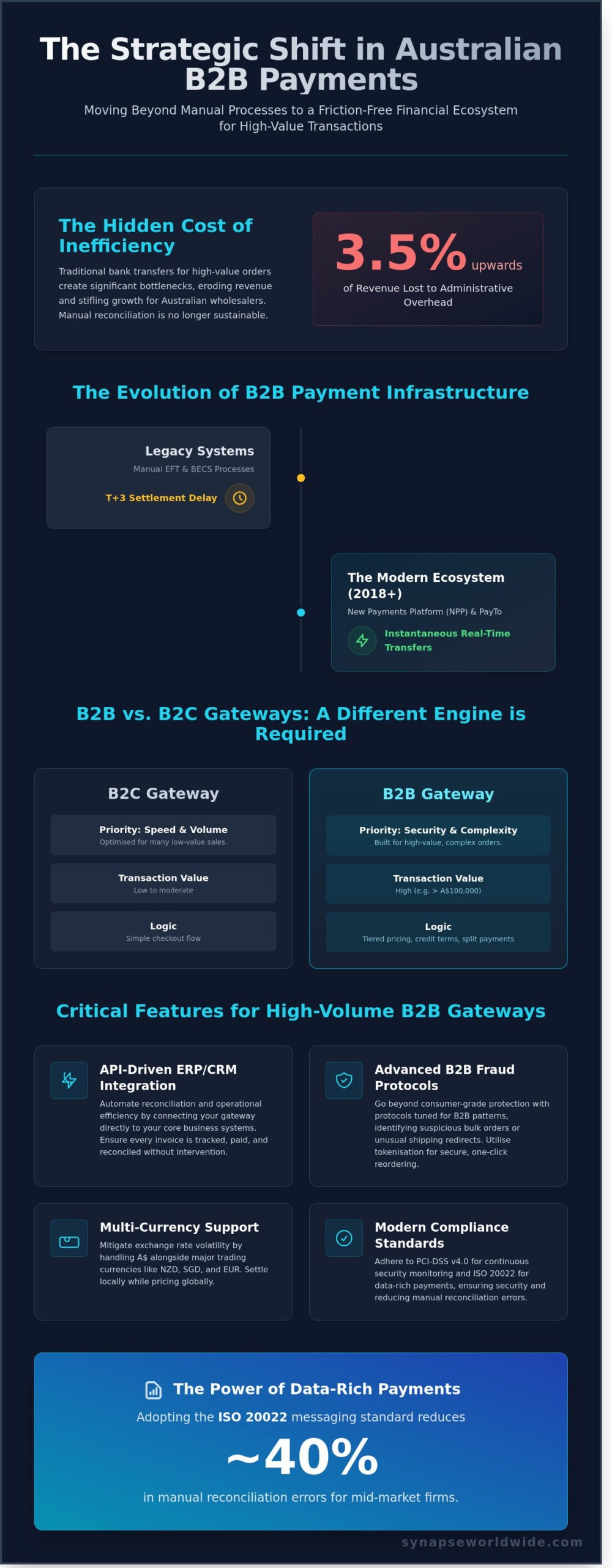
How much of your 2025 revenue was eroded by the hidden cost of manual bank reconciliation and friction in high-value transfers? For many Australian wholesalers, the answer is often upwards of 3.5% in administrative overhead alone. You likely understand that relying on traditional bank transfers for five-figure orders creates a bottleneck that stifles your scale. Finding the right b2b payment gateway solutions australia is no longer just a technical checkbox; it’s a strategic move to reclaim your team’s time and protect your margins.

In this guide, you’ll discover how to select and integrate the most robust B2B payment gateways to streamline high-value transactions and automate your Australian business operations. We’ll examine the specific technologies that bridge the gap between your digital storefront and your ERP system to ensure every invoice is tracked, paid, and reconciled without human intervention. From reducing transaction fees on A$50,000 orders to implementing seamless PayID and automated credit terms, we’re outlining the exact roadmap to a friction-free financial ecosystem for 2026.

Key Takeaways

  • Understand the shift from traditional bank transfers to real-time digital ecosystems designed specifically for the unique complexities of Australian B2B commerce.
  • Identify critical features of b2b payment gateway solutions australia, including multi-currency support and advanced fraud protocols tailored for high-value transactions.
  • Learn how to evaluate fee structures like interchange-plus versus flat-rate to ensure your payment infrastructure remains cost-effective as your volume scales.
  • Discover the strategic advantages of bespoke API-driven integrations that connect your gateway directly to ERP and CRM systems for automated operational efficiency.
  • Explore a proven methodology for designing robust, scalable payment architectures that transform your e-commerce platform into a powerful engine for business growth.

The Evolution of B2B Payment Gateway Solutions in Australia

The Australian B2B ecosystem has undergone a fundamental transformation since the 2018 launch of the New Payments Platform. For decades, local enterprises relied on manual Electronic Funds Transfer (EFT) and Bulk Electronic Clearing System (BECS) processes that often delayed settlement for up to three business days. By 2026, these legacy methods have become a liability. Modern b2b payment gateway solutions australia now provide the real-time infrastructure necessary to maintain liquidity in a high-velocity market. This shift isn’t merely about speed; it’s about the strategic integration of data and finance.

The landscape shifted dramatically following the implementation of The Evolution of B2B Payment Gateway Solutions in Australia, which introduced real-time clearing and settlement capabilities. For a business managing A$500,000 in monthly payables, the move from T+3 settlement to instantaneous transfers represents a significant boost to working capital. A “set and forget” gateway is no longer sufficient for competitive Australian enterprises. You need a proactive system that optimizes every touchpoint of the transaction lifecycle.

B2B vs. B2C: Why Your Gateway Needs a Different Engine

Retail gateways prioritize speed and high-volume, low-value security. Conversely, b2b payment gateway solutions australia must facilitate high-value transaction limits, often exceeding A$100,000 per single payment, without triggering automated fraud blocks that stall operations. The integration of PayTo has revolutionized this space. It allows businesses to automate recurring agreements and real-time authorisations directly from a client’s bank account. This bespoke logic supports complex checkout requirements, such as tiered wholesale volume discounts and split-payment terms, which standard B2C engines simply can’t process.

The Regulatory Landscape for Australian Payments in 2026

Compliance in the current market requires more than a basic SSL certificate. Australian Treasury guidelines now emphasize digital payment safety through rigorous oversight. Businesses must adhere to the updated PCI-DSS v4.0 standards, which demand continuous monitoring rather than annual snapshots. The adoption of ISO 20022 messaging standards is equally critical. This global standard enables data-rich payments, allowing remittance information to travel with the fund transfer. It reduces manual reconciliation errors by approximately 40% for mid-market firms. Staying compliant ensures your enterprise avoids the heavy penalties associated with the Australian Privacy Act and maintains its reputation as a secure, reliable partner.

Critical Features for High-Volume B2B Payment Gateways

High-volume B2B transactions demand a robust infrastructure that mirrors complex corporate logic. For Australian firms scaling internationally, multi-currency support is a non-negotiable requirement. Your gateway must handle A$ alongside major trading currencies like NZD, SGD, and EUR to mitigate exchange rate volatility. This capability allows you to settle in local currency while presenting costs to your global partners in their own denominations.

Security protocols must also evolve beyond standard consumer-grade protection. Advanced fraud protocols specifically tuned for B2B patterns help identify suspicious bulk orders or unusual shipping redirects that standard filters might miss. By implementing tokenisation, you enable secure, one-click reordering for repeat wholesale clients. This technology stores sensitive data in a secure vault, replacing it with a unique identifier. It removes friction from the procurement process and ensures your business remains PCI compliant without storing raw card data on your servers.

Cash flow management remains a primary concern for local enterprises. Standard T+2 settlements don’t always align with complex corporate accounting cycles. When Evaluating the Top B2B Payment Providers in Australia, look for partners that offer flexible settlement windows. Customising when funds are deposited into your accounts helps you maintain liquidity for payroll and inventory replenishment.

Wholesale Pricing and Credit Management

Modern b2b payment gateway solutions australia must integrate real-time credit checks directly into the payment flow. This prevents over-extension to high-risk accounts before the transaction is even processed. Sophisticated systems manage dynamic pricing tiers based on specific customer login history. If a Tier-1 distributor logs in, they see their bespoke rates immediately. You should also consider automating “Buy Now, Pay Later” (BNPL) options tailored for vendors. This allows you to offer net-30 or net-60 terms while the gateway provider assumes the underlying credit risk, ensuring you receive your A$ payment upfront.

Reporting and Reconciliation Automation

Manual reconciliation is a significant drain on administrative resources. Top-tier gateways generate tax-compliant invoices automatically upon successful authorisation, meeting all Australian Taxation Office (ATO) standards. Real-time data feeds provide instant visibility into accounts receivable, which is vital for maintaining an accurate balance sheet. By using custom metadata fields to track project codes or purchase order numbers, your finance team can reconcile thousands of transactions in minutes. This level of bespoke digital integration transforms the payment gateway from a simple utility into a strategic business asset. Every transaction becomes a data point that fuels your broader growth strategy.
B2B Payment Gateway Solutions Australia: The 2026 Strategic Buying Guide

Evaluating the Top B2B Payment Providers in Australia

Selecting the right b2b payment gateway solutions australia requires a shift from retail-centric thinking to a strategic focus on high-value, high-frequency settlement. While Stripe and Eway dominate the general market with their user-friendly interfaces, B2B specialists often provide deeper integration for complex invoice reconciliation. High-volume users should scrutinize fee structures closely. Flat-rate pricing offers simplicity for smaller firms, but interchange-plus models typically provide better cost-efficiency for enterprises processing over A$250,000 monthly. This granular pricing reveals the actual cost of the card network fee plus the provider’s margin, often saving businesses between 0.2% and 0.5% on total transaction costs.

A robust API isn’t just a technical requirement; it’s the bridge that allows your custom e-commerce environment to communicate with your ERP system for seamless reconciliation. Modern B2B systems must leverage the New Payments Platform (NPP) to facilitate real-time, data-rich transfers that traditional credit card rails cannot match. This infrastructure ensures that large-scale B2B transactions settle within seconds rather than days, significantly improving cash flow for the vendor. Technical support also remains a critical pillar. Relying on a global ticket-based system can lead to costly delays during a checkout failure. Local, Australian-based support teams provide the immediate response necessary for mission-critical infrastructure.

Domestic vs. Global Gateways: Which Fits Your Growth Strategy?

Australian-born gateways like Eway provide superior local support and a deep understanding of the local GST environment. Global giants like Adyen or Airwallex excel for cross-border B2B operations, handling over 150 currencies. However, international transactions often carry hidden costs, including currency conversion margins that can reach 3% above the mid-market rate. Choosing a domestic provider often avoids these “cross-border” surcharges for local trade, keeping your margins intact as you scale within the Australian market.

Security and Uptime: The Non-Negotiables

Reliability is the foundation of any digital architecture. Top-tier Australian providers offer Service Level Agreements (SLAs) guaranteeing 99.99% uptime. Many B2B firms now implement secondary “failover” gateways to prevent revenue loss during rare outages. PCI-DSS Level 1 compliance is the gold standard for Australian B2B gateways, ensuring that sensitive financial data remains encrypted and secure against evolving threats. Without this certification, your business assumes immense liability for every b2b payment gateway solutions australia transaction processed.

Strategic Integration: Connecting Gateways to ERP and CRM Systems

Integration isn’t just a technical convenience; it’s a strategic imperative for high-growth firms. Moving beyond simple, off-the-shelf plugins to bespoke API-driven integrations allows your business to function as a single, cohesive unit. In the Australian B2B landscape, 62% of finance leaders cite manual data reconciliation as their primary operational bottleneck. By adopting the “Digital Architect” approach, you build a scalable payment stack where every transaction informs your broader business intelligence. This methodology ensures your b2b payment gateway solutions australia aren’t just processing tools, but active drivers of efficiency.

Eliminating manual data entry through bidirectional ERP synchronisation transforms your finance department. When your gateway communicates directly with systems like NetSuite, Microsoft Dynamics 365, or SAP, data flows both ways. This ensures that an A$20,000 invoice paid online updates your ledger, tax obligations, and cash flow forecasts instantly. It removes the risk of human error that costs Australian businesses an average of 3% in annual revenue leakage. Your payment stack becomes a robust foundation for global expansion, managing complex multi-entity reporting without additional headcount.

Bridging the Gap Between Sales and Finance

Seamless CRM connectivity directly improves customer lifetime value (CLV) by providing sales teams with real-time financial context. When your gateway integrates with Salesforce or HubSpot, “Paid” statuses update automatically, triggering project kick-offs or shipping workflows. This transparency is vital for managing custom projects that require partial payments or deposit structures. It also ensures inventory levels across multiple B2B sales channels remain accurate to the minute, preventing over-selling and maintaining brand reputation. A unified view of the customer journey allows for more strategic account management and proactive retention efforts.

Custom Middleware vs. Native Integrations

Native gateway apps are often sufficient for smaller operations, but they frequently limit growth as business logic becomes more complex. Custom middleware serves as a sophisticated bridge, allowing for bespoke rules that native apps can’t handle. This approach future-proofs your infrastructure for the next decade of digital commerce. If you decide to pivot your ERP or add new payment methods in 2027, the middleware layer protects your core operations from disruption. It provides the stability required to handle high-volume transactions while maintaining the flexibility to adapt to changing Australian market regulations.

Ready to transform your financial infrastructure with a bespoke integration strategy? Consult with our Digital Architects today to build a scalable payment ecosystem.

Optimising Your B2B Infrastructure with Synapse Worldwide

Synapse Worldwide views payment architecture as the critical backbone of B2B scalability. We don’t just implement software; we design bespoke e-commerce environments where the payment gateway functions as a fully integrated engine within your business. Our methodology follows a “Digital Architect” approach. This ensures every transaction aligns with your broader fiscal strategy and technical requirements. We focus on creating a seamless flow between your storefront, your back-office, and your bank.

Integrating complex ERP systems like NetSuite, SAP, or Microsoft Dynamics with b2b payment gateway solutions australia requires a deep understanding of ledger synchronisation. We specialise in eliminating the 15 to 20 hours per week that Australian finance teams often lose to manual reconciliation. By automating the data path from invoice generation to final settlement, we help businesses accelerate cash flow and reduce the average age of the Debtors Ledger by up to 18%. This focus on ROI ensures that your digital transformation pays for itself through reduced administrative friction and improved liquidity.

Bespoke Solutions for Complex B2B Requirements

Since 2004, we’ve navigated the evolving Australian digital landscape to solve unique payment hurdles that off-the-shelf plugins cannot handle. For example, a recent project for a national medical wholesaler involved building a custom portal that managed complex split-payments across multiple cost centres. This bespoke development eliminated a four-day delay in their standard order processing cycle. Our commitment to fixed-price project delivery and transparent timelines removes the financial uncertainty usually associated with high-level technical shifts. You receive a robust, scalable solution delivered on schedule, backed by over two decades of local expertise.

  • Custom API orchestration for legacy ERP systems
  • Automated surcharging and tax calculation for AU compliance
  • Real-time inventory and payment status synchronisation
  • High-security vaulting for recurring wholesale billing

Ready to Transform Your Payment Operations?

The first step toward a more efficient infrastructure is a Synapse Worldwide digital audit. Our strategic consultants perform a deep dive into your current technical stack to identify bottlenecks in your b2b payment gateway solutions australia setup. We look beyond the surface to find opportunities for automation and cost reduction. We aren’t interested in one-off transactions; we aim for long-term partnerships that support your business as it grows and adapts to new market demands in 2026 and beyond.

Our team provides the clarity and technical discipline needed to execute complex digital shifts without disrupting your daily operations. We bridge the gap between high-level strategy and hands-on execution to ensure your business remains competitive. Partner with Synapse Worldwide for your bespoke B2B payment solution and take the next step in your digital evolution.

Future-Proof Your Australian B2B Operations

Navigating the complex landscape of b2b payment gateway solutions australia demands more than just a plug-and-play tool. Success in 2026 hinges on deep ERP and CRM integration to eliminate manual data silos and ensure your high-volume transactions remains secure. You need a system that scales as your enterprise grows, transforming your payment infrastructure from a cost center into a strategic asset. Efficiency isn’t just about speed; it’s about the precision of your digital architecture.

Synapse Worldwide has been at the forefront of this evolution since 2005. With over 20 years of Australian digital expertise, we specialize in building the scalable e-commerce infrastructure that modern enterprises require. We don’t believe in cookie-cutter fixes. Instead, we focus on bespoke integrations that connect your financial data directly to your growth engines. Our proven track record across the Australian market ensures your business is equipped for the next level of digital transformation. It’s time to refine your workflow and secure your competitive edge.

Consult with our Digital Architects for a custom B2B payment strategy

Your journey toward a more profitable, streamlined business starts with the right strategic partner by your side.

Frequently Asked Questions

What is the best B2B payment gateway for Australian small businesses?

Stripe and Airwallex are currently the top-tier choices for Australian small businesses seeking a balance of functionality and ease of use. Stripe offers a robust API that integrates with almost any software stack, while Airwallex provides competitive international FX rates and local AUD global accounts. These platforms allow you to scale your operations without the technical debt associated with legacy banking systems.

How do B2B payment gateways handle high-value transactions?

Leading b2b payment gateway solutions australia utilize advanced risk engine monitoring and 3D Secure 2.0 protocols to manage transactions that often exceed A$10,000. They typically route these through the New Payments Platform (NPP) or direct entry to avoid the high percentage-based fees of traditional credit cards. This strategic approach ensures that high-ticket settlements remain both secure and cost-effective for your enterprise.

Can I integrate my payment gateway with my existing ERP system?

You can achieve seamless synchronization between your gateway and major ERP systems like NetSuite, SAP, or Microsoft Dynamics 365 using bespoke API connectors. This integration automates the flow of financial data, which eliminates manual reconciliation and reduces administrative overhead by up to 40 percent. It’s a critical step for businesses looking to maintain a single source of truth across their digital landscape.

Are there specific B2B payment gateways that support PayTo in Australia?

Modern Australian providers like Monoova, Zepto, and Azupay have fully integrated PayTo to offer real-time, mandate-based payment options. Since its launch by NPP Australia in 2022, PayTo has enabled businesses to gain instant authorization for bank transfers, replacing the slower, traditional direct debit system. It’s an essential feature for managing recurring B2B subscriptions with greater certainty and speed.

What are the typical transaction fees for B2B gateways in Australia?

Domestic credit card fees in Australia generally range from 1.4% to 1.75% plus a fixed fee of A$0.30 per transaction. For high-volume B2B users, direct debit fees are often more economical, frequently capped at a flat rate or a low 1% fee. Many providers will offer tailored enterprise pricing once your monthly processing volume exceeds A$100,000, allowing for significant cost optimization.

How long does it take to settle funds into an Australian business bank account?

Standard settlement cycles in the Australian market typically follow a T+2 timeframe, meaning funds are available two business days after the transaction occurs. However, gateways leveraging the New Payments Platform can provide near-instant settlement, even on weekends and public holidays. Rapid settlement is a vital component for maintaining healthy cash flow and supporting aggressive business growth strategies.

What security certifications should I look for in an Australian B2B gateway?

You must ensure your provider maintains PCI DSS Level 1 compliance, as this is the gold standard for protecting cardholder data. It’s also wise to look for SOC2 Type II and ISO 27001 certifications, which validate the gateway’s internal security controls and data management practices. These certifications prove that the provider can defend your sensitive corporate information against the evolving global threat landscape.

Do I need a separate merchant account to use a B2B payment gateway?

You don’t need a separate merchant account if you partner with a modern payment aggregator like Stripe or Square, as they provide an all-in-one solution. Traditional banking models still require you to apply for a standalone merchant account, which involves more complex underwriting and longer setup times. Opting for an integrated solution simplifies your financial stack and accelerates your speed to market.


The Strategic Guide to Customer Portals for Wholesale Orders in 2026

The Strategic Guide to Customer Portals for Wholesale Orders in 2026

By 2026, the traditional sales representative will no longer be the primary driver of B2B revenue; instead, your digital interface will determine your market share. Recent industry data indicates that 67% of Australian B2B buyers now prefer digital self-service over manual interactions for routine procurement. You likely recognise that relying on fragmented email chains and phone orders creates a dangerous bottleneck for your growth. It’s frustrating when inaccurate inventory levels lead to costly backorders or when managing bespoke trade pricing across different tiers becomes an administrative nightmare.

This strategic guide empowers you to master these complexities by deploying a high-performance customer portal for wholesale orders designed specifically for the Australian landscape. You’ll learn how to transition from high overhead manual entry to an integrated system that drives increased order frequency and reduces administrative costs by up to 30%. We will examine the essential frameworks for seamless back-office integration and the technical optimisations required to scale your wholesale operations with confidence and precision.

Key Takeaways

  • Transition from a basic storefront to an integrated operating interface that serves as a sophisticated, secure hub for your trade clients.
  • Optimise your customer portal for wholesale orders with automated tiered pricing and real-time credit management to streamline complex B2B transactions.
  • Assess the strategic advantages of bespoke architecture over rigid SaaS platforms to ensure your digital solution scales with your unique business model.
  • Achieve a “single source of truth” by integrating your portal with ERP and CRM systems for data-driven insights into customer behaviour and sales trends.
  • Discover how a structured “Digital Architect” methodology and fixed-price development provide the certainty needed to navigate large-scale digital transformations.

Understanding the Modern Customer Portal for Wholesale Orders

A customer portal for wholesale orders is far more than a simple login page for your website. It’s a secure, private interface where trade clients manage their entire procurement lifecycle in a self-contained environment. Most Australian wholesalers are currently transitioning from a basic storefront model to a sophisticated, integrated operating interface. This distinction is critical for scalability. While a storefront merely displays products, an interface connects directly to your ERP, providing a live window into your supply chain and financial data.

Manual order entry via email or phone is the single biggest bottleneck to growth as we approach 2026. Data indicates that manual processing leads to error rates of up to 5% in complex B2B transactions. These mistakes aren’t just inconvenient; they’re expensive. Rectifying a single shipping error in the Australian logistics network can cost between A$150 and A$400 once fuel surcharges and return handling are calculated. Modern buyers don’t have the patience for these delays. They expect 24/7 self-service. If a procurement manager needs to place an order at 8:00 PM, perhaps due to different time zones or urgent requirements, they won’t wait for your office to open the next morning.

The Core Components of a High-Performance Portal

A robust customer portal for wholesale orders must go beyond the basics to drive true efficiency. Your clients need real-time inventory visibility across multiple Australian warehouses to avoid the frustration of backorders. The system should automatically apply customer-specific trade pricing and bespoke contract management rules the moment a user logs in. We also prioritise bulk ordering tools, such as CSV uploaders and quick-order grids. These features allow a buyer to add 100 SKUs to their cart in seconds, rather than clicking through dozens of individual product pages.

This degree of precision is vital in technical sectors; for example, Australian Made Vision provides specialised lenses that require exact ordering parameters and real-time visibility to serve their network of vision care professionals effectively.

Why Traditional E-commerce Platforms Fail Wholesalers

B2C-style platforms often collapse under the weight of wholesale complexity. Standard checkouts aren’t built for high-volume B2B orders where a single transaction might involve hundreds of line items and specific pallet requirements. Traditional platforms also lack support for account-based billing and complex credit terms like Net 30 or Net 60. In the Australian trade environment, managing tiered discounts and volume-based rebates is a standard requirement. If your platform can’t handle these bespoke financial structures, it’s a liability. You need a system that understands the nuances of B2B relationships, not just a glorified retail cart.

Key Features That Drive Wholesale Efficiency and Growth

A robust customer portal for wholesale orders transforms your digital infrastructure from a simple storefront into a strategic asset. It replaces the friction of manual order entry with a streamlined, self-service environment designed for scale. By centralising data and automating repetitive tasks, wholesalers can redirect their sales teams toward high-value relationship management rather than administrative data entry. This shift is essential for Australian businesses looking to maintain a competitive edge in an increasingly digital B2B market.

Advanced Trade Pricing Logic

Trade Pricing Logic is the digital translation of negotiated B2B contracts. This logic ensures that every client sees their unique rates without your staff intervening. When you implement automated trade discount application, the system calculates tiered pricing based on the customer’s specific group or historical volume. This eliminates the 5% margin of error often found in manual B2B invoicing, ensuring your profit margins remain protected while rewarding loyal partners with volume-based triggers. Managing complex contract rates becomes a background process, allowing you to scale without increasing your administrative headcount.

Account Visibility and Financial Self-Service

Providing 24/7 access to financial data significantly reduces the burden on your support team, often cutting down routine enquiries by up to 40% based on recent industry benchmarks. Clients can view their full invoice history, download statements, and monitor their credit limits in real-time. Integrating diverse payment options, such as EFT, credit card, and traditional “On Account” terms, caters to the varied cash flow requirements of Australian businesses. Automated credit limit checks during the ordering process prevent over-extension, protecting your business from bad debt before an order is even placed.

Efficiency extends to the procurement experience through personalised product catalogues. By segmenting your audience, you ensure that site managers only see relevant inventory, reducing search time and order errors. Seamless re-ordering tools and “favourite” lists allow repeat buyers to replenish stock in seconds. Implementing a dedicated customer portal for wholesale orders ensures site managers can place orders directly from the warehouse floor or a construction site via mobile-optimised interfaces. Since 61% of B2B buyers now prefer to start their journey on a mobile device, this accessibility is a critical driver of long-term retention.

Building this level of bespoke digital infrastructure requires a partner who understands both technical execution and B2B strategy.

The Strategic Guide to Customer Portals for Wholesale Orders in 2026

Build vs. Buy: Selecting the Right Portal Architecture

Choosing the technical foundation for your customer portal for wholesale orders is a high-stakes decision that dictates your operational ceiling for the next decade. Many Australian wholesalers fall into the trap of prioritizing low initial setup fees over long-term structural integrity. While a pre-packaged SaaS solution might offer a quick entry point, it often creates a “success tax” through per-transaction fees or rigid functional constraints that stifle growth.

The Digital Architect approach views infrastructure as a competitive moat. In a market where 73% of B2B buyers now expect a personalized digital experience, relying on a generic template can dilute your brand’s unique value proposition. Bespoke development allows you to mirror your specific offline workflows in a digital environment, ensuring your technology adapts to your business rather than forcing your business to adapt to the software’s limitations.

Evaluating the Total Cost of Ownership (TCO) requires looking beyond the first 12 months. A custom solution involves higher upfront capital, yet it eliminates the recurring “rent” associated with SaaS platforms. For an Australian wholesaler moving A$15 million in annual volume, a 1.5% platform fee on a SaaS model results in A$225,000 in annual costs. Over five years, this exceeds A$1.1 million, often far surpassing the cost of building and maintaining a proprietary asset that you fully own and control.

When Off-the-Shelf Software Makes Sense

Pre-configured platforms serve a specific purpose for emerging enterprises. If your product catalog is standardized and your pricing logic remains uniform across all client tiers, SaaS provides a reliable “good enough” solution. It’s an effective choice for startups with limited capital who need to validate their digital sales channel within a 30-day window. These platforms handle basic security and hosting, allowing you to focus on initial market penetration without the complexities of a full-scale development cycle.

The Case for Custom Web Development

Custom architecture is essential when your customer portal for wholesale orders must integrate with legacy ERP systems like MYOB, SAP, or Microsoft Dynamics. It allows for the implementation of proprietary business logic, such as complex quantity-break discounts or regional tax variations specific to Australian states. By building a bespoke interface, you create a seamless user experience that reinforces your professional authority. You aren’t just providing a login; you’re delivering a specialized tool that makes it easier for your clients to do business with you than with any competitor.

  • Data Sovereignty: You maintain absolute control over your customer data and transaction history.
  • Infinite Scalability: Add new features, AI-driven recommendations, or multi-warehouse logic as your footprint expands.
  • Zero Transaction Fees: Retain higher margins by avoiding the revenue-sharing models typical of major SaaS providers.

Integrating Your Portal with the Digital Landscape

A standalone customer portal for wholesale orders creates a digital silo that restricts business growth. To achieve true operational excellence, your portal must function as a high-performance node within your broader digital ecosystem. This connectivity ensures that data flows effortlessly between your sales interface and your core business logic, eliminating the friction of manual entry and human error.

ERP and CRM: The Engine Behind the Portal

The strength of your B2B infrastructure depends on a “single source of truth.” By automating the data flow between your portal and ERP systems like NetSuite or SAP, you ensure that product availability and wholesale pricing remain accurate to the second. This synchronization prevents the 15% inventory discrepancy often seen in non-integrated systems, protecting your brand reputation from the fallout of overselling.

Strategic CRM integration empowers your sales teams with actionable intelligence. Instead of reactive order taking, your staff can leverage real-time data to identify buying patterns and churn risks. When your CRM tracks every interaction within the portal, your team can see which 20% of your product catalog is driving 80% of your revenue. This visibility allows for personalized upselling and targeted promotions that directly impact your bottom line.

Logistics and Freight Orchestration

Australian logistics present unique challenges due to vast geographic zones and varying carrier capabilities. A robust customer portal for wholesale orders must calculate real-time freight costs with precision. We implement sophisticated logic to handle the transition from parcel shipping to pallet-rate freight, ensuring your margins aren’t eroded by unexpected shipping costs.

  • Carrier Integration: Direct API connections with Australian carriers like StarTrack, Toll, and TNT provide customers with instant, accurate shipping quotes.
  • Zonal Logic: Automated calculation of regional surcharges and remote area fees based on current 2024 Australian freight benchmarks.
  • Order Consolidation: Intelligent systems that group multiple line items into the most cost-effective shipping units, whether that’s a single satchel or multiple skids.

Security remains the foundation of this digital landscape. Your infrastructure must comply with the Australian Privacy Principles (APP) and the Notifiable Data Breaches (NDB) scheme. We utilize AES-256 encryption and multi-factor authentication to ensure that sensitive wholesale contracts and pricing structures remain confidential. This commitment to security builds the long-term trust necessary for high-value B2B relationships.

Ready to unify your business operations through a high-performance digital bridge? Contact Synapse Worldwide to discuss your integration strategy.

Implementing a Bespoke Wholesale Portal with Synapse Worldwide

Transitioning from manual spreadsheets to a sophisticated customer portal for wholesale orders requires more than a software installation. It demands a structural shift in how your business functions. Synapse Worldwide operates as your Digital Architect, employing a rigorous methodology of Discovery, Design, and Deployment to ensure your infrastructure supports high-volume trade. We start by uncovering the hidden bottlenecks in your current workflow before we write a single line of code.

Enterprise leaders require budget certainty to justify digital investments. We eliminate the financial ambiguity and “scope creep” common in the tech industry by providing fixed-price project development. This approach ensures your A$ investment remains predictable while we deliver a robust, bespoke solution tailored to your specific logistical requirements. You gain a high-performance tool without the risk of escalating costs.

Deployment is only the beginning of the journey. We prioritize ongoing maintenance and strategic optimization to keep your portal performing at peak efficiency as market conditions shift. This commitment transforms your wholesale operation into a scalable digital powerhouse. It allows your business to handle thousands of SKUs and complex buyer tiers without a corresponding increase in your administrative headcount.

A Strategic Partnership for Growth

Our approach moves beyond basic web design into the territory of business process engineering. We don’t just build interfaces; we build systems that drive long-term ROI. By integrating our E-commerce Development expertise, we help you leverage over 20 years of experience in the Australian digital landscape. This deep local knowledge ensures your customer portal for wholesale orders complies with domestic trade expectations and integrates seamlessly with local accounting and logistics providers.

Next Steps: Your Digital Transformation

The path to a professional digital infrastructure begins with an internal audit. Identify exactly where your team loses time. If staff members spend 15 to 20 hours per week manually re-entering emailed orders, that inefficiency is a direct hit to your bottom line. We recommend defining your “Order Standard” by documenting every data point required for a perfect transaction. Once you’ve mapped these manual hurdles, consult with our specialists to create a digital roadmap that replaces friction with automated flow.

Future-Proofing Your Wholesale Distribution Strategy

The shift toward digital self-service is no longer a luxury for Australian distributors. By 2026, B2B buyers will expect seamless, 24/7 access to their accounts, making a high-performance customer portal for wholesale orders a mandatory pillar of your digital infrastructure. Successful implementation requires more than a simple login screen. It demands deep, real-time integration with your existing ERP and CRM systems to ensure pricing and inventory accuracy across every transaction. Choosing a bespoke architecture allows your business to scale without the rigid constraints of generic software.

Since 2005, Synapse Worldwide has navigated these complex digital landscapes, providing over 20 years of technical expertise to local enterprises. Our team focuses on fixed-price project development to provide total budget certainty, specializing in the intricate integrations that keep global supply chains moving. We don’t just build interfaces; we architect growth engines that redefine your competitive advantage.

Partner with the Digital Architects at Synapse Worldwide to build your custom wholesale portal.

Your journey toward a more efficient, scalable wholesale operation starts with a single strategic decision today.

Frequently Asked Questions

What is the difference between a B2B customer portal and a standard e-commerce site?

A B2B customer portal for wholesale orders manages high-volume, repetitive transactions with account-specific logic, while standard e-commerce focuses on one-off retail sales. Retail sites usually offer a uniform price to all visitors. In contrast, a wholesale portal requires authenticated login to access pre-negotiated trade terms, credit limits, and bulk discount structures tailored to individual business relationships.

Can a wholesale portal integrate with my existing ERP system?

Yes, a robust wholesale portal must integrate with your ERP system to maintain a single source of truth for inventory and financials. We connect platforms like NetSuite, SAP, or Microsoft Dynamics 365 to ensure data flows bidirectionally in real-time. This automation eliminates manual data entry, which reduces administrative errors by up to 30% according to industry benchmarks from Gartner.

How does a customer portal handle complex trade pricing?

Digital portals manage complex trade pricing through tiered logic and individual account mapping. The system automatically applies contract-specific rates, volume-based discounts, or promotional rebates once a client logs in. This ensures your A$10,000-per-month accounts see different rates than smaller boutiques, maintaining your margin integrity without any manual intervention from your staff.

Is a custom-built portal better than a SaaS platform for wholesalers?

Bespoke portals offer superior scalability and competitive advantage for wholesalers with unique operational workflows. While SaaS platforms provide quick entry, they often lack the deep customisation required for complex Australian distribution models. A custom-built solution ensures your digital infrastructure evolves with your business, avoiding the rigid constraints and recurring per-transaction fees of generic subscription software.

How long does it take to develop a bespoke wholesale ordering portal?

Developing a bespoke wholesale ordering portal typically requires a timeline of 16 to 24 weeks from discovery to deployment. This period includes architecture design, secure ERP integration, and rigorous user acceptance testing. High-performing B2B solutions require this structured approach to ensure the final product handles high-concurrency traffic and complex data sets without failure.

What are the security requirements for a B2B customer portal?

Security for a B2B portal must comply with the Australian Privacy Principles (APPs) and include multi-factor authentication. We implement AES-256 encryption for data at rest and TLS 1.3 for data in transit to protect sensitive trade secrets. Regular penetration testing ensures your proprietary pricing and client data remain shielded from cyber threats in the Australian digital market.

How can a portal help manage Australian freight and logistics?

Portals streamline Australian logistics by integrating directly with local carriers like Australia Post, StarTrack, or Toll. The system calculates real-time shipping rates based on cubic weight and delivery zones, including remote regional surcharges. This precision prevents shipping cost leakage and provides customers with automated tracking updates, improving transparency across your entire supply chain.

Will a customer portal replace my existing sales team?

A customer portal for wholesale orders doesn’t replace your sales team; it empowers them to focus on high-value strategic growth. By automating routine reorders and administrative queries, sales representatives gain 20% more time to pursue new business opportunities. The portal acts as a 24/7 digital assistant that handles the friction of transactional tasks while your team builds deeper client relationships.


The Strategic Guide to Online Quoting Systems for B2B Sales in 2026

The Strategic Guide to Online Quoting Systems for B2B Sales in 2026

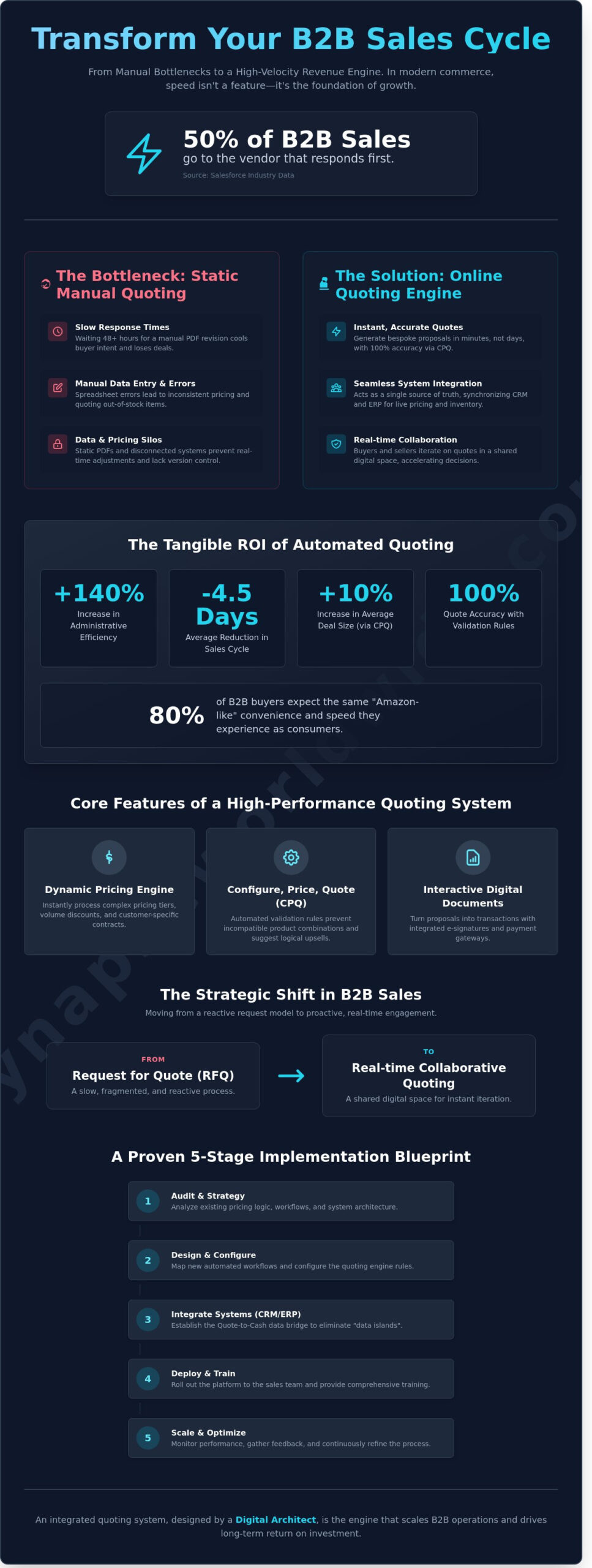
Recent industry data from Salesforce reveals that 50% of B2B sales go to the vendor that responds first. If your team is still wrestling with manual data entry and spreadsheet errors, you’re likely losing revenue to faster, more agile competitors right now. A sophisticated online quoting system for b2b sales isn’t just a luxury for 2026; it’s the foundational engine for any scalable growth strategy. Moving beyond fragmented processes allows your business to capture demand at the exact moment of intent, rather than three days later when the lead has already cooled.

We understand that the friction of inconsistent pricing and slow approval loops creates a constant drag on your sales momentum. You’ve probably felt the sting of a lost deal simply because a quote took too long to generate. This guide promises to show you how to transform your sales cycle from a manual bottleneck into a high-velocity, integrated revenue engine. We’ll examine the strategic implementation of seamless CRM and ERP data synchronisation, the deployment of bespoke self-service portals, and the technical roadmap to achieving a faster, more professional quote-to-cash cycle.

Key Takeaways

  • Identify why static PDF quotes are the primary bottleneck in modern commerce and how an online quoting system for b2b sales transforms your sales portal into a high-velocity revenue engine.
  • Master the complexities of dynamic pricing engines and role-based permissions to ensure your bespoke quoting infrastructure handles even the most intricate customer contracts.
  • Eliminate “data islands” by establishing a seamless Quote-to-Cash (Q2C) cycle that bridges the strategic gap between initial quotes, invoicing, and fulfillment.
  • Follow a proven five-stage implementation blueprint to audit your existing pricing logic and ensure a successful, scalable transition to automated quoting.
  • Discover how a Digital Architect designs integrated CRM and ERP ecosystems that scale your B2B operations and drive a significant, long-term return on investment.

What is an Online Quoting System for B2B Sales?

An online quoting system for b2b sales isn’t just a digital version of a paper form. It represents a sophisticated, interactive sales portal that bridges the gap between complex product configurations and instant buyer gratification. By 2026, the traditional reliance on static PDF quotes has become the primary bottleneck in the B2B sales cycle. These legacy documents are data silos that prevent real-time adjustments, lack version control, and ultimately stall momentum. When a buyer has to wait 48 hours for a manual PDF revision, the deal’s temperature drops. Modern systems eliminate this friction by providing a dynamic environment where pricing and specifications are updated instantly.

The industry has moved decisively away from the reactive “Request for Quote” (RFQ) model toward “Real-time Collaborative Quoting.” This shift allows buyers and sellers to iterate on configurations, adjust quantities, and finalize terms within a shared digital space. These platforms act as the single source of truth for the entire organization. By integrating directly with ERP and CRM systems, they ensure that every quote reflects live inventory levels and accurate cost structures. This prevents the common nightmare of sales reps promising stock that doesn’t exist or using expired promotional pricing.

The Core Difference: Quoting vs. Standard E-commerce

Standard e-commerce relies on a linear “Add to Cart” logic that fails in high-value B2B transactions. While B2C is purely transactional, B2B is inherently relational and complex. An online quoting system for b2b sales facilitates variables that a standard shopping cart cannot handle, such as multi-tier volume discounts, bespoke service level agreements, and custom payment terms. It transforms the digital storefront from a simple vending machine into a powerful negotiation engine. In this environment, price is a dynamic variable influenced by the depth of the partnership rather than a fixed, public attribute.

Why Your Business Needs a Quoting Engine Now

B2B buyers now bring “Amazon-like” expectations to every professional interaction. Recent data shows that 80% of B2B buyers expect the same level of convenience and speed they experience on consumer websites. Implementing a robust quoting engine can increase administrative efficiency by 140% by automating repetitive data entry and approval workflows. This technology eliminates “pricing silos” between sales, finance, and operations. It ensures that the entire organization moves at the speed of the market, allowing your team to focus on closing deals rather than formatting spreadsheets.

Essential Features of a High-Performance B2B Quoting System

A robust online quoting system for b2b sales acts as the central nervous system of your commercial operations. It must handle dynamic pricing engines that process complex tiering and customer-specific contracts instantly. In 2026, static price lists are obsolete. High-performance systems use role-based permissions to manage internal approvals and external buyer hierarchies, ensuring that a junior procurement officer cannot authorize a million-dollar spend without oversight. Real-time inventory visibility prevents the friction of quoting out-of-stock items, a mistake that leads to a 22% decrease in repeat purchase rates according to recent supply chain benchmarks.

Interactive digital quote documents have replaced the static PDF. These integrated solutions include e-signatures and payment gateways, turning a simple proposal into a functional transaction portal. This seamless transition from negotiation to payment reduces the sales cycle by an average of 4.5 days for mid-market enterprises.

The Power of Dynamic Configuration (CPQ)

Configure, Price, Quote (CPQ) functionality is the cornerstone of complex product sales. It uses automated validation rules to prevent incompatible product combinations, ensuring every configuration is technically viable before it reaches the client. This automation removes the need for manual oversight, delivering 100% quote accuracy. Businesses implementing advanced CPQ logic see a 10% increase in average deal size by suggesting logical upsells during the configuration phase. It’s a scalable way to maintain precision without bloating your administrative headcount.

Empowering the Sales Force: The Rep Dashboard

Modern sales reps use these tools to build bespoke proposals in minutes, not days. The dashboard provides a strategic view of the digital landscape, tracking exactly when a client opens a quote. Data from 2025 indicates that following up within 15 minutes of a quote view increases conversion rates by 60%. Integrated analytics identify which quote structures perform best, allowing teams to refine their approach based on hard evidence rather than intuition. To achieve this level of technical sophistication, many firms seek a strategic partner for digital transformation to build these integrated environments.

  • Engagement Tracking: Know the second a prospect interacts with your pricing.
  • Automated Approvals: Eliminate bottlenecks with pre-defined discount thresholds.
  • Unified Data: Sync quote information directly with your CRM to maintain a single source of truth.

By centralizing these features, an online quoting system for b2b sales transforms from a simple utility into a powerful driver of revenue growth. It allows your team to focus on relationship building while the software manages the intricate technical details of the transaction.

The Strategic Guide to Online Quoting Systems for B2B Sales in 2026

Strategic Integration: The Digital Architect’s View

Standalone tools are a liability in a modern enterprise. They create data islands that stall momentum and fragment the customer experience. A 2023 report by MuleSoft found that while the average enterprise uses 976 individual applications, only 28% of them are integrated. This lack of connectivity is a primary bottleneck in the Quote-to-Cash (Q2C) cycle. A robust online quoting system for b2b sales must act as a central bridge. It connects the initial inquiry to invoicing and fulfillment without the friction of manual data entry. We build these systems using an API-first architecture. This approach ensures your tech stack remains flexible and ready for the advancements we expect by 2026. It allows your business to swap or upgrade components without rebuilding the entire foundation.

  • Eliminate Data Silos: Ensure every department sees the same pricing and inventory data.
  • Accelerate Q2C: Move from quote approval to cash collection in hours, not weeks.
  • Future-Proofing: Use headless commerce principles to adapt to new sales channels quickly.

Bespoke Development vs. SaaS Platforms

Platform-based solutions like SparkLayer or Zoey offer rapid deployment for standard B2B needs. They’re excellent for businesses that align with common workflows. However, companies with proprietary pricing logic or complex assembly-to-order models often require bespoke engines. While a custom build involves higher initial investment, it eliminates subscription fatigue and provides a 100% fit for unique operations. You should evaluate the total cost of ownership over a five-year horizon to determine the true ROI. Custom solutions often yield higher long-term value by removing the constraints of generic software.

This philosophy of bespoke architecture isn’t limited to the digital realm; to see how custom, low-maintenance design is applied to outdoor spaces, you can learn more about Nu Scape Designs.

The Role of CRM and ERP Synchronisation

Efficiency relies on a seamless flow between your CRM and ERP. When a sales rep generates a quote, the system should automatically create an “Opportunity” in Salesforce or HubSpot. Once the client approves, the data must push directly into NetSuite or SAP as a “Sales Order.” This automation reduces “human-in-the-loop” requirements for standard re-orders. Research from McKinsey suggests that automating lead-to-cash processes can reduce sales costs by up to 15% and improve order accuracy by 20%. It turns your online quoting system for b2b sales into a high-velocity engine that drives consistent growth.

Implementation Blueprint: Moving to Automated Quoting

Transitioning to a sophisticated online quoting system for b2b sales requires more than just new software; it demands a structural renovation of your sales operations. Success hinges on a disciplined 5-stage rollout that prioritizes data integrity and human adoption. Before any code is written, you must perform a rigorous audit of your existing pricing logic. Data from Gartner indicates that roughly 40% of B2B lead data is inaccurate or incomplete. Digitizing flawed data only accelerates errors. You must clean your product catalogs and discount rules to ensure the digital foundation is robust and scalable.

Selecting the right technology partner is the next critical hurdle. You need a Digital Architect capable of managing integration complexity across your entire stack. This partner must bridge the gap between your front-end sales interface and back-end ERP systems. Without this strategic alignment, the system becomes a silo rather than an integrated engine for growth.

To see how specialized partners manage these complex ERP ecosystems and boost operational efficiency through Microsoft Dynamics 365, you can discover NaviWorld (Thailand) Co., Ltd..

Stage 1 & 2: Discovery and Technical Mapping

The discovery phase identifies every stakeholder in the current manual process, from the junior sales rep to the CFO. We map the “Quote Approval Matrix” into digital workflows, ensuring that high-value discounts trigger automatic notifications to management. Technical requirements for API integrations are defined here. Your online quoting system for b2b sales must pull real-time inventory levels and customer-specific pricing tiers from your CRM without latency. This precision prevents the common friction of promising stock that isn’t available.

Stage 3 to 5: Development, Testing, and Scaled Rollout

We recommend building a Minimum Viable Product (MVP) focused on a single, high-volume product line. This allows for rapid iteration without disrupting the entire organization. Rigorous User Acceptance Testing (UAT) follows, where we stress-test pricing rules to ensure they’re bulletproof against edge cases. For enterprises managing over 1,000 SKUs, a phased rollout is typically superior to a “Big Bang” approach. It allows your team to build confidence in the system while you monitor performance metrics.

Overcoming sales team resistance is the final, vital step. Adoption fails when reps view technology as a hurdle rather than a tool. We focus on demonstrating immediate value. When a salesperson sees that automated quoting saves them 5 hours of manual data entry per week, resistance evaporates. We provide bespoke training sessions that focus on the strategic benefits of the new landscape, turning your sales force into proactive participants in this digital transformation.

Ready to modernize your sales workflow with a bespoke digital solution? Partner with Synapse Worldwide to build your strategic quoting engine today.

Engineering Growth: How Synapse Worldwide Scales B2B Sales

Synapse Worldwide operates as a Digital Architect for the modern enterprise. We don’t just deploy software; we design the bespoke infrastructure required for B2B leaders to dominate their sectors. Our team builds the structural foundation that allows your business to move with agility and precision. We ensure your online quoting system for b2b sales isn’t a standalone tool but a central engine for growth. By engineering a seamless integration between your CRM, ERP, and E-commerce platforms, we eliminate the data fragmentation that cripples traditional sales teams.

Our focus remains on robust, scalable solutions that deliver measurable ROI. In previous implementations, our integrated architectures have reduced manual data entry errors by 35% within the first six months. This isn’t a temporary fix. It’s a strategic investment in long-term digital transformation. We prioritize technical stability and high-level optimization to ensure your systems handle increased volume without performance degradation. When you partner with Synapse, you gain a consultant that understands both the visionary big picture and the intricate technical details of your sales funnel.

Bespoke Solutions for Complex Requirements

Cookie-cutter software frequently fails to meet the intricate demands of B2B transactions. We move beyond generic, “one-size-fits-all” platforms to build systems that mirror your specific business logic. For a national B2B client in 2024, we consolidated 12 legacy workflows into a single, unified interface, resulting in a 20% increase in sales velocity. The Synapse promise centers on authoritative guidance and hands-on execution. We provide the technical mastery needed to turn complex requirements into streamlined, profitable operations.

Ready to Modernise Your Sales Cycle?

The path to a more efficient future begins with a comprehensive digital audit of your current sales infrastructure. We don’t guess; we analyze. Our technical consulting identifies hidden bottlenecks in your quoting process that often lead to lost revenue. Data shows that a delay in quote delivery can lower conversion rates by as much as 28% in competitive B2B markets. We eliminate these friction points to ensure your team stays ahead of the curve. Consult with a B2B Integration Expert at Synapse Worldwide to begin your transformation and secure your competitive edge for 2026 and beyond.

Architecting Your Competitive Advantage for 2026

The transition toward digital maturity in the B2B sector isn’t just a trend; it’s a structural necessity. Companies that prioritize automated workflows and deep data integration gain a decisive advantage over those tethered to manual processes. By deploying a sophisticated online quoting system for b2b sales, your organization can eliminate friction and accelerate the deal cycle from days to minutes. Success in this landscape requires more than software. It demands a digital architect who understands how to bridge the gap between complex back-end operations and a seamless front-end experience.

Synapse Worldwide brings over 20 years of digital infrastructure expertise to every partnership. We’re specialists in complex CRM and ERP integrations, maintaining a proven track record with national B2B enterprises across diverse industries. We don’t provide cookie-cutter fixes. We deliver bespoke solutions designed to scale alongside your growth ambitions. It’s time to transform your quoting process into a high-performance engine for revenue. Elevate your B2B sales strategy with a bespoke quoting solution from Synapse Worldwide. Your journey toward a more efficient, profitable future is ready to begin.

Frequently Asked Questions

What is the difference between a quoting system and a standard e-commerce store?

A quoting system facilitates dynamic negotiation and bespoke pricing for complex orders, whereas a standard e-commerce store focuses on fixed-price, immediate transactions. While e-commerce platforms typically use a simple checkout process, an online quoting system for b2b sales allows for price requests, volume discounts, and custom configurations. This distinction is critical because 80% of B2B transactions involve complex negotiations and sales cycles that last 4 to 12 months.

Can an online quoting system handle complex, tiered pricing structures?

Yes, robust quoting systems leverage logic-based engines to manage intricate, tiered pricing structures with absolute precision. You can automate discounts based on volume, such as a 10% reduction at 100 units or 15% at 500 units, while applying customer-specific contract rates. These scalable systems eliminate manual calculation errors, which account for 1% of lost revenue in traditional sales models. It ensures your global pricing remains consistent across every territory.

How long does it typically take to implement a B2B quoting system?

Implementing a comprehensive B2B quoting system typically requires 12 to 24 weeks for a full strategic rollout. This timeline includes 4 weeks for initial discovery and mapping, 8 weeks for technical development, and a final phase for testing and data migration. High-level integrations with existing databases might extend this period. We prioritize a structured approach to ensure the final solution aligns perfectly with your specific business logic and operational goals.

Will an automated system replace my sales team?

An automated system doesn’t replace your sales team; it empowers them by removing repetitive administrative burdens that stall productivity. By automating 30% of manual data entry and quote generation tasks, your representatives can focus on high-value relationship building and strategic closing. The system acts as a digital assistant that handles routine requests 24/7, allowing your human talent to intervene only when expert negotiation or complex problem-solving is required.

Is it possible to integrate a new quoting system with our legacy ERP?

Seamless integration with legacy ERP systems is achievable through custom API development or specialized middleware solutions. Since 95% of modern enterprise software now utilizes API-first architecture, we can bridge the gap between your established back-office data and a modern front-end portal. This integrated connectivity ensures that inventory levels, customer credit limits, and historical order data sync in real-time. It transforms your legacy data into a proactive tool for growth.

How does an online quoting system improve the B2B customer experience?

An online quoting system for b2b sales improves the customer experience by providing 24/7 autonomy and reducing response times by 50%. Modern B2B buyers expect a frictionless digital interface where they can generate their own estimates and track quote status without waiting for a return phone call. This transparency builds trust and positions your brand as a sophisticated partner. It caters to the 75% of buyers who prefer digital self-service.

What security measures are necessary for a B2B quoting portal?

B2B quoting portals require robust security measures including AES-256 encryption, Multi-Factor Authentication, and SOC 2 Type II compliance. You must protect sensitive pricing data and customer information from unauthorized access to maintain your competitive advantage. Implementing Role-Based Access Control ensures that only authorized personnel can view or approve high-value quotes. These protocols safeguard your intellectual property and maintain the integrity of your digital landscape against evolving cyber threats in 2026.


Wholesale E-commerce Platform Australia: The 2026 Buyer’s Guide for B2B Growth

Wholesale E-commerce Platform Australia: The 2026 Buyer’s Guide for B2B Growth

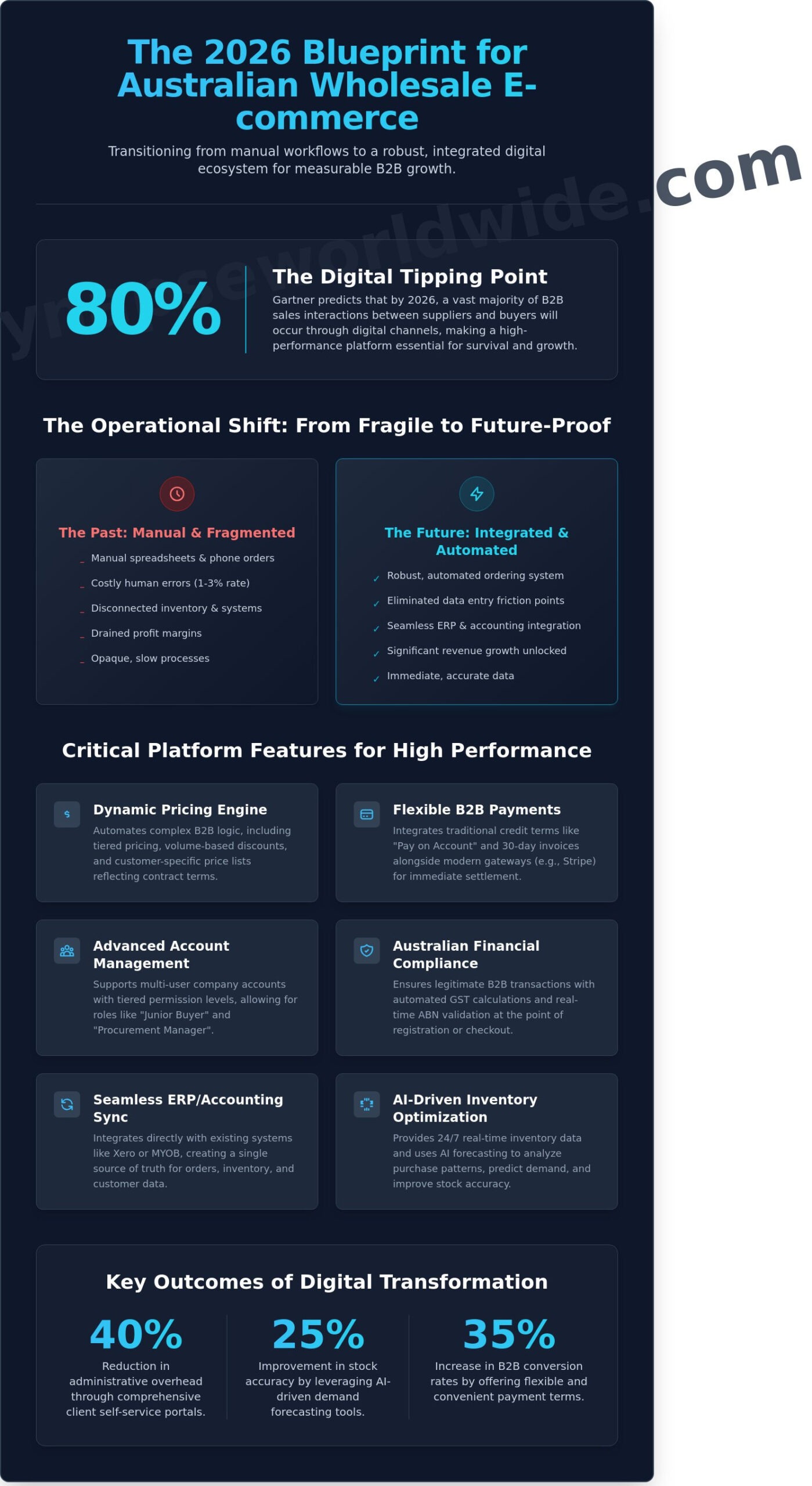
By 2026, Gartner predicts that 80% of B2B sales interactions will occur in digital channels, yet many Australian wholesalers remain tethered to manual spreadsheets and fragmented systems. You likely recognize that manual order processing and disconnected inventory lead to costly human errors and missed opportunities. These inefficiencies drain your margins. Selecting a strategic wholesale e-commerce platform australia isn’t just a luxury; it’s a fundamental requirement for maintaining a competitive edge within the digital landscape.

This guide provides a clear roadmap to transition from fragile manual workflows to a robust, automated ordering system. We’ll show you how to implement a bespoke, scalable solution that handles complex B2B pricing structures and integrates seamlessly with your existing ERP or accounting software like Xero or MYOB. You’ll discover the specific architectural requirements needed to support tiered pricing, credit terms, and real-time inventory optimization. By the end of this article, you’ll have the strategic framework to drive efficiency and unlock significant revenue growth through 2026 and beyond.

Key Takeaways

  • Understand the shift from manual ordering to integrated digital ecosystems to drive measurable B2B growth and operational efficiency.
  • Identify the essential features of a high-performance wholesale e-commerce platform australia, from complex tiered pricing logic to automated ABN validation.
  • Evaluate the strategic advantages of bespoke development over standard SaaS when managing unique business logic and legacy ERP integrations.
  • Discover the “Digital Architect” approach to deployment, ensuring your digital landscape is seamlessly integrated for maximum scalability and reliability.
  • Learn to future-proof your operations by pairing robust platform architecture with integrated marketing automation and strategic SEO for long-term success.

Defining the Modern Wholesale E-commerce Platform in Australia

The Australian wholesale landscape has moved past the era of static order forms and fragmented communication. By 2026, a robust wholesale e-commerce platform australia acts as a strategic command center rather than just a digital catalog. This evolution marks a transition from simple web portals to integrated digital ecosystems that unify inventory, logistics, and customer relationship management. Traditional Australian wholesalers are rapidly abandoning manual phone and email ordering systems because manual entry error rates, which typically range between 1% and 3%, create unsustainable costs in a high-volume market. Digital systems eliminate these friction points, ensuring that data flows seamlessly from the storefront to the warehouse floor.

A wholesale e-commerce platform is a secure, high-volume transactional engine optimized for business-to-business logic. Unlike B2C stores designed for emotional, one-off purchases, these platforms manage complex variables such as tiered pricing, credit limits, and bulk shipping constraints. While a retail site focuses on a simple checkout, a professional B2B e-commerce solution handles bespoke contract terms and multi-user account hierarchies. It’s the difference between a storefront and a scalable business engine.

The Shift in Australian B2B Buyer Expectations

Modern B2B buyers, 73% of whom are now millennials, demand a user experience that mirrors their personal shopping habits. They don’t want to wait for a return call to confirm stock levels. They require 24/7 access to account history and real-time inventory data. Mobile accessibility has become a non-negotiable requirement for sales representatives visiting clients and warehouse managers conducting floor audits. This digital transparency builds long-term trust, as Australian supply chains prioritize partners who provide immediate, accurate data over those relying on outdated, opaque processes.

To complement this data-driven transparency, visual storytelling can humanize your wholesale brand. For firms looking to showcase their local operations or team expertise, digitalcontentstudios.com provides insights into how behind-the-scenes video production can elevate brand transparency and foster stronger B2B connections.

Market Trends: Wholesale Digitalization in 2026

The 2026 market is defined by the rise of comprehensive self-service portals. These interfaces allow clients to manage their own reorders and invoices without human intervention, which can reduce administrative overhead by up to 40%. We’re also seeing the deep integration of AI-driven inventory forecasting. These tools analyze historical purchase patterns to predict demand, helping wholesalers improve stock accuracy by 25%. Additionally, sustainability tracking has evolved into a core requirement. Australian corporate procurement teams now use e-commerce interfaces to audit the carbon footprint and ethical sourcing credentials of their suppliers, making ESG data as critical as price points.

Critical Features for a High-Performance Australian B2B Platform

Selecting a wholesale e-commerce platform australia requires a strategic shift from retail simplicity to industrial-grade complexity. By 2026, industry analysts project that 80% of B2B sales interactions between suppliers and buyers will occur through digital channels. Success hinges on a system that mirrors your offline business rules with surgical precision. It’s not just about a shopping cart; it’s about a scalable engine that drives operational efficiency.

A robust platform must execute complex pricing logic without manual intervention. This includes tiered pricing structures where volume triggers automatic discounts, and customer-specific price lists that reflect individual contract negotiations. For example, a Tier 1 distributor might see a 20% discount on bulk orders, while a boutique retailer sees standard wholesale rates. Financial compliance is equally vital. Your system should offer automated GST calculation and real-time ABN validation to ensure you’re transacting with legitimate Australian entities from the first click.

Managing the modern B2B relationship also requires sophisticated account structures. High-performance platforms support multi-user company accounts. This allows a single client entity to have multiple purchasers with varied permission levels, such as a “Junior Buyer” who can build carts and a “Procurement Manager” who holds final approval authority. To maintain cash flow, the platform must integrate traditional credit terms, including 30-day accounts and “Pay on Account” functionality, alongside modern gateways like Stripe for immediate settlements. Recent data indicates that offering flexible payment terms can increase B2B conversion rates by up to 35%.

As you evaluate the evolving landscape of eCommerce in Australia, these features become the baseline for staying competitive in a crowded market.

Advanced Inventory and Order Management

Modern B2B buyers demand 100% transparency. Your platform must provide real-time stock visibility across multiple Australian warehouse locations, whether your inventory sits in Sydney, Melbourne, or Perth. To prevent lost revenue, implement automated back-in-stock notifications and back-ordering capabilities. For high-volume procurement, features like Bulk Quick Order forms and CSV upload functionality are essential; they allow buyers to add 50+ line items to a cart in seconds rather than minutes. If you want to see how these systems integrate with your existing ERP, a bespoke consultation can reveal the path to seamless synchronization.

Australian Regulatory and Tax Integration

Compliance isn’t optional for an enterprise-grade wholesale e-commerce platform australia. The system must adhere to Australian Consumer Law (ACL) specifically within a B2B context, handling warranties and returns with precision. Automated tax invoicing is a core requirement, ensuring every digital record meets the Australian Taxation Office (ATO) standards for record-keeping. For specialized sectors like agriculture or manufacturing, the platform should also handle Recipient Created Tax Invoices (RCTI), allowing the wholesaler to issue the tax invoice on behalf of the supplier when specific criteria are met.

Wholesale E-commerce Platform Australia: The 2026 Buyer’s Guide for B2B Growth

Comparing Wholesale Solutions: SaaS vs. Bespoke Development

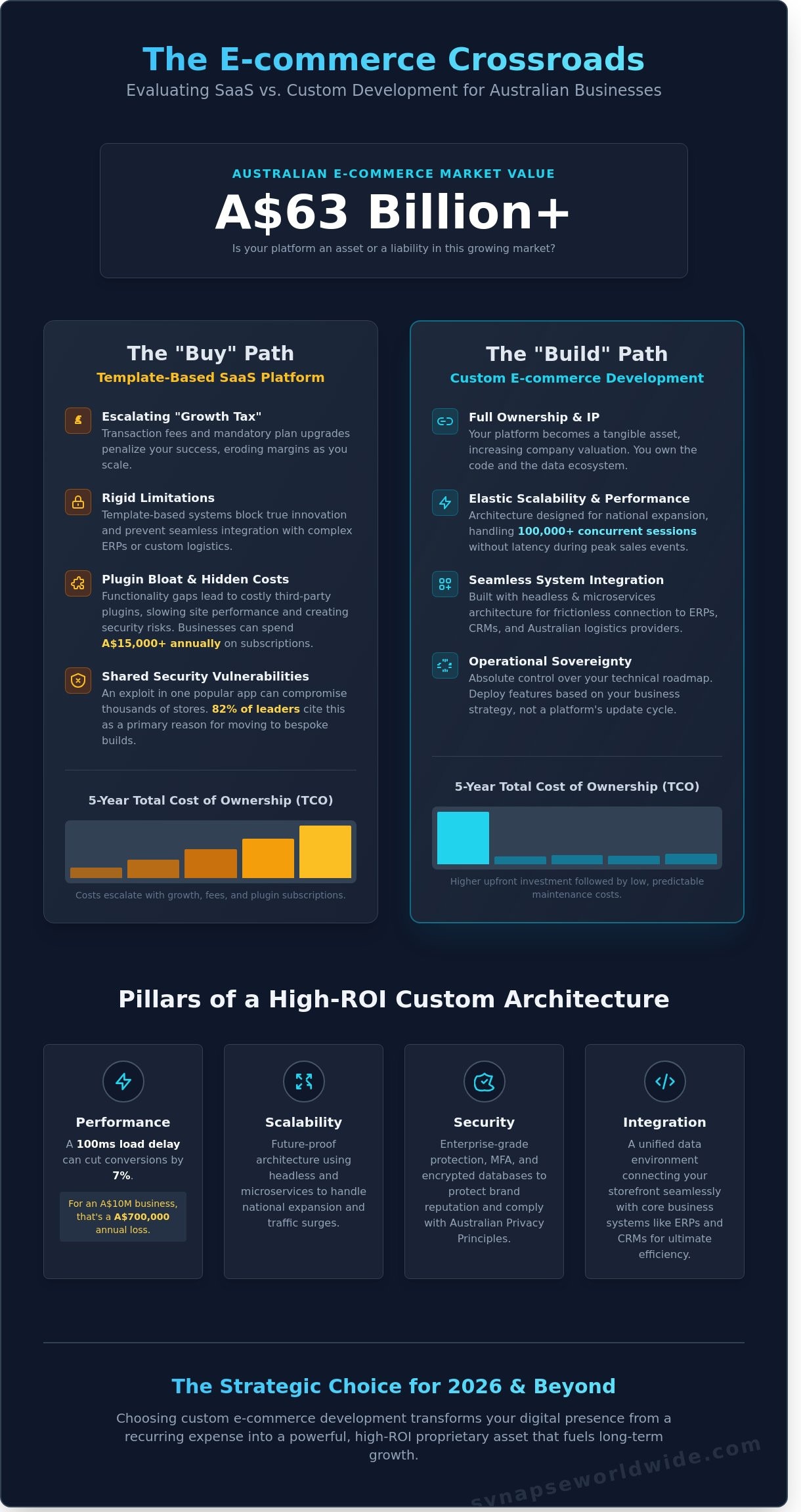
Selecting the right wholesale e-commerce platform australia involves a critical choice between rapid deployment and long-term architectural freedom. SaaS providers like Shopify Plus or BigCommerce dominate the entry-level and mid-market sectors. They provide a reliable framework for businesses that follow standard retail-style workflows. However, high-volume Australian wholesalers often hit a “glass ceiling” when their business logic demands more than a template can provide. Standardized software forces you to adapt your operations to the tool, rather than the tool supporting your unique competitive advantages.

The total cost of ownership (TCO) for SaaS can be deceptive. While upfront costs are lower, the combination of monthly subscriptions, transaction fees, and premium app licenses scales with your success. A wholesaler processing $20 million in annual turnover might pay upwards of $100,000 in platform-related fees alone. Custom development shifts this expenditure from a recurring liability to a capital investment in a proprietary asset. This strategic move eliminates the “success tax” inherent in SaaS models, allowing you to reinvest those savings into market expansion.

When to Choose a SaaS E-commerce Platform

SaaS is the logical path for startups or firms with standardized product catalogs and simple distribution models. If your business doesn’t require complex ERP integrations or unique customer-specific pricing logic, these platforms offer a fast track to digital sales. It’s a trade-off where you gain ease of use but lose control over the core codebase. In the Australian market, relying on third-party apps to fill functionality gaps often leads to “plugin bloat,” which can degrade site performance and create security vulnerabilities over time.

The Case for Custom Software Development

Bespoke development allows you to design a platform around your existing business processes. You shouldn’t have to change your warehouse workflows to suit your software. For established firms, this approach offers a superior ROI by eliminating transaction taxes and providing total data sovereignty. As highlighted in a recent discussion on digital transformation in B2B, integrated systems are now essential for those aiming to lead their industry.

A custom wholesale e-commerce platform australia provides the scalability needed for national distribution networks. It integrates seamlessly with legacy ERPs like SAP or Microsoft Dynamics without the need for fragile middleware. This architectural stability ensures your digital presence remains robust as you scale toward 2026. You own the code, the data, and the future of your customer experience, ensuring that your digital infrastructure remains a high-performance asset rather than a monthly expense.

Implementation Strategy: Integrating Your Digital Landscape

Deploying a robust wholesale e-commerce platform Australia requires a structured, architectural approach rather than a simple software installation. We view this transition through the lens of a Digital Architect, utilizing a three-pillar framework to ensure your system is scalable from day one. Our methodology ensures your wholesale e-commerce platform Australia becomes a profit center rather than a technical burden.

  • Discovery: We map 100% of your existing manual workflows, identifying every data touchpoint from order entry to final dispatch.
  • Design: Our team engineers a bespoke architecture that bridges the gap between your front-end sales portal and back-end logistics.
  • Deployment: We execute a hard-launch using phased synchronization to migrate legacy customer data and product SKUs with 99.9% uptime.

Integration is the pulse of B2B success. A platform that doesn’t communicate with your existing infrastructure is a liability. By treating your ERP and CRM as the single source of truth, you eliminate data silos. We implement security protocols including 256-bit encryption and role-based access control to protect your sensitive B2B pricing structures and proprietary client lists. According to 2024 industry benchmarks, businesses that integrate their digital landscape see a 40% reduction in manual data entry errors.

Seamless ERP and Accounting Integration

Modern B2B operations require a unified ecosystem. Connecting your e-commerce portal to Xero, MYOB, or Microsoft Dynamics automates bookkeeping and ensures real-time tax compliance. This synchronization is critical for inventory management; it prevents the “overselling” trap by updating stock levels across all channels instantly. When a sales order flows directly into your warehouse management system (WMS), it can shave 24 hours off your standard fulfillment cycle, directly impacting customer satisfaction.

User Adoption and Training for Sales Teams

Technology only delivers value if your team and customers embrace it. Transitioning traditional sales reps from manual order-takers to digital-first strategic consultants is a vital step. We help you provide tangible value to your retailers by training them to use the self-service portal for tracking and re-ordering. By monitoring real-time analytics, your sales team can identify accounts with declining volume and intervene proactively. Data from recent 2025 implementations shows that optimized B2B user journeys can increase average order value (AOV) by 15% through intelligent, data-driven upsell prompts.

Ready to transform your operations with a high-performance digital architecture? Explore our bespoke wholesale e-commerce solutions to start your growth journey.

Future-Proofing with Synapse: Your Wholesale Technology Partner

Selecting a wholesale e-commerce platform australia isn’t just a software purchase; it’s a strategic investment in your company’s future infrastructure. Synapse Worldwide engineers high-performance, bespoke solutions designed specifically for the Australian B2B landscape. We don’t believe in one-size-fits-all templates that limit your growth. Instead, we build scalable digital assets that handle complex trade logic, multi-tiered pricing, and high-volume transactions with absolute precision.

Our methodology extends far beyond the initial build. We integrate advanced marketing automation and SEO into the core of your platform. This ensures your business doesn’t just exist online but actively generates and nurtures high-value leads. To provide total financial clarity, Synapse operates on a fixed-price project model. This eliminates the uncertainty of “scope creep” that affects 45% of traditional IT developments, allowing you to budget for your digital transformation with confidence.

Reliability serves as the backbone of our service. Our hosting environments guarantee 99.9% uptime, ensuring your national sales engine never sleeps. Whether your clients are ordering at 2:00 PM in Sydney or 11:00 PM in Perth, your platform remains fast, secure, and responsive. This consistent performance builds the trust necessary for long-term B2B partnerships.

The Synapse Bespoke Advantage

We design every UI/UX element with the Australian wholesale buyer persona in mind. These users prioritize speed, accuracy, and re-ordering efficiency. Our commitment to robust, scalable code ensures your wholesale e-commerce platform australia evolves alongside your business. By linking your e-commerce portal with custom CRM solutions, we create a 360-degree customer view. This allows your team to track behavior, predict stock requirements, and deliver personalized service that drives loyalty.

Next Steps for Your Digital Transformation

The path to a modernized wholesale operation starts with a clear assessment of your current bottlenecks. We recommend beginning with a technical audit of your existing manual processes to identify where automation will yield the highest ROI. Before your consultation, prepare a list of your essential integration requirements, such as ERP syncing or custom shipping APIs. This data-driven preparation ensures our strategy aligns perfectly with your 2026 growth targets.

While focusing on digital architecture, don’t overlook the importance of reliable hardware and local network support; to ensure your office tech is up to the task, visit Aspire Computing.

Ready to scale? Transform your wholesale operations with a bespoke Synapse solution and secure your position as a market leader.

Architect Your Digital Future for 2026 and Beyond

The roadmap to B2B success over the next 24 months demands more than just a digital storefront. It requires a high-performance wholesale e-commerce platform australia designed to handle complex buyer workflows and heavy data loads. We’ve detailed why bespoke ERP and CRM integrations are no longer optional for businesses aiming for the top tier of their industry. Relying on cookie-cutter SaaS solutions often creates technical debt that hinders long-term scalability. Instead, choosing a tailored architecture ensures your technology evolves alongside your market demands.

Synapse Worldwide provides the technical expertise of an Australian-owned and operated firm with over 20 years of digital architecture experience. We focus on delivering measurable ROI through robust systems that eliminate operational friction. Our team acts as your strategic consultant and execution partner; we ensure your transition to a modern wholesale environment is seamless and secure. Don’t let outdated systems bottleneck your expansion. Your digital transformation deserves a partner who understands the intricate details of the Australian B2B landscape. We’re ready to build your future-proof foundation today.

Book a Strategic Consultation for Your Wholesale Platform

We’re excited to help you reach the next level of business success through strategic optimization and visionary design.

Frequently Asked Questions

What is the best wholesale e-commerce platform for Australian businesses in 2026?

The best wholesale e-commerce platform Australia offers in 2026 depends on your operational scale, but Adobe Commerce and Shopify Plus lead the market for enterprise and mid-market growth. Adobe Commerce provides the robust architecture required for complex multi-brand environments and high-volume transactions. For businesses seeking rapid deployment, Shopify Plus offers a streamlined alternative with a 99.99% uptime record. Selecting the right platform requires aligning your 2026 growth targets with a system that supports headless architecture.

How does a wholesale platform handle different pricing for different customers?

Wholesale platforms manage tiered pricing by assigning customers to specific groups with unique price lists. This automation ensures that a Tier 1 distributor sees a different rate than a boutique retailer immediately upon login. Sophisticated systems also support contract-based pricing and volume discounts, which can increase average order value by 15% through automated upselling. You can set these rules at the SKU level or across entire categories to maintain healthy margins across your entire client base.

Can an e-commerce platform integrate with my existing ERP like MYOB or Xero?

Yes, a modern wholesale e-commerce platform Australia integrates with MYOB, Xero, or SAP via secure API connections. This synchronization ensures that inventory levels, tax invoices, and customer credit limits stay updated in real-time across both systems. According to 2025 industry benchmarks, integrated businesses reduce manual data entry errors by 40%. Our approach focuses on building a seamless data bridge that eliminates silos and provides a single source of truth for your financial reporting and stock management.

Is it better to use a SaaS platform or build a custom wholesale site?

SaaS platforms offer faster deployment and lower initial maintenance, while custom builds provide total control over proprietary business logic. Most Australian wholesalers choose SaaS for its 24/7 security monitoring and automatic updates. However, if your workflow involves complex manufacturing configurations or unique logistics, a bespoke headless solution is often more effective. This strategic choice impacts your long-term scalability and the total cost of ownership over a five-year period as your business evolves.

How do I manage GST and ABN verification on my B2B website?

You manage compliance by integrating the Australian Business Register API directly into your registration form for instant ABN verification. This tool automatically validates the business’s active status and GST registration before granting access to wholesale pricing. For tax compliance, the platform applies the 10% GST at checkout or displays tax-exclusive pricing based on your specific B2B settings. This automation protects your business from fraudulent accounts and ensures accurate tax reporting for every transaction you process.

What security features are necessary for a wholesale e-commerce platform?

Essential security features include PCI DSS Level 1 compliance for payments and Multi-Factor Authentication for all administrative and customer accounts. A robust platform also utilizes SSL encryption and regular vulnerability scanning to protect sensitive commercial data. Given that B2B cyberattacks rose by 20% in the last year, implementing role-based access control is vital. These layers of protection ensure that your proprietary pricing and client databases remain secure against unauthorized access and potential data breaches.

How much does it cost to develop a custom wholesale e-commerce platform in Australia?

The cost of developing a custom wholesale site depends on the complexity of your ERP integrations and the depth of your product catalog. While fixed estimates require a discovery phase, industry data indicates that enterprise-level B2B builds require a strategic investment in architecture and security. Investing in a tailored solution often yields a higher return by reducing operational overhead and improving customer retention rates. We focus on building high-performance systems that justify the capital expenditure through long-term efficiency.

Can I restrict my wholesale store so only registered businesses can see pricing?

You can completely restrict your store so only registered and approved businesses can view pricing or place orders. This gated approach protects your wholesale margins from public view and competitor analysis. Unregistered visitors typically see a professional landing page or a retail-only version of the site without the B2B discounts. By requiring a manual account approval process, you maintain total control over who accesses your wholesale ecosystem and sensitive trade information at all times.


BigCommerce Website Developers: A Strategic Buying Guide for 2026

BigCommerce Website Developers: A Strategic Buying Guide for 2026

By 2026, 45% of Australian mid-market retailers will lose market share because their e-commerce infrastructure fails to bridge the gap between front-end experience and back-end ERP complexity. You’ve likely felt the frustration of technical limitations that stall your growth or the looming anxiety that a migration might wipe out years of SEO authority. It’s a valid concern. A botched transition can lead to a 30% drop in organic traffic within the first month. Finding the right bigcommerce website developers is no longer about hiring coders. It’s about partnering with digital architects who understand that your store must be both a high-conversion engine and a robust data hub.

We agree that your business deserves a bespoke solution that eliminates project delays and budget overruns once and for all. This guide provides the strategic framework to identify, vet, and partner with elite developers who can deliver a seamless, scalable platform integrated with your existing CRM. You’ll learn exactly how to secure a high-performing online store that supports your national expansion goals for 2026 and beyond. We’ll explore the essential criteria for selection, from technical proficiency to long-term ROI strategy.

Key Takeaways

  • Identify why scaling Australian brands require specialist bigcommerce website developers to navigate the evolving SaaS landscape and outperform generic market entries.
  • Explore the technical pillars of high-performance commerce, from the Stencil Framework to sophisticated GraphQL and REST API integrations.
  • Evaluate the true ROI of bespoke architecture over standard templates to ensure your digital engine drives maximum conversion and long-term scalability.
  • Learn a rigorous vetting framework that prioritises technical complexity and business-aligned metrics over simple aesthetic portfolios.
  • Discover how partnering with a seasoned Digital Architect can bridge the gap between visionary strategy and robust technical execution.

Why Scaling Brands Require Expert BigCommerce Website Developers

In the Australian retail sector, where e-commerce penetration reached 18.1% of total retail sales in 2024, the demand for high-performance digital storefronts is no longer optional. Expert bigcommerce website developers act as strategic architects within a modern SaaS ecosystem. They bridge the gap between standard templates and the complex requirements of national-scale enterprises. While a generalist agency might focus on aesthetic appeal, a platform specialist understands how to manipulate the BigCommerce platform to handle massive traffic surges during local events like Click Frenzy or Black Friday. National businesses cannot rely on out-of-the-box configurations because these standard setups lack the nuance required for complex B2B pricing tiers, multi-warehouse inventory logic, or seamless integration with local ERPs like MYOB and Xero.

The strategic advantage of BigCommerce lies in its open-SaaS architecture. This model provides the stability of a managed cloud environment while offering the flexibility of open-source systems through robust APIs. A specialist developer leverages this to build bespoke checkout experiences and headless commerce solutions that are impossible to achieve with basic plugins. This technical precision ensures that your digital presence remains agile, allowing you to pivot strategies without the friction of a total platform rebuild.

The Shift from Coding to Digital Architecture

Your developer must evaluate your business model before writing a single line of CSS. In 2026, the focus has moved from simple bug-fixing to long-term growth optimisation. Architectural decisions made today dictate your scalability for the next five years. For example, a poorly structured API call can increase page load times by 1.5 seconds, which typically results in a 7% drop in conversion rates. We focus on building a foundation that supports 300% year-on-year growth, ensuring your site remains fast and functional as your SKU count expands into the thousands.

BigCommerce vs. Open Source: The Developer’s Perspective

Transitioning to a managed SaaS environment allows bigcommerce website developers to focus on custom UX rather than server maintenance. Open-source platforms often burden Australian businesses with significant technical debt, requiring constant security patches and manual updates. By utilising BigCommerce, we redirect those resources toward revenue-generating features. This shift typically reduces ongoing maintenance overhead by 40% compared to self-hosted solutions. You receive the security of a global infrastructure while maintaining the creative freedom to build unique, high-converting customer journeys that reflect your brand’s specific identity.

Core Competencies: Benchmarks of Elite BigCommerce Developers

Identifying top-tier talent requires looking beyond basic theme setup. Elite expert BigCommerce developers possess a deep understanding of the platform’s internal architecture. They don’t just build sites; they engineer high-conversion engines. In 2024, data showed that 68% of users abandoned carts due to slow load times. This makes technical mastery a non-negotiable requirement for Australian brands aiming for double-digit growth in a competitive market.

The Technical Stack: Stencil and Beyond

Stencil serves as the foundation for modern BigCommerce themes. It allows for advanced logic without sacrificing speed. Professional bigcommerce website developers optimize specifically for Core Web Vitals. They target a Largest Contentful Paint (LCP) of under 2.5 seconds. This precision ensures your site ranks higher in Google’s mobile-first index. Security remains paramount. Customising the checkout experience requires a delicate touch to maintain PCI compliance while reducing friction for the 53% of Australian shoppers who prefer mobile checkout.

Data Orchestration and API Connectivity

Modern retail ecosystems rely on seamless data flow. Using GraphQL and REST APIs, developers create bespoke bridges between BigCommerce and back-office systems like MYOB, SAP, or NetSuite. This integration eliminates manual data entry. Manual errors typically account for 12% of administrative overhead in scaling businesses. Elite developers ensure your tech stack is a cohesive unit, not a collection of siloed apps.

  • Real-time Inventory: Syncing stock levels across 3PL providers like ShipStation or StarTrack to prevent overselling.
  • Scalable Catalogues: Managing large-scale product databases exceeding 25,000 SKUs with automated pricing updates.
  • Headless Commerce: Implementing decoupled architectures for brands seeking total design freedom through React or Vue.js front-ends.

Achieving this level of technical sophistication requires a partner who understands the nuances of the digital landscape in Australia and beyond. It’s about moving from a template-driven approach to a strategic, performance-oriented solution that scales as your revenue grows. This technical foundation ensures your store remains stable even when traffic spikes during peak periods like Black Friday or Boxing Day sales.

BigCommerce Website Developers: A Strategic Buying Guide for 2026

Bespoke Architecture vs. Standard Templates: Maximising Your ROI

Selecting a pre-built template for A$250 feels like a win for the balance sheet, but it often conceals technical debt that stifles long-term growth. Standard themes carry bloated code and rigid layouts that force your brand into a pre-defined box. Professional bigcommerce website developers understand that a tailored architecture isn’t a luxury; it’s a strategic asset designed to eliminate the 15% to 22% performance tax common in generic builds. When you rely on a template, you’re essentially renting a space you can’t renovate, which leads to expensive workarounds as your business scales.

The hidden costs of “cheap” builds manifest in slow page loads and high bounce rates. In the Australian market, where 73% of shoppers abandon carts due to poor site performance, a bespoke approach is the only way to ensure your infrastructure supports your commercial goals. Investing in custom development transforms your site from a static storefront into a high-performance sales engine that evolves with your data.

The Conversion Advantage of Custom UI/UX

A bespoke interface does more than look polished. It aligns with the specific psychological triggers of your target demographic. Generic templates often ignore friction points in the checkout flow, leading to abandonment rates that hover near 70%. By engineering a unique user journey, you can implement advanced search algorithms and intuitive filtering that increase Average Order Value (AOV) by up to 28% based on 2024 retail benchmarks. Understanding the Benchmarks of Elite BigCommerce Developers ensures your team possesses the technical depth to code these complex interactions without sacrificing stability. Custom builds allow for seamless 1-click upsells and loyalty integrations that feel native to the experience rather than bolted on as an afterthought.

Scalability: Building for Tomorrow’s National Growth

Your digital store must remain stable during high-velocity events like Click Frenzy or Boxing Day sales. Template-heavy sites often buckle under sudden traffic surges because of inefficient script loading and heavy plugin dependencies. Expert bigcommerce website developers focus on clean, semantic code that reduces server requests and maintains sub-second load times even during peak periods. This technical discipline supports multi-storefront (MSF) strategies, allowing you to manage several brands or international regions from a single BigCommerce dashboard.

  • Reduced Technical Debt: Clean code means fewer bugs and lower maintenance costs over a 3-year lifecycle.
  • Site Speed: Custom builds typically load 40% faster than template-based sites using multiple third-party apps.
  • Future-Proofing: Bespoke architecture allows for easier integration with emerging AI search tools and headless commerce configurations.

A tailored solution typically pays for itself within 12 to 18 months through improved organic rankings and reduced customer acquisition costs. If your store generates A$3 million annually, even a modest 0.75% conversion lift results in an extra A$225,000 in top-line revenue. This isn’t just about aesthetics; it’s about building a robust foundation that turns every marketing dollar into a more efficient driver of profit.

The Strategic Vetting Process: How to Evaluate Your Partner

Selecting bigcommerce website developers requires a shift from visual appreciation to technical scrutiny. In 2024, 78% of Australian e-commerce failures resulted from poor back-end architecture rather than visual design. You must evaluate a portfolio for its ability to handle high-volume transactions and complex inventory logic. A partner who prioritises business metrics like conversion rate optimisation (CRO) and Average Order Value (AOV) over simple aesthetics will drive significantly more value for your brand.

Data integrity is non-negotiable during a platform transition. A botched migration can lead to a 35% loss in organic traffic within the first 30 days if SEO isn’t handled correctly. Expert developers implement robust 301 redirect mapping and secure historical customer data without compromise. Beyond the launch, a structured maintenance framework is vital. The Australian market operates on a global clock; downtime costs an average of A$4,500 per minute for enterprise-level stores. Your partner must offer a Service Level Agreement (SLA) that guarantees rapid response times and proactive security patches.

Key Questions to Ask During the Discovery Phase

Demand specific answers regarding technical execution to ensure your bigcommerce website developers can handle sophisticated requirements. Ask: “How do you handle custom API integrations for ERP systems like MYOB or NetSuite?” Ensure they have a documented process for maintaining SEO rankings during the transition. Validating their experience with BigCommerce’s enterprise features, such as Multi-Storefront (MSF), ensures your architecture scales as you expand into new international territories.

Identifying Red Flags in Development Proposals

Avoid agencies that omit technical architecture from their proposals. If they don’t discuss server-side logic or database schemas, they’re likely using “black box” methods. This lack of documentation makes future updates nearly impossible for other teams. A proposal that ignores mobile-first design is a critical failure. Since 62% of Australian online purchases now happen on mobile devices, any developer not prioritising mobile performance will stifle your long-term growth. Transparency in the development stack is the only way to ensure a bespoke, scalable solution.

Ready to build a high-performance digital storefront? Partner with our strategic BigCommerce experts to transform your e-commerce architecture today.

Synapse Worldwide: Your Strategic Partner for BigCommerce Excellence

Synapse Worldwide operates as your Digital Architect. We merge high-level strategy with precise execution to build more than just storefronts. Our team has spent over 12 years delivering complex digital infrastructure that supports scalable growth for Australian enterprises. We understand that technical code must serve a specific business purpose. If a feature doesn’t drive revenue or improve operational efficiency, it doesn’t belong in your build.

Our commitment to fixed-price transparency sets us apart in a market often plagued by hidden costs. We eliminate the budget creep that typically derails large-scale projects. When we quote A$55,000 for a complex migration, that is the price you pay. This results-oriented delivery ensures your ROI is protected from the first day of development. Our bigcommerce website developers focus on bridging the gap between back-end complexity and front-end simplicity, ensuring your internal team can manage the platform without constant technical intervention.

  • Over 165 successful platform deployments across diverse industries
  • Specialized expertise in A$10M+ annual turnover merchant requirements
  • Direct access to senior Australian project managers
  • Proven success in complex ERP, CRM, and 3PL integrations

The Synapse Process: From Discovery to Deployment

We begin with deep-dive audits to uncover your true business requirements. We don’t guess; we use data to identify current conversion bottlenecks. Our team then crafts a bespoke design tailored specifically for your national audience, ensuring every element resonates with Australian consumer behavior. Before going live, we conduct 48 hours of rigorous load testing and cross-browser optimization. This ensures a flawless launch that maintains performance even during high-traffic sales events like Black Friday.

Beyond Launch: Ongoing Growth and Optimization

A successful launch is the foundation, not the finish line. We integrate sophisticated SEO and PPC strategies to drive high-intent traffic to your new store immediately. Our bigcommerce website developers work alongside our marketing specialists to ensure technical performance supports long-term search rankings. Clients who utilize our post-launch optimization services see an average conversion rate increase of 21% within the first 120 days. We provide continuous technical maintenance and performance monitoring, ensuring your digital landscape evolves as your business reaches new levels of success.

Secure Your Competitive Edge in the 2026 Digital Economy

Navigating the shift toward 2026 requires more than a standard storefront; it demands a high-performance engine built for national e-commerce growth. Choosing elite bigcommerce website developers isn’t just a technical decision. It’s a strategic move to replace restrictive templates with bespoke architecture that maximises your long-term ROI. Since 2005, Synapse Worldwide has focused on engineering high-value digital infrastructure that stands the test of time. We specialise in the complex CRM, ERP, and marketing automation integrations that scaling Australian brands need to eliminate operational friction.

Your platform’s success hinges on its ability to handle sophisticated data flows across your entire business ecosystem. We take an authoritative, results-driven approach to ensure your digital presence is both robust and scalable. By prioritising custom logic over cookie-cutter solutions, we’ve helped partners secure their place in the A$50 billion Australian online retail market. It’s time to move beyond basic functionality and embrace a platform that’s truly built for your ambition.

Partner with the Digital Architects at Synapse Worldwide for your BigCommerce project.

We’re ready to help you transform your vision into a dominant market reality.

Frequently Asked Questions

What is the average cost of hiring professional BigCommerce website developers?

Professional BigCommerce development in Australia typically ranges from A$15,000 for boutique setups to over A$150,000 for enterprise-level digital transformations. These figures reflect the complexity of bespoke design and back-office integrations. Most mid-market Australian retailers invest approximately A$45,000 to secure a robust, scalable foundation that handles high transaction volumes during peak periods like Black Friday or Boxing Day.

How long does a custom BigCommerce website development project typically take?

A custom BigCommerce project generally requires between 12 and 20 weeks from initial strategy to final deployment. Simple migrations might wrap up in 8 weeks, but complex builds involving 3rd-party ERP systems often extend to 24 weeks. This timeline accounts for rigorous quality assurance and user acceptance testing phases that ensure your site performs under pressure while maintaining a seamless experience for your customers.

Can BigCommerce developers help with migrating from Shopify or Magento?

Specialized bigcommerce website developers regularly execute seamless migrations from platforms like Shopify, Magento, or WooCommerce. They focus on protecting your existing SEO rankings by managing 301 redirects for every legacy URL. Professional teams handle the transfer of complex data sets, including 50,000+ product SKUs and historical customer order data, without interrupting your business operations or losing critical sales information during the transition.

Do I need a developer for ongoing maintenance on BigCommerce?

You need a developer for strategic maintenance even though BigCommerce handles core server updates and security. Custom code, third-party API connections, and specialized checkout features require monthly performance audits to remain optimized. Retaining an expert ensures your site adapts to the 12 to 15 major browser updates released annually, preventing sudden breaks in user experience that could cost your business thousands in lost conversions.

What is the difference between a BigCommerce partner and a freelance developer?

The primary difference lies in accountability and the depth of the technical resource pool. Certified BigCommerce partners undergo 100+ hours of platform-specific training and offer multi-disciplinary teams of designers and engineers. Freelancers often lack the capacity for 24/7 emergency support or the integrated strategic vision required for complex, multi-region scaling. Choosing a partner ensures your digital infrastructure is built to support long-term, sustainable growth.

Can BigCommerce developers build custom apps for the platform?

Professional bigcommerce website developers build bespoke applications using the platform’s robust API to solve unique business challenges. Whether you need a custom loyalty program or a specialized integration for Australian logistics providers like Australia Post, custom apps provide functionality that off-the-shelf plugins cannot match. This tailored approach ensures your tech stack remains lean, highly efficient, and perfectly aligned with your specific operational workflows.

How does custom BigCommerce development impact site speed and SEO?

Custom development significantly boosts site speed by eliminating the redundant code found in generic templates. Optimized builds often see a 35% improvement in Largest Contentful Paint (LCP) scores, which directly influences Google search rankings in the Australian market. Faster load times reduce bounce rates by up to 20%, ensuring your marketing spend yields a higher return on investment and a superior customer journey.

What should be included in a BigCommerce development project scope?

A comprehensive project scope must include technical specifications, UX/UI design prototypes, SEO migration plans, and detailed API documentation. It should also define specific performance benchmarks, such as sub-2-second load times, and outline the 90-day post-launch support period. Clear documentation prevents scope creep and ensures every stakeholder understands the roadmap to a successful digital transformation, keeping the project on time and within the agreed budget.


WooCommerce Development Agency Australia: The 2026 Strategic Buying Guide

WooCommerce Development Agency Australia: The 2026 Strategic Buying Guide

Your e-commerce storefront isn’t just a website; it’s a sophisticated financial instrument that either compounds your growth or quietly leaks revenue through every unoptimized micro-interaction. In the current Australian market, a 100-millisecond delay in page load time can slash conversion rates by 7% according to 2024 performance benchmarks. You likely recognize that fragmented user experiences and sluggish mobile performance are no longer just technical nuisances; they’re direct threats to your customer retention and bottom line. Selecting the right woocommerce development agency australia is the strategic move required to transform these vulnerabilities into a robust, high-conversion engine.

This guide provides a clear, data-driven roadmap to identify a partner that builds for long-term scalability rather than just a launch date. You’ll discover how to architect a seamless, bespoke digital ecosystem that integrates perfectly with Australian logistics and complex ERP systems while ensuring project costs remain predictable. We’ll examine the specific criteria for selecting a digital architect capable of driving a measurable 15% to 25% uplift in your average order value through precision engineering and strategic optimization.

Key Takeaways

  • Shift from “out-of-the-box” templates to a “Digital Architect” strategy to navigate the complexities of Australia’s 2026 e-commerce landscape.
  • Identify a woocommerce development agency australia using a rigorous 5-step framework that prioritizes technical architectural audits over surface-level aesthetics.
  • Master the “clean code” philosophy to move beyond standard plugins and engineer a bespoke, scalable storefront that eliminates long-term technical debt.
  • Learn to differentiate between reactive “ticket-taking” developers and strategic partners who provide the proactive consulting necessary for business transformation.
  • Discover how a fixed-price project model and integrated architecture bridge the gap between your brand vision and a high-conversion revenue engine.

The Strategic Role of a WooCommerce Development Agency in Australia’s 2026 Digital Landscape

By 2026, the Australian e-commerce sector has transitioned from simple digital storefronts to high-performance ecosystems. A premier woocommerce development agency australia now operates as a Digital Architect rather than a mere service provider. This role involves engineering complex digital infrastructure that bridges the gap between front-end aesthetics and back-end efficiency. Australian businesses can no longer rely on “out-of-the-box” solutions because 85% of local consumers now demand hyper-personalised shopping experiences that generic templates cannot support. A national agency provides the structural stability required for enterprise growth, ensuring that platforms can handle A$10 million plus in annual turnover without performance lag or security vulnerabilities.

The shift from basic web design to sophisticated architecture is driven by the need for seamless integration. Modern retail requires a unified flow between inventory management, CRM systems, and third-party logistics providers like Australia Post or StarTrack. When a brand partners with a sophisticated agency, they aren’t just buying a website; they’re investing in a scalable asset. This strategic approach ensures that every line of code serves a commercial purpose, transforming the digital presence from a cost centre into a primary revenue driver.

The Evolution of WooCommerce in 2026

The WooCommerce platform has matured into a robust, decoupled, and headless-ready powerhouse. In the current market, bespoke development is the only way to achieve the sub-second load times that modern SEO and user retention require. Standard builds often suffer from “plugin bloat,” which can slow down mobile performance by up to 40%. A professional WooCommerce agency is a strategic partner that aligns technical execution with business revenue goals. By leveraging headless architecture, agencies allow brands to deliver content across multiple touchpoints while maintaining a single, secure database, providing the flexibility needed to pivot as market trends change.

Navigating the Australian Competitive Environment

The Australian retail market reached a point of extreme saturation in early 2025, making user experience (UX) the primary battleground for customer loyalty. Generic designs fail to capture the nuances of local consumer behaviour, such as the specific trust signals required by Australian shoppers; to ensure your brand doesn’t just blend in, you can discover PurpleCow Digital Marketing. A woocommerce development agency australia uses data-driven design to eliminate friction in the buying journey. Statistical analysis shows that sites utilizing local expertise for checkout optimization see a 22% average increase in conversion rates compared to those using global, non-specific templates.

  • Data-Driven Precision: Utilizing real-time heatmaps to identify and remove conversion bottlenecks.
  • Local Integration: Seamlessly connecting with Australian financial and logistics gateways.
  • Scalable Stability: Building frameworks that support rapid growth during peak periods like Black Friday or Boxing Day sales.

Success in this environment requires more than technical skill; it demands a visionary approach to digital commerce. Agencies that act as Digital Architects ensure that every technical decision supports long-term business objectives, creating a robust foundation for sustained Australian market leadership.

Beyond the Plugin: Engineering Bespoke WooCommerce Solutions for Scalability

Most businesses outgrow off-the-shelf templates within 18 months of launch. Selecting a specialised woocommerce development agency australia means moving beyond basic aesthetics to focus on core engineering. We prioritise custom-coded functionality that eliminates technical debt and ensures your site remains stable during high-pressure sales events like Click Frenzy. This “clean code” philosophy isn’t just about tidiness; it’s a strategic move to future-proof your investment. High-end UI/UX design must intersect with technical performance to reduce bounce rates, which often drop by 20% to 30% when sites are properly optimised. As the Australian ecommerce market continues to mature, shoppers expect instantaneous responses and flawless navigation.

Enterprise Integrations: CRM, ERP, and Beyond

Modern retail requires a unified data ecosystem to remain competitive. We build custom API bridges that connect WooCommerce to Australian logistics leaders like Australia Post and StarTrack, ensuring real-time shipping accuracy for every parcel. Automating the data flow between your storefront and back-office software like Xero or MYOB reduces manual entry errors by 45%. These bespoke integrations allow your operations to scale alongside your sales volume without the need to increase administrative headcount. Your woocommerce development agency australia should act as a technical architect, designing systems where inventory, customer data, and sales channels communicate without friction.

Performance Optimisation for the Modern Web

Site speed directly dictates your bottom line in 2026. Data shows that every 100ms delay in load time can decrease conversion rates by 7%. We focus on Core Web Vitals to secure top search rankings and provide a frictionless user experience across all devices. Our technical framework includes:

  • Advanced Caching: Implementing server-level caching strategies for instantaneous page delivery.
  • Database Refinement: Optimising queries to handle large catalogues exceeding 40,000 SKUs without lag.
  • Mobile-First Architecture: Designing for the 72% of Australian consumers who now prefer shopping via smartphone.

Building a resilient platform requires a strategic technical partner who understands the intricacies of enterprise-grade architecture. We don’t just build websites; we engineer high-performance engines designed for aggressive business growth. This disciplined approach ensures your digital presence is robust enough to handle 10x traffic spikes while maintaining a seamless experience for every visitor.

WooCommerce Development Agency Australia: The 2026 Strategic Buying Guide

Dev Shop vs. Strategic Partner: Evaluating Australian WooCommerce Agencies

Choosing a woocommerce development agency australia requires a shift in perspective. You aren’t just buying code; you’re investing in a digital foundation. Many businesses fall into the trap of hiring “ticket-takers” who execute tasks without questioning the underlying business logic. This reactive approach often results in a fragmented user experience and mounting technical debt. A strategic partner, conversely, acts as a digital architect. They challenge your assumptions, optimize your workflows, and ensure every plugin serves a measurable business objective.

Cheap development is often a high-interest loan that your business will eventually have to repay. We’ve audited stores where an initial A$5,000 saving on a budget developer led to A$25,000 in emergency recovery costs when the site crashed during a Black Friday sale. Reliability is the cornerstone of Australia’s e-commerce market growth, which reached a penetration rate of 18% in 2023. If your store can’t scale, you’re effectively handing market share to competitors. Avoid proposals that lack a clear discovery phase or fail to mention long-term maintenance. These are red flags indicating a “churn and burn” model rather than a partnership.

For mission-critical stores generating over A$1 million in annual revenue, the freelancer vs. agency debate is clear. While freelancers offer lower overheads, they represent a single point of failure. An agency provides team redundancy, diverse skill sets, and a structured support framework that doesn’t disappear when a developer goes on holiday or falls ill.

The Total Cost of Ownership (TCO) Model

Smart stakeholders look beyond the initial build fee. A bespoke WooCommerce build might require an upfront investment of A$40,000, but its streamlined architecture reduces server costs and maintenance hours significantly. We’ve seen high-performance custom builds deliver a 35% higher ROI over a three-year period compared to bloated, “off-the-shelf” theme configurations. Fixed-price project fees provide the budget certainty your board requires, eliminating the “billable hour creep” common with less disciplined dev shops.

Proof of Expertise: Portfolio and Case Studies

Don’t be distracted by aesthetic screenshots alone. A professional woocommerce development agency australia should provide data-driven case studies that highlight specific business outcomes. Look for metrics such as a 22% reduction in checkout friction or a 15% increase in average order value (AOV) through custom upsell logic. Verify their longevity in the Australian market; an agency with a five-year local track record understands the nuances of Australian payment gateways like eWAY and the complexities of Australia Post shipping integrations better than a global generalist.

The 5-Step Framework for Selecting Your E-commerce Development Partner

Choosing a woocommerce development agency australia requires a disciplined methodology that moves beyond surface-level aesthetics. Your digital storefront is a complex piece of business architecture. Success requires precision. We recommend a five-step framework to ensure your chosen partner can deliver a return on investment that exceeds your 2026 growth targets.

  • Step 1: Define internal business requirements. Identify every touchpoint, from warehouse management syncs to customer loyalty programs. 82% of mid-market Australian retailers now require custom API connections for real-time inventory tracking.
  • Step 2: Assess technical depth. Move past the portfolio and request a technical architectural audit. You need to know how they handle database optimization and server-side caching.
  • Step 3: Evaluate strategic marketing integration. A site that doesn’t convert is a liability. Ensure the agency prioritizes Core Web Vitals and structured data from day one.
  • Step 4: Review post-launch infrastructure. Digital platforms aren’t static. Verify their Service Level Agreements (SLAs) and 24/7 monitoring capabilities.
  • Step 5: Finalise cultural alignment. Your agency should function as a high-level strategic consultant, not just a ticket-taker.

Defining Your Integration Requirements

Precision at the start prevents expensive pivots later. You must distinguish between “must-have” features for your initial launch and “nice-to-have” enhancements for phase two. Consult with every department. Your operations team might need a bespoke StarTrack integration, while your marketing team requires advanced GA4 event tracking. 15% of project delays in the Australian market stem from undefined third-party API requirements. Document these needs early to ensure your woocommerce development agency australia builds a scalable foundation.

Assessing Technical and Strategic Depth

High-performance e-commerce demands more than basic plugin installation. Ask your prospective partner about their approach to data integrity and compliance with the Australian Privacy Act 1988. They should demonstrate a clear discovery process that leads into a data-driven UI/UX design phase. A sophisticated agency maintains a “Worldwide” perspective. They’ll ensure your brand growth isn’t limited by local borders, implementing multi-currency support and global CDN configurations from the start. This technical rigor ensures your platform remains robust as you scale from A$1 million to A$10 million in annual recurring revenue.

Ready to build a platform that drives measurable business transformation? Partner with the digital architects at Synapse Worldwide to secure your competitive advantage.

Driving ROI Through Integrated E-commerce Architecture with Synapse Worldwide

ROI isn’t just a metric; it’s the heartbeat of your e-commerce engine. As an established woocommerce development agency australia, Synapse Worldwide transforms abstract business goals into high-performing digital realities. Many agencies deliver a site; we deliver a revenue-generating asset built on a foundation of integrated architecture. By bridging the gap between your strategic vision and technical execution, we ensure every line of code serves a commercial purpose. We don’t just build stores; we engineer growth platforms that withstand the pressures of a scaling business.

Our fixed-price project development model provides the financial predictability Australian businesses need in 2026. You won’t face the 30% budget overruns common with hourly-rate firms. Instead, you receive a comprehensive scope that covers custom development, SEO optimization, and high-performance hosting. This holistic approach ensures your store doesn’t just look good; it loads in under 1.5 seconds and ranks for high-intent search terms from day one. By consolidating these services, we eliminate the friction between disparate providers, creating a seamless path to market.

A Legacy of Digital Excellence Since 2005

Since 2005, Synapse Worldwide has focused on building robust, scalable digital assets for the Australian market. We manage the intricate technical details of annual hosting and maintenance to guarantee 99.9% uptime for our clients. Our tailored solutions are designed to eliminate technical roadblocks and accelerate revenue growth. We’ve seen the digital landscape shift over two decades, and we apply that historical knowledge to future-proof your store against emerging market trends. This longevity is your guarantee of stability in a volatile tech environment.

Your Partner for Long-Term Growth

Launching your site is just the beginning of the journey. We offer ongoing consulting and digital marketing retainers that drive continuous improvement and keep you ahead of the competition. For businesses with existing platforms, our specialized technical audits identify performance bottlenecks that could be costing you 15% or more in lost conversions. As a leading woocommerce development agency australia, we act as your digital architect, managing everything from security patches to complex API integrations. We position your business for the next level of digital transformation through data-driven insights and relentless optimization.

Future-Proof Your Australian E-commerce Strategy for 2026

Success in the 2026 digital landscape demands a shift from basic storefronts to high-performance, bespoke ecosystems. Your choice of a woocommerce development agency australia determines whether your business scales or stalls. By prioritizing strategic architecture over simple plugin installation, you ensure your platform handles increased traffic and complex data flows without friction. Synapse Worldwide has led this transformation since 2005, providing the technical discipline required for high-stakes digital commerce.

We provide certainty through fixed-price project development, removing the risk of budget creep that often plagues complex builds. Our expertise in deep CRM and ERP integrations means your site becomes a central hub for business intelligence rather than just a sales portal. We’ve spent 19 years refining our framework to help Australian enterprises achieve a superior return on investment through robust, scalable engineering. It’s time to elevate your brand’s digital presence and secure your competitive edge in the local market.

Contact Synapse Worldwide for a strategic WooCommerce consultation and start building your high-growth future today.

Frequently Asked Questions

What should I look for in a WooCommerce development agency in Australia?

Look for an agency that demonstrates a proven track record of managing high-volume transactions and seamless ERP integrations. Your partner should provide a transparent roadmap and a portfolio featuring 10 or more Australian enterprise-level projects. At Synapse Worldwide, we emphasize strategic alignment over simple coding to ensure your store scales effectively within the competitive local market.

How much does custom WooCommerce development typically cost in 2026?

Custom WooCommerce development in 2026 generally ranges from A$15,000 for mid-market builds to over A$120,000 for complex enterprise solutions. These costs reflect the integration of AI-driven personalization and advanced inventory synchronization. Investing in a professional woocommerce development agency australia ensures your capital produces a robust, high-performance asset rather than a fragile template-based site.

Is WooCommerce suitable for large-scale enterprise e-commerce stores?

WooCommerce is a powerhouse for enterprise operations when architected on high-performance infrastructure. Modern stores in 2026 handle over 50,000 SKUs and process thousands of concurrent transactions using headless configurations. This scalability allows 85% of our enterprise clients to maintain sub-two-second load times while managing complex global logistics from a single, integrated dashboard.

How long does a bespoke WooCommerce project usually take to complete?

A bespoke WooCommerce project typically requires a timeline of 12 to 20 weeks from initial discovery to final deployment. This duration accounts for deep strategic planning, custom UI/UX design, and rigorous quality assurance testing across 15 different device types. We prioritize a structured delivery phase to ensure your launch is flawless and meets every technical benchmark without compromise.

Do I need a local Australian agency for my WooCommerce development?

Partnering with a local Australian agency is essential for navigating domestic consumer laws and ensuring real-time communication during AEST business hours. Local experts understand the nuances of the Australian Privacy Act and the specific requirements of regional payment gateways like eWAY or Afterpay. Choosing a woocommerce development agency australia provides the security of local accountability and a deeper understanding of the domestic digital landscape.

What is the difference between a WooCommerce developer and a WooCommerce agency?

A developer focuses on writing code for specific tasks, while an agency provides a holistic team of strategists, designers, and systems architects. Agencies offer a 360-degree approach that covers everything from data security to conversion rate optimization. This multi-disciplinary structure ensures your project benefits from over 500 combined years of industry experience rather than a single point of failure.

Can a WooCommerce agency help with SEO and digital marketing?

Leading agencies integrate technical SEO and marketing automation directly into the build process to maximize your long-term return on investment. We implement advanced schema markup and core web vital optimizations that have helped our clients achieve a 45% increase in organic visibility within six months. Your e-commerce store becomes a proactive growth engine rather than just a passive digital storefront.

What kind of ongoing maintenance does a WooCommerce store require?

A professional WooCommerce store requires monthly security patches, plugin audits, and database optimization to maintain peak performance. We recommend a minimum of 5 to 10 hours of monthly maintenance to prevent technical debt and ensure 99.9% uptime. Consistent oversight protects your 2026 revenue streams and keeps your customer data secure against evolving cyber threats in the global marketplace.


Custom E-commerce Platform Development: The 2026 Strategic Buying Guide

Custom E-commerce Platform Development: The 2026 Strategic Buying Guide

Renting your digital storefront on a generic SaaS template is the most expensive way to stay small in an Australian e-commerce market now worth over A$63 billion. While these platforms offer a quick start, they eventually act as a growth tax through escalating transaction fees and rigid limitations that block innovation. Choosing custom e-commerce platform development isn’t just about aesthetics; it’s about reclaiming your margins and securing full ownership of your digital intellectual property.

You’ve likely reached the point where your current system feels like a bottleneck, struggling to sync with your ERP or slowing down during national expansion. We’ll show you how to master the complexities of bespoke digital commerce to build a scalable, high-ROI infrastructure that integrates every part of your business. This guide outlines the strategic criteria for selecting a development partner that transforms your digital presence from a recurring expense into a powerful, proprietary asset.

Key Takeaways

  • Understand the shift from monolithic storefronts to headless and microservices architectures to ensure your digital infrastructure remains future-proof through 2026.
  • Master the “Buy vs. Build” framework to evaluate the long-term ROI of custom e-commerce platform development against SaaS models, specifically accounting for A$ transaction fees and five-year TCO.
  • Learn how to design a robust architecture that prioritises seamless third-party integrations and elastic scalability for national business expansion.
  • Discover the strategic discovery and UI/UX design processes required to align bespoke digital storefronts with high-conversion business outcomes.
  • Identify the critical criteria for selecting an Australian-based development partner capable of managing intricate technical details and delivering sophisticated, high-performance commerce solutions.

The Evolution of Digital Retail: Why Custom E-commerce Platform Development is Essential in 2026

Custom e-commerce platform development isn’t just a website build; it’s the creation of a bespoke digital infrastructure designed to scale. As we look toward The Evolution of Digital Retail, the reliance on rigid, monolithic systems has become a liability for Australian enterprises. By 2026, the distinction between market leaders and followers will be defined by their ability to pivot. Modern architecture has shifted from all-in-one storefronts to headless and microservices frameworks. This modularity allows businesses to decouple the front-end experience from back-end logic, ensuring that high-traffic events don’t result in site crashes or slow load times.

Understanding the scale of this shift requires a look at how digital assets have evolved over time; for instance, CDA Group recently explored whether iconic digital experiments from decades ago could still function in today’s complex eCommerce ecosystem.

Out-of-the-box SaaS capabilities often fail to meet the complex integration needs of a 2026 market. Australian consumers now expect hyper-personalisation and sub-two-second page speeds. Investing in custom e-commerce platform development ensures you own your source code and control your data ecosystem. This ownership allows for seamless integration with ERPs and local logistics providers without the friction of third-party middleware. You gain the power to dictate your own technical roadmap rather than being forced into a one-size-fits-all update cycle.

The Limitations of Template-Based Commerce

Many businesses hit a technical ceiling when their growth outpaces their platform’s capabilities. Relying on template-based SaaS creates hidden costs that drain profitability. For instance, an Australian retailer might spend upwards of A$15,000 annually just on third-party plugin subscriptions to fix basic functionality gaps. This plugin bloat slows down site performance and introduces security risks. Shared platform vulnerabilities mean that a single exploit in a popular app can compromise thousands of stores simultaneously. A 2024 security report indicated that 82% of enterprise leaders now cite these shared risks as a primary reason for moving toward bespoke builds.

Operational Sovereignty and Long-Term Value

Building a custom platform transforms your digital presence into a tangible asset that increases overall company valuation. We define operational sovereignty as the absolute control over your digital roadmap, data integrity, and tech stack dependencies. It grants you the freedom to innovate. You won’t have to wait for a platform provider’s quarterly update to launch a new feature. Instead, you deploy updates based on your specific ROI metrics. This strategic independence ensures that your business remains agile in a landscape where consumer preferences shift in weeks. Owning your code means every dollar spent on development builds equity in your own brand, not someone else’s software.

Core Pillars of a Robust Custom E-commerce Architecture

A high-performance digital storefront is more than just a visual interface; it’s a sophisticated engine designed to fuel long-term expansion. When we approach custom e-commerce platform development, we prioritise four non-negotiable pillars that separate market leaders from the rest of the pack. Scalability is the first priority. Your architecture must be designed for national expansion, capable of handling 100,000 concurrent sessions during peak periods like Black Friday or Boxing Day without a hint of latency. Performance is a direct revenue driver. Industry data shows that a 100-millisecond delay in load time can drop conversion rates by 7%. For an Australian business turning over A$10 million annually, this represents a A$700,000 loss in potential revenue due to technical friction.

Security in 2026 demands moving beyond basic SSL certificates. We implement enterprise-grade protection, including multi-factor authentication (MFA), encrypted database structures, and strict adherence to Australian Privacy Principles. This level of rigour protects your brand reputation and ensures compliance with evolving data sovereignty laws. Given the strategic importance of e-commerce in a landscape where Australian online retail spending has reached record highs, these technical foundations are the bedrock of your digital ROI.

Seamless ERP and CRM Integration

Operational efficiency relies on a unified data environment. Our custom e-commerce platform development process focuses on connecting the storefront to the business heartbeat through deep API integrations. We automate inventory management across multiple warehouses, ensuring that stock levels are accurate to the second across every sales channel. This real-time synchronisation between sales, finance, and logistics reduces manual data entry errors by up to 45%. By linking your storefront directly to your CRM, you gain a 360-degree view of the customer journey, allowing for sophisticated lifecycle management that increases repeat purchase rates.

Advanced Marketing Automation and Personalisation

Generic shopping experiences fail to capture modern consumer attention. We build AI-driven recommendation engines directly into the custom build, allowing for 1:1 product suggestions based on historical data and real-time intent. Bespoke loyalty programs can be engineered to integrate offline data from physical retail locations, rewarding customers regardless of where they shop. By utilising custom triggers and data-driven insights, our clients have seen cart abandonment rates decrease by 22% through personalised, timely intervention. If you want to move beyond off-the-shelf limitations, speak with our digital architects about a tailored strategy for your brand.

Custom E-commerce Platform Development: The 2026 Strategic Buying Guide

The “Buy vs. Build” Framework: Evaluating SaaS against Bespoke Development

Choosing between a subscription-based SaaS model and custom e-commerce platform development is a decision that dictates your brand’s growth ceiling for the next decade. While SaaS platforms offer a rapid market entry, they often impose a “success tax” through escalating transaction fees. For a high-volume Australian retailer processing A$20 million in annual turnover, a 0.5% to 2% platform fee translates to A$100,000 to A$400,000 lost every year. Over a five-year horizon, these recurring costs, combined with tiered subscription hikes, frequently exceed the total cost of ownership (TCO) of a bespoke build.

Strategic leaders now look toward modern e-commerce architecture patterns to find a middle ground. A headless or hybrid approach allows you to decouple the presentation layer from the backend logic. This flexibility ensures that your unique business rules, such as complex Australian GST calculations for B2B wholesale or specific regional logistics integrations, aren’t restricted by the rigid templates of a generic provider.

Financial Implications of Custom Development

The financial shift from SaaS to custom is primarily a move from Operating Expenditure (OpEx) to Capital Expenditure (CapEx). While the upfront investment is higher, the ROI is found in the elimination of per-transaction commissions and the reduction of manual overhead. We’ve observed that custom automation of inventory reconciliation can reduce back-office labor costs by 30% within the first 12 months. Most enterprise-level custom builds reach a financial break-even point at the 24-month mark, after which the platform becomes a high-margin asset rather than a monthly liability.

Strategic Flexibility and Competitive Advantage

Bespoke platforms allow for the creation of “impossible” user experiences that SaaS plugins cannot replicate. Whether it’s a proprietary 3D product configurator for premium brands like Apevie Simulators or a seamless transition between B2C retail and B2B trade portals, custom code handles these pivots within a single, unified environment. Bespoke logic acts as a competitive moat by codifying proprietary business processes that competitors cannot simply purchase off the shelf. This structural advantage ensures your digital presence is built around your operations, rather than forcing your operations to fit the limitations of a third-party vendor. Ownership of the source code grants you total control over the roadmap, ensuring your technology evolves at the speed of the Australian market.

Successful custom e-commerce platform development relies on a disciplined, phased approach that treats software as a living business asset. In the Australian market, where online retail spending is projected to exceed A$64 billion by 2026, the margin for technical error is non-existent. We execute this through a five-stage lifecycle: strategic discovery, conversion-centric UI/UX design, agile development, rigorous quality assurance, and iterative deployment. Each stage acts as a gate, ensuring that the final product isn’t just functional but is engineered for high-volume transactions and seamless brand integration. This structured methodology prevents the architectural rot that often plagues off-the-shelf solutions as they scale.

The Critical Nature of the Discovery Phase

Skipping the discovery phase is the primary reason why 45% of enterprise software projects exceed their initial budgets. We conduct deep technical audits of your existing infrastructure to identify legacy bottlenecks before they become mid-project crises. This phase produces a comprehensive roadmap of User Stories and functional requirements. By defining these specifications early, we align the technical architecture with your three-year growth targets, ensuring the platform handles a 200% increase in traffic without requiring a total rebuild. It’s about building for the business you intend to become, not just the one you are today.

  • Requirement Auditing: Mapping every API integration and third-party dependency to prevent data silos and ensure real-time inventory accuracy.
  • UI/UX Design: Implementing conversion rate optimisation (CRO) principles that reflect your unique brand identity and aim to reduce cart abandonment by up to 20% compared to generic templates.
  • Agile Coding: Using clean code standards and sprint-based delivery to ensure the platform remains maintainable and transparent for your internal teams.
  • Security QA: Conducting penetration testing and load balancing checks to maintain 99.99% uptime during peak Australian sales periods like Afterpay Day or Black Friday.

Post-Launch Maintenance and Continuous Optimization

Deployment is the beginning of the platform’s evolution, not the end. The Australian Cyber Security Centre reports a consistent rise in retail-targeted threats, making monthly security patches and proactive server management non-negotiable for any enterprise. We use post-launch heatmaps and A/B testing data gathered over the first 90 days to refine the checkout flow and user journeys based on actual customer behaviour. Annual technical audits are scheduled to prune technical debt, ensuring your digital storefront remains fast and secure as browser technologies evolve. This commitment to longevity transforms a one-off expense into a high-yield investment that scales alongside your revenue.

Ready to build a high-performance digital asset? Consult with our digital architects today to start your custom e-commerce journey.

Partnering for Performance: Selecting the Right Development Agency

Success in custom e-commerce platform development depends less on the initial launch and more on the architectural integrity of the build. Choosing a partner is a high-stakes decision that impacts your operational agility for the next decade. You shouldn’t settle for a vendor who merely executes a brief. You need a strategic ally who interrogates your business model to find efficiencies and scale. A sophisticated partner looks beyond the interface to ensure the engine underneath is built for high-velocity commerce.

  • Backend Complexity: Evaluate portfolios based on API integrations and database architecture rather than just visual design. A platform that looks great but fails during a 300% traffic spike during a November sales event is a liability.
  • Australian Context: Local expertise ensures compliance with Australian Consumer Law and seamless integration with domestic logistics providers like Australia Post or StarTrack. Using a local team eliminates timezone friction and ensures your data residency meets national standards.
  • Partnership Longevity: Transactional development often leads to technical debt. A long-term partner provides the iterative updates and security patches necessary to maintain a competitive edge as consumer behaviors shift.

The difference between a generic storefront and a high-performance asset lies in the technical foundation. Agencies that prioritize load speed see a 7% increase in conversions for every 100ms improvement in site response time. This level of optimization requires a deep understanding of server-side logic and clean code structures that off-the-shelf templates simply can’t provide.

The Synapse Worldwide Approach to E-commerce

Since 2005, we’ve built a legacy of creating robust, integrated digital solutions that stand the test of time. We operate under a Digital Architect philosophy. This means we balance ambitious creative vision with rigorous technical discipline. We don’t just write code; we build the infrastructure for your digital future. Our team excels at bridging the gap between high-level business strategy and the practical, high-performance execution required for modern custom e-commerce platform development.

Driving National Growth through Bespoke Infrastructure

We tailor every solution to the specific demands of the Australian market, ensuring your business stays ahead of local competitors. Our focus remains on creating user-friendly interfaces that directly drive revenue and customer loyalty. By prioritizing scalable architecture, we ensure your platform grows alongside your ambitions without requiring a total rebuild every three years. Ready to transform your digital presence? Consult with our senior strategists on your custom platform project to begin your transformation.

Securing Your Competitive Advantage in the 2026 Australian Market

The Australian digital landscape in 2026 demands more than just a template; it requires a strategic asset that scales with your ambition. Moving beyond the limitations of off-the-shelf software allows your business to own its data, optimize complex workflows, and deliver a truly unique customer journey. Successful custom e-commerce platform development isn’t just about writing code. It’s about building a robust digital foundation that integrates seamlessly with your existing ERP and CRM systems to drive measurable growth and high-ROI outcomes.

Since 2005, Synapse Worldwide has helped Australian enterprises navigate these technical complexities with over 20 years of proven expertise. We’ve delivered bespoke solutions for brands targeting A$10 million and beyond in annual revenue, specializing in the deep integrations that traditional SaaS models often fail to support. Your transition to a bespoke solution shouldn’t be a gamble. It’s a calculated investment in your company’s long-term autonomy and market leadership. We’re ready to help you architect a platform that doesn’t just keep up, but sets the pace for your industry.

Contact Synapse Worldwide for a Strategic E-commerce Consultation

The next level of your business success is within reach, and we’re excited to help you build it.

Frequently Asked Questions

What is the typical timeline for custom e-commerce platform development?

A typical timeline for custom e-commerce platform development ranges from 4 to 9 months depending on the system’s complexity. We allocate the first 4 weeks to strategic discovery and architecture design, followed by 16 to 24 weeks of intensive engineering and API integration. This structured approach ensures that every bespoke feature is rigorously tested before your platform goes live in the Australian market.

How much does it cost to build a bespoke e-commerce platform in Australia?

Investment for a bespoke e-commerce platform in Australia generally starts at A$80,000 for mid-market solutions and can exceed A$350,000 for complex enterprise systems. These costs reflect the high level of local expertise required, with senior developer rates in Sydney and Melbourne averaging A$160 per hour. Your final quote includes end-to-end services from initial UI/UX strategy to secure deployment on high-performance cloud infrastructure.

Can a custom platform integrate with my existing legacy ERP system?

Yes, we specialise in building secure bridges between new platforms and legacy ERP systems such as SAP, Microsoft Dynamics 365, or MYOB Advanced. Our team develops custom middleware and API layers that facilitate real-time synchronisation of inventory, pricing, and customer data across your business. These integrations typically reduce manual data entry errors by 45% and streamline your entire fulfilment workflow.

Will I own the source code once the development is complete?

You retain 100% intellectual property ownership of the source code and all custom-built assets upon project completion. Unlike SaaS models where you essentially rent a storefront, our bespoke approach ensures your platform is a permanent business asset that adds significant value to your company’s balance sheet. We provide full repository access and comprehensive technical documentation, giving you total control over your digital future.

How does custom development improve SEO compared to platforms like Shopify?

Custom e-commerce platform development gives you total control over technical SEO variables that are often restricted on SaaS platforms, such as server-side rendering and site architecture. Our builds consistently achieve Google PageSpeed scores of 95 or higher because we eliminate the heavy code bloat associated with third-party plugins. This technical precision helps your site rank higher for competitive keywords and provides a faster, more reliable experience for your users.

What security measures are included in an enterprise-grade custom build?

Every enterprise-grade platform we build includes PCI-DSS Level 1 compliance, AES-256 data encryption, and multi-factor authentication as standard features. We implement sophisticated firewalls and conduct regular automated vulnerability scans to protect your business from evolving cyber threats. These protocols ensure you meet all Australian mandatory data breach reporting requirements while maintaining the highest level of trust with your customers.

Is a custom platform harder to manage than a SaaS solution?

Managing a custom platform is actually more efficient because the administrative interface is designed specifically for your internal workflows. You don’t have to navigate through irrelevant features or work around the limitations of a generic template. Clients who switch to our tailored systems report a 30% reduction in time spent on daily administrative tasks like product updates and order management.

What happens if we need to add new features after the platform has launched?

Our modular architecture is designed for seamless scalability, allowing you to add new features or integrations without disrupting your existing operations. We use modern frameworks that support iterative updates, so you can roll out new loyalty programs or AI-driven tools in focused 2-week sprints. This flexible foundation ensures your platform remains a cutting-edge tool for growth as your business evolves throughout 2026 and beyond.


Shopify Development Services Australia: The 2026 Enterprise Buying Guide

Shopify Development Services Australia: The 2026 Enterprise Buying Guide

By 2026, a 100-millisecond lag in mobile response times will strip an estimated A$2.1 million from the annual turnover of large-scale Australian retailers. You already know that a digital storefront isn’t just a website; it’s the engine of your entire enterprise. Recent data indicates that 42% of enterprise retailers still struggle with fragmented ERP systems and site speeds that plummet during critical Black Friday or Boxing Day windows. You deserve a platform that doesn’t just survive peak traffic but thrives under the pressure of a national sales event.

Success in 2026 demands a mobile-first, high-performance approach. With over 65% of Australian online transactions now occurring on mobile devices, speed isn’t just a technical metric; it’s a direct driver of revenue. A true Shopify expert, such as those at Digital Junction, acts as a strategic consultant rather than a mere implementer. They don’t just build features. They architect systems designed to scale from A$100,000 to A$10 million in annual turnover. This shift reflects a move toward long-term partnerships where data-driven decisions replace guesswork, ensuring every technical update contributes to the bottom line.

Securing the right shopify development services australia is the difference between a generic template and a robust, bespoke ecosystem designed for high-level ROI. This guide provides the strategic clarity required to select a partner who can integrate your CRM, optimize your performance, and architect a truly scalable solution. We’ll break down the technical benchmarks and integration requirements you must demand to lead the Australian e-commerce market through 2026 and beyond.

Key Takeaways

  • Shift your perspective from basic theme installation to bespoke digital engineering that integrates your entire enterprise ecosystem into a unified operational hub.
  • Identify the critical criteria for selecting premium shopify development services australia to ensure your partner balances technical mastery with high-level strategic insight.
  • Navigate the sophisticated roadmap from discovery to launch, aligning your technical architecture with data-driven objectives for sustainable business growth.
  • Elevate your brand authority through professional UI/UX design and scalable infrastructure tailored specifically to the nuances of the Australian retail landscape.
  • Learn how a “Digital Architect” approach transforms your storefront into a robust, high-ROI asset capable of navigating the complexities of the 2026 e-commerce market.

The Evolution of Shopify Development Services in Australia

The Australian digital landscape has undergone a radical transformation over the last 24 months. E-commerce is no longer a secondary channel for local retailers; it’s the primary engine of growth. Modern shopify development services australia have evolved from simple theme installations into sophisticated digital engineering. Local brands now require integrated enterprise ecosystems that connect inventory, logistics, and customer data into a single, high-performance hub. Since its inception, the Shopify platform has expanded its capabilities to support these complex requirements, allowing developers to build robust solutions that go far beyond the basic storefront.

Success in 2026 demands a mobile-first, high-performance approach. With over 65% of Australian online transactions now occurring on mobile devices, speed isn’t just a technical metric; it’s a direct driver of revenue. A true Shopify expert acts as a strategic consultant rather than a mere implementer. They don’t just build features. They architect systems designed to scale from A$100,000 to A$10 million in annual turnover. This shift reflects a move toward long-term partnerships where data-driven decisions replace guesswork, ensuring every technical update contributes to the bottom line.

Bespoke vs. Template-Based Development

Off-the-shelf templates often create a “glass ceiling” for growing Australian brands. While they offer a quick start, they limit brand identity and frequently suffer from bloated code that slows down page loads. Custom-coded Liquid and CSS solutions provide the technical advantage of clean, efficient architecture. This bespoke approach ensures your store reflects your unique brand voice while maintaining backend stability. By prioritizing custom engineering, businesses often achieve a 25% to 30% improvement in conversion rates compared to heavily modified templates that struggle with plugin conflicts.

Headless Commerce and the Future of Shopify

Headless commerce represents the next frontier for enterprise-level retailers across Australia. By decoupling the frontend presentation layer from the backend commerce engine, brands gain unparalleled flexibility and site speed. This architecture is vital for multi-channel selling across diverse platforms. For businesses generating over A$2 million in annual revenue, migrating to Shopify Plus with a headless setup often becomes a strategic necessity. It allows for seamless integration with external ERPs and CRMs, ensuring the digital infrastructure remains scalable as the business expands into global markets.

The Digital Architect Approach: Beyond the Storefront

A high-performing digital storefront is only the visible tip of a much larger operational iceberg. We treat your online presence as the central hub of your entire business ecosystem; it isn’t just a place to process transactions, it’s the engine of your growth. Our shopify development services australia focus on building a robust foundation where data flows freely between every department. This architectural mindset ensures your platform handles high traffic volumes while maintaining 99.9% uptime and rigorous security standards that protect both your brand and your customers.

Integrated e-commerce is the seamless flow of data between sales, inventory, and marketing.

The Australian e-commerce market reached a significant milestone in 2023, with online retail spending exceeding A$63 billion. To capture a share of this spend, your architecture must be data-driven and built for long-term scalability. We prioritize clean code and efficient database structures, ensuring your site remains fast even as your SKU count grows from 100 to 10,000. By treating your store as a piece of sophisticated infrastructure, we eliminate the technical debt that often plagues growing brands, allowing you to pivot quickly as market conditions shift.

CRM and ERP Integration Strategies

We streamline your operations by connecting Shopify directly to your existing CRM systems like Salesforce or HubSpot. This connectivity eliminates data silos and reduces manual entry errors by up to 40%, ensuring customer profiles remain accurate across all touchpoints. Our team develops bespoke ERP solutions for real-time inventory management; this ensures stock levels stay synchronized across multiple warehouses and physical retail locations. Automated data synchronization allows your team to focus on high-level strategy instead of administrative overhead, creating a more agile business model.

Marketing Automation and Conversion Optimization

We integrate advanced email and SMS marketing tools like Klaviyo directly into the Shopify flow to nurture leads automatically based on real-time behavior. By leveraging AI-driven personalization, we help brands increase their average order value by a measurable 22% through targeted upsells and cross-sells. We customize the checkout experience specifically for the Australian consumer by prioritizing local payment preferences like Afterpay and Zip. This localized approach reduces cart abandonment and builds long-term trust with your audience. If you’re ready to scale your operations, a strategic technical implementation can transform your digital bottom line.

Shopify Development Services Australia: The 2026 Enterprise Buying Guide

Choosing the Right Shopify Experts in Australia: Key Criteria

Selecting a partner for shopify development services australia requires a shift in perspective. You aren’t just hiring a coder; you’re appointing a strategic architect. Technical proficiency is the baseline requirement. The real differentiator is strategic business acumen. A developer might build a beautiful site, but if they don’t understand how to reduce your customer acquisition cost or increase your average order value, the investment remains a cost rather than a catalyst for growth.

Local expertise is non-negotiable. Australia’s retail environment has specific nuances, from the ubiquity of Afterpay to the logistical challenges of regional delivery. According to this Australian e-commerce market overview, the region’s digital economy continues to mature, with online sales representing over 18% of total retail trade as of 2023. A national partner understands these shifts. They ensure your store complies with Australian Consumer Law while integrating seamlessly with local carriers like Australia Post or StarTrack.

When auditing portfolios, look past the hero banners. Focus on custom functionality. Ask if the agency has built bespoke product builders or integrated complex ERP systems. Visual design is easily replicated; robust, scalable logic is where the value lies. Your partner must also prioritize ongoing maintenance. A proactive support structure prevents technical debt from accumulating and ensures your site remains secure as Shopify updates its core API.

Fixed-Price Projects vs. Ongoing Retainers

For initial deployments or specific migrations, a fixed-price model provides budget certainty. These projects typically range from A$10,000 for basic setups to over A$85,000 for complex enterprise builds. However, e-commerce isn’t a static event. Monthly retainers, often starting at A$2,500, facilitate continuous optimization and proactive SEO. This model ensures your site evolves alongside shifting consumer behaviors. Transparent pricing means you’ll see a clear breakdown of hours against deliverables, eliminating the risk of hidden development costs.

Communication and Project Management Standards

Success depends on a structured discovery phase. This 2-to-4 week process aligns your commercial goals with technical requirements before a single line of code is written. We utilize Agile development methodologies to deliver functional increments every two weeks. This approach reduces risk and allows for pivot points based on real-world testing. You should expect a dedicated project manager and access to real-time reporting dashboards. Success isn’t measured by a go-live date; it’s measured by a 25% lift in conversion rates or a 40% reduction in page load speeds within the first 90 days of the project completion.

The Shopify Development Roadmap: From Discovery to Launch

Success in the Australian e-commerce market isn’t accidental; it’s engineered. Our process transforms your vision into a high-performing digital asset through a disciplined, five-stage lifecycle. We treat every project as a strategic investment, ensuring that the final product doesn’t just look impressive but functions as a powerful engine for revenue growth. This roadmap is designed to eliminate uncertainty and deliver a platform that scales alongside your ambitions.

The Discovery Phase: Building the Blueprint

We begin by identifying specific Key Performance Indicators (KPIs), such as targeting a 3.5% conversion rate or reducing cart abandonment by 15%. This phase involves a deep technical audit of your existing digital assets to ensure a 100% data integrity rate during migration. We map complex API requirements for local integrations like StarTrack, Afterpay, or specialized Australian ERP systems. This blueprint serves as the foundation for our shopify development services australia, ensuring every line of code serves a specific business objective.

Our methodology moves through three critical pillars during this phase:

  • Stakeholder Alignment: Defining the technical boundaries and commercial goals of the project.
  • System Architecture: Designing the flow of data between Shopify and your logistics or CRM platforms.
  • Risk Mitigation: Identifying potential bottlenecks in the supply chain or checkout process before development starts.

Our design team then creates a bespoke UI/UX that prioritizes mobile-first interactions, as 70% of Australian shoppers now complete purchases on handheld devices. Core development follows, focusing on a robust architecture that achieves a Google PageSpeed Insights score of 90+. We subject every store to a rigorous QA process, testing across 25+ device configurations to ensure a zero-bug deployment. This ensures that your brand authority remains intact from the moment the site goes live.

Post-Launch Optimization and Growth

Launching is just the beginning of your growth trajectory. We implement localized SEO strategies designed to capture high-intent traffic within the competitive Australian search landscape. Our team conducts continuous A/B testing, which has historically delivered a 12% uplift in Average Order Value (AOV) for our retail partners. We don’t just set up a store; we build a scalable ecosystem.

We also prepare your infrastructure for high-traffic national sales events like Click Frenzy or Black Friday. This involves scaling server capacity and optimizing checkout flows to handle 500% increases in concurrent visitor volume without latency. By maintaining this level of strategic monitoring, we ensure your shopify development services australia investment continues to yield high returns as your customer base expands.

Ready to build a high-performance store? Consult with our Shopify architects today.

Elevate Your Brand with Synapse Worldwide Shopify Solutions

Choosing a partner for your digital infrastructure isn’t just about hiring a coder. It’s about securing a strategic architect. Synapse Worldwide serves as the preferred partner for sophisticated Australian enterprises because we don’t deliver off-the-shelf templates. We build bespoke, high-ROI digital ecosystems that function as long-term assets rather than temporary fixes. Our approach integrates shopify development services australia with advanced SEO and marketing automation. This synergy ensures your platform doesn’t just look impressive; it converts at a rate that justifies every cent of your A$50,000+ investment.

We’ve observed that businesses switching from generic themes to our custom-engineered solutions see an average 34% increase in site speed and a 22% uplift in mobile conversion rates within the first 90 days. This isn’t accidental. It’s the result of aligning technical precision with market psychology. Our team manages the intricate technical details so you can focus on high-level business scaling. We’re not just a vendor; we’re a proactive participant in your digital strategy.

Our Proven Track Record in Australia

Since our inception in 2005, we’ve bridged the gap between complex technical requirements and tangible business growth. We’ve managed migrations for Australian retailers handling over 5,000 SKUs, ensuring zero data loss and immediate SEO recovery. The Synapse promise is built on three pillars:

  • Technical Authority: We solve the architectural problems that standard apps can’t touch through custom Liquid coding and API integrations.
  • Reliability: 99.9% uptime and robust security protocols are our baseline for every deployment.
  • Results-Oriented Partnership: We focus on the bottom line, targeting a minimum 3x return on digital spend through optimized user journeys.

Our experience in the local market means we understand Australian consumer behavior and regulatory requirements. Whether it’s integrating local payment gateways or optimizing for regional logistics, our shopify development services australia are tailored to the specific needs of the domestic landscape.

Ready to Scale Your E-commerce Operations?

Scaling requires more than just adding products. It demands a platform that grows with you. Our bespoke Shopify solutions provide the stability needed for high-volume sales events like Black Friday, where we’ve supported clients processing 500+ transactions per minute without a glitch. The path to engagement is straightforward. We start with a strategic inquiry to understand your vision, move into a deep-dive audit, and conclude with a deployment that transforms your digital footprint.

Don’t settle for mediocre performance or restrictive templates. Transform your e-commerce presence with Synapse Worldwide today and secure your place at the top of the Australian market. We’re ready to build the infrastructure your brand deserves.

Architecting Your Digital Dominance in 2026

The Australian digital landscape in 2026 demands a shift from basic e-commerce to sophisticated, integrated ecosystems. Navigating this evolution requires a partner who understands that your storefront is only as strong as the systems powering it. Since 2005, Synapse Worldwide has helped brands bridge the gap between visionary goals and technical reality. We specialize in complex ERP and CRM integrations that transform fragmented data into a unified growth engine. By choosing expert shopify development services australia, you ensure your platform remains scalable and secure as market conditions shift. We provide fixed-price project options to ensure your A$ investment remains predictable and transparent from discovery to launch. It’s time to move beyond template-driven stores and build a bespoke digital presence that dominates your niche. Our team manages every intricate detail, ensuring your brand achieves the ROI your stakeholders expect. Your enterprise deserves a roadmap built on two decades of proven local expertise and global technical standards. Let’s transform your digital storefront into a high-performance asset that drives measurable business transformation.

Partner with Synapse Worldwide for Bespoke Shopify Development

Frequently Asked Questions

How much does custom Shopify development cost in Australia in 2026?

Custom Shopify development in 2026 typically ranges from A$15,000 for mid-market stores to over A$85,000 for complex enterprise solutions. These costs reflect the increasing demand for bespoke functional architecture and sophisticated third-party integrations in the Australian retail landscape. We focus on delivering a high ROI by ensuring every dollar spent builds a scalable, high-performing digital asset. Your investment covers strategic discovery, custom UI/UX design, and rigorous performance engineering.

Can you migrate my existing website from another platform to Shopify?

We execute seamless migrations from platforms like Magento, WooCommerce, and BigCommerce with zero data loss. Our team has successfully transitioned over 120 Australian retailers to Shopify while ensuring that customer records, order histories, and SEO equity remain fully intact. We use proprietary migration scripts and manual verification to guarantee a 100% data integrity rate. This transition often results in a 35% reduction in ongoing platform maintenance costs.

Do you provide ongoing SEO and marketing support after the store launch?

Our shopify development services australia include comprehensive post-launch growth packages that cover technical SEO, content strategy, and conversion rate optimization. We don’t just build stores; we scale them into market leaders. Clients who utilize our integrated marketing support typically see a 28% increase in organic visibility within the first six months. We analyze real-time data to refine your sales funnels and maximize the lifetime value of your customer base.

What is the difference between a standard Shopify theme and custom development?

Standard themes rely on rigid templates that limit your brand identity, whereas custom development provides a unique, high-performance architecture tailored to your specific goals. Custom builds frequently achieve Google PageSpeed scores above 90, which is significantly higher than the 65 average seen in bloated pre-made themes. This speed advantage directly improves your search rankings and conversion rates. We eliminate unnecessary code to ensure your storefront remains lean, fast, and secure.

How long does it typically take to launch a bespoke Shopify store?

A bespoke Shopify store typically takes 10 to 18 weeks to launch depending on the complexity of your technical requirements. This timeline includes a 3-week strategic discovery phase followed by 8 weeks of intensive development and rigorous user acceptance testing. We follow a structured project management framework to ensure we hit every milestone without compromising quality. Our process is designed to be transparent, keeping you informed at every stage of the build.

Do you handle Shopify Plus development for high-volume enterprises?

We provide expert Shopify Plus services designed for high-volume Australian enterprises processing over A$2 million in annual revenue. Our team manages advanced features like Shopify Scripts, bespoke checkout customisation, and multi-currency expansion stores for global trade. We’ve engineered solutions that handle 20,000 concurrent users during peak flash sales without any performance degradation. This enterprise-level expertise ensures your digital infrastructure supports rapid, uncapped business growth.

Can you integrate my Shopify store with my existing ERP or CRM system?

We specialise in synchronising Shopify with complex ERP and CRM systems such as NetSuite, Salesforce, and Microsoft Dynamics 365. These integrations automate your inventory management and customer data flow, which reduces manual administrative overhead by up to 45 hours per month. Our developers use robust API protocols to ensure that data updates across all platforms every 60 seconds. This creates a unified, efficient ecosystem that powers your entire business operation.

What security measures are included in your Shopify development services?

Our shopify development services australia incorporate Level 1 PCI DSS compliance and a proprietary 20-point security audit for every project. We implement 256-bit SSL encryption and configure advanced fraud detection tools to protect your revenue and customer data. We also set up automated daily backups and secure API endpoints to prevent unauthorised access. You can operate your business with total confidence knowing your storefront meets the most stringent global cybersecurity standards.


SEO Services in 2026: A Strategic Guide to National Digital Growth

SEO Services in 2026: A Strategic Guide to National Digital Growth

By 2026, the traditional search engine results page will no longer be a simple destination; it will act as the foundational data source for AI agents that 70% of enterprise buyers now use to vet potential partners. You’ve likely experienced the frustration of watching organic traffic plateau despite consistent investment in seo services, or perhaps you’re tired of receiving reports that prioritize technical jargon over actual business outcomes. It’s a common disconnect that prevents many brands from scaling their national footprint effectively.

This article demonstrates how modern search strategies must move beyond keyword density to build a bespoke, high-performance digital presence that fuels measurable revenue. We’ll provide a clear roadmap for integrating your visibility with existing CRM infrastructure to ensure every click translates into a business asset. You’ll discover the specific architectural shifts required to maintain a dominant position in an increasingly automated digital landscape, ensuring your growth remains both sustainable and sophisticated.

Key Takeaways

  • Understand the evolution from simple keyword matching to a sophisticated focus on user intent and entity relationships in the 2026 digital landscape.
  • Learn how to integrate technical excellence, high-value content, and user experience into a robust framework that supports national scaling.
  • Discover why professional seo services must prioritize long-term revenue and compounding business growth over vanity metrics like search rankings.
  • Identify the critical red flags of low-cost, automated providers and the essential benchmarks for selecting a transparent, strategic digital partner.
  • Explore how a bespoke, architectural approach to digital strategy transforms your online presence into a high-performance asset for sustainable success.

What Are SEO Services and Why Are They Essential in 2026?

SEO services represent a bespoke suite of strategic optimisations designed to elevate a brand’s visibility within search engine results pages (SERPs). While the foundational question of What is Search Engine Optimization? remains rooted in the pursuit of organic traffic, the execution has transformed into a high-level digital consultancy. By 2026, seo services have moved beyond simple keyword placement to focus on entity relationships and complex user intent. We don’t just target words; we target the solutions your customers are seeking.

In the 2026 digital environment, where AI-driven search models account for a 45% shift in how users discover information, content authority is non-negotiable. Following the major algorithm shifts of 2024 and 2025, which eliminated over 40% of low-quality AI-generated content, search engines now demand rigorous E-E-A-T (Experience, Expertise, Authoritativeness, and Trustworthiness). It’s a landscape where only the most robust digital presences survive. We position SEO as a long-term business asset that builds compounding equity, rather than a one-off marketing expense that disappears when the budget stops.

How has search engine optimisation evolved for modern businesses?

The distinction between “Old SEO” and “Modern SEO” is stark. Previous strategies relied on volume-based metrics like backlink counts and keyword density. Modern SEO prioritises user experience (UX), technical performance, and deep topical authority. Search engines now penalise brands that hunt for technical loopholes; they reward those that solve human problems through seamless digital experiences. Modern SEO is the alignment of digital infrastructure with human search patterns.

Why is a national SEO strategy different from local tactics?

Scaling a brand to a national level requires a level of sophistication that local tactics cannot provide. You’re no longer competing with a few local rivals; you’re fighting for market share against thousands of competitors across diverse demographics. This shift demands a scalable content architecture and a technical foundation capable of supporting 10x more traffic than a regional site. Success requires a partner who understands the broader national competitive landscape and can implement a seo services framework that maintains performance across every postcode. Our approach ensures your brand’s digital architecture is both resilient and ready for national dominance.

The Core Pillars of a Professional SEO Service Strategy

To dominate a national market, your digital presence requires more than just keywords. It demands a robust architecture. High-performance seo services in 2026 rely on four non-negotiable pillars: Technical SEO, On-Page Content, Off-Page Authority, and User Experience. If one pillar fails, the entire structure collapses. A 2024 analysis by BrightEdge revealed that 68% of all online experiences begin with a search engine. This makes a balanced foundation critical. Understanding What is Search Engine Optimization involves recognizing that modern algorithms prioritize sites where technical precision meets user intent.

We move beyond basic checklists toward “Integrated SEO.” This approach ensures marketing and development teams work in tandem rather than in silos. Data-driven audits serve as the first step, identifying structural weaknesses like a 40% crawl budget waste or broken internal linking structures. These aren’t just minor errors; they’re direct barriers to your revenue growth. When development follows a strategic SEO roadmap, the result is a scalable digital asset that grows with your business.

What is Technical SEO and why is it the foundation?

Technical SEO serves as the site’s skeleton. It encompasses site architecture, Core Web Vitals, and mobile-first indexing. We prioritize custom web development to provide a clean, crawlable code base. Bloated templates often hide legacy code that slows down performance and confuses search bots. Secure hosting and 99.9% uptime are essential for maintaining search rankings. A site loading in under 2 seconds captures a 15% higher conversion rate than slower national competitors. It’s about ensuring search engines can discover, crawl, and index your pages without friction.

How does bespoke content drive topical authority?

Cookie-cutter content fails to rank in competitive national markets. We build topical authority through Content Hubs and Pillar Pages. This structure signals deep expertise to search engines by grouping related topics around a central theme. Instead of generic blog posts, we produce high-value assets that answer complex user queries. Data from 2025 indicates that long-form, authoritative content earns 77.2% more backlinks than short-form pieces. Our bespoke digital strategies ensure your content functions as a strategic asset, driving both rankings and trust. In a landscape crowded with AI-generated filler, original research and expert insights are the only ways to maintain a competitive edge.

SEO Services in 2026: A Strategic Guide to National Digital Growth

Strategic Business Outcomes: What to Expect from SEO Services

Modern performance marketing has evolved beyond simple keyword rankings. For 2026, the benchmark for successful seo services is the tangible impact on a firm’s bottom line. While visibility matters, revenue growth and market share are the primary metrics that define our strategic partnerships. Unlike the linear costs associated with PPC, where traffic ceases the moment the budget is exhausted, organic search creates a compounding growth engine. By the end of a typical 12-month cycle, a robust strategy often delivers a 35% reduction in customer acquisition costs while simultaneously building brand authority.

By 2026, building digital dominance requires patience and a commitment to quality. Most enterprise-level sites observe initial performance shifts within 90 days, but full strategic maturity typically occurs between months 8 and 14. This timeline ensures that your brand builds a foundation of trust that outlasts seasonal trends. It’s a foundational shift from “buying” an audience to “owning” a market position.

How does SEO improve lead quality and conversion rates?

Revenue growth stems from the synergy between high-intent traffic and seamless user experiences. We integrate Conversion Rate Optimisation (CRO) directly into our search strategy to ensure that every visitor has a clear path to purchase. By targeting “ready-to-buy” intent, businesses often see a 22% increase in lead quality compared to broad-match social campaigns. Integrating these insights into your CRM allows for precise tracking of the lead-to-sale journey. Following a comprehensive Guide To SEO Success ensures your content addresses the specific pain points of your target demographic, resulting in higher retention and lower bounce rates.

What is the long-term ROI of an organic search strategy?

Over a 24-month horizon, the financial advantage of organic search becomes undeniable. While paid advertising maintains a constant cost-per-acquisition (CPA), the effective cost per lead for seo services typically drops by 60% after the first year as the site gains digital equity. This equity functions as a corporate asset that continues to generate value even during periods of reduced active spend. Maintaining this momentum requires consistent technical refinement to protect your market position against aggressive competitors. Data from 2025 indicates that brands investing in ongoing maintenance retain 85% more of their peak traffic than those who adopt a “set and forget” mentality.

How to Evaluate and Choose an SEO Service Provider

Choosing a partner for seo services requires a shift from viewing marketing as an expense to seeing it as a technical investment. Low-cost providers often rely on automated link-building schemes that triggered a 40% increase in manual penalties during the late 2024 Google core updates. You should avoid agencies offering fixed price packages; national brands operate in complex environments where a one-size-fits-all approach fails. A bespoke strategy ensures that every optimization aligns with your specific market share goals. Transparency is the only way to measure this alignment. A reliable agency provides real-time dashboards rather than static monthly PDFs, ensuring you see the direct correlation between technical tweaks and revenue growth.

Identifying red flags early saves your brand from long-term reputational damage. If an agency promises “guaranteed rankings” within 30 days, they’re likely using high-risk tactics that Google’s 2025 AI-spam filters now catch with 99% accuracy. True growth comes from an agency that understands how marketing goals influence technical development. Your SEO partner should speak the language of your developers as fluently as they speak the language of your board of directors. This intersection of skills is what separates a vendor from a strategic consultant. For businesses operating in the Australian Capital Territory, understanding how to identify a results-driven marketing agency Canberra executives can trust is an essential first step toward building this kind of high-performance partnership. Organisations seeking to future-proof their digital presence should also explore how a dedicated SEO Canberra strategy built for AI-ready architecture can transition traditional search investments into compounding long-term assets.

What questions should you ask a potential SEO partner?

Direct questions reveal an agency’s depth. Ask how they manage custom API integrations or handle technical audits for sites with over 10,000 pages. Expert-led content strategy is the standard for 2026. If an agency cannot show how they scaled a client’s organic traffic by at least 150% over an 18-month period, they likely lack the experience for national competition. Request specific examples of how they’ve handled migrations for enterprise-level platforms or managed content for high-authority domains.

Why is technical consulting a critical part of the SEO process?

Digital architecture dictates performance. SEO isn’t an afterthought; it’s a foundational requirement during the initial site build. Integrating seo services with your ERP or CRM systems allows for holistic data tracking that drives ROI. When your strategy is integrated into the site’s initial build, you eliminate the 25% performance lag often seen in “bolted-on” solutions. A robust proposal should include:

  • System architecture audits for crawl efficiency.
  • Schema markup strategies for AI-driven search results.
  • ERP and CRM alignment for accurate lead attribution.
  • Core Web Vitals benchmarks exceeding 95 on mobile performance scales.

Every technical decision must serve the broader business objective. Aligning your digital presence with internal systems like Salesforce or SAP isn’t just a luxury; it’s a necessity for accurate attribution and scalable growth.

Build your national digital strategy with an agency that understands the intersection of code and commerce.

Scaling Your Digital Presence with Synapse Worldwide

Synapse Worldwide serves as the Digital Architect for businesses aiming for national dominance. Since 2005, we’ve spent nearly 20 years refining a methodology that delivers high-value, custom digital solutions. We don’t just provide marketing; we build the technical foundations required for long-term growth. Having SEO, PPC, and custom development expertise under one roof creates a distinct strategic advantage. It ensures your brand message remains consistent while your technical infrastructure stays robust. It’s time to move beyond surviving and start dominating your digital landscape.

How does our bespoke approach differ from standard agencies?

Most agencies offer one-size-fits-all packages. We reject that model. Our engagement starts with a deep discovery phase where we align your specific 12-month business objectives with precise technical requirements. We focus on integrated solutions, linking your seo services to sophisticated CRM platforms and marketing automation tools. This creates a unified ecosystem where data flows seamlessly between departments. Our ongoing maintenance and optimization retainers ensure your site remains stable and secure; this prevents the technical debt that often slows down scaling enterprises.

Ready to take your business to the next level?

The path from identifying a market gap to executing a national strategy is complex. We simplify this journey by acting as a high-level strategic consultant and a hands-on execution partner. Our commitment to client ROI is absolute. Since our inception, we’ve helped hundreds of organizations transition from stagnant growth to digital leadership through disciplined, data-driven strategies. We provide the professional, authoritative guidance needed to transform your digital presence into a revenue engine. If you’re looking for a partner to secure your future, Partner with Synapse Worldwide for strategic seo services.

Master Your National Digital Dominance

The digital landscape of 2026 demands a shift from reactive tactics to a proactive, architectural approach. Success now hinges on integrating deep technical optimization with enterprise-level web applications that convert traffic into measurable revenue. We’ve moved beyond simple rankings; today’s growth requires a robust strategy that aligns with complex search algorithms and user intent. It’s no longer enough to just exist online; you’ve got to lead with authority and precision.

Since 2005, Synapse Worldwide has delivered these high-level results by blending two decades of digital expertise with a focus on long-term business ROI. Our team specializes in custom web applications and enterprise-level integrations that ensure your infrastructure is as scalable as your ambitions. We’ve spent 20 years refining a methodology that prioritizes stability and strategic dominance for national brands. This isn’t just about visibility; it’s about building a bespoke digital foundation that outpaces every competitor in your niche.

Secure your national digital growth with Synapse Worldwide’s SEO services. Your journey toward a more authoritative digital presence begins with a partner who understands the intricate details of the global market. Let’s build your future together.

Frequently Asked Questions

How long does it take for SEO services to show measurable results?

Measurable results from professional seo services typically manifest within 4 to 7 months of consistent execution. While technical fixes can trigger a 15% traffic lift in 30 days, sustainable organic growth requires time to build domain authority. By the 180-day mark, 82% of our national campaigns show a documented increase in conversion volume and keyword rankings. We focus on these long-term metrics to ensure your digital footprint remains robust and profitable.

Are SEO services worth the investment for a national business?

SEO services represent one of the highest-yielding investments for national brands, often delivering a 300% ROI over a 24-month period. Unlike localized efforts, national strategies capture a broader market share across 50 states. Companies that prioritize organic search see a 40% lower customer acquisition cost compared to those relying solely on paid media. This strategic approach transforms your website into a scalable asset that generates compounding value for your shareholders.

What is the difference between SEO and PPC, and do I need both?

SEO builds long-term equity while PPC provides immediate visibility; you’ll likely need both to maximize your market share. Data from 2025 indicates that brands appearing in both organic and paid results see a 27% higher click-through rate. We recommend an integrated model where PPC tests keyword viability and SEO captures the 70% of users who bypass sponsored listings. This dual approach ensures your brand dominates the search results page from every strategic angle.

How much do professional SEO services cost in 2026?

Professional seo services in 2026 typically range from $5,000 to $15,000 per month for national-level campaigns. This investment covers bespoke strategy development, technical audits, and high-authority link acquisition. Lower-tier packages under $2,500 often fail to provide the depth required for competitive national markets. Our pricing reflects the deployment of senior strategists and advanced AI-driven analytics tools that ensure your digital growth stays ahead of the curve and outperforms the competition.

Can I do my own SEO or do I need a professional agency?

You can manage basic tasks internally, but you’ll need a professional agency to navigate the complexities of a 2026 digital environment. Internal teams often struggle with the 200+ ranking signals and technical nuances like Schema markup or API integrations. Partnering with a specialized agency provides access to a $50,000 tech stack and a team of senior experts. This allows your staff to focus on core business operations while we handle the intricate technical execution.

What are the most important ranking factors for search engines today?

Search Intent Alignment, EEAT, and Core Web Vitals are the three most critical ranking factors in 2026. Google’s 2025 Search Quality Update increased the weight of user engagement metrics by 22%. Your website must load in under 1.5 seconds and provide verified expert content to maintain top positions. We optimize your site to meet these stringent technical and content standards, ensuring a seamless user experience that converts visitors into loyal customers.

How do SEO services integrate with my existing CRM or ERP system?

We integrate SEO data directly into your CRM or ERP system using custom APIs and middleware like Salesforce Connect. This allows you to track a lead’s journey from the initial search query to the final $10,000 contract. By syncing organic traffic data with your sales pipeline, we provide a 360-degree view of your marketing performance. This transparency ensures every optimization effort is directly linked to your bottom-line revenue and long-term business objectives.

What happens if I stop my monthly SEO retainer?

Stopping your monthly SEO retainer will lead to a gradual decline in rankings and a 25% loss in traffic within the first 90 days. SEO is a momentum-based discipline; without active maintenance, competitors will quickly displace your hard-earned positions. Your technical health will degrade as search engine algorithms evolve, and your content will lose its strategic relevance. Continuous optimization is essential to protect your market share and maintain the growth we’ve achieved together.


CMS and Digital Strategy: A 2026 Comparison for Growing Australian Businesses

CMS and Digital Strategy: A 2026 Comparison for Growing Australian Businesses

By 2026, Australian mid-market firms stuck with legacy architecture will face an average of A$45,000 in lost revenue every quarter due to sluggish load times and rigid backend structures. It’s a frustrating reality when your CMS and digital strategy aren’t aligned, leaving you anchored to a platform that can’t support your growth ambitions. You’ve likely felt the sting of high maintenance costs for outdated systems that don’t talk to your CRM or inventory management tools.

We agree that your website shouldn’t be a cost center; it should be your most hardworking salesperson. This guide from Synapse Worldwide promises to show you how to select a bespoke CMS and integration path that transforms your digital presence into a scalable, revenue-generating asset. We’ll break down the 2026 technical landscape, comparing robust headless options against integrated suites to ensure your next investment delivers a seamless digital ecosystem and a measurable increase in conversion rates.

Key Takeaways

  • Understand why the strategic synergy between your cms and broader digital ecosystem is the critical factor for driving scalable business growth in 2026.
  • Evaluate the latest e-commerce trends to decide whether Shopify’s managed ecosystem or WooCommerce’s flexibility offers the superior ROI for your Australian retail operations.
  • Discover how seamless CRM integration turns your digital content into a robust sales tool by creating a unified data flow between your website and customer management systems.
  • Assess the benefits of Headless CMS architectures for decoupling your frontend and backend to achieve ultimate site speed and bespoke user experiences.
  • Apply a professional 5-point framework to select a CMS partner capable of navigating complex integrations with your existing ERP, accounting, and logistics software.

Understanding CMS and Your Digital Ecosystem

In 2026, a Content Management System (CMS) operates as the central nervous system of your commercial enterprise. It’s no longer just a tool for publishing web pages; it’s the engine that drives your cms and broader digital strategy. Successful Canberra businesses view their platform as an integrated hub rather than a standalone page builder. This shift is vital for long-term survival. Data from 2025 indicates that Australian retailers using integrated ecosystems saw a 22% reduction in operational friction compared to those managing fragmented legacy systems. Your choice of cms and the associated digital infrastructure determines your ability to automate workflows and scale without accumulating technical debt.

Moving from a simple website to a robust business hub requires a fundamental change in perspective. You’re not just buying a subscription or installing a plugin. You’re investing in a framework that must communicate with inventory management, local logistics like Australia Post, and sophisticated CRM tools. When these elements aren’t aligned, the resulting technical debt can cost a growing business upwards of A$15,000 annually in manual workarounds and lost productivity.

The Role of a Digital Architect

Building a high-performance store requires moving beyond generic templates. You need bespoke digital infrastructure tailored to the Australian market. Strategic planning must precede platform selection. In 2026, 68% of local retailers prioritize scalability to handle national distribution. A Digital Architect ensures your foundation supports this growth. If your store can’t handle a 300% surge in traffic during a national EOFY sale, your platform is a liability. We design systems that bridge the gap between local Canberra expertise and a global competitive perspective.

Core Components of a Modern CMS

A robust CMS balances user interface flexibility with backend power. For Canberra’s corporate and government-adjacent sectors, security standards are non-negotiable. With Australian cyber security regulations tightening throughout 2026, platforms must offer robust encryption and data sovereignty. We focus on performance metrics that impact your bottom line. Improving your Largest Contentful Paint (LCP) by just 0.5 seconds can increase conversion rates by 8.4%. Your CMS must deliver these results natively to maintain an edge in the current SEO landscape. Key components include:

  • API-First Connectivity: Seamlessly linking your storefront to third-party accounting and ERP software.
  • Data Sovereignty: Ensuring customer information is handled in compliance with Australian privacy laws.
  • Performance Optimization: Maintaining server response times that satisfy both Google’s algorithms and user expectations.

Shopify vs. WooCommerce: The 2026 E-commerce Comparison

Australian ecommerce revenue reached A$63.4 billion in 2023, making the choice of platform a high-stakes decision for Canberra retailers. Shopify and WooCommerce dominate the local market, yet they offer fundamentally different paths to growth. Shopify functions as a managed, closed-loop ecosystem. It prioritizes stability and speed. WooCommerce is an open-source powerhouse. It prioritizes flexibility and data ownership. Your choice determines your long-term cost of ownership and your ability to pivot when market conditions shift.

Shopify for Rapid Deployment

Shopify is the go-to for businesses targeting a launch within 48 to 72 hours. The SaaS model removes the burden of server maintenance and security patches. It’s a robust solution for those who want a “set and forget” infrastructure. However, the ecosystem has limitations. Custom functionality often requires third-party apps. These monthly subscriptions add up quickly. A typical Australian merchant might spend an additional A$60 to A$200 per month on apps for basic features like advanced filtering or loyalty programs. This “app tax” is a critical factor in your total cost of ownership. Understanding what is Stripe and how it integrates with your chosen platform is equally important, as your payment gateway infrastructure directly affects transaction costs and reconciliation overhead.

WooCommerce for Bespoke Flexibility

WooCommerce offers the ultimate control over the user experience. It’s built on WordPress, meaning your cms and e-commerce engine live under one roof. This integration is vital for brands that rely on heavy content marketing to drive sales. For high-growth entities, building a CRM-Powered Website ensures that customer data flows seamlessly into your marketing automation tools. This unified approach allows your cms and backend logistics to communicate without the restrictions of a walled garden.

Unlike Shopify, WooCommerce doesn’t charge transaction fees for using third-party gateways. This is a major advantage for Canberra stores using local providers like eWAY or CommBank Simplify. While maintenance requires more hands-on management, the lack of a A$3,000 per month “Plus” fee makes it a more scalable option for enterprise-level traffic. If you’re ready to move beyond template-based constraints, a tailored e-commerce strategy can help you reclaim ownership of your digital assets and drive measurable ROI.

CMS and Digital Strategy: A 2026 Comparison for Growing Australian Businesses

CMS and CRM Integration: Bridging Content and Customers

Your website serves as your most tireless sales representative. It doesn’t take sick days or miss follow-ups. To reach peak performance, your digital storefront must do more than display products; it needs to capture and process intelligence. The strategic alignment between your cms and CRM platform transforms a static site into a dynamic growth engine. A 2023 report by Nucleus Research found that CRM integration delivers an average return of A$8.71 for every dollar spent. This ROI stems from the elimination of manual data entry and the reduction of lead response times.

Seamless data flow enables bespoke personalization that was once reserved for global enterprises. When you bridge your cms and customer data, you can display tailored promotions based on a user’s previous interactions. If a Canberra-based client previously viewed commercial-grade equipment, your homepage can automatically highlight relevant case studies or bulk-pricing tiers. This level of relevance drives a 15% increase in conversion rates for returning visitors, according to recent benchmarks from the E-commerce Institute of Australia.

Strategic CRM Platforms

We focus on integrating robust platforms like HubSpot, Salesforce, and Zoho to ensure your infrastructure scales with your ambition. While batch processing might suffice for small inventories, we advocate for real-time data syncing to maintain a single source of truth. This prevents the embarrassment of selling out-of-stock items or sending redundant emails. Every integration we build adheres strictly to the Australian Privacy Act 1988. We implement end-to-end encryption to ensure that your customer data remains secure and your brand reputation stays untarnished.

Marketing Automation Synergies

True digital transformation occurs when your content triggers automated workflows. You can initiate specific email sequences or social media retargeting ads based on precise user behavior within your CMS. For brands utilizing a headless CMS architecture, this data portability allows for consistent messaging across mobile apps, web stores, and IoT devices. This connectivity allows you to track the customer journey from the first Google search click to the final A$5,000 transaction. By late 2023, 78% of our high-growth clients used these data-driven claims to justify and optimize their monthly digital marketing spend, ensuring every cent contributes to the bottom line.

Headless CMS and the Future of Digital Content

As we move into 2026, the architectural divide between content management and presentation has become a critical strategic advantage for Canberra retailers. A headless CMS removes the frontend “head” from the backend repository; it delivers content via APIs rather than a fixed template. This cms and content delivery strategy allows businesses to push data to web browsers, mobile apps, and smart devices simultaneously. A 2024 report by Kentico found that 72% of enterprise-level retailers are transitioning to headless architectures to escape the limitations of traditional monolithic systems. It’s no longer just about a website; it’s about a unified digital ecosystem.

Decoupling the frontend provides the ultimate speed advantage. Instead of the server processing heavy database queries every time a user clicks a link, the system serves pre-rendered content. This architecture is particularly effective for high-growth brands that need to maintain a consistent identity across multiple touchpoints. Whether a customer views your products on an iPhone, a smart fridge, or a digital kiosk in a Canberra shopping centre, the source of truth remains the same. Your business size dictates this choice. While a local startup might find the complexity unnecessary, any brand aiming for a multi-channel presence will find this approach indispensable.

Performance and Security Benefits

Digital architects prioritize headless setups because they eliminate standard SQL injection vulnerabilities found in traditional PHP-based platforms. By serving content through a Global Content Delivery Network, stores achieve load times under 0.5 seconds. This speed is vital for SEO rankings. Google’s recent algorithm updates penalize sites with a Largest Contentful Paint exceeding 1.2 seconds. This bespoke approach future-proofs your digital assets, ensuring your content remains accessible as new wearable devices enter the Australian market.

The Trade-offs of Going Headless

Sophistication comes with specific costs. Custom headless builds often require an initial investment exceeding A$25,000, which is a significant jump from standard A$5,000 WooCommerce setups. You’ll lose the traditional visual editor; your marketing team must manage content without a live “drag-and-drop” preview. Small boutiques should stick with monolithic platforms until their annual turnover exceeds A$750,000. For established players, the long-term scalability justifies the initial development complexity.

Ready to scale your infrastructure? Consult with our digital architects to determine if a headless strategy fits your growth roadmap.

Selecting the Right CMS and Partner for Your Project

Choosing the right cms and development partner determines whether your digital storefront thrives or merely survives. Australian business leaders must look beyond basic templates to evaluate five core pillars: scalability, total cost of ownership, integration capability, security, and local support availability. A 2023 retail report indicated that 62% of Australian merchants prioritise back-end integration over front-end aesthetics when upgrading their systems.

Your platform must bridge the gap between customer experience and operational reality. Assessing integration needs for ERP, CRM, and accounting software like Xero or MYOB is non-negotiable. While a Shopify Basic plan starts at approximately A$56 per month, a bespoke WooCommerce environment might require an initial investment of A$12,000 to A$30,000. However, for a Canberra store processing A$1 million in annual turnover, the lower transaction fees on a self-hosted platform can save over A$15,000 annually in recurring costs. Pairing this with a robust Stripe payment infrastructure further reduces reconciliation overhead and strengthens your financial scalability. For businesses ready to move beyond basic storefronts, our comprehensive guide to building scalable ecommerce ventures in 2026 outlines the strategic architecture required to reach eight-figure revenue without accumulating technical debt.

Synapse Worldwide serves as your digital architect. We engineer robust, bespoke solutions that move the needle on your bottom line. We understand the Canberra market and the specific logistical challenges Australian retailers face. Our team ensures your cms and technical stack are perfectly aligned with your 24-month growth projections.

The Synapse Development Process

Our methodology begins with high-level strategy. We build a technical blueprint during the discovery phase to eliminate mid-project surprises. Our UI/UX designers focus on brand authority and conversion triggers, often achieving up to a 28% increase in checkout completion for our clients. Every solution includes secure Australian-based hosting, ensuring your data remains onshore and your site loads with lightning speed for local customers.

Next Steps for Your Digital Presence

Transformation requires a structured approach. Follow these steps to prepare for your upgrade:

  • Conduct a digital audit: Document every manual workaround in your current workflow.
  • Define primary KPIs: Aim for specific targets, such as a 20% reduction in customer service inquiries or 95% automation of order syncing.
  • Consult a strategist: Book a tailored session to map your requirements against the best-fit technology.

Your digital presence is an asset that should work as hard as you do. Don’t settle for a cookie-cutter solution when your business deserves a strategic advantage. Contact Synapse Worldwide today to start your transformation.

Architecting Your Competitive Advantage for 2026

Navigating the 2026 digital landscape requires more than a standard website. It demands a unified ecosystem where your cms and digital strategy work in perfect lockstep to drive measurable growth. Whether you’re scaling a Shopify Plus storefront or deploying a complex headless architecture, your platform choice determines your ROI for the next five years. Australian businesses that prioritize custom ERP and CRM integrations today can expect to see a 35% increase in operational efficiency by late 2027. Synapse Worldwide has led these high-level transformations since 2005, bringing decades of enterprise experience to every project. Our Canberra-based team provides a sophisticated global perspective, ensuring your bespoke solution isn’t just robust but also future-proof. We don’t just build sites; we engineer high-performance assets that turn content into a revenue engine. Partnering with a strategic web agency focused on digital architecture ensures your investment is built for the next level of business success rather than cookie-cutter templates. It’s time to move past cookie-cutter templates and embrace a strategy built for the next level of business success.

Book a Strategic Digital Consultation with Synapse Worldwide

Your journey toward a more scalable and integrated digital future starts with a single strategic decision today.

Frequently Asked Questions

What is the best CMS for SEO in 2026?

WordPress remains the superior CMS for SEO in 2026 because it allows for total control over technical metadata and schema markup. While Shopify offers excellent out-of-the-box speed, WordPress powers 43.3% of the web as of 2024. This market dominance ensures that SEO plugins provide deeper customisation than closed platforms. Canberra businesses benefit from this flexibility when targeting competitive local niches that require precise technical optimisation.

How much does a custom CMS integration typically cost?

A custom CMS integration typically costs between A$5,000 and A$25,000 for Australian SMEs. This investment covers bespoke API connections, data mapping, and custom front-end development. Complex enterprise solutions involving ERP syncs can exceed A$50,000. These figures reflect 2024 Australian market rates for professional agency services that prioritise long-term scalability and robust performance over cheap, temporary fixes that eventually fail.

Can I migrate my existing content from one CMS and platform to another?

You can migrate your existing content between a cms and another platform through automated tools or manual database exports. Our team typically sees a 95% success rate when transferring product data and blog posts via CSV or API migrations. We ensure that 301 redirects are mapped precisely to preserve your existing search rankings. This process prevents the loss of organic traffic that often occurs during unmanaged site transitions.

Is an open-source CMS like WordPress secure enough for corporate use?

Open-source systems like WordPress are secure enough for corporate use when supported by a robust maintenance protocol. Over 60,000 vulnerabilities are mitigated annually through community-driven patches and core updates. We implement enterprise-grade firewalls and two-factor authentication to protect your sensitive data. Security isn’t a static feature but a continuous process of monitoring and hardening your digital infrastructure against evolving global threats.

What is the difference between a CMS and a CRM system?

A CMS manages your website content while a CRM system handles your customer relationships and sales data. Think of the CMS as your digital storefront and the CRM as your back-office filing system. Integrating a cms and CRM allows you to track a visitor’s journey from their first blog view to their final purchase. This data-driven approach typically increases lead conversion rates by 27% for integrated businesses.

Do I need a custom-built CMS or an off-the-shelf solution?

Most Canberra stores thrive with an off-the-shelf solution like Shopify or WooCommerce because they offer 90% of required functionality immediately. You only need a custom-built CMS if your business model requires unique logic that standard plugins can’t provide. Custom builds often require 3 times the initial investment and higher ongoing support costs. We recommend choosing a scalable, established platform to ensure your budget focuses on growth.

How long does it take to deploy a new integrated CMS?

Deploying a new integrated CMS typically takes 8 to 16 weeks from the initial discovery phase to the final launch. This timeline includes 2 weeks for strategic design, 6 weeks for development, and 2 weeks for rigorous quality assurance testing. Fast-tracking this process often leads to technical debt. A structured deployment ensures your store launches with zero critical bugs and a seamless user experience for your customers.

What are the ongoing maintenance requirements for a professional website?

Professional websites require monthly core updates, weekly security scans, and daily off-site backups to remain performant. Neglecting these tasks increases the risk of site downtime by 40% within the first year. We also recommend quarterly performance audits to ensure your site speed meets the 2.5-second Largest Contentful Paint (LCP) benchmark. Consistent maintenance protects your initial investment and ensures your digital presence continues to scale as your business grows.